A Heart Illuminated: 10 Life-Changing Truths About the Holy Spirit
For many who follow Christ, the Holy Spirit can feel like a mystery. We are comfortable speaking of God the Father, our loving Creator, and we cherish the story of Jesus, our Savior and Friend. But the third person of the Trinity, the Holy Spirit, is often the most forgotten and least understood.ยน He can seem more like a concept than a companion, a divine force rather than a personal friend. We hear Him described with powerful but impersonal imagesโwind, fire, a riverโand we can be left wondering, who is He, really? And what does He mean for my life, right here, right now?
If you have ever felt this way, you are not alone. But the beautiful truth is that the Holy Spirit is not a distant doctrine to be debated a dear Friend to be known. He is the Helper Jesus promised would never leave us, the Comforter who walks with us through every trial, and the Guide who longs to lead us into a deeper, more vibrant relationship with God.ยน
This journey we are about to take is an invitation. It is an invitation to move past confusion and into clarity, to trade distance for intimacy. It is a chance to discover the life-changing truths about the Holy Spirit that can illuminate your heart, empower your faith, and draw you into the incredible fellowship He so freely offers. Letโs step into the warmth of His presence and get to know the magnificent Person of the Holy Spirit.
Part I: Understanding Who He Is

Who Is the Holy Spirit, and Is He Truly a Person?
In our modern world, we might be tempted to think of the Holy Spirit as a kind of cosmic energy or an impersonal power, a spiritual “force” that we can tap into. While He is undeniably powerful, the Bible paints a picture that is infinitely more intimate and relational. The Holy Spirit is not an “it”; He is a “He.” He is a divine Person with all the attributes of personhood, and understanding this truth is the first step toward a real relationship with Him.โด
The Scriptures consistently describe the Holy Spirit performing actions that only a person can perform. He has a mind and He teaches us, reminding us of everything Jesus said (John 14:26).โต He has a will, distributing spiritual gifts to believers as He sees fit (1 Corinthians 12:11).โถ He also has emotions. The apostle Paul urges us not to “grieve” the Holy Spirit, an instruction that would be meaningless if the Spirit were merely an impersonal force (Ephesians 4:30).โถ You can only grieve someone who loves you and is personally invested in your life.
The Spirit speaks and gives guidance to the church and to individuals.โท In the book of Acts, we read that the Holy Spirit told the leaders of the church in Antioch to set apart Barnabas and Saul for a special work (Acts 13:2).โถ In another instance, the early believers Ananias and Sapphira were judged for lying not to men directly to the Holy Spirit (Acts 5:3-4).โธ One can only lie to a being who possesses awareness and understandingโa person.
Perhaps the most touching evidence of His personhood comes from Jesus Himself. In the hours before His crucifixion, Jesus promised His disciples that He would send “another Advocate” to be with them forever (John 14:16-17).ยณ The word “another” here means “another of the same kind.” Jesus was promising a Helper who would be just as personal, caring, and present as He had been. He wasn’t promising a vague spiritual influence; He was promising a Person.
This distinction is not just a matter of theology; it is the very foundation for a living, breathing faith. We cannot have a relationship with a force. We cannot be comforted by an energy. We cannot be guided by an “it.” But we can love, trust, obey, and walk in fellowship with a Person. When we understand that the Holy Spirit is a personal being, our view of the Christian life is transformed. Sin is no longer just breaking a rule; it is grieving a dear Friend. Prayer is no longer a monologue; it is a conversation with a divine Counselor. And our journey of faith is no longer a solitary struggle; it is a walk in constant companionship with our ever-present Helper.ยน

How Can the Holy Spirit Be Fully God, Yet Distinct from the Father and Son?
One of the most powerful mysteries of our faith is the doctrine of the Trinity: that our God is one yet eternally exists as three distinct Personsโthe Father, the Son, and the Holy Spirit.ยณ It is a truth that stretches our minds, because we have no perfect parallel in our created world. Any analogy we use, such as a man being a father, a husband, and an employee all at once, ultimately falls short of capturing the divine reality.ยณ Yet, the Bible clearly and consistently presents this beautiful truth.
The Holy Spirit is not a lesser god, a third of God, or a created being. He is fully and equally God. The Scriptures testify to His divinity in numerous ways. As we saw, lying to the Holy Spirit is equated with lying to God Himself (Acts 5:3-4).โถ He possesses the attributes that belong to God alone. He is eternal, as the writer of Hebrews calls Him the “eternal Spirit” (Hebrews 9:14).ยณ He is all-present, for the psalmist asks, “Where can I go from your Spirit? Where can I flee from your presence?” (Psalm 139:7). He is all-knowing and all-powerful, possessing the full nature of God.โธ
His divinity is also evident in the work He does. At the dawn of time, it was the “Spirit of God” who was hovering over the waters, participating in the divine act of creation (Genesis 1:2).โต This is a work that only God can perform. Most importantly, the Holy Spirit is included in the singular name of the one God. In the Great Commission, Jesus commands His followers to baptize new disciples “in the name of the Father and of the Son and of the Holy Spirit” (Matthew 28:19).โน The word “name” is singular, revealing a deep unity, yet three distinct Persons are listed as the one God into whose fellowship we are brought.
Although the Father, Son, and Holy Spirit are one God, they have distinct roles in the great story of salvation. In simple terms, the Father is the divine architect who planned our redemption, the Son is the one who accomplished our redemption through His life, death, and resurrection, and the Holy Spirit is the one who applies that redemption to our hearts, drawing us to faith and transforming us.โถ
Interestingly, the Holy Spirit’s primary role often makes Him the least visible member of the Trinity. His mission is to shine the spotlight not on Himself on the Father and the Son. Jesus said the Spirit would “testify about me” and “glorify me” (John 15:26, John 16:14). He is like the divine stage manager, working tirelessly behind the scenes to ensure that all our attention and adoration are directed toward Jesus. Some have beautifully described this as the “Modesty of God”.ยนโฐ He is powerful and glorious He “prefers not to be noticed”.ยนโฐ
This perspective can transform our understanding. If you have ever felt that the Holy Spirit is hard to “see” or connect with, take heart. It is not a sign of your failure a sign of His success. Every time your heart is warmed with love for Jesus, every time you feel a deep sense of belonging as a child of God the Father, you are experiencing the direct, powerful, and successful ministry of the Holy Spirit. He is working perfectly, pointing you to the glory of the Son and the love of the Father.
Part II: The Spirit’s Work Throughout Scripture

Was the Holy Spirit Active in the Old Testament?
It is a common misconception to think of the Holy Spirit as arriving on the scene only in the New Testament, at the dramatic event of Pentecost. The reality is that the Spirit of God has been powerfully at work since the very first page of the Bible. He is not a New Testament novelty but an eternal Person who has been active throughout all of salvation history.ยนยน
From the very beginning, the Spirit was present and active in creation, “hovering over the surface of the waters” (Genesis 1:2).ยณ The book of Job affirms that the “Spirit of God has made me, and the breath of the Almighty gives me life” (Job 33:4).โต He was also the divine author behind the human authors of Scripture. The apostle Peter tells us that the prophets of old “spoke from God as they were carried along by the Holy Spirit” (2 Peter 1:21).ยณ
But the primary way we see the Spirit working in the Old Testament was in a selective and often temporary manner. He would “come upon” specific individuals to empower them for a particular task or office.ยนยฒ For example, the Spirit came powerfully upon Samson, giving him supernatural strength to defeat his enemies (Judges 14:6).ยณ He came upon the craftsmen Bezalel and Oholiab, filling them with skill and wisdom to build the Tabernacle (Exodus 31:1-6). He anointed kings like Saul and David for leadership, and He inspired the prophets to speak God’s word.ยนยน
This empowerment could be withdrawn. This is why King David, after his great sin, prayed in anguish, “Do not take your Holy Spirit from me” (Psalm 51:11). He knew that the empowering presence he had experienced as king could be removed, as it had been from his predecessor, King Saul (1 Samuel 16:14).ยนยน
This sets the stage for the revolutionary change that happened at Pentecost. The Old Testament looked forward to a day when God would do something new. Through the prophet Joel, God promised, “I will pour out my Spirit on all flesh” (Joel 2:28).โถ This promise was fulfilled after Jesus’ death, resurrection, and ascension. At Pentecost, the Holy Spirit was poured out not just on a select few on all who believed in Jesus.
The crucial difference is the shift from a temporary, external empowerment to a permanent, internal indwelling. In the Old Testament, the Spirit came upon people. In the New Testament, the Spirit comes to live in people.ยนยฒ Jesus promised His disciples that the Advocate “lives with you and will be in you” (John 14:17). This indwelling is a permanent seal, a guarantee of our eternal inheritance that will never be taken away (Ephesians 1:13).โต
This shift represents a powerful “democratization” of God’s presence. In the Old Testament, the special, empowering presence of God was reserved for prophets, priests, and kings. After Pentecost, that same empowering presence is given to every single believer. Every Christian becomes a “temple of the Holy Spirit” (1 Corinthians 6:19).โต The same Spirit who empowered Moses to lead, David to rule, and Isaiah to prophesy now lives in the heart of every person who trusts in Christ. This is a staggering and deeply empowering truth for our daily lives.

What Do the Biblical Symbols of the Spirit (Dove, Fire, Wind) Teach Us?
God, in His wisdom, knows that our finite human minds struggle to comprehend His infinite nature. To help us, He has woven beautiful and powerful symbols throughout Scripture that reveal the different facets of the Holy Spirit’s character and work. These are not just poetic images; they are divine lessons, each showing us something true and vital about our Helper.ยนโถ
Dove (Gentleness & Peace)
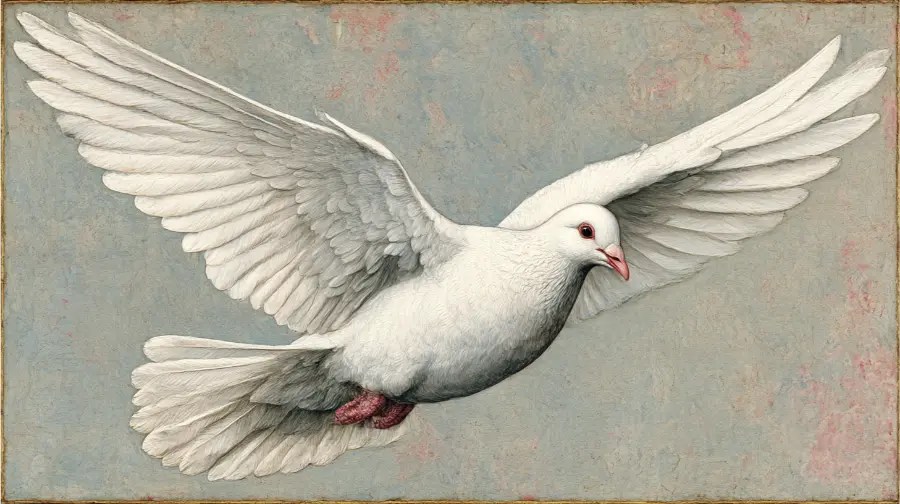
At Jesus’ baptism, the Holy Spirit descended upon Him “in bodily form like a dove” (Luke 3:22).ยนโธ This is perhaps the most recognized symbol of the Spirit. The dove represents His gentleness, purity, and the peace that He brings. It signifies God’s pleasure and blessing.ยนโน The Spirit does not force His way into our lives; He leads gently, like a dove that comes to rest peacefully upon us.ยนโท He is our Comforter, bringing a peace that surpasses all understanding.
Fire (Purification & Power)
In stark contrast to the gentleness of the dove, the Spirit is also symbolized by fire. John the Baptist declared that Jesus would baptize “with the Holy Spirit and fire” (Matthew 3:11).ยนโน Fire represents the intense power and purifying presence of God. Just as a refiner’s fire burns away impurities from precious metal, the Holy Spirit works in our lives to burn away sin, purify our motives, and conform us to the image of Christ.ยนโธ At Pentecost, “tongues of fire” rested on the believers, symbolizing the divine energy and passionate zeal they were receiving for their mission (Acts 2:3).ยนโท
Wind/Breath (Life & Unseen Power)
The original Hebrew and Greek words for “spirit” (ruach and pneuma) can also be translated as “wind” or “breath”.ยนโน Jesus used this imagery when talking to Nicodemus about being born again: “The wind blows wherever it pleasesโฆ So it is with everyone born of the Spirit” (John 3:8).ยนโธ We cannot see the wind itself we can see and feel its effects. Likewise, the work of the Holy Spirit is often invisible and mysterious, yet His power to bring new life and transform a person from the inside out is undeniable.ยฒยน He is the very breath of God, giving spiritual life to all who believe.
Water (Cleansing & New Life)
Water is a powerful symbol of cleansing and life. Jesus told Nicodemus that one must be “born of water and the Spirit” to enter God’s kingdom (John 3:5).ยนโน This points to the spiritual cleansing from sin that the Spirit accomplishes in the new birth. Jesus also described the Spirit as “rivers of living water” that would flow from within those who believe in Him, quenching our deepest spiritual thirst and overflowing to bring life to others (John 7:37-39).ยนโธ
Oil (Anointing & Consecration)
In the Old Testament, oil was used to anoint priests and kings, setting them apart and consecrating them for God’s service. This act symbolized the Holy Spirit coming upon them for empowerment.ยนโธ In the New Testament, this anointing is for every believer. The Spirit anoints us, setting us apart as belonging to God and empowering us for the life and ministry He has called us to. This anointing brings healing, comfort, and a spiritual sensitivity to God’s leading (1 John 2:20).ยนโท
These symbols, when held together, reveal a beautiful and necessary paradox in the Spirit’s character. He is as gentle as a dove and as powerful as a fire. He is as peaceful as still water and as unstoppable as a mighty wind. We need this divine tension in our lives. We need the gentle comfort of the Dove in our sorrows and the purifying power of the Fire to overcome our sin. We need the quiet assurance of the Oil and the sovereign force of the Wind to be effective witnesses for Christ. To embrace only one side of His nature is to have an incomplete picture. A healthy, vibrant Christian life embraces the fullness of who He is: our gentle Comforter and our powerful Advocate.
Part III: The Spirit’s Role in Your Life Today

What Is the Difference Between the “Gifts” and the “Fruit” of the Spirit?
One of the most common areas of curiosityโand sometimes confusionโfor Christians is the distinction between the “gifts of the Spirit” and the “fruit of the Spirit.” Both come from the same loving God they serve different, though complementary, purposes in our lives and in the church. A simple way to understand the difference is this: gifts are about what we do, while fruit is about who we are.ยฒยณ
The gifts of the Spirit, described in passages like 1 Corinthians 12 and Romans 12, are divine abilities or empowerments given to believers to serve others and build up the body of Christ.ยฒโด These can include gifts like teaching, administration, mercy, healing, wisdom, or prophecy.โต The Holy Spirit distributes these gifts sovereignly, meaning He decides who gets which gift. No single person receives all the gifts, and they are given not for our own benefit for the “common good” of the church community (1 Corinthians 12:7).ยฒโด They are the tools God gives us to do His work in the world.
The fruit of the Spirit, on the other hand, is described in Galatians 5:22-23 as “love, joy, peace, forbearance, kindness, goodness, faithfulness, gentleness and self-control”.โต Unlike gifts, which are given, fruit is grown. It is the inevitable result of a life lived in connection with Jesus, a process of our character being slowly transformed to reflect His character.ยฒโด While no one has all the gifts, every single believer is called to cultivate all the aspects of the Spirit’s fruit. This fruit is the true evidence of our spiritual maturity and our relationship with Christ.
The following table helps summarize these key distinctions:
| Basis | Gifts of the Spirit (1 Cor. 12) | Fruit of the Spirit (Gal. 5) |
|---|---|---|
| What It Is | Divine empowerments for service. Our abilities. | Divine attributes of Christ’s character. Our being. |
| Purpose | To build up the church and serve others. Outward-focused. | To reflect the character of Christ. Inward transformation with outward evidence. |
| How We Get It | Given sovereignly by the Spirit at a point in time. | Grown continuously through a life of surrender and walking with the Spirit. |
| Who Gets It | Distributed diversely. No one has all the gifts. | Cultivated universally. All believers are called to bear all the fruit. |
| Examples | Teaching, healing, wisdom, administration, prophecy. | Love, joy, peace, patience, kindness, goodness, faithfulness, gentleness, self-control. |
It is crucial to see that these two are not in competition; they are designed to work together. The Bible places a clear priority on the fruit. The church in Corinth was a perfect example of a community that was incredibly gifted but spiritually immature. They exercised spectacular gifts but were plagued by division, arrogance, and a lack of love.ยฒโถ
It is no accident that the Apostle Paul, after discussing spiritual gifts in 1 Corinthians 12, inserts the famous “love chapter” in 1 Corinthians 13 before returning to practical instructions about gifts in chapter 14. He is making a powerful point: gifts without fruit are worthless. A person can prophesy, have great faith, or perform miracles if they do not have love, they are nothing more than “a resounding gong or a clanging cymbal” (1 Corinthians 13:1).
Love, the first and foremost fruit of the Spirit, is the context that gives all the gifts their meaning and effectiveness.ยฒยณ A spiritual gift in the hands of someone who lacks patience, kindness, or self-control can do more harm than good. Therefore, Although we should desire that the Spirit would use us in powerful ways through His gifts, our primary focus must be on cultivating His fruit. Our character is the foundation upon which our ministry is built.

What Does It Mean to Be “Filled with the Holy Spirit”?
The phrase “filled with the Holy Spirit” can sound mystical and perhaps even intimidating. For some, it brings to mind dramatic emotional experiences, while for others, it is a source of confusion.ยนโต What does it really mean, and is it something for every believer? The Bible’s teaching on this is both powerful and wonderfully practical.
It is vital to distinguish between the indwelling of the Spirit and the filling of the Spirit. At the very moment you place your faith in Jesus Christ, the Holy Spirit comes to live inside you. This is the indwelling. You are “sealed” with the Spirit, and He will never leave you.ยนโต At salvation, you receive all of the Holy Spirit; there is not “more” of Him to get later.ยฒโท
The “filling” of the Spirit is different. It is not about us getting more of Him about Him getting more of us.ยฒโธ In Ephesians 5:18, Paul gives a command: “Do not get drunk on wineโฆ Instead, be filled with the Spirit.” The verb tense used here in the original Greek language implies a continuous, ongoing action. It is not a one-time event but a daily way of life.ยนโต
Paul’s contrast with drunkenness is the key to understanding what he means. What happens when a person is drunk? The alcohol influences and controls their thoughts, their speech, and their actions. They are “under the influence.” In the same way, to be “filled with the Spirit” means to be continually under His divine influence and control.ยฒโท It means consciously and willingly yielding every part of our livesโevery thought, every decision, every relationship, every “room” of our heartโto His leadership.ยนโต
This is not about chasing a feeling or a dramatic experience. It is a practical, moment-by-moment choice of surrender. The common idea that we are like spiritual gas tanks that need a “top-up” of the Spirit is misleading.ยฒโน A better picture is that the Spirit already lives in every room of our house we have kept some doors locked. To be filled is to progressively unlock every door and joyfully give Him lordship over the entire home of our heart.
The results of this filling are not necessarily loud or sensational. According to the verses that follow in Ephesians, a Spirit-filled life is characterized by joyful worship, a heart of thankfulness, and humble, loving relationships with others (Ephesians 5:19-21).ยนโต It empowers us to understand the depth of Christ’s love and gives us boldness to share our faith with others.ยฒโธ
Therefore, being filled with the Spirit is not a special experience reserved for a spiritual elite. It is the command and the privilege for every single Christian. It is the ongoing journey of surrendering our will to His, of allowing the one who already indwells us to fully influence us, leading us day by day into a life that reflects the beauty and character of Jesus.

How Does the Holy Spirit Help Us When We Don’t Know How to Pray?
If you have ever knelt to pray and felt that the words just would not come, or felt so overwhelmed by sorrow or confusion that you did not even know what to ask for, you are in good company. The Bible itself acknowledges this universal human struggle with incredible compassion. The Apostle Paul writes, “In the same way, the Spirit helps us in our weakness. We do not know what to pray for as we oughtโฆ” (Romans 8:26).ยณยน This single verse is a source of immense comfort, normalizing our feelings of inadequacy and pointing us to our divine Helper.
The Holy Spirit’s help in prayer is one of His most intimate and encouraging ministries. When we are at our weakest, He is at His strongest on our behalf. The passage continues, “โฆbut the Spirit himself intercedes for us with groanings too deep for words” (Romans 8:26).ยณยณ When our pain, fear, or longing is so powerful that it exists only as a deep ache in our soul, the Holy Spirit takes that raw, pre-verbal groaning and communicates it perfectly to the Father.
Think of the Spirit as the perfect translator of the human heart. Our perspective is limited. Our desires can be mixed. Our understanding of what we truly need is often flawed. We might pray for comfort when what we really need is strength, or for an escape from a trial when God intends to use it to produce endurance. The Holy Spirit knows both our hearts and the heart of the Father. He takes the jumbled, weak, and sometimes misguided prayers that we offer and refines them. He translates our heart’s deepest cry into a perfect request that is always in complete alignment with God’s will.
This is confirmed in the very next verse: “And he who searches our hearts knows the mind of the Spirit, because the Spirit intercedes for God’s people in accordance with the will of God” (Romans 8:27).ยณยน This is an incredible assurance. It means that you can never truly “pray wrong.” Even when your words are clumsy, your thoughts are scattered, or your emotions are a mess, the Spirit acts as a divine filter and advocate. He ensures that your prayers reach the Father’s throne in their purest and most perfect form.
Beyond this powerful intercession, the Spirit also actively guides our prayer life. It is the Spirit who awakens within us the authentic cry of a child to a loving parent, enabling us to pray, “Abba, Father!” (Romans 8:15).ยณยณ He prompts us to pray when we might otherwise neglect it. He also guards us from praying with wrong motives, gently steering our hearts away from selfish requests and toward prayers that prioritize God’s glory, like “hallowed be your name”.ยณยณ
This truth should liberate us from the pressure to perform in prayer. We do not need to find the “right” words or achieve a certain emotional state. We can come to God just as we are, with all our weakness and confusion, trusting that our perfect Helper is there to take our feeble attempts and turn them into powerful, effective prayers that are heard and cherished by our Father in heaven.
Part IV: Diverse Experiences of the Spirit

What Does the Catholic Church Teach About the Holy Spirit?
Although the Holy Spirit is sometimes seen as a point of division among Christian denominations, there is a vast and beautiful common ground, particularly with the Catholic Church. For Catholics, the Holy Spirit is not an afterthought but the very life and soul of the Church and the individual believer.ยณโถ
At its core, the Catholic Church’s teaching on the Holy Spirit is rooted in the mystery of the Trinity. The Nicene Creed, recited at Mass, affirms that the Holy Spirit is “the Lord, the giver of life, who proceeds from the Father and the Son, who with the Father and the Son is adored and glorified”.ยณโธ This confession establishes His full divinity and co-equality within the Godhead, a foundational belief shared with Protestant and Orthodox Christians.
A distinctive feature of Catholic teaching is the emphasis on the Holy Spirit’s work through the sacraments. Sacraments are understood as visible, tangible signs through which Christ communicates the invisible grace of His Spirit.โดโฐ This begins at Baptism, which is seen as the moment a person is born again of “water and the Spirit” and initially receives the Holy Spirit and all of His gifts.ยณโถ Later, the sacrament of Confirmation “seals” and strengthens the grace of Baptism, enriching the believer with a “special strength of the Holy Spirit” to be a bold and true witness for Christ in the world.ยณโท
This sacramental understanding does not confine the Spirit’s work rather provides tangible moments of assurance. For our human nature, which is both physical and spiritual, grasping a purely invisible reality can be difficult. The physical elements of the sacramentsโthe water of Baptism, the anointing with oil (chrism) in Confirmationโserve as God’s gracious way of making the spiritual reality of the Spirit’s presence concrete and certain.ยฒยฒ They are outward signs that confirm a powerful inward grace.
The Holy Spirit is also seen as the “soul of the Church”.ยณโถ He is the one who builds, animates, and sanctifies the binding all its members together in a spiritual unity.โดโฐ Pope Francis has taught that without the Spirit, even the most well-organized church programs and communities remain “soulless”.ยณโถ
Finally, Catholic teaching strongly encourages a deep, personal relationship with the Holy Spirit. Saints and popes have long urged the faithful to pray to the Spirit intentionally every day, asking for His guidance, comfort, and protection.ยณโถ This is a call to move beyond a purely intellectual understanding to an intimate, moment-by-moment fellowship. As Pope Benedict XVI acknowledged, the Spirit can sometimes be the “neglected person of the Blessed Trinity,” a sentiment that resonates across all Christian traditions and highlights a universal desire to know this divine Friend more deeply.โดยณ

What Does It Feel Like to Experience the Holy Spirit?
Theology can tell us what the Holy Spirit does the stories of believers tell us what it feels like to encounter Him. A relationship with the Spirit is not just theoretical; it is a deeply felt, personal experience. While every person’s journey is unique, the testimonies of those who have had a powerful encounter with the Holy Spirit reveal common themes of overwhelming love, powerful transformation, and undeniable divine presence.
For many, the experience is one of intense, overpowering emotion. One man described it as being “filled with His awesome overpowering Love and Life,” a feeling a “million times more powerful” than even the love for his own child.โดโด Another, after crying out to Jesus in his backyard, felt a “Presence that was so Powerful and Beautiful I couldn’t handle it,” followed by “uncontrollable Joy and Love” that filled his very spirit.โดโต This encounter is often accompanied by physical sensations, such as uncontrollable shaking, a feeling of heat, or as one person described it, “a sensation like lightning striking my chest”.โดโด
These powerful encounters are often preceded by a moment of deep conviction and surrender. The Spirit tenderly reveals an area of sin or a need for God, leading to a point of crisis where a person breaks down and gives control of their life to Jesus.โดโต This surrender is followed by an incredible sense of liberation. One woman, after a dream in which she felt “three forceful tugs on my body,” woke up to find she had been completely freed from three addictions.โดโด Another felt a “huge burden lifted” after confessing a secret sin, a tangible release from shame and guilt.โดโถ
The Spirit’s presence also brings supernatural guidance. One foster mother felt a persistent, seemingly strange prompting from the Holy Spirit to check her newborn baby boy. Obeying this nudge, she discovered he had a life-threatening birth defect that doctors had missed, saving his life. She later learned that the breast milk she had also felt prompted to secure for him was critical to his survival after surgery.โดโท These are not just happy coincidences; they are moments of direct, life-altering divine intervention.
For some, a powerful encounter with the Spirit includes the spontaneous gift of speaking in tongues, a heavenly language they have never learned.โดโด For others, the experience is quieter but no less powerfulโa gentle, guiding presence that has been there since childhood, like a “light switch” turning off wrong desires and providing protection.โดโธ
What is most striking about these diverse stories is not the specific manifestation the universal outcome: transformation. Whether the experience is a quiet prompting or a dramatic vision, a feeling of warmth or an outburst of tongues, the result is always a changed life. Worldly interests fade, addictions are broken, fear is replaced by boldness, and a new, passionate love for Jesus is born.โดโด The way the Spirit chooses to reveal Himself may differ for each of us His goal is always the same: to draw us closer to Himself and to remake us from the inside out. This truth should free us from comparing our experience to others and instead encourage us to look for the evidence of His transformative work in our own unique story.
Part V: Drawing Closer to the Spirit

How Can I Cultivate a Deeper, Personal Relationship with the Holy Spirit?
Knowing about the Holy Spirit is one thing; walking in daily friendship with Him is another. Moving from theological knowledge to relational intimacy is the great adventure of the Christian life. This journey is not a formula to be mastered a relationship to be cultivated. Here are practical, biblical steps you can take to open your heart more fully to the presence and power of the Holy Spirit.
Simply Ask and Invite Him
The journey begins with a simple, heartfelt invitation. Jesus made an incredible promise: “If you then, though you are evil, know how to give good gifts to your children, how much more will your Father in heaven give the Holy Spirit to those who ask him!” (Luke 11:13).ยณโฐ Pray specifically, “Holy Spirit, I want to know you more. Come and fill me. Be my guide, my comforter, and my friend.” Invite Him into your day, your decisions, and your struggles. This simple act of asking opens the door of your heart to a deeper fellowship.ยณโท
Embrace Daily Obedience
Friendship with God is built on trust, and trust is proven through obedience. Intimacy with the Spirit grows not just by learning more about Him by obeying the things He asks of you.โดโน Often, this involves small, quiet promptingsโto forgive someone who has hurt you, to be generous with your time or money, to put away a sinful habit, or to speak a word of encouragement. Each act of obedience, no matter how small, deepens your trust and makes your heart more sensitive to His leading.
Immerse Yourself in His Word
The Holy Spirit is the author of the Bible. He inspired every word (2 Peter 1:21).ยณ Therefore, one of the primary ways He speaks to us today is through the Scriptures. When you read the Bible, you are not just reading an ancient text; you are engaging with the living Word that the Spirit Himself breathed out. Ask Him to illuminate the pages, to teach you and transform you as you read. The Word and the Spirit work in perfect harmony; you cannot know one well without the other.โดโธ
Practice Continual Surrender (Be Filled)
As we have learned, being “filled with the Spirit” is an ongoing process of yielding control of your life to Him. This is a practical, daily choice. It means waking up in the morning and saying, “Holy Spirit, this day is yours. Lead me.” It means pausing before a difficult conversation and praying, “Holy Spirit, give me your words.” It is the conscious surrender of your plans, your ambitions, your relationships, and your thoughts to His loving lordship.ยฒโท
Make Much of Jesus
The Holy Spirit’s primary mission is to glorify Jesus Christ (John 16:14). When our lives are centered on worshiping, honoring, and loving Jesus, we are aligning ourselves perfectly with the Spirit’s work.โดโน As you focus your heart on Christ, you will find the Spirit’s presence becomes more powerful. He delights in a heart that treasures the Son.
Find a Place to Serve
The Spirit gives gifts for the building up of the church. When you step out in faith to serve others in your local you are creating an opportunity for the Spirit to work through you. Serving develops humility, maturity, and a selfless character, which makes your heart fertile ground for the Spirit to produce His fruit and manifest His power.โดโน
Cultivating a relationship with the Holy Spirit is not a linear checklist but a beautiful, dynamic cycleโa dance of divine invitation and human response. He prompts, and we respond in obedience. That obedience leads to greater intimacy, which in turn makes us more attuned to His next gentle nudge. It is a lifelong partnership that begins with a simple invitation and leads to an ever-deepening friendship.

Conclusion: Your Ever-Present Helper
The Holy Spirit is not a distant, unknowable force the most intimate and present reality of God in our lives today. He is the fulfillment of Jesus’ most precious promise: that we would not be left as orphans that we would have an Advocate, a Comforter, and a Helper to be with us forever (John 14:16).ยณ
From the dawn of creation to the empowering fire of Pentecost, from the quiet promptings in the hearts of Old Testament prophets to the permanent indwelling in every believer today, His work is woven through every page of Scripture and every moment of our lives. He is the Person who convicts us of sin, draws us to the Savior, and seals us for eternity. He is the one who transforms our character, empowers our service, and translates the deepest groanings of our hearts into perfect prayers.
The journey to know Him more deeply is the greatest adventure you will ever embark upon. It is a path of daily surrender, joyful obedience, and growing intimacy. He is not waiting for you to become perfect before you can approach Him. He is here, waiting for your simple invitation.
Let this be the day you take one small step. Perhaps it is to pray a simple prayer: “Holy Spirit, show me more of you.” Perhaps it is to obey a gentle nudge you have been ignoring. Whatever it is, know that as you step toward Him, He is already rushing to meet you. For He is your ever-present Helper, your dearest and the very life of God within you.