
 English
 Chinese
 Dutch
 Arabic
 Spanish
 Portuguese
 Russian
 French
 Italian
 German
 Japanese
Genesis says Adam lived 930 years. It never gives Eve’s age, either when she was made or when she died. When they lived depends on how the genealogies are read: by Archbishop James Ussher’s chronology of 1650, one reading among several, Adam was created in 4004 BC and would be about 6,030 years old today.
Genesis counts Adam’s years three ways, and then ends his life in three words: “and he died” (Genesis 5:5). Eve’s years it never counts. What it keeps of her is a sentence of hope spoken after grief, at the birth of Seth: God “hath appointed me another seed instead of Abel, whom Cain slew” (Genesis 4:25). We would like a number for her. Scripture gives us her trust.
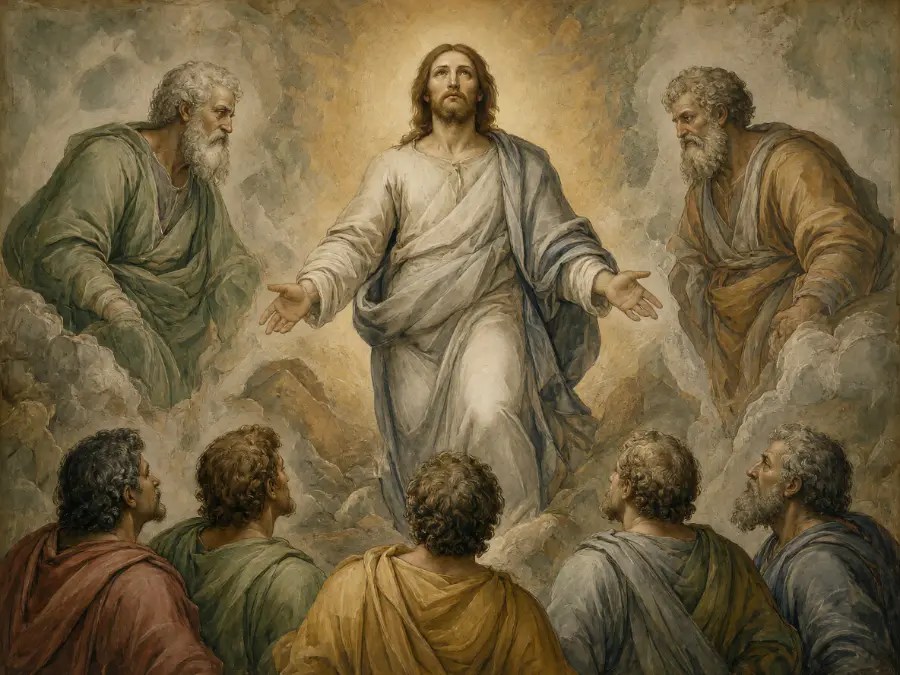
How long did Adam live?
Adam’s age appears at the head of the genealogy that runs from Adam to Noah, and it is given three ways: his age when Seth was born, the years he lived after that, and the total. “And Adam lived an hundred and thirty years, and begat a son in his own likeness, and after his image; and called his name Seth: And the days of Adam after he had begotten Seth were eight hundred years: and he begat sons and daughters: And all the days that Adam lived were nine hundred and thirty years: and he died” (Genesis 5:3–5).
That is 130 years to the birth of Seth, 800 years after it, and 930 in all. The Greek translation of Genesis known as the Septuagint divides the same life differently, 230 years before Seth and 700 after, and reaches the same total of 930. Seth’s own line runs on from there through nine generations to Noah, with every age recorded.
Most other ages people ask about are not in the Bible at all:
| Question | The Bible’s answer | Where to look |
|---|---|---|
| Adam’s age when he was made | Not given | Genesis 1–2 |
| Their ages when they ate the forbidden fruit | Not given | Genesis 3 |
| Adam’s age when Cain and Abel were born | Not given | Genesis 4:1–2 |
| Adam’s age when Seth was born | 130 (230 in the Septuagint) | Genesis 5:3 |
| Adam’s age when he died | 930 | Genesis 5:5 |
| Eve’s age at any point | Not given | Nowhere |
How old was Eve when she died?
The Bible does not say. The last event of her life that Genesis records is the birth of Seth, when she said that God “hath appointed me another seed instead of Abel, whom Cain slew” (Genesis 4:25). Adam was 130 that year. If both were made on the sixth day, as Genesis 1 says, Eve was about Adam’s age and still living when he was 130. Beyond that, Scripture gives no year for her death and no length for her life.
Over Adam’s remaining 800 years Genesis says only that “he begat sons and daughters” (Genesis 5:4). It names none of them and does not say how many were Eve’s. Whom they married belongs to a separate question, how Adam and Eve’s children had children of their own.
The Life of Adam and Eve is a retelling of their story outside the Bible, printed in English in R. H. Charles’s 1913 edition of the Old Testament apocrypha and pseudepigrapha. In it the dying Adam tells his sons, “Behold, I am nine hundred and thirty years old,” and Eve dies soon after him. Before she dies she asks her children to make “tables of stone and others of clay” and to write their parents’ lives on them, so that the record would survive whether the world was judged by water or by fire. It is a legend, and Genesis says nothing of Eve’s death.
How old were Adam and Eve when God created them?
Genesis gives them no age at creation because it gives them no childhood. They are made as grown people and given grown people’s work at once: “Be fruitful, and multiply, and replenish the earth” (Genesis 1:28). Jewish teachers gave a number. Genesis Rabbah, a collection of rabbinic teaching on Genesis dated to about AD 400, records Rabbi Yoḥanan’s view that Adam and Eve were made with the bodies of people “approximately twenty years old”, and Rabbi Elazar bar Rabbi Shimon’s that “Eve, too, was created in her full form.”
Irenaeus of Lyons, a bishop of the second century, thought of Adam as young in another sense: “But man was a child, not yet having his understanding perfected; wherefore also he was easily led astray by the deceiver.” His point was Adam’s inexperience, not the age of his body.
Whether husband and wife were the same age depends on the reading too. Genesis 1 puts both on the sixth day. Genesis 2 tells of Eve’s making separately, from a rib taken while Adam slept, without saying how long after him. The Book of Jubilees, a Jewish retelling of Genesis from the second century BC, says that Adam and the rib that became his wife were made in the first week, and “in the second week He showed her unto him.” Ussher kept both on the sixth day, which he dated to Friday, 28 October 4004 BC.
How old they were when they sinned is also unknown, because Genesis does not say how long they lived in Eden first. Jubilees gives them seven years in the garden; Ussher thought it “very probable, that Adam was turned out of paradise the same day that he was brought into it”, which he placed on the tenth day of the world.

When did Adam and Eve live?
The Bible gives ages, not dates. To date Adam, a chronologer adds up the age at which each father had his son, through the genealogies of Genesis 5 and 11, until the line reaches an event whose date is known, and then counts back. The result depends on which text supplies the numbers. From Adam to the Flood, the ages in the Hebrew text, which the KJV translates, add up to 1,656 years; the Septuagint’s add up to 2,242.
James Ussher, Archbishop of Armagh, used the Hebrew numbers in his Annals of the World (in Latin in 1650, in English in 1658). He placed the beginning of time “at the start of the evening preceding the 23rd day of October” in 4004 BC, and the death of Adam, “the first father of all mankind”, in 3074 BC.
The Jewish calendar also counts its years from creation. Its reckoning is attributed to Rabbi Yossi ben Halafta, a sage of the second century, and his work Seder Olam, and it dates creation to 3761 BC. Rabbi Rachel Solomin explains that Jews who read the biblical accounting of time as literal still accept that date, and adds: “Others claim that the date is figurative, symbolic, or holds esoteric meaning.”
Some older Christian counts used the longer Greek numbers. The traditional Christmas Proclamation of the Roman Martyrology announced the birth of Christ “In the five thousand one hundred and ninety-ninth year of the creation of the world”, the Septuagint’s reckoning. The English Roman Missal of 2011 says instead “when ages beyond number had run their course”. In 1908 the Catholic Encyclopedia judged that “the freedom of the Catholic in investigating the chronology of this period is quite unrestricted”, and the Catechism today says that the account of the fall “uses figurative language, but affirms a primeval event, a deed that took place at the beginning of the history of man” (paragraph 390).
Orthodox Christians long counted the years from creation. The Byzantine era, accepted in the Orthodox church from 691, placed creation “5508 years (and three months and 24 days) before the birth of Christ”. Russia kept this count until Peter the Great’s calendar reform of 1 January 1700, which fell in the old count’s year 7208.
Modern Christian organisations give answers many thousands of years apart. Answers in Genesis, the Institute for Creation Research and Creation Ministries International, three leading young-earth organisations, “argue that there are no gaps” in Genesis 5 and 11, which puts the beginning “a little more than 6,000 years ago”; some young-earth writers allow gaps that would put the first day “perhaps 10,000 to 12,000 years ago”. Reasons to Believe, an old-earth ministry, concludes that “Adam and Eve existed approximately 100,000 to 150,000 years ago.” BioLogos, which accepts evolution, sets out several models: Adam and Eve as representatives of humanity about 200,000 years ago in Africa, as a couple “living perhaps 6000 years ago in the ancient Near East”, or as figures in non-historical readings of Genesis.
How old would Adam and Eve be today?
Genesis closes Adam’s life at 930, so the question really asks how long ago he was made. Each reading dates creation differently. Counted to 2026, with no year zero between 1 BC and AD 1, the answers are these:
| Reading | Creation dated to | Years before 2026 |
|---|---|---|
| Ussher’s Annals (Hebrew numbers) | 4004 BC | About 6,030 |
| Jewish calendar | 3761 BC | About 5,786 |
| Old Roman Martyrology (Septuagint) | 5199 BC | About 7,224 |
| Byzantine count (Orthodox) | 5509 BC | About 7,534 |
| Young-earth organisations | No calendar date | A little over 6,000 |
| Reasons to Believe | No calendar date | 100,000 to 150,000 |
| BioLogos | Several models | About 200,000, about 6,000, or none |
By the Jewish calendar, the year 5787 began on 12 September 2026. The Septuagint and Byzantine figures run longer than Ussher’s because the Greek genealogies give older ages at which fathers had their sons.
Did Adam really live 930 years?
Jews and Christians have read the long ages of Genesis 5 in several ways, and each tradition holds more than one view.
Among Jewish commentators, Moses Maimonides, writing in Egypt in 1190, limited the long lives to the men Genesis names: “only the persons named lived so long, whilst other people enjoyed the ordinary length of life.” He explained it by “their food or mode of living, or by way of miracle.” Nachmanides (the Ramban), writing in Spain in the thirteenth century, rejected this as “words without substance.” He held that the first man was made in “absolute perfection as regards beauty, strength, and height. Even after it was decreed upon him that he be mortal, it was in his nature to live a long time.” Lives shortened, he wrote, after the Flood, when “the atmosphere became tainted, and as a result their days kept on decreasing.”
Christians who take the ages as real lifespans include young-earth and old-earth ministries. The Institute for Creation Research points to the steady fall in lifespans after the Flood and to the build-up of genetic mutations over generations, and its writer Brian Thomas concludes, “And if the patriarch’s lifespans were real, then the verses that record and refer to them accurately describe real history.” Hugh Ross of Reasons to Believe, which holds an old earth, argued in 2004 that “long human life spans described in Genesis are scientifically reasonable.”
Other Christians read the numbers differently. The notes of the New American Bible, Revised Edition, published by the United States Catholic bishops, compare Genesis 5 with Mesopotamian lists of kings: “Before the flood, the ages of the kings ranged from 18,600 to 36,000 years, but after it were reduced to between 140 and 1,200 years. The biblical numbers are much smaller.” The Old Testament scholar John Walton argues that the ages “likely reflect how ancient peoples used genealogies rhetorically, not how long people actually lived”, and that “A long lifespan may be intended to extend honor to the individual”.
Psalm 90 gives the ordinary span of a life: “The days of our years are threescore years and ten” (Psalm 90:10). Adam’s 930 years are more than thirteen of those lives.
Some early readers, Jubilees and Justin Martyr among them, explained why Adam, like every one of the long-lived patriarchs down to Noah, fell short of 1,000 years: God had warned that he would die “in the day” he ate the fruit, and “one day is with the Lord as a thousand years” (2 Peter 3:8). A Jewish midrash, Pirkei DeRabbi Eliezer, explains the missing seventy years another way: Adam says of King David, “I took from my years seventy years and added them to his days,” and David’s life came to seventy, for he “was thirty years old when he began to reign, and he reigned forty years” (2 Samuel 5:4).
Seventy is the span Psalm 90 gives to the rest of us, and the same psalm turns from the count to the prayer that matters in a life of any length, whether 930 years or threescore and ten: “So teach us to number our days, that we may apply our hearts unto wisdom” (Psalm 90:12).
Related reading
- Adam and Eve’s family tree
- How many years from Adam to Jesus?
- What did Adam and Eve look like?
- When did Noah live?
- Did Adam and Eve go to heaven?


Leave a Reply