
 English
 Chinese
 Dutch
 Arabic
 Spanish
 Portuguese
 Russian
 French
 Italian
 German
 Japanese
Christmastide is the Christmas season, the weeks the Church keeps after Christ’s birth. In the Catholic calendar it runs from Christmas Eve to the Baptism of the Lord, on Sunday 10 January 2027. Other churches end it with the Epiphany on 6 January, or keep it for forty days, to Candlemas on 2 February.
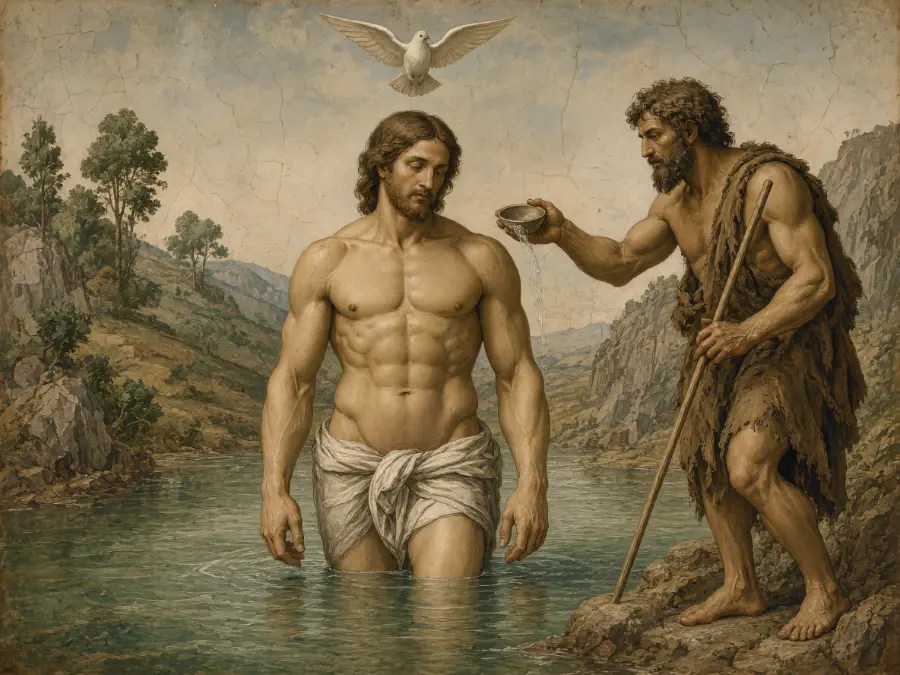
The birth of Christ is too great a joy for one day, so the Church gives it a season. The rules of the Roman calendar, approved in 1969, set it next to Easter: “After the annual celebration of the Paschal Mystery, the Church has no more ancient custom than celebrating the memorial of the Nativity of the Lord and of his first manifestations, and this takes place in Christmas Time.” And in those few weeks the Church’s calendar follows the child. It starts at the manger, goes to the house where the wise men kneel, and ends at the river where he stands as a grown man of about thirty (Luke 3:23). Luke gives the years between only a few verses: the child growing up in Nazareth, the boy of twelve who stays behind in the Temple (Luke 2:40–51), and then one line for all the rest: “And Jesus increased in wisdom and stature, and in favour with God and man” (Luke 2:52).
What does the word Christmastide mean?
It means Christmas time, in an old English word, “tide”, a time or season, which we still hear in “eventide” at the close of the day. Merriam-Webster dates the first known use of “Christmastide” to 1590, so English speakers have had a name for these weeks for more than four hundred years. Its dictionary gives the word as the festival season from Christmas Eve until after New Year’s Day or, especially in England, until the Epiphany. Even the dictionary, then, gives the season two endings, and the churches give it several more.
How long does Christmastide last in each church?
Every church begins the season at Christmas, and they part ways only at its end. The shortest reckoning ends with the Epiphany, twelve days on; the Catholic season runs a few days more, to the Baptism of the Lord; and the longest runs past Candlemas, forty days after Christmas.
| Church | Christmas ends with | Last day, 2026–27 |
|---|---|---|
| Lutheran (Missouri Synod) | The Epiphany, 6 January, which begins a new season | Wednesday 6 January |
| Orthodox, new calendar | Theophany, 6 January | Wednesday 6 January |
| Catholic | The Baptism of the Lord, the Sunday after 6 January | Sunday 10 January |
| Orthodox, old (Julian) calendar | Theophany, 6 January by their calendar | Tuesday 19 January |
| Church of England | The Epiphany, 6 January, or Candlemas for a forty-day Christmas | Wednesday 6 January or Tuesday 2 February |
| Protestant churches in Germany | The Epiphany, 6 January; the whole cycle closes with the week of Candlemas | Wednesday 6 January or Saturday 6 February |
The Catholic Church has kept its end date since the calendar Pope Paul VI approved in 1969, which says: “Christmas Time runs from First Vespers (Evening Prayer I) of the Nativity of the Lord up to and including the Sunday after Epiphany or after 6 January.” So the season opens with evening prayer as night falls on Christmas Eve, Thursday 24 December 2026. In 2027 the Epiphany comes on Wednesday 6 January and the Baptism of the Lord on Sunday 10 January, and Ordinary Time begins the next day, Monday 11 January. Catholics in the United States reach the same last day by another road. Their bishops move the Epiphany to Sunday 3 January (the rule is explained in why Christians celebrate the Epiphany), and the next Sunday is again 10 January. Either way the wise men come first, and a few days or a week later the Catholic season closes where the grown Jesus stands in the Jordan.
Lutherans of the Missouri Synod count “the 12 days of Christmas” and then keep the Epiphany on 6 January as a “13th day” of Christmas that “also marks the beginning of a new liturgical season”, so that one day is both the last of Christmas and the first of what follows. The Church of England keeps both lengths of the season. Christmas there “is often celebrated for twelve days, ending with the Epiphany,” says its guide to the seasons, while some churches today keep another tradition, “in which Christmas lasts for a full forty days, ending with the Feast of the Presentation on 2 February.” An Anglican who stops at the Epiphany and one who carries on to February are both keeping their church’s Christmas. Through all these days Catholic and Lutheran churches are dressed in white, and there is more on the colours of the church year in what the colours of Advent mean.
How do Orthodox Christians keep the season from Christmas to Theophany?
On the calendar of the Orthodox Church in America one feast leads straight into the next, with no gap between the manger and the river. The Nativity is kept for a whole week, until its leave-taking on 31 December. The eighth day brings the Circumcision of the Lord, and from 2 January the Church begins to prepare for Theophany, the feast of Christ’s baptism in the Jordan, which it celebrates on 6 January.
Churches that keep the older Julian calendar keep these same days by that calendar, whose dates now fall thirteen days later than the civil ones: their Nativity on 25 December comes on Thursday 7 January 2027, and their Theophany on Tuesday 19 January. The Russian, Serbian and Georgian churches are among them, while the Greek Orthodox Church and others keep 25 December with us. So just as most of the West reaches the Epiphany, our Orthodox brothers and sisters in Moscow, Belgrade and Tbilisi are beginning their Christmas, and the same child is welcomed twice in one winter.
In the Russian tradition the days between the two feasts are called Svyatki, the holy days. An Orthodox convent in Minsk, St Elisabeth’s, writes that “in the minds of the Orthodox faithful these holidays are still inseparable, and the twelve days between them constitute one uninterrupted feast.” The usual Wednesday and Friday fasts are not kept, the faithful are asked to set aside their daily work as far as they can, and only the eve of Theophany is a day of strict fasting. The convent’s advice for those days is very concrete: visit one another as guests, sing carols, go to church, and visit “the sick, the prisoners, the elderly and the orphans.” So Christmas is carried to sickbeds and prison cells as well as kept in church, and any of us can keep it that way.
Which feasts fill the Christmas season?
The season celebrates the birth of Christ and the first times he was shown to the world, and its first days are crowded with saints and feasts, which are set out one by one in when the twelve days of Christmas start and end. The Catholic calendar also keeps the Holy Family on the Sunday between Christmas and 1 January, or on 30 December when no Sunday falls in those days, and Mary, the Holy Mother of God, on 1 January, the eighth day. Within a week of the birth, then, the Church has turned to the home Jesus grew up in and to the mother who raised him.
After those first days the season looks outward, for at the Epiphany the wise men from the East find the child, and the Church remembers him shown to the nations. At the Baptism of the Lord the same child, now grown, comes to the Jordan, and the heavens open over him. The Catholic season ends there, at the river, where his public life begins, so that in a little over two weeks the calendar has carried us from the manger to the start of his ministry.
When we go on singing carols and saying our Christmas prayers into January, we are keeping the same feast the whole Church keeps, and we keep it because the child who grew up in Nazareth is still with us after the shops have moved on.
Is Candlemas the end of Christmas?
For many Christians Christmas ends at Candlemas, the feast of the Presentation, on 2 February. It comes forty days after Christmas and remembers the day Mary and Joseph brought the child to the Temple. The Church of England’s guide to the Epiphany season says that “the festal cycle ends only with the Feast of the Presentation (Candlemas).” The feast is kept with a procession of lighted candles, and in the Church of England’s service the minister begins by counting back to the manger: “Dear friends, forty days ago we celebrated the birth of our Lord Jesus Christ.”
By old custom in Germany the wider Christmas season closes with Candlemas, and there many Christians leave the Christmas tree standing until 2 February, and many Catholics keep the nativity scene up as well. Since the church year of 2018–19 the Protestant churches in Germany have made that longer reckoning official: their Epiphany season, the last part of Christmas time, now always ends with the week in which 2 February falls, which in 2027 is the week that ends on Saturday 6 February, so that in Germany Christmas now runs all the way to the Temple.
Someone was waiting there when Mary and Joseph came. Simeon, a devout man of Jerusalem, had been promised that he would not die before he had seen the Lord’s Christ, and when the parents brought the child in, “Then took he him up in his arms, and blessed God, and said, Lord, now lettest thou thy servant depart in peace, according to thy word: For mine eyes have seen thy salvation” (Luke 2:28–30). Christmastide, however long a church keeps it, is time to look at the child as Simeon did, until we too can say we have seen.
Related reading
- When are the 12 days of Christmas?
- What is Epiphany, and why do Christians celebrate it?
- Catholic Christmas traditions from Advent to the Baptism of the Lord
- What is the origin of Christmas Eve?
- Why is Christmas celebrated on 25 December?
- What do the colours of Advent mean?


Leave a Reply