
 English
 Chinese
 Dutch
 Arabic
 Spanish
 Portuguese
 Russian
 French
 Italian
 German
 Japanese
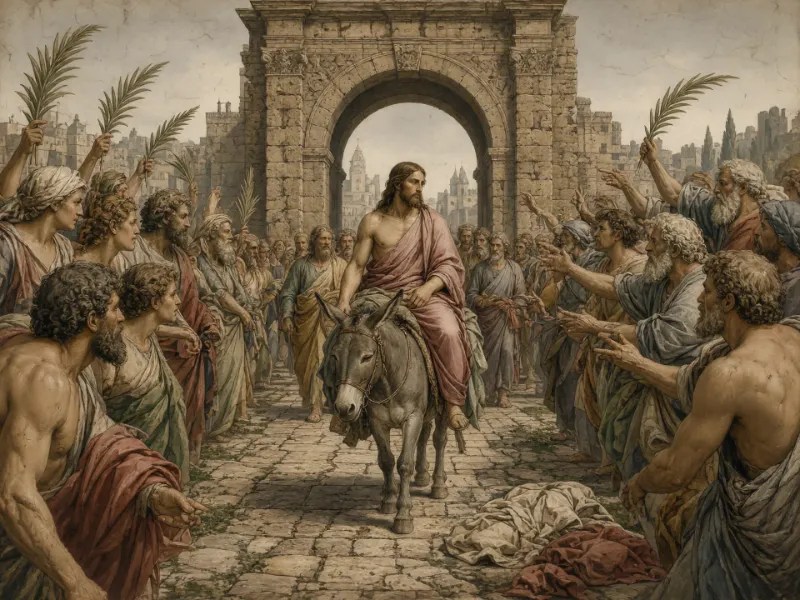
Christianity started in Jerusalem around AD 30, among the Jewish followers of Jesus. He had taught in the synagogues of Galilee and was crucified near the city, and on the day of Pentecost the believers he left behind were joined by thousands: “the same day there were added unto them about three thousand souls” (Acts 2:41). Our faith began there, among Jews in Jerusalem who met to pray and to break bread together.
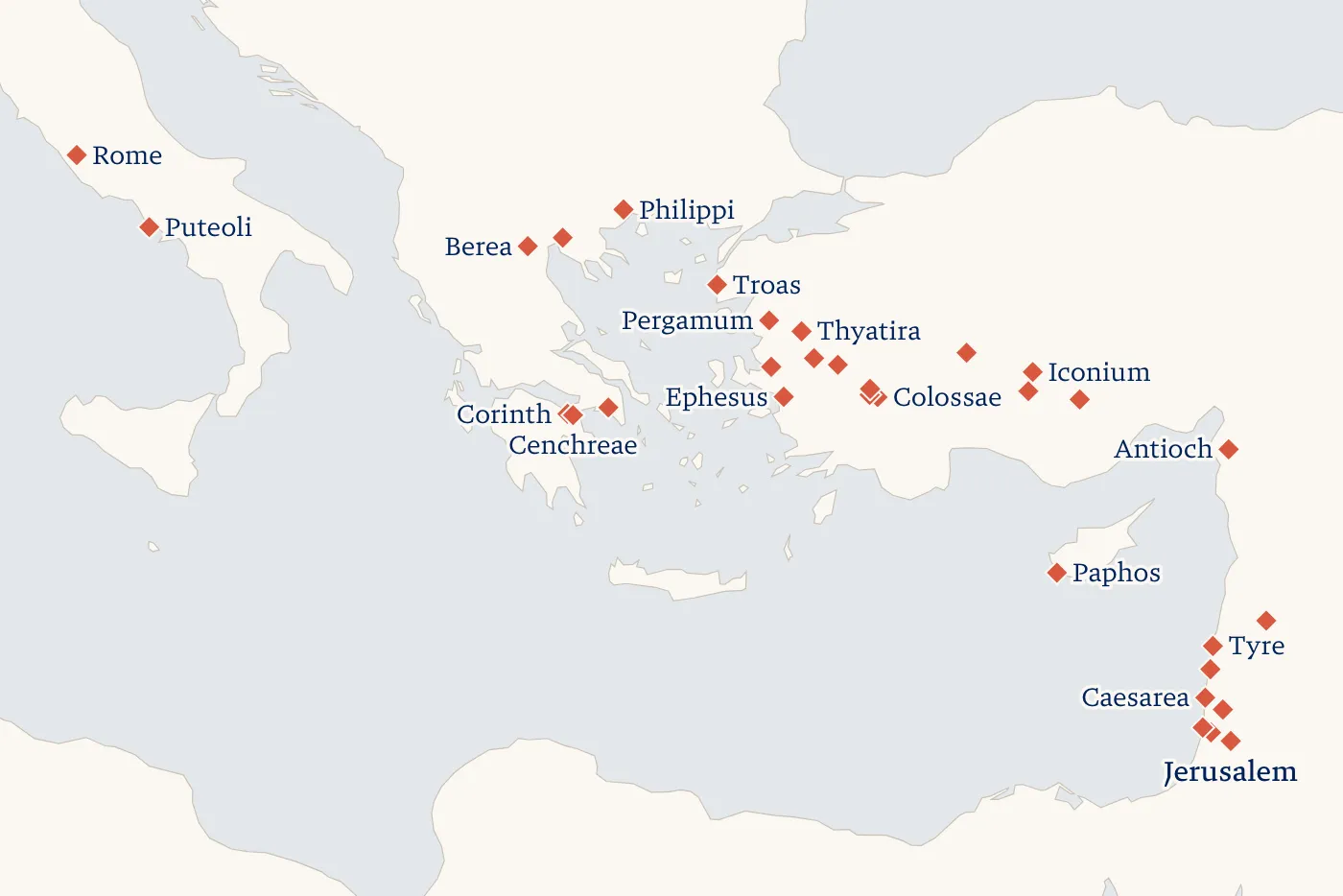
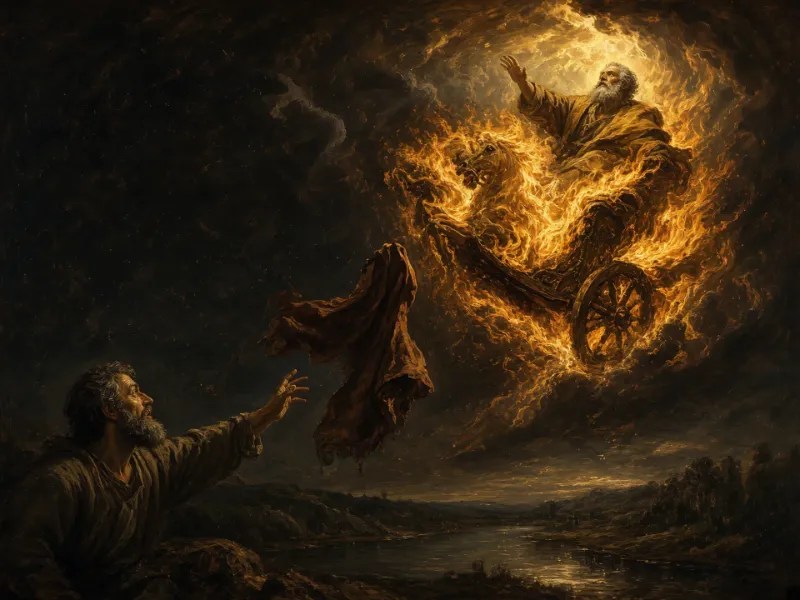
Before he was taken up, Jesus had told the apostles where it would go from there: “ye shall be witnesses unto me both in Jerusalem, and in all Judaea, and in Samaria, and unto the uttermost part of the earth” (Acts 1:8). In Luke’s Gospel the same charge is to preach “among all nations, beginning at Jerusalem” (Luke 24:47). Acts tells its story in that order, Jerusalem first, then Judaea and Samaria, then the far places, and the map below follows the same road outward from the one city, century by century.
You can watch it happen on a map, one century at a time: the places the New Testament names, the churches named in writings from the 100s, and 825 baptisteries that survive from the 200s to the 1100s, each tied to the record it comes from.
When did Christianity start?
John the Baptist began to preach “in the fifteenth year of the reign of Tiberius Caesar, Pontius Pilate being governor of Judaea, and Herod being tetrarch of Galilee” (Luke 3:1). Jesus’ own preaching followed, and Peter later summed up those years as the word “which was published throughout all Judaea, and began from Galilee, after the baptism which John preached” (Acts 10:37). Pilate governed Judaea from AD 26 to 36, and Jesus was crucified under him in Jerusalem in about AD 30. The church’s first great day came soon after, at Pentecost, in the same city.
When the apostles came back to Jerusalem after the ascension, the believers were still few enough to count by name: “the number of names together were about an hundred and twenty” (Acts 1:15). Then “when the day of Pentecost was fully come, they were all with one accord in one place” (Acts 2:1), and by the end of that day three thousand more had been baptized. They “continued stedfastly in the apostles’ doctrine and fellowship, and in breaking of bread, and in prayers” (Acts 2:42), and they went on “breaking bread from house to house … And the Lord added to the church daily such as should be saved” (Acts 2:46–47), until “the number of the men was about five thousand” (Acts 4:4).
What those first believers held is what Paul handed on to the Corinthians as he had received it, “how that Christ died for our sins according to the scriptures; And that he was buried, and that he rose again the third day” (1 Corinthians 15:3–4), and that the risen Lord was seen “of above five hundred brethren at once” (1 Corinthians 15:6). Christianity began with Jesus, crucified, buried and risen, and with people who had seen him alive, which is why the question of who founded Christianity always comes back to him.
Where did Christianity start?
Jesus’ work began in Galilee, where he “went about all Galilee, teaching in their synagogues, and preaching the gospel of the kingdom” (Matthew 4:23), and it came to the cross in Jerusalem, for “the place where Jesus was crucified was nigh to the city” (John 19:20). Both lie in the Holy Land, and in those years Judaea had a Roman governor. So if you are asking which country started Christianity, the answer is that land: Galilee, Judaea and the city of Jerusalem.
Even on the first day, though, the gospel was heard in one city by people from many. Acts says that “there were dwelling at Jerusalem Jews, devout men, out of every nation under heaven” (Acts 2:5), and it gives the crowd’s own list of where they came from: “Parthians, and Medes, and Elamites, and the dwellers in Mesopotamia, and in Judaea, and Cappadocia, in Pontus, and Asia, Phrygia, and Pamphylia, in Egypt, and in the parts of Libya about Cyrene, and strangers of Rome, Jews and proselytes, Cretes and Arabians” (Acts 2:9–11). The first Christians were Jews, gathered in Jerusalem from all those lands. Rome is already on that list, and Rome is where Acts ends.

Which country took Christianity first?
Armenia was the first country to take Christianity as its own, about 300, when Gregory the Illuminator converted King Tiridates III. By then the faith had been spreading for some two hundred and seventy years, and tradition says it first reached Armenia with the apostles Bartholomew and Thaddeus, long before its king believed.
Christianity did not begin in Ethiopia, though an “Ethiopian” comes into the story very early. In the days after Stephen’s death, when the believers had just been scattered from Jerusalem, Philip met “a man of Ethiopia, an eunuch of great authority under Candace queen of the Ethiopians … had come to Jerusalem for to worship” (Acts 8:27). Philip baptized him (Acts 8:38), and he “went on his way rejoicing” (Acts 8:39). Candace was not a name but the title of the queens of Kush, the kingdom on the Nile in what is now northern Sudan, which the Greeks called Aethiopia. So the faith first went south with an official of that court.
The church of today’s Ethiopia keeps the tradition that Matthew and Bartholomew preached there in the first century. Its kingdom of Aksum took the faith as its own in the 300s, when Frumentius baptized King Ezana, who reigned from about 303 to about 350, and Christianity became the state religion.
How did Christianity spread?
It went out from Jerusalem by the road Jesus had named, and the first steps were taken in suffering. After Stephen’s death “there was a great persecution against the church which was at Jerusalem; and they were all scattered abroad throughout the regions of Judaea and Samaria, except the apostles” (Acts 8:1). Judaea and Samaria, the second and third names in Jesus’ charge, were reached by scattered people, and “they that were scattered abroad went every where preaching the word” (Acts 8:4). In Samaria, when Philip preached, “they were baptized, both men and women” (Acts 8:12).
Some of the scattered “travelled as far as Phenice, and Cyprus, and Antioch” (Acts 11:19), and at Antioch, today’s Antakya, some of them “spake unto the Grecians, preaching the Lord Jesus” (Acts 11:20), and “a great number believed” (Acts 11:21). Our very name comes from that city: “the disciples were called Christians first in Antioch” (Acts 11:26).
From Antioch, Paul and those who traveled with him carried it across Asia Minor and over the sea into Greece. In Thessalonica the people who dragged the believers before the city’s rulers cried, “These that have turned the world upside down are come hither also” (Acts 17:6). By the time Paul wrote to Rome he could say that “from Jerusalem, and round about unto Illyricum, I have fully preached the gospel of Christ” (Romans 15:19), and he was already looking further west: “Whensoever I take my journey into Spain, I will come to you” (Romans 15:24). To the Colossians he wrote that the gospel “is come unto you, as it is in all the world; and bringeth forth fruit” (Colossians 1:6).
There were believers in Rome before Paul ever reached it. He had written “To all that be in Rome, beloved of God, called to be saints” (Romans 1:7), and on his way there, at Puteoli, “we found brethren” (Acts 28:14). Acts, which began in Jerusalem, closes in Rome with Paul “Preaching the kingdom of God, and teaching those things which concern the Lord Jesus Christ, with all confidence, no man forbidding him” (Acts 28:31).

What did Roman writers say about the first Christians?
Two Roman writers who had no love for our faith tell us where it came from and how far it had gone. Tacitus, in his Annals, writes of the persecution after the fire of Rome, when Nero blamed “a class … called Christians by the populace”, and he explains the name in one hostile sentence: “Christus, from whom the name had its origin, suffered the extreme penalty during the reign of Tiberius at the hands of one of our procurators, Pontius Pilatus, and a most mischievous superstition, thus checked for the moment, again broke out not only in Judaea, the first source of the evil, but even in Rome”. Then, he says, “an immense multitude was convicted”. A historian who called the faith an evil still names Judaea as the place it began, and gives the same reign and the same governor that Luke gives.
Pliny the Younger, whom Trajan sent to Bithynia about AD 110, wrote to Trajan about the Christians accused before him. They told him they “met on a stated day before it was light, and addressed a form of prayer to Christ, as to a divinity”. The prosecutions, he wrote, reached “persons of all ranks and ages, and even of both sexes”, and “this contagious superstition is not confined to the cities only, but has spread its infection among the neighbouring villages and country”. Some of the accused said they had left the faith “a few above twenty years ago”, so it seems there were Christians in Bithynia a generation before Pliny came.
About eighty years after a hundred and twenty names were counted in Jerusalem, a Roman sent by Trajan was finding men and women of every age, in the cities and in the villages, who met before daylight to pray to Christ.
Two centuries later the persecutions ended. In February 313 the emperors Constantine and Licinius agreed at Milan on a law that gave Christians the right to organize churches, returned the property taken from them and ended the empire’s systematic persecution. In 380 the emperor Theodosius went further and issued an edict prescribing a creed binding on all his subjects, the faith in the Father, the Son and the Holy Spirit set out at Nicaea. What those centuries meant for the empire is told in early Christianity and the Roman Empire.
How far had Christianity spread, century by century?
The first layer of our map of how Christianity spread comes from the New Testament itself: 32 places where it names believers or a church, from Jerusalem to Rome. In the 100s the letters and records of the church add 11 more, and they reach far beyond Paul’s roads, to Lyon and Vienne in Gaul, to Carthage in Africa, where martyrs were tried in 180, and to Alexandria in Egypt, where Pantaenus kept a school.
From the 200s on it follows the baptisteries, the rooms and buildings made for baptism: 825 that survive, from the catalogue of Ristow, Hořínková and Zbíral, each placed in its century. The earliest with an exact date is at Dura-Europos, on the Euphrates in today’s Syria, from the year 232.
| Century | Baptisteries |
|---|---|
| 200s | 3 |
| 300s | 36 |
| 400s | 143 |
| 500s | 396 |
| 600s | 78 |
| 700s | 97 |
| 800s | 44 |
| 900s | 12 |
| 1000s | 11 |
| 1100s | 5 |
When you open the map, read its dots as a floor, the least that can be shown, rather than a census. A baptistery appears only where its stone survived and someone dug; the 127 the catalogue rates doubtful and the 155 it rates only possibly or probably are left off; and 80 of the rest are placed only roughly. Take the high count for the 500s with care as well, because 146 of those 396 are dated only to a span that begins earlier.
Even so, the count climbs every century from three in the 200s to 396 in the 500s, and every one of those rooms was made for what the three thousand did in Jerusalem on the first day, when they “were baptized” (Acts 2:41). The one at Dura-Europos was built about two hundred years after Pentecost, and by the 500s they are counted in hundreds. Each was a place where someone was brought into the faith that began in Jerusalem, and the faith went where Jesus had said it would go, “unto the uttermost part of the earth” (Acts 1:8).


Leave a Reply