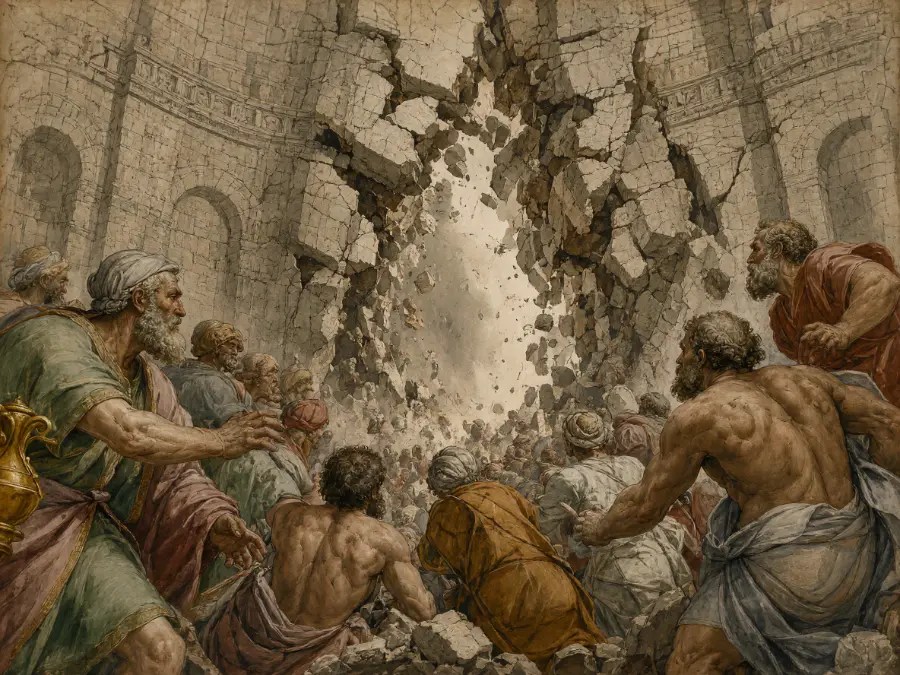
Facts & Statistics about daniel in the bible


  • Daniel was a young Jewish nobleman taken into Babylonian captivity, yet he maintained his faith and integrity despite immense pressure to assimilate.
  • His life exemplifies the importance of small, consistent choices of obedience, illustrated through his early refusal to eat the king’s food.
  • Daniel’s remarkable career spanned multiple empires, showcasing that one can engage with society while remaining devoted to God.
  • His prophecies provide assurance of God’s sovereignty over history, culminating in the eternal Kingdom of God that surpasses all earthly powers.

Have you ever felt like an outsider, a stranger in a strange land? Have you ever felt the immense pressure to fit in, to compromise your deepest beliefs just to get by in a world that doesn’t seem to share your values? In these moments, our hearts long for a role model, for proof that it is possible not just to survive but to thrive with our faith intact. The Bible gives us such a figure in the prophet Daniel, a man whose life story reads like a blueprint for courage in a hostile world.

This article will journey through the life and times of the prophet Daniel, exploring the historical facts, incredible stories, and breathtaking prophecies that make his book one of the most compelling in all of Scripture. We will uncover not just what happened to Daniel, but what his life means for us today as we seek to live with unwavering faith in a challenging world. From the fiery furnace to the lions’ den, from the rise and fall of mighty empires to the promise of an eternal King, Daniel’s story is a timeless testament to the unshakable sovereignty of God and the powerful peace that comes from a life wholly devoted to Him.

Who Was the Prophet Daniel?

To truly grasp the power of Daniel’s story, we must first meet the man himself. He was not a myth or a legend, but a real person who faced immense trials with extraordinary faith. His life began in the twilight of his nation’s freedom and was spent in the heart of the world’s most powerful empires, yet he never lost sight of who—and Whose—he was.

A Noble Youth in Exile

Daniel was a young Jewish nobleman, possibly from the royal family of Judah, who was taken into captivity by King Nebuchadnezzar of Babylon around the year 605 B.C..¹ He was likely just a teenager, perhaps only 14 or 15 years old, when his life was violently upended.⁴ He was part of the first wave of deportations, a tragic consequence of Judah’s persistent spiritual rebellion against God, a judgment the prophets had long foretold.⁵ Imagine the trauma: torn from his home, his family, and his homeland, and marched hundreds of miles to the capital of the very empire that had conquered his people.

A Man of Unshakable Character

Even in these devastating circumstances, Daniel’s character shone brightly. He is one of the few major figures in the Bible about whom nothing negative is ever recorded, a testament to his powerful integrity.⁵ His Hebrew name, Daniel, means “God is my judge,” a principle that defined his entire existence.⁷ From his first appearance in Scripture to his last, his life was a declaration that his allegiance was to God alone, regardless of the king he served or the culture that surrounded him. He was a man of deep humility, exceptional wisdom, and courage that was forged in the fires of conviction.¹⁰

Indoctrination and Resistance

Upon arriving in Babylon, Daniel and his three closest friends—Hananiah, Mishael, and Azariah—were chosen for a special three-year training program designed to prepare them for service in the king’s court.⁵ This was more than just education; it was a systematic attempt at indoctrination. The goal was to strip them of their Hebrew identity and remake them into loyal Babylonians. A key part of this process was changing their names to honor pagan gods. Daniel was renamed Belteshazzar, which means “Bel’s Prince,” a name tied to Babylon’s chief deity.²

It was here, at the very beginning of his exile, that Daniel made a stand that would define the rest of his life. He “resolved that he would not defile himself with the king’s food, or with the wine that he drank”.¹² This royal diet likely violated Jewish kosher laws or involved food that had first been offered to idols.⁴ This was his first test, and his quiet, respectful, yet firm resistance set the pattern for a lifetime of faithfulness.

The narrative’s focus on this initial, seemingly small test over food is profoundly major. It establishes the foundational theme of the entire book: heroic faith is not born in a single moment of crisis, but is built through a lifetime of small, consistent choices of obedience. The courage Daniel and his friends would later show when facing a fiery furnace or a den of lions was forged in the quiet discipline of choosing God at the dinner table. This provides a powerful and accessible lesson for believers today, showing that a life of great faith begins with simple, everyday acts of integrity.

A Lifetime of Service

God honored Daniel’s faithfulness, blessing him and his friends with exceptional knowledge, wisdom, and divine insight, including the supernatural ability to understand and interpret dreams and visions.¹⁰ This gift propelled Daniel into the highest echelons of power, where he served with loyalty and distinction for nearly 70 years.⁵ His remarkable career spanned the reigns of several of the most powerful kings in history, from the mighty Babylonian Empire under Nebuchadnezzar and his successor Belshazzar, to the Medo-Persian Empire under Darius the Mede and Cyrus the Great.¹⁵ He was a living testament to the truth that one can be

in the world—even at its very center of power—without being of the world.

Fact Detail Scripture Reference
Hebrew Name & Meaning Daniel, “God is my judge” Daniel 1:68
Babylonian Name & Meaning Belteshazzar, “Bel’s Prince” Daniel 1:74
Lineage Noble or Royal, from the Tribe of Judah Daniel 1:31
Approximate Lifespan c. 620 B.C. to c. 530 B.C. Daniel 1:1, 9:23
Place of Service Babylon, the capital of the Babylonian and Persian Empires Daniel 1:15
Key Character Traits Humility, Wisdom, Integrity, Courage, Prayerfulness Daniel 2:28, 6:4, 9:311
Kings Served Nebuchadnezzar, Belshazzar, Darius the Mede, Cyrus the Great Daniel 2–615

What Was Life Like in Babylon During Daniel’s Exile?

To fully appreciate the courage of Daniel and his we must understand the world they inhabited. It was not a neutral environment; it was a culture designed to absorb and erase their unique faith. The splendor of Babylon was both a marvel and a spiritual minefield, a place where faithfulness to God was a radical and dangerous act.

The Splendor and Power of Babylon

The Neo-Babylonian Empire, particularly under King Nebuchadnezzar II, was the undisputed superpower of its time.¹⁸ The city of Babylon was an architectural wonder, a sprawling metropolis protected by immense double walls. Its legendary Processional Way, lined with brilliant blue-glazed bricks depicting lions and dragons, led to the magnificent Ishtar Gate.¹⁹ Archaeological discoveries have confirmed the grandeur of Nebuchadnezzar’s building projects, validating the historical backdrop of Daniel’s accounts and lending credibility to the king’s proud boast in Daniel 4:30, “Is not this the great Babylon I have built?”.¹⁹ Society was highly structured, with a clear hierarchy from the king and priests at the top, down through merchants and craftsmen, to farmers and slaves at the bottom.²²

A Polytheistic and Idolatrous Culture

Babylonian daily life was deeply intertwined with the worship of a vast pantheon of gods and goddesses.²⁰ While Marduk was the chief god of the city, countless other deities were honored in massive temple complexes that functioned as major economic and religious centers.²⁰ The king himself was a central religious figure, and rituals involving food offerings to idols were a part of the very fabric of society.²³ This context makes Daniel’s refusal of the king’s food in chapter 1 more than just a dietary choice; it was a rejection of the entire religious system that propped up Babylonian power. It highlights the stark contrast between the exclusive, covenant faithfulness demanded by the God of Israel and the all-encompassing polytheism of the empire.

The Persian Transition and Zoroastrian Influence

Daniel’s long life meant he witnessed one of history’s great turning points: the fall of Babylon to the rising Medo-Persian Empire in 539 B.C..⁷ This event, which happened exactly as Daniel had prophesied, brought a major cultural shift. The Persian Empire was heavily influenced by the teachings of Zoroastrianism, a religion that viewed the world as a cosmic battleground between a supreme good god (Ahura Mazda) and an opposing evil spirit.²⁵ This dualistic worldview emphasized truth, order, and righteousness.²⁶

Although the Persians were generally more tolerant of other religions—famously demonstrated by Cyrus the Great’s decree allowing the Jewish exiles to return to Jerusalem and rebuild their Temple—their own legal and religious framework created new kinds of tests.²⁷ The conflict in Daniel 6, for instance, is not about idolatry, but about law and loyalty. This demonstrates that the pressures on God’s people can change form from one culture to the next, but the fundamental challenge to remain faithful endures.

The different trials faced by Daniel and his friends—the fiery furnace under the Babylonians and the lions’ den under the Persians—are not random. They are rooted in the specific legal and religious values of the ruling empire. In Daniel 3, the Babylonian king Nebuchadnezzar demands worship of a golden image, an act of idolatrous hubris typical of his culture. The punishment for refusal is death by fire, a known Babylonian practice.²⁸ Decades later, in Daniel 6, the conflict shifts. The Persian officials trap Daniel using the law itself, convincing King Darius to sign an

irrevocable decree that criminalizes prayer to any god but the king.¹³ The issue is not just idolatry, but a clash between God’s law and the unchangeable law of the Medes and Persians.²⁹ The punishment is being thrown to lions, a method of execution associated with the Persians, who considered fire a sacred element and would not use it for capital punishment.²⁹

By recording these distinct trials, the book of Daniel makes a powerful theological point: God’s sovereignty extends over every form of human power. He can deliver His people from the blatant idolatry of one empire and from the legalistic traps of another. For believers today, this is a powerful assurance that no matter the specific nature of the cultural pressure we face, God’s power to save is absolute.

What Are the Most Inspiring Stories from Daniel’s Life?

The first half of the Book of Daniel is filled with some of the most memorable and faith-building stories in all of Scripture. These are not just tales of ancient heroism; they are living testimonies to God’s power and His intimate care for those who trust Him completely. Each story reveals a different facet of what it means to live a life of unwavering faith.

The Fiery Furnace: Faith That’s Not Afraid of the Fire (Daniel 3)

The story of the fiery furnace is a powerful drama of corporate courage. King Nebuchadnezzar, in an act of supreme arrogance, builds a massive golden statue and commands all his officials to bow down and worship it. Three of Daniel’s friends—Shadrach, Meshach, and Abednego—resolutely refuse. Their response to the enraged king is one of the Bible’s great declarations of faith: “If we are thrown into the blazing furnace, the God we serve is able to deliver us from it… But even if he does not, we want you to know, Your Majesty, that we will not serve your gods or worship the image of gold you have set up” (Daniel 3:17-18).³⁰

Their faith was not a transactional bargain with God. They trusted in God’s ability to save them, but their obedience was not conditional on that outcome.³² They chose to honor God even if it meant death. As they were thrown into the furnace, heated seven times hotter than normal, a miracle occurred. Not only were they unharmed—not a hair singed, not a scent of smoke on their clothes—but the king saw a fourth man walking with them in the flames, one whose form was “like a son of the gods”.³⁰ This is a beautiful picture of the promise that Jesus is with us in the very midst of our trials. The outcome was stunning: a pagan king glorified the God of Israel, demonstrating that our personal faithfulness can have a kingdom-wide impact.³⁰

The Writing on the Wall: When Pride Comes Before the Fall (Daniel 5)

Decades later, a different king sits on the throne of Babylon. Belshazzar, Nebuchadnezzar’s successor, throws a lavish, drunken feast.¹³ In a moment of supreme hubris, he calls for the sacred gold and silver vessels that had been stolen from God’s Temple in Jerusalem. He and his nobles, wives, and concubines drink from these holy cups, toasting their idols of gold, silver, and stone.³⁴ This was not just revelry; it was a deliberate act of blasphemy, a direct challenge to the God of Israel.³⁵

Suddenly, the party grinds to a halt in terror. The fingers of a human hand appear and begin to write a cryptic message on the palace wall: MENE, MENE, TEKEL, PARSIN.³⁶ None of the king’s wise men can interpret it. Daniel, now a respected elder, is summoned. He boldly rebukes the king for his arrogance, reminding him of how God humbled Nebuchadnezzar, a lesson Belshazzar failed to learn.¹³ Daniel then interprets the divine verdict: the king’s reign has been

numbered and brought to an end; he has been weighed in the balances and found lacking; his kingdom will be divided and given to the Medes and Persians.³⁴ The Bible records with chilling finality, “That very night Belshazzar, king of the Babylonians, was slain”.²⁴ This story stands as an eternal warning that God is the ultimate judge of all human power and pride.

The Lions’ Den: A Life of Unwavering Prayer (Daniel 6)

The story shifts again, this time to the Medo-Persian empire under King Darius. Daniel, because of his exceptional qualities, is promoted to a high office, provoking intense jealousy among the other administrators.⁹ Unable to find any fault in his professional or personal life, his enemies devise a wicked plot to use his faith against him. They manipulate the king into signing an irrevocable decree that forbids anyone from praying to any god or man, except the king, for 30 days.¹³

Daniel knew the law had been signed. He knew the penalty was death. Yet, he did not flinch. He “went home to his upstairs room where the windows opened toward Jerusalem. Three times a day he got down on his knees and prayed, giving thanks to his God, just as he had done before” (Daniel 6:10).³⁹ His consistent, disciplined prayer life was more precious to him than life itself.⁴⁰

Thrown into the den of hungry lions, Daniel was miraculously preserved. An angel from God, he explained to the astonished king the next morning, had “shut the mouths of the lions”.³⁸ This powerful act of deliverance, like the rescue from the furnace, caused another powerful pagan king to issue a decree honoring the God of Daniel as the “living God” whose “kingdom will not be destroyed”.⁴¹ It is a powerful testament to the protection God provides for those whose trust is in Him alone.

When viewed together, these three famous stories offer more than just isolated examples of courage. They reveal a theological progression, showing the escalating conflict between God’s kingdom and the kingdoms of this world. The fiery furnace story demonstrates God’s power over public persecution and demands for false worship. The writing on the wall reveals God’s sovereign judgment over personal arrogance and blasphemy. The lions’ den shows God’s intimate protection of an individual’s private integrity and consistent devotion. Together, they paint a comprehensive picture, assuring believers that God is our defender in our public stands, our judge against the proud, and our protector in our daily, personal walk of faith.

What Are Daniel’s Major Prophecies and What Do They Mean for Us Today?

Although the stories of Daniel’s life are inspiring, the second half of his book shifts to a series of breathtaking prophecies that have captivated and guided believers for centuries. These visions, filled with strange beasts and cryptic timelines, are not meant to be a puzzle for the intellectually curious. They are a divine revelation, a pulling back of the curtain of history to show that God is in complete control and that His ultimate purposes will prevail.

The Prophetic Blueprint: Four Kingdoms and a Fifth

The central pillar of Daniel’s prophecy is the revelation of a succession of four great world empires, all of which will eventually be shattered and replaced by the eternal Kingdom of God.⁴² This truth is revealed in two powerful, parallel visions.

  • Nebuchadnezzar’s Dream of a Great Statue (Daniel 2): In this vision, King Nebuchadnezzar sees an enormous, dazzling statue. Its head is made of gold, its chest and arms of silver, its belly and thighs of bronze, and its legs of iron, with its feet being a fragile mixture of iron and clay.²⁴ Daniel interprets this statue as a sequence of earthly kingdoms, beginning with Nebuchadnezzar’s own Babylonian empire (the head of gold).⁴⁵ Historically, these kingdoms are understood to be Babylon, Medo-Persia, Greece, and Rome.⁴² This vision represents the kingdoms from a human perspective: a glorious, man-made image of power and splendor.⁴⁷
  • Daniel’s Vision of Four Beasts (Daniel 7): Years later, Daniel has his own vision that covers the same sweep of history, but from God’s perspective. He sees four monstrous beasts rising from the chaotic sea: a lion with eagle’s wings (Babylon), a ferocious bear (Medo-Persia), a swift, four-headed leopard (Greece), and a terrifying, indescribable beast with iron teeth and ten horns (Rome).⁴⁸ This vision reveals the true nature of human empires when they are not submitted to God: they are violent, predatory, and destructive.⁵¹

The shift in imagery between these two visions is a powerful theological lesson. The world often presents power, wealth, and empire as something glorious and desirable—a dazzling golden statue. But God’s perspective, revealed to His prophet, shows that these same pursuits, when divorced from Him, become monstrous and beastly. This encourages believers to look at worldly power with spiritual discernment and to place their ultimate hope not in the fleeting kingdoms of man, but in the eternal Kingdom of God.

  • The Unstoppable Kingdom: The climax of both visions is the dramatic arrival of God’s Kingdom. In Daniel 2, a “stone…cut out by no human hand” strikes the statue on its fragile feet, and the entire image is smashed to dust. The stone then grows into a great mountain that fills the whole earth.²⁴ In Daniel 7, after the beasts are judged, the “Ancient of Days” (God the Father) gives everlasting dominion to “one like a son of man”.⁴⁸ This is the central hope of all biblical prophecy: human kingdoms will rise and fall, but the Kingdom of our God and His Christ will triumph and endure forever.⁴³

The “Seventy Weeks” Prophecy: A Timetable for the Messiah (Daniel 9)

Perhaps the most specific and stunning prophecy in the entire Old Testament is found in Daniel 9. While Daniel is praying and confessing the sins of his people, reflecting on Jeremiah’s prophecy of a 70-year exile, the angel Gabriel appears to him with a new revelation.⁵⁴

Gabriel reveals a new prophetic clock, a period of “seventy ‘sevens’”—or 490 years—decreed for the people of Israel and the city of Jerusalem. The purpose of this period is “to finish the transgression, to put an end to sin, to atone for iniquity, to bring in everlasting righteousness, to seal both vision and prophet, and to anoint a most holy place” (Daniel 9:24).²⁸

This prophecy is widely understood as a precise timetable for the first coming of the Messiah. The 490-year clock begins with the command to restore and rebuild Jerusalem, a decree issued by the Persian king Artaxerxes in 445 or 444 B.C..⁵⁵ The prophecy then states that after sixty-nine of those “sevens” (a total of 483 years), the “Anointed One,” the Messiah, will appear and then be “cut off”.²⁸ Astonishingly, calculating 483 years from the decree of Artaxerxes points directly to the time of Jesus Christ’s ministry, specifically His triumphal entry into Jerusalem, followed shortly by His crucifixion—His being “cut off”.⁵⁵

The prophecy also speaks of a final, seventieth “week” (a seven-year period) that many Bible scholars believe is yet to be fulfilled and corresponds to the end-times tribulation period described in the New Testament.⁵⁶

For believers today, these prophecies are a deep well of encouragement. They are not merely historical curiosities. They are a rock-solid assurance that God is sovereign over every detail of history.⁵³ He knows the end from the beginning, and His plans for redemption cannot be thwarted. In a world that often feels chaotic and uncertain, Daniel’s prophecies remind us that history is not a random series of events, but a story that is moving toward a glorious conclusion: the full and final establishment of the kingdom of our Lord.

What is the “Son of Man” in Daniel’s Vision and Why is it Important for Christians?

Within the breathtaking visions of Daniel, one figure stands out with unique and powerful significance: the “one like a son of man” in Daniel 7. This title, which originates in Daniel’s vision, becomes one of the most important ways Jesus identifies Himself, making it a crucial bridge between the Old and New Testaments.

The Vision of the Son of Man (Daniel 7:13-14)

After Daniel witnesses the terrifying vision of the four beastly kingdoms, the scene shifts to the courtroom of heaven. He sees the “Ancient of Days”—a title for God the Father—seated on a fiery throne of judgment.⁴⁹ It is a scene of ultimate authority and power.

Then, a stunning event unfolds: “there came one like a son of man, and he came with the clouds of heaven. He approached the Ancient of Days and was led into his presence” (Daniel 7:13). This figure is then given everlasting authority, glory, and sovereign power. The vision declares that all nations and peoples will worship Him, and His kingdom is one that will never be destroyed.⁵²

Who is the Son of Man?

On the surface, the Aramaic phrase bar enash, or “son of man,” can simply mean a human being, and it is used this way elsewhere in the Old Testament (for example, in Ezekiel). But the context of Daniel 7 makes it clear that this is no ordinary human. He comes “with the clouds of heaven,” a description consistently associated with God Himself in the Old Testament.⁶⁰ He receives worship from all nations, an honor that is due to God alone.⁶⁰ Therefore, this figure is presented as both human in appearance and divine in nature and authority.

Jesus, the Son of Man

This powerful and mysterious title from Daniel becomes Jesus’s favorite way to refer to Himself. He uses the title “Son of Man” over 80 times in the Gospels, far more than any other title.⁵⁹ When He used this phrase, He was deliberately and directly identifying Himself with the divine, glorious, and eternally reigning king from Daniel’s vision.⁵¹

The most dramatic example of this is during His trial before the Sanhedrin. When the high priest demands to know if He is the Messiah, the Son of God, Jesus gives a world-changing answer by quoting Daniel 7: “I am… And you will see the Son of Man sitting at the right hand of the Mighty One and coming on the clouds of heaven” (Mark 14:62).⁵¹ To his accusers, this was an unmistakable and blasphemous claim to be the divine being from Daniel’s prophecy, the one who would judge the world and rule forever.

A Title of Both Divinity and Suffering

The genius of this title is that it holds two powerful truths in perfect tension. It points to Jesus’s genuine humanity (“son of man”) while simultaneously declaring His divine authority and eternal kingship (“coming on the clouds”).⁷ But Jesus did something radical with this title that no one expected. He took this image of ultimate power and glory and fused it with the new and shocking concept of suffering.

Again and again, Jesus taught that “the Son of Man must suffer many things and be rejected… And he must be killed and after three days rise again” (Mark 8:31).⁵⁹ He revealed that the path to the eternal throne of Daniel 7 was through the sacrifice of the cross. He redefined messiahship, not as a conquest of political power, but as a victory achieved through service, humility, and redemptive suffering. For believers, this is the heart of the gospel. Our King is not one who conquered with the sword, but one who conquered sin and death by giving His own life. It teaches us that in God’s kingdom, the way up is down, and true authority is found in laying down our lives for others, just as the Son of Man did for us.

When Was the Book of Daniel Written, and Why Does It Matter?

Among Bible scholars, few topics have generated as much discussion as the date of the Book of Daniel. Although It may seem like a technical debate for academics, the question of when Daniel was written has powerful implications for our understanding of God and His Word. At its heart, the debate is about the reality of supernatural prophecy.

The Two Main Views

There are two primary positions on the book’s date of composition:

  • The Traditional 6th-Century View: This long-held view, supported by conservative scholars and the book’s own testimony, is that the prophet Daniel wrote the book during the Babylonian exile, around 540-530 B.C..³ This would mean that Daniel’s detailed prophecies about the rise and fall of the Medo-Persian, Greek, and Roman empires were written hundreds of years before those events actually happened.
  • The Critical 2nd-Century View: Many modern secular scholars and critics argue that the book was written much later, during a period of intense persecution of the Jews under the Greek king Antiochus IV Epiphanes, around 167-164 B.C..²⁴ According to this view, the “prophecies” about the Persian and Greek empires are not prophecies at all, but rather history written after the events had already occurred, a literary device known asvaticinium ex eventu, or “prophecy after the event”.⁶¹

Why the Date Is So Important

The core issue that separates these two views is the possibility of God divinely revealing the future.⁶² If Daniel wrote in the 6th century B.C., his stunningly accurate predictions are among the most powerful proofs in all of Scripture for the divine inspiration of the Bible and God’s sovereign knowledge of all history. But if the book was written in the 2nd century B.C., this powerful evidence is explained away, and the book is seen as a clever work of historical fiction designed to encourage its original readers, rather than a supernatural revelation.⁶⁴

Evidence for the Traditional 6th-Century Date

Despite the prevalence of the critical view in secular academia, the evidence for the traditional 6th-century date is remarkably strong and has been bolstered by modern discoveries.

  • Linguistic Evidence: The style of the book’s languages points to an earlier date. The Aramaic used in chapters 2-7 is an older, “Imperial Aramaic” style consistent with the 6th and 5th centuries B.C., not the later style of the 2nd century.²⁹ The book also contains numerous Old Persian and Babylonian words that a 6th-century court official like Daniel would know intimately, but a 2nd-century writer in Judea would not.²⁹ Conversely, the book contains only three Greek words (all for musical instruments), which is highly unlikely for a book supposedly written deep in the Greek period when Hellenistic culture was pervasive.²⁹
  • Historical Accuracy: The author of Daniel displays a precise, eyewitness-level knowledge of 6th-century Babylonian life, culture, and politics—details that were once challenged by critics but have since been confirmed by archaeology.⁵ For example, critics long claimed the book was in error for naming Belshazzar as king, as he was not in any known king lists. But the discovery of the Nabonidus Cylinder in the 19th century confirmed that Belshazzar was the son of King Nabonidus and served as his co-regent, ruling in Babylon—exactly as the book portrays.¹⁹
  • External Evidence: The discovery of the Dead Sea Scrolls provided powerful evidence for an early date. The scrolls contain copies of Daniel that have been dated to the 2nd century B.C..⁶⁶ This makes it extremely improbable that the book could have been written, circulated widely, and gained the status of revered Scripture all within the span of a few decades.⁶⁶ the first-century Jewish historian Josephus records a tradition that the Book of Daniel was shown to Alexander the Great when he came to Jerusalem in the 4th century B.C., which, if accurate, would place the book’s existence long before the 2nd-century date.²⁹

The debate often reveals more about a person’s worldview than it does about the evidence itself. The prophecies in Daniel are so clear and have been so precisely fulfilled that critics feel they must have been written after the fact. This line of reasoning, But inadvertently pays a high compliment to the book. The fact that the primary argument against its authenticity is its “impossible” accuracy serves as a powerful testimony to its divine origin. For the person of faith, the Book of Daniel is a rock-solid anchor, proving that we serve a God who holds all of history in His hands.

What Is the Catholic Church’s Stance on the Book of Daniel?

The Book of Daniel holds a special place of honor within the Catholic valued for its powerful stories of faith, its powerful prophecies, and its rich contribution to the Church’s prayer and liturgy. The Catholic understanding of the book includes some important elements that differ from many Protestant traditions.

Canon and Authorship

The Catholic Church affirms that the Book of Daniel is a divinely inspired and canonical part of Sacred Scripture.⁶⁷ Regarding its authorship, the Church acknowledges the ongoing scholarly discussion about its composition. But the traditional view—that the prophet Daniel himself was the author of the work during the Babylonian exile—has been the strong and prevailing position within Catholic thought.⁶⁷ The primary purpose of the book, from a Catholic perspective, is to provide strength and comfort to God’s people during times of persecution by revealing God’s ultimate control over all earthly powers and the certain triumph of His eternal kingdom.⁶⁷

The Deuterocanonical Additions

The Catholic Bible includes three sections within the Book of Daniel that are not found in the Hebrew Masoretic Text or in most Protestant Bibles. These are known as the “deuterocanonical” parts, meaning they belong to the “second canon.” The Catholic at the Council of Trent, definitively affirmed that these texts are fully inspired and belong in the Bible.⁶⁷

These three additions are:

  1. The Prayer of Azariah and the Song of the Three Young Men (Daniel 3:24-90): This beautiful passage is inserted into the story of the fiery furnace. It contains a heartfelt prayer of repentance by Azariah (Abednego) and a magnificent hymn of praise sung by all three men from within the flames. This “Canticle of the Three Young Men” is a beloved part of the Church’s official daily prayer, the Liturgy of the Hours, particularly for Sunday morning prayer.⁶¹
  2. The Story of Susanna (Daniel 13): This chapter tells the gripping story of a virtuous and beautiful woman named Susanna who is falsely accused of adultery by two corrupt community elders after she rejects their advances. Sentenced to death based on their false testimony, her life is saved by the wisdom of the young Daniel, whom God inspires to cross-examine the elders separately. He exposes their lies, Susanna is vindicated, and the wicked elders receive the punishment they intended for her.⁷¹ The story is a powerful lesson on God’s justice, the protection of the innocent, and a model of chastity and trust in God. Early Church Fathers saw Susanna as a symbol, or “type,” of the persecuted Church and even of Christ himself, who was also falsely accused and unjustly condemned.⁷¹
  3. The Story of Bel and the Dragon (Daniel 14): This final chapter contains two narratives in which Daniel uses his God-given wisdom to expose the foolishness of idolatry.⁷⁴ In the first story, he proves that the great Babylonian idol, Bel, is not a living god by cleverly revealing that its priests and their families are secretly consuming the food offerings left for it at night.⁷⁵ In the he destroys a great serpent or “dragon” that the Babylonians worship, demonstrating that it is a mere mortal creature, not a deity.⁷⁵ The termdrakon in the original Greek can refer to a large snake or reptile, and snake worship was common in the ancient world.⁷⁷ These stories serve as a sharp and insightful critique of paganism.

These deuterocanonical stories are not seen as random additions but as thematic extensions of the book’s core message. They move the conflict between divine wisdom and human corruption from the royal court into the legal and religious spheres of life. They powerfully reinforce the idea that faithfulness to God and reliance on His wisdom are the keys to overcoming falsehood and injustice in every area of society, providing a rich and practical application of the book’s timeless truths.

Liturgical Use

The Book of Daniel is woven into the fabric of Catholic worship. Passages from Daniel are read at Mass throughout the liturgical year, especially during the seasons of Lent and the final weeks of Ordinary Time. The vision of the “Son of Man” from Daniel 7 is fittingly proclaimed on the Solemnity of Our Lord Jesus Christ, King of the Universe, directly linking Daniel’s prophecy to the Church’s worship of Jesus as the eternal King.⁶⁹ The use of these sacred texts in the liturgy continually reminds the faithful of God’s sovereignty, the call to live with integrity, and the firm hope we have in the coming of God’s eternal kingdom.

How Can We Live Faithfully Like Daniel in a Secular World?

The life of Daniel is more than just an ancient story; it is a timeless manual for faithful living, especially for believers who find themselves in a culture that does not share their deepest convictions. Daniel’s experience as an “exile” in Babylon provides a powerful and practical model for how we can be a faithful presence in our own secular world.

Lessons from a Life of Prayer (Daniel 6 & 9)

At the very core of Daniel’s resilience was his deep and disciplined prayer life. It was the source of his wisdom, his courage, and his endurance.

  • Prayer as a Non-Negotiable Priority: For Daniel, prayer was not a last resort or a casual activity; it was the central habit of his life. Even as one of the highest officials in a global empire, he made time to get on his knees three times a day to pray and give thanks.⁴⁰ When a law was passed making his prayer life a capital offense, he did not change his routine. His communion with God was more important than his own safety, teaching us that a consistent, prioritized prayer life is the foundation for a courageous faith.
  • Prayer Rooted in Humility: When Daniel prayed for the restoration of his people in Daniel 9, his prayer was not one of demand, but of powerful humility. He identified himself with the sins of his nation, confessing, “we have sinned,” and based his entire appeal not on Israel’s merit, but on God’s “abundant compassion”.⁸⁰ This models for us a posture of prayer that acknowledges our complete dependence on God’s grace and mercy.
  • Prayer as a Spiritual Battle: In a remarkable passage in Daniel 10, we get a rare glimpse behind the curtain of the physical world. An angel, sent with an answer to Daniel’s prayer, reveals that he was delayed for 21 days, resisted by a demonic “prince of the kingdom of Persia,” until the archangel Michael came to his aid.⁸¹ This is a stunning reminder that prayer is not a passive exercise; it is an active engagement in a spiritual battle. It teaches us the importance of perseverance in prayer, knowing that our requests are heard instantly in heaven but may face opposition in the spiritual realm.⁸³

Faithful Presence in “Exile”

The Book of Daniel is a masterclass in how to be “in the world, but not of the world”.⁸⁴ Daniel’s life shows us how to navigate a foreign culture without either compromising our faith or withdrawing into isolation.

  • Engage with Excellence, Don’t Assimilate: Daniel and his friends did not retreat from Babylonian society; they engaged it. They learned its language and literature, excelled in their education, and worked with integrity in its government, seeking the welfare of the city where God had placed them.⁸⁵ They were found to be “ten times better” than all their peers, earning the respect of pagan kings.²⁸ Their example calls us to pursue excellence in our own vocations—in our workplaces, schools, and communities—as a powerful form of witness, demonstrating the goodness and wisdom of our God without being absorbed by the world’s values.⁸⁷
  • Courage Forged by Conviction: Daniel’s life was anchored by a deep resolve to honor God above all else (Daniel 1:8). He knew where to draw the line, and he had the courage to hold that line with both grace and grit.¹² To live faithfully in a secular age requires us to prayerfully establish our own convictions based on God’s Word and to ask for the courage to live them out with wisdom and love, trusting God with the results.
  • The Necessity of Community: Crucially, Daniel did not stand alone. He had a small community of faith—his three friends—who stood with him, prayed with him, and faced the fire with him.⁸⁵ They formed a “God-honoring subculture” that gave them the strength to resist the immense pressure to conform. This is a vital lesson for us: we cannot survive, let alone thrive, in spiritual exile on our own. We need to lean on a community of fellow believers for encouragement, accountability, and support.

The very structure of the Book of Daniel offers a final, powerful pastoral lesson. The author intentionally places the encouraging stories of God’s miraculous deliverance in chapters 1-6 before introducing the complex and often difficult visions of future conflict in chapters 7-12.¹⁷ This is a brilliant strategy. It first builds our faith by grounding us in the historical reality of God’s power to save His people in tangible ways. Only after establishing this foundation of trust does the book move to the long-term prophetic timeline. The message is clear: The God who saved Daniel and his friends from the furnace and the lions’ den is the same God who will see His people through all the trials of history until His final victory. Do not be afraid. Trust Him.

Conclusion

The story of Daniel, the noble youth taken into exile, resonates through the centuries with a message of unwavering hope and courageous faith. He was a man who lived at the center of worldly power but whose heart was centered on God. In a culture designed to erase his identity, he stood firm. In the face of life-threatening danger, he trusted. In the presence of arrogant kings, he spoke truth with humility and boldness.

His life teaches us that God is sovereign over all of history, from the rise and fall of the mightiest empires to the quietest details of our personal lives. His prophecies assure us that though the kingdoms of this world may rage, they are temporary. The Kingdom of our God and His Son, the “one like a son of man,” is eternal and will ultimately triumph.

Daniel is more than a distant hero. He is a model for what is possible for any believer who, like him, resolves to honor God above all else. His life is a call to us—to live with integrity in our daily choices, to cultivate a life of consistent prayer, to engage our world with excellence and grace, and to place our ultimate hope not in the shifting sands of this age, but in the unshakable rock of God’s coming Kingdom. May we, like Daniel, be found faithful, and may we live with the quiet confidence that the God of Daniel is our God, and He is with us always.


Discover more from Christian Pure

Subscribe now to keep reading and get access to the full archive.

Continue reading

Share to...