
 English
  Chinese
  Dutch
Dutch  Arabic
  Spanish
  Portuguese
  Russian
  French
  Italian
  German
  Japanese
When did Jesus’ baptism take place according to the Gospels?
The baptism of our Lord Jesus is a powerful moment in salvation history, marking the beginning of his public ministry. As we examine the Gospel accounts, we find that they do not provide us with a precise date for this event. But they do offer some important context that can help us understand its timing.
All four Gospels place Jesus’ baptism at the beginning of his public ministry, just before his temptation in the wilderness. The Synoptic Gospels – Matthew, Mark, and Luke – present a similar sequence of events: John the Baptist’s ministry, Jesus’ baptism, his temptation, and then the start of his preaching and teaching (Moscicke & Moore, 2022, pp. 21–23; Tarocchi, 2018, pp. 29–45; Wong, 2015, pp. 1986–1997).
Luke’s Gospel provides us with the most specific historical context. He tells us that John began his ministry “in the fifteenth year of the reign of Tiberius Caesar” (Luke 3:1-2). Most scholars date this to around 28-29 AD. Since Jesus’ baptism follows shortly after John begins his work, we can reasonably place it in this general timeframe (Tarocchi, 2018, pp. 29–45).
I must note that pinpointing exact dates in ancient history is often challenging. But I encourage you to reflect on the spiritual significance of this moment. Jesus’ baptism marks a pivotal transition, the moment when he steps out of the hidden years of Nazareth and into his public role as the Messiah.
Psychologically we might see this as a moment of powerful identity formation for Jesus in his human nature. As he emerges from the waters, he hears the Father’s voice affirming him: “You are my beloved Son; with you I am well pleased” (Luke 3:22). This divine affirmation strengthens Jesus for the challenging ministry that lies ahead.
Although we may not know the exact date, we can be certain that Jesus’ baptism occurred at precisely the right moment in God’s plan of salvation. It reminds us that God works in history, entering into our human timeline to bring about our redemption. Let us give thanks for this mystery of divine love made manifest in the waters of the Jordan.
How old was Jesus when he was baptized?
Luke’s Gospel tells us that “Jesus, when he began his ministry, was about thirty years of age” (Luke 3:23). This statement comes immediately after the account of Jesus’ baptism, suggesting that his baptism and the start of his public ministry coincided, and that both occurred when he was around 30 years old (Moscicke & Moore, 2022, pp. 21–23; Tarocchi, 2018, pp. 29–45).
I must note that in the ancient world, precise ages were often not as important as they are in our modern context. The phrase “about thirty” could indicate an age range rather than an exact figure. But this age is major for several reasons.
In Jewish culture of that time, 30 was considered the age of maturity and readiness for public office. We see this reflected in the Old Testament, where Joseph was 30 when he entered Pharaoh’s service (Genesis 41:46), and David was 30 when he began to reign (2 Samuel 5:4). By beginning his ministry at this age, Jesus was aligning himself with this tradition of leadership and service (Moscicke & Moore, 2022, pp. 21–23).
Psychologically we might see this as the culmination of Jesus’ human development. He had lived through childhood, adolescence, and young adulthood, experiencing the full range of human growth and maturation. At 30, he was ready to step into his unique role as teacher, healer, and Savior.
I invite you to reflect on what this means for our own spiritual journeys. Jesus’ baptism at this age reminds us that God’s call often comes after a period of preparation and growth. Just as Jesus spent years in the quiet of Nazareth before his public ministry, so too we may need times of hidden formation before we are ready to fully embrace our vocations.
Jesus’ baptism at the age of 30 speaks to us of the dignity of ordinary human life and work. For most of his life, Jesus lived and worked as a carpenter, sanctifying human labor through his divine presence. This should give us hope and encouragement in our own daily tasks and responsibilities.
Although we focus on the age of 30, let us not forget that Jesus is also eternal, the Word who was with God in the beginning. In his baptism, we see the meeting of time and eternity, as the eternal Son enters fully into our human experience. May this mystery deepen our love for Christ and our commitment to follow him, whatever our age or stage of life.

What time of day did Jesus’ baptism likely occur?
In the climate of the Jordan Valley, where temperatures can be quite high, it would have been most practical to conduct baptisms in the cooler parts of the day – perhaps in the early morning or late afternoon. These times would have been more comfortable for both John and those coming to be baptized.
From a symbolic perspective, we might imagine Jesus’ baptism occurring at dawn, as the light of a new day breaks over the Jordan. This would beautifully symbolize the dawn of a new era of salvation that Jesus’ ministry inaugurates. As the Gospels tell us, after his baptism, “the heavens were opened to him” (Matthew 3:16), suggesting a dramatic moment of divine revelation.
But I must caution against being too definitive about such details when our primary sources do not provide them. What is most important is not the exact hour, but the powerful significance of the event itself.
I invite you to consider how the time of day might have affected the experience of those present. Imagine the anticipation building as people gathered by the riverside, perhaps after a night of reflection or a journey from their homes. The act of baptism, with its symbolic dying and rising, might have taken on added power in the liminal moments of dawn or dusk.
Although we cannot know with certainty the exact time of Jesus’ baptism, we can be sure that it occurred in God’s perfect timing. As St. Paul reminds us, “When the fullness of time had come, God sent forth his Son” (Galatians 4:4). The baptism of Jesus marks a crucial moment in this fullness of time, when the eternal enters into our temporal reality in a new and powerful way.
On what day of the week might Jesus have been baptized?
In the Jewish tradition, which Jesus fully embraced, each day of the week held its own significance. The Sabbath, observed from Friday evening to Saturday evening, was particularly sacred as a day of rest and worship. Some might speculate that Jesus’ baptism occurred on a Sabbath, symbolizing the beginning of a new creation and the fulfillment of the old covenant (Tarocchi, 2018, pp. 29–45; Wong, 2015, pp. 1986–1997).
But I must caution against such definitive claims without clear scriptural evidence. John’s baptismal ministry seems to have been an ongoing activity, likely occurring on various days of the week to accommodate the crowds coming to him.
Psychologically we might consider how the day of the week could have impacted the experience of those present. A weekday baptism might have emphasized Jesus’ solidarity with working people, while a Sabbath baptism could have underscored the sacred nature of the event.
What is most important, is not the specific day, but the eternal significance of what occurred. In Jesus’ baptism, we see the inauguration of a new era in salvation history. As St. Paul tells us, “If anyone is in Christ, he is a new creation. The old has passed away; behold, the new has come” (2 Corinthians 5:17).
The early Christian community, inspired by Christ’s resurrection, began to gather on the first day of the week, Sunday, which they called the Lord’s Day. This practice reminds us that in Christ, every day is made holy, every day is an opportunity for new beginnings and divine encounters (Alexander, 2018).
I encourage you to see each day as an opportunity to live out your baptismal calling. Whether it’s Monday or Friday, whether you’re at work or at rest, you are called to be a living witness to Christ’s love and grace. The day of the week on which Jesus was baptized may be unknown to us the transformative power of that event is available to us every day.

In what season did Jesus’ baptism probably happen?
Many scholars and traditions suggest that Jesus’ baptism likely occurred in the winter, specifically around the time we now celebrate as the Feast of the Epiphany in early January. This timing is based on several considerations (Moscicke & Moore, 2022, pp. 21–23; Tarocchi, 2018, pp. 29–45).
The Gospel of Luke tells us that Jesus was “about thirty years of age” when he began his ministry, which started with his baptism (Luke 3:23). If we accept the traditional date of Jesus’ birth in late December, then his baptism at age 30 would naturally fall in the winter months (Moscicke & Moore, 2022, pp. 21–23).
The Jordan River, where John was baptizing, typically has its highest water levels in the winter due to seasonal rains. This would have made it an ideal time for baptisms, with sufficient water for full immersion (Tarocchi, 2018, pp. 29–45).
From a symbolic perspective, the winter season beautifully reflects the themes of new beginnings and God’s light entering the darkness of the world. Just as nature seems dormant in winter, waiting for new life to spring forth, so too was the world waiting for the Messiah to begin his public ministry.
I invite you to consider the psychological impact of the season on those witnessing this event. The cold of winter might have made the act of baptism more striking and memorable, emphasizing the commitment of those coming to John for this ritual of repentance.
But I must remind you that the power of Jesus’ baptism transcends any particular season. Whether in the chill of winter or the heat of summer, the moment Jesus entered the waters of the Jordan, he sanctified all water for the baptism that would come to mark his followers.
In the Church’s liturgical year, we celebrate the Baptism of the Lord shortly after Epiphany, linking it closely with the manifestation of Christ to the world. This reminds us that Jesus’ baptism was an epiphany, a revelation of his identity as the beloved Son and the inauguration of his saving mission (Alexander, 2018).
Let us not forget that in Jesus’ baptism, we see the whole Trinity revealed – the Son in the water, the Spirit descending like a dove, and the Father’s voice from heaven. This Trinitarian revelation is not confined to any season but is eternally present and active in our lives and in the Church.
Whatever the season of Jesus’ baptism, let us remember that through our own baptism, we are called to bear fruit in every season of our lives. As the Psalmist says, we are to be like trees “planted by streams of water that yields its fruit in its season” (Psalm 1:3).
May we, in every season of our lives – in times of winter cold and summer heat, in springtime growth and autumn harvest – live out the grace of our baptism. Let us continually turn away from sin, embrace the new life Christ offers, and be living witnesses to God’s love in our world. For in Christ, every season is a season of grace, every moment an opportunity for renewal and growth in faith, hope, and love.

Where exactly was Jesus baptized?
Archaeological evidence and historical research point us to a site known as “Bethany beyond the Jordan” (Al-Maghtas in Arabic), located on the eastern bank of the Jordan River, in modern-day Jordan(Waheeb, 2019). This site, recognized by UNESCO as a World Heritage Site in 2015, is believed to be the actual location where Jesus was baptized by John the Baptist(Waheeb, 2019).
The area contains two distinct archaeological areas: Tell el-Kharrar, also known as Jabal Mar Elias (Elijah’s Hill), and the area of the Churches of St. John the Baptist(Waheeb, 2019). Excavations have revealed a vast web of religious history, including churches, water systems, baptismal pools, and pilgrim stations dating from the Roman and Byzantine periods(Waheeb, 2019).
I am struck by the power of place in shaping our spiritual experiences. For early Christians, this site became a focal point of devotion, a tangible connection to the pivotal moment when Jesus began His public ministry. The physical features of the landscape – the river, the wilderness – would have resonated deeply with the biblical narratives of exodus, purification, and new beginnings.
Historically, we see how this location became a center of pilgrimage and monastic life. Generations of monks, hermits, and pilgrims resided in and visited the site, leaving behind testimonies of their devotion(Waheeb, 2019). This continuity of faith across centuries speaks to the deep human need for connection to our spiritual roots.
Although there is strong evidence for this location, there has been some debate among scholars and different Christian traditions about the exact spot. The western bank of the Jordan River, in what is now Israel, also has sites associated with Jesus’ baptism. This reminds us that faith often transcends precise geographical certainties.
Today, the Baptism Site has regained its status as a pilgrimage destination for Christians worldwide(Waheeb, 2019). People come to be baptized in the same waters where Jesus was baptized, seeking a powerful connection to that transformative moment. I encourage you to see in this not just a historical curiosity an invitation to renewal of your own baptismal commitment.
Who baptized Jesus and what was their religious background?
John the Baptist emerges from the Gospel narratives as a figure of great spiritual intensity and prophetic power. He was, a man deeply rooted in the Jewish faith and traditions. Born into a priestly family – his father Zechariah was a temple priest – John would have been steeped in the rituals and teachings of Judaism from his earliest days.
Yet John was no ordinary priest. He chose a life of asceticism in the wilderness, reminiscent of the ancient prophets like Elijah. His diet of locusts and wild honey, his clothing of camel’s hair – these speak of a man who had turned away from the comforts of society to focus entirely on his spiritual mission. I see in John a personality driven by an overwhelming sense of divine calling, willing to embrace extreme self-denial in pursuit of spiritual purity.
John’s message was one of repentance and preparation for the coming of the Messiah. His baptism was a ritual of purification, drawing on Jewish traditions of ritual washing but infusing them with a new urgency and meaning. It’s important to understand that John’s baptism was not the Christian sacrament as we know it today rather a precursor, a sign of repentance and readiness for God’s coming kingdom.
Historically, we must place John within the context of the various Jewish renewal movements of his time. Some scholars have suggested connections between John and the Essene community, known for their ascetic practices and apocalyptic beliefs. Although we cannot confirm such a direct link, John shared some of their spiritual intensity and expectation of imminent divine intervention.
John’s relationship with Jesus was complex and powerful. The Gospels tell us they were related – John’s mother Elizabeth was Mary’s cousin. Yet John’s declaration that he was not worthy to untie Jesus’ sandals shows his deep reverence for Jesus’ unique identity and mission. I’m struck by how John, despite his own major following, willingly stepped aside to point to Jesus as the true fulfillment of Israel’s hopes.
The fact that Jesus chose to be baptized by John is major. It shows Jesus’ alignment with John’s message of repentance and renewal, while also marking a transition point. After His baptism, Jesus began His own public ministry, while John’s role began to diminish.
John’s fate – imprisoned and eventually executed by Herod Antipas – reminds us of the political tensions of the time. His fearless criticism of those in power, rooted in his prophetic understanding of God’s justice, ultimately cost him his life.
In John the Baptist, we see a man fully devoted to preparing the way for the Lord. His religious background provided the foundation his unique calling led him to a radical life of prophecy and spiritual renewal. As we reflect on his role in baptizing Jesus, let us be inspired by his humility, his courage, and his single-minded focus on God’s coming kingdom.
What was the religious context of baptism in Jesus’ time?
To understand the powerful significance of Jesus’ baptism, we must immerse ourselves in the rich religious context of His time. Baptism, as practiced in first-century Palestine, was not a new concept rather a practice with deep roots in Jewish tradition and evolving meanings in the diverse spiritual landscape of the era.
In the Jewish context, ritual washing for purification was a well-established practice. The Torah prescribed various occasions for such washing, often related to cleansing from ritual impurity. The mikveh, a ritual bath, was a common feature in Jewish communities. But these washings were typically self-administered and repeatable, unlike the baptism we see John practicing.
We must also consider the practice of proselyte baptism for Gentile converts to Judaism. Although the exact origins of this practice are debated, by Jesus’ time it was likely an established part of the conversion process. This baptism symbolized a cleansing from pagan impurity and a new birth into the covenant community of Israel. I see in this a powerful ritual of identity transformation, marking a clear break with the past and entry into a new community.
The Qumran community, associated with the Dead Sea Scrolls, practiced repeated ritual washings as part of their intensely spiritual lifestyle. These washings were connected with ideas of moral purification and preparation for the coming of God’s kingdom. Although we cannot draw a direct line between Qumran and John the Baptist, we see similar themes of purification and eschatological expectation.
John’s baptism introduced some major innovations. It was a one-time event, administered by John rather than self-performed. Most importantly, it was linked to a call for repentance and ethical renewal in preparation for the imminent coming of God’s kingdom. John’s baptism was not just about ritual purity, but about a fundamental reorientation of one’s life toward God’s purposes.
Historically, we must place John’s baptismal activity within the context of various renewal movements in Judaism of the time. There was a widespread sense of expectation, a hope for God’s decisive intervention in history. John’s baptism tapped into this longing, offering a concrete way for people to express their desire for change and their readiness for God’s coming.
John’s baptism, while drawing large crowds, was also controversial. The religious authorities questioned his authority to perform this rite. His activity in the wilderness, away from the temple, could be seen as a challenge to the established religious order.
When Jesus came to be baptized by John, He was entering into this rich and complex religious context. His submission to John’s baptism aligned Him with this movement of renewal and repentance. Yet, as the Gospels make clear, Jesus’ baptism was also unique, marked by the descent of the Spirit and the divine voice of approval.
How did the early Church Fathers interpret and teach about Jesus’ baptism?
The Fathers saw in Jesus’ baptism a layered event, rich with theological meaning. For many, it was seen as a moment of epiphany – a revelation of Christ’s divine nature and mission. The voice from heaven declaring Jesus as the beloved Son was understood as a clear manifestation of the Trinity. As Irenaeus of Lyon wrote, “The Father was revealed from heaven, the Son was revealed on earth, and the Spirit was revealed in the form of a dove.”
This Trinitarian interpretation was central to the early Church’s understanding. It provided a powerful basis for the developing doctrine of the Trinity and was often used in catechetical instruction. I see in this a powerful insight into the relational nature of God, which speaks to our deepest human needs for love and belonging.
Many Fathers also saw Jesus’ baptism as a model for Christian baptism. Cyril of Jerusalem taught that just as the Spirit descended on Jesus at His baptism, so too does the Spirit come upon believers in their baptism. This connection helped to establish the theological foundation for the sacrament of baptism in the early Church.
Interestingly, some Fathers wrestled with the question of why Jesus, being sinless, would need to be baptized. John Chrysostom, in his homilies, explained that Christ was baptized not for His own sake, but for ours – to set an example of humility and obedience. This interpretation highlights the exemplary nature of Christ’s life, a theme that resonates deeply in Christian spirituality.
The Fathers also saw in Jesus’ baptism a recapitulation of creation and a foreshadowing of the new creation. Just as the Spirit hovered over the waters in Genesis, so now the Spirit descends on Jesus as He emerges from the waters of Jordan. This cosmic dimension of Christ’s baptism was particularly emphasized in the Eastern tradition.
Historically, we see how these interpretations shaped the liturgical and sacramental life of the early Church. The feast of Epiphany, which in the East focused primarily on Christ’s baptism, became a major celebration. The baptismal liturgies developed by the Fathers often included rich symbolism drawn from their understanding of Christ’s baptism.
Although there was broad agreement on the significance of Jesus’ baptism, the Fathers did not always agree on every detail of interpretation. This diversity reminds us of the richness of our theological tradition and the importance of ongoing reflection on these central events of our faith.
Some Fathers, like Tertullian, saw in Jesus’ baptism a sanctification of the waters themselves, making them fit for Christian baptism. This idea of the cosmic effects of Christ’s actions would have powerful implications for Christian understanding of creation and sacramentality.
May we, like the Fathers, continue to ponder the mystery of Christ’s baptism, allowing it to deepen our faith and inspire our lives. Let us see in it a call to our own baptismal renewal, a reminder of our Trinitarian faith, and an invitation to participate in God’s ongoing work of new creation in our world.
What is the significance of Jesus’ baptism for Christians today?
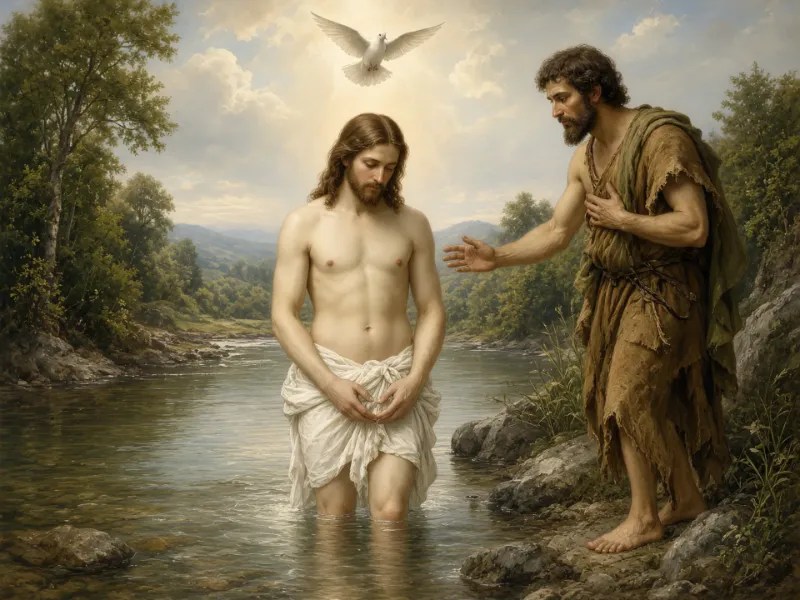
Jesus’ baptism reminds us of our own baptismal identity. In the waters of baptism, we are united with Christ, dying to our old selves and rising to new life in Him. As Paul writes, “We were buried therefore with him by baptism into death, in order that, just as Christ was raised from the dead by the glory of the Father, we too might walk in newness of life” (Romans 6:4). This powerful reality shapes our entire Christian existence.
Psychologically, baptism serves as a powerful symbol of transformation and new beginnings. It speaks to our deep human need for cleansing, renewal, and belonging. When we remember Jesus’ baptism, we are invited to reconnect with this transformative moment in our own lives, to reclaim our identity as beloved children of God.
The Trinitarian dimension of Jesus’ baptism – the Son in the water, the Spirit descending, the Father’s voice from heaven – reminds us that we are baptized into the life of the Trinity. This relational understanding of God invites us into a dynamic, loving relationship with the Divine. It challenges us to live out this Trinitarian love in our relationships with others, fostering communities of mutual love and support.
Historically, Jesus’ baptism marks the beginning of His public ministry. For us today, this serves as a reminder that our baptism is not just a private, spiritual event a commissioning for mission. We are called, like Jesus, to live out our baptismal identity in service to God’s kingdom. This challenges us to consider how we are using our gifts and talents to further God’s work in the world.
The humility of Christ in submitting to John’s baptism offers us a powerful example. Despite His divine nature, Jesus aligned Himself with sinful humanity, showing solidarity with our human condition. This invites us to a spirituality of humility and solidarity, especially with those who are marginalized or suffering.
Jesus’ baptism also points us toward the cosmic dimensions of salvation. As the Fathers taught, Christ’s entering the waters sanctifies all of creation. This reminds us of our responsibility as baptized Christians to be stewards of God’s creation, working for the renewal and healing of our world.
The descent of the Spirit at Jesus’ baptism prefigures the gift of the Spirit to all believers. This empowers us for Christian living and mission. We are called to be continually open to the Spirit’s guidance and empowerment in our daily lives.
For many Christians today, especially those baptized as infants, reflecting on Jesus’ baptism can serve as an opportunity for baptismal renewal. It invites us to consciously reaffirm our baptismal promises and recommit ourselves to Christian discipleship.
In our increasingly secular world, Jesus’ baptism reminds us of the countercultural nature of our Christian identity. Like Jesus, who began His ministry by stepping into the Jordan, we are called to live out our faith in ways that may sometimes go against the current of our society.
Finally, in an age often marked by division, Jesus’ baptism speaks of unity. All Christians, regardless of denomination, share in this one baptism. This common foundation calls us to work for greater unity among all followers of Christ.
Let us allow the significance of Jesus’ baptism to permeate our lives today. May it remind us of who we are, empower us for service, and draw us ever deeper into the life of the Triune God. As we face the challenges and opportunities of our time, may we do so as those who have been baptized into Christ, bearing His light and love to all we encounter.


Leave a Reply