
 English
 Chinese
 Dutch
 Arabic
 Spanish
 Portuguese
 Russian
 French
 Italian
 German
 Japanese
Matthew never says how old Jesus was when the wise men came, but his clues point to a child under two, perhaps about a year old. The wise men found “the young child” in “the house” (Matthew 2:11), and Herod then killed the boys of Bethlehem “from two years old and under” (Matthew 2:16).
We usually picture the wise men at the manger, kneeling in the straw beside the shepherds. Matthew sets them somewhere quieter. “When they were come into the house, they saw the young child with Mary his mother, and fell down, and worshipped him” (Matthew 2:11). Matthew has no shepherds and no manger here, only a house, a mother and her little boy, and travellers from the east on their knees. The house is the first of Matthew’s clues to the age of the child inside it.
If you came wondering how old Jesus was when he died, that is a different question, and Luke gives its starting point: when his ministry began, Jesus “began to be about thirty years of age” (Luke 3:23). The rest of that answer is in how old Jesus was when he died.
How old was Jesus when the wise men found him?
Set that house beside Luke’s account of the birth night and the distance between the two scenes begins to show. On the night Jesus was born, Luke tells us, the shepherds “found Mary, and Joseph, and the babe lying in a manger” (Luke 2:16), a newborn laid in a feeding trough. By the time the wise men arrive, the family is living under a roof, and some time has passed.
Matthew’s word for the child is a second hint, though a weaker one than it looks. Luke calls the newborn in the manger a brephos, the Greek word for a baby just born. Matthew calls Jesus a paidion, a young child. Some readers have taken that as proof that Jesus was older, but Luke uses paidion too, for the newborn of whom the shepherds “made known abroad the saying which was told them concerning this child” (Luke 2:17). The word alone cannot tell us whether Jesus was a week old or a year.
The strongest clue is also the darkest. Herod “enquired of them diligently what time the star appeared” (Matthew 2:7). When the wise men did not come back, he killed the boys of Bethlehem “from two years old and under, according to the time which he had diligently inquired of the wise men” (Matthew 2:16). He set his limit by what they had told him. A frightened king who wanted no rival left alive would set the limit above the true age, so the child was likely younger than two. Yet if Jesus had been only days old, a limit of a few months would have served Herod just as well. It is a terrible way to learn a child’s age: from the reach of the order sent out to kill him.
Augustine, around AD 400, thought the wise men reached Bethlehem on the thirteenth day after the birth, the 6 January of the Church’s calendar. Some of the Fathers, among them Epiphanius and the poet Juvencus, went the other way: they took Herod’s order at its word and concluded that the wise men came two years after the birth, so the picture of a two-year-old Jesus goes back at least to the fourth century. Early or late, every one of these readers keeps the visit inside Herod’s limit.
Between them lies the reading the clues favour most: some months, perhaps about a year. The road alone was long. From Persia, where many have placed the wise men’s home, to Jerusalem is “between 1000 and 1200 miles”, a journey that “may have taken any time between three and twelve months by camel.” The writers of the 1910 Catholic Encyclopedia, who give those figures, set the visit “probably a year, or a little more than a year, after the birth of Christ.” Think what that means: men who packed for a journey of months because of a light in the sky, and kept going until they found the child.
Did the wise men visit Jesus at the manger?
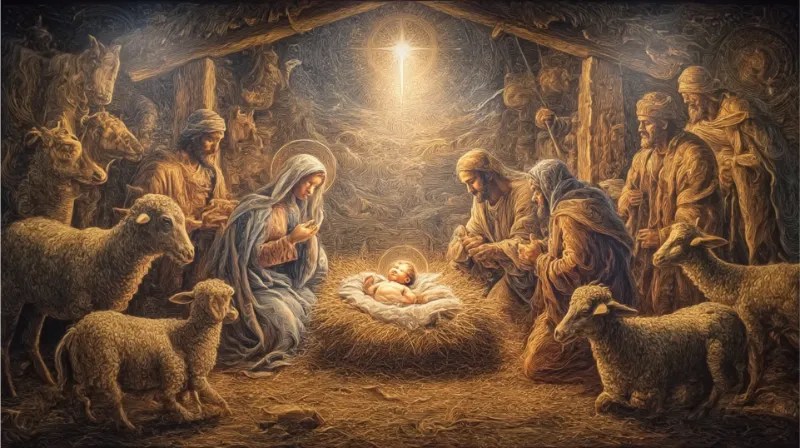
Not in Matthew’s telling. The shepherds came to the manger the night Jesus was born; the wise men came later, to a house. Our nativity sets put them all together in one scene, and that is a fair way to tell one story. The poor of Israel and the learned of the nations kneel before the same child. A nativity scene shows the whole mystery at once; it was never a timetable.
The Church’s year tells the story in its own order. In the West the wise men have a feast of their own, the Epiphany, on 6 January or the Sunday near it. On that feast in 2026 Pope Leo XIV told the crowd in St Peter’s Square what the wise men’s kneeling means for us: “Kneeling like the Magi before the Infant of Bethlehem means, also for us, to profess having found that true humanity in which the glory of God shines forth.” The wise men found the glory of God in a little boy in a house in Bethlehem, and that is where we are asked to look for it too. The Orthodox Church honours them with the birth itself, on 25 December, and gives 6 January to Theophany, the Baptism of the Lord in the Jordan. When each church keeps the feast, and how, is told in why Christians celebrate Epiphany.
How do Matthew’s and Luke’s accounts fit together?
Luke gives us the shepherds, the circumcision and the presentation in the Temple; Matthew gives us the wise men, the flight into Egypt and Herod’s killings. Laid side by side, the two Gospels tell us Jesus’ age at three moments and fall silent at the rest, and the wise men come in the silence.
| Moment | Jesus’ age | Where to read it |
|---|---|---|
| Shepherds at the manger | The night of his birth | Luke 2:8–16 |
| Circumcision and naming | Eight days | Luke 2:21 |
| Presentation in the Temple | About forty days | Luke 2:22–38 |
| Wise men in the house | Not given; under two | Matthew 2:11, 16 |
| Flight into Egypt | Not given; soon after the wise men left | Matthew 2:13–15 |
| Home to Nazareth | Not given; each Gospel places it differently | Luke 2:39; Matthew 2:19–23 |
Those forty days show us a family keeping the law of Moses to the letter. A mother was unclean seven days after a son’s birth, the boy was circumcised on the eighth day, and she waited “three and thirty days” more before she came to the sanctuary (Leviticus 12:2–4). Mary and Joseph waited out every one of those days before they carried the Son of God up to his Father’s house.
Luke’s next sentence is where readers have stumbled since Augustine’s day. “And when they had performed all things according to the law of the Lord, they returned into Galilee, to their own city Nazareth” (Luke 2:39). Matthew says that after the wise men left, the family fled to Egypt and settled in Nazareth only after Herod was dead. Augustine fitted the two together by putting the wise men first, in the first days of Jesus’ life; then came the Temple, and then Egypt. Others, the writers of the 1910 encyclopedia among them, read Luke’s return to Galilee as a short stay: the family went home to Nazareth after the presentation, came back to live in Bethlehem, and the wise men found them there, in a house, about a year after the birth. Each reading takes both Gospels at their word.
One small detail sits more easily with the later visit. At the Temple, Mary and Joseph offered “a pair of turtledoves, or two young pigeons” (Luke 2:24), the offering the law allowed a mother who was “not able to bring a lamb” (Leviticus 12:8). Had the wise men already given their gold, the family could have bought the lamb. It is a hint, nothing more, and believers who love both Gospels have read them both ways.
Who were the wise men, and were they kings?
Matthew calls them magoi, Magi, and tells us only that they came “from the east” (Matthew 2:1). The word first belonged to a priestly caste of the Medes, who served as priests in Persia. By Matthew’s day it was used for learned men of the East who read the stars and dreams. Justin Martyr, in the middle of the second century, says the Magi came from Arabia, and many since have thought of Persia. Wherever they lived, the first people from the nations to kneel before Jesus were scholars who had travelled a long way because of a sign in the sky.
How many were there? Matthew does not count them, and he never calls them kings. We say three because they brought three gifts, while the Christians who painted them in Rome’s catacombs showed two in one place and four in another, and in the East tradition has often spoken of twelve. The names Gaspar, Melchior and Balthasar were given to them in the West by the seventh century. Matthew never thought the number worth giving; what he wants us to see is that they came a long way and knelt.
Their crowns came from a psalm the Church still sings at Epiphany: “The kings of Tarshish and of the isles shall bring presents: the kings of Sheba and Seba shall offer gifts. Yea, all kings shall fall down before him” (Psalm 72:10–11). Christians heard those kings in Matthew’s travellers. Tertullian, around AD 207, wrote that “the East generally regarded the magi as kings,” and in much of the world they are still the Three Kings. Whatever their rank at home, Matthew shows them doing what the psalm’s kings do, falling down before a greater king and opening their treasures.
Their gifts were “gold, and frankincense and myrrh” (Matthew 2:11), and the Church read meaning in them early. Irenaeus, writing about AD 180, saw in each gift who the child was: “myrrh, because it was He who should die and be buried for the mortal human race; gold, because He was a King, of whose kingdom is no end … frankincense, because He was God.” Myrrh is a strange present for a little boy, and Irenaeus saw in it the road ahead of him. What led the wise men to Bethlehem, Matthew calls “his star”, and nobody knows what it was; the explanations are gathered in what the Star of Bethlehem was.
Why did Herod kill the boys of Bethlehem?
Because a king was afraid of a child. Herod had sent the wise men on with a lie, “that I may come and worship him also” (Matthew 2:8). When they went home “another way” (Matthew 2:12), he “was exceeding wroth, and sent forth, and slew all the children that were in Bethlehem, and in all the coasts thereof” (Matthew 2:16). It fits what we know of him. A Jewish encyclopedia of 1906 says Herod “inaugurated his reign with acts of vengeance and cruelty,” and that “the last years of Herod’s reign were, like the first, full of horrors.”
We do not know how many boys died. The Greek liturgy speaks of 14,000; scholars a century ago, reckoning by the size of a village like Bethlehem, put it between six and twenty. The Jewish historian Josephus, who records many of Herod’s cruelties in his last years, does not mention it. Matthew gives the grief its full weight. He lets the mothers of Bethlehem weep in the words of Jeremiah: “Rachel weeping for her children, and would not be comforted, because they are not” (Matthew 2:18). The Western Church remembers these children as the Holy Innocents on 28 December, and the Greek Church on 29 December, so the boys whose number nobody wrote down are remembered in prayer every year, a few days after Christmas.
The child Herod wanted was already gone. Warned in a dream, Joseph “took the young child and his mother by night, and departed into Egypt” (Matthew 2:14). So the family left the house in Bethlehem behind them. Whatever his age, the young child had already been found there by strangers from the east, who knelt before him and opened their treasures.


Leave a Reply