
 English
 Chinese
 Dutch
 Arabic
 Spanish
 Portuguese
 Russian
 French
 Italian
 German
 Japanese
Where the churches’ words differ
How it begins
- Our Father, who art in heavenCatholics, Orthodox, Anglicans, Lutherans, Methodists and Presbyterians, in the traditional wording
- Our Father which art in heavenThe King James Bible and the 1662 Book of Common Prayer
- Our Father in heavenThe modern wording the churches agreed in 1975 and revised in 1988, in the Episcopal Prayer Book, the ELCA’s worship book and the United Methodist Hymnal
What we ask God to forgive
- forgive us our trespasses, as we forgive those who trespass against usCatholics, Orthodox, Anglicans, Lutherans and Methodists
- forgive us our debts, as we forgive our debtorsPresbyterian and Reformed churches, from Matthew 6:12
- forgive us our sins as we forgive those who sin against usThe modern wording, closer to Luke 11:4
Temptation
- lead us not into temptationEvery traditional wording, and the Church of England’s modern one
- save us from the time of trialThe modern wording of 1975 and 1988
Evil
- deliver us from evilNearly every English wording in use, the Orthodox Church in America’s included
- deliver us from the Evil OneHapgood’s Orthodox service book of 1906
The ending
- Amen, with no closing praiseCatholics outside Mass, and Luther’s Small Catechism
- For the kingdom, the power and the glory are yours now and for ever.Catholics at Mass, after the priest’s prayer for peace
- For thine is the kingdom, and the power, and the glory, for ever and ever. Amen.Anglicans and Lutherans; Methodists and Presbyterians end “forever”
- For thine is the kingdom … of the Father, and of the Son, and of the Holy Spirit, now, and ever, and unto ages of ages.The Orthodox priest, alone
When each church prays it
- Catholics
At every Mass the whole congregation stands to say or sing the Our Father just before Communion. The priest then prays alone that we be delivered from every evil and kept in peace, and the people answer with the closing praise.
The Church asks for it at Morning and Evening Prayer as well, so that with the Mass it is prayed solemnly three times a day, as the first Christians prayed it three times a day. In the Rosary an Our Father opens each decade of ten Hail Marys.
- Orthodox
At the Divine Liturgy the priest asks that we may call on God as our Father “boldly and without condemnation,” and the people say or sing the prayer before Communion. The priest then sings the closing praise alone.
In the daily services, and in the prayers Orthodox Christians say at home, it follows the Trisagion, “Holy God, Holy Mighty, Holy Immortal, have mercy on us,” sung three times.
- Anglicans
The Church of England says the prayer has a place in every Anglican act of worship. In the 1662 Prayer Book it comes twice in Morning Prayer, with the people kneeling and saying it aloud with the minister, the first time with the closing praise and the second without. At the Holy Communion in the American Prayer Book of 1979, priest and people say it together after the great prayer of thanksgiving.
- Lutherans
In Germany’s Lutheran churches a bell rings while the congregation prays it, in every service, so that anyone who hears the bell and cannot be there can pray along.
Luther’s Small Catechism teaches it petition by petition, and asks Christians to say it with the Creed each morning and evening, kneeling or standing, and again before meals.
- Methodists, Presbyterians and Baptists
Methodists use it widely in Sunday worship and as part of the Lord’s Supper, and Presbyterians pray it with “debts.” Baptist churches have no prayers set for them by any denomination, so whether the Lord’s Prayer is said on a Sunday is up to each congregation.
Churches that don’t pray it as a set prayer
Almost every church says these words aloud, but a few read Jesus’ “After this manner therefore pray ye” as a pattern for our own prayers rather than words to repeat. The Church of Jesus Christ of Latter-day Saints teaches that the prayer “serves as a pattern to follow and not as a piece to memorize and recite repetitively,” since Jesus gave it straight after warning against vain repetitions. Jehovah’s Witnesses call it a model prayer that is “not to be recited word for word,” and point out that Luke gives it in other words than Matthew.
Quakers who worship in silence keep no set order of service, so no fixed prayer is said in their meetings, though some Quakers do pray words from the Bible. And a small number of Bible teachers who divide Scripture into dispensations, among them the Berean Bible Society, hold that Jesus gave the prayer to his disciples for Israel’s kingdom and the Tribulation, so they do not pray it today.
Many Churches of Christ leave it out of their services for another reason. They teach that the kingdom came at Pentecost, so “Thy kingdom come” has already been answered. Not every congregation agrees, and some pray it.
Where the Lord’s Prayer comes from
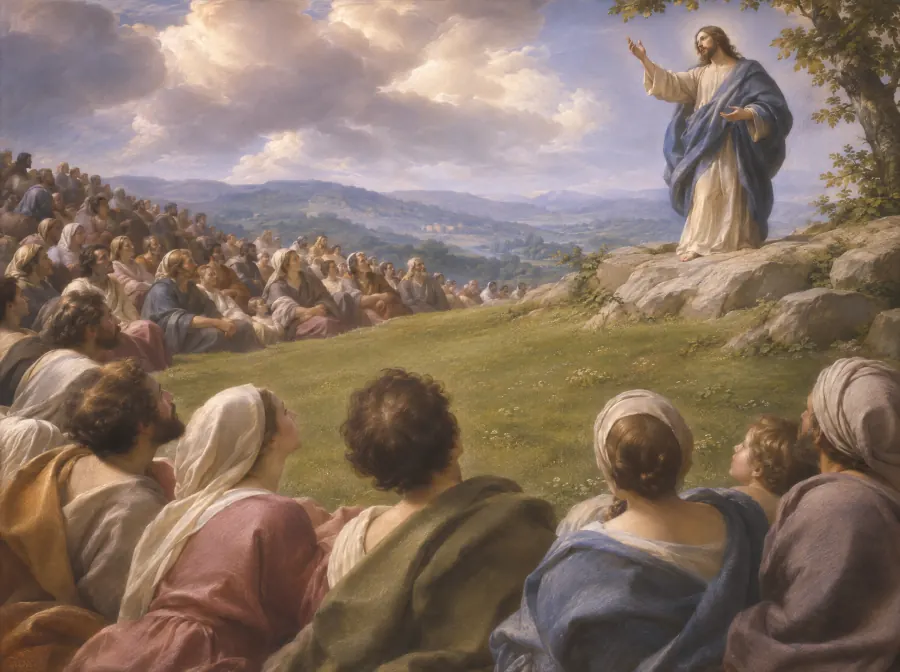
Jesus gave this prayer twice. In Matthew it stands in the middle of the Sermon on the Mount, straight after he warns against vain repetitions: “After this manner therefore pray ye” (Matthew 6:9). In Luke one of the disciples asks, “Lord, teach us to pray, as John also taught his disciples,” and Jesus answers with a shorter prayer of five petitions (Luke 11:1–4). The churches have always prayed Matthew’s longer form, with its seven.
Even a single word of it keeps its mystery. The word we translate “daily,” epiousios, appears nowhere else in the New Testament, and the Catechism gives three ways the Church has heard it: bread for this day, the bread we need, and the Bread of Life himself.
The closing praise is nearly as old as the Gospels. The Didache, a handbook for Christians usually dated to around the year 100, ends the prayer “for Thine is the power and the glory for ever and ever” and tells believers to pray it three times a day. Its words echo King David’s prayer, “Thine, O LORD, is the greatness, and the power, and the glory” (1 Chronicles 29:11). The oldest Greek copies of Matthew do not have it, and neither did Jerome’s Latin Bible, which is why Catholics end the prayer at “deliver us from evil.”
Tertullian of Carthage wrote the earliest known commentary on the prayer, and he called it “an epitome of the whole Gospel.”
How the English words took shape
- 1526William Tyndale’s New Testament asks God to “forgeve vs oure treaspases.”
- 1549The first Book of Common Prayer makes “trespasses” the word of English worship.
- 1611The King James Bible goes back to “debts,” the word in the Greek, and prints the closing praise.
- 1906Isabel Hapgood publishes the Orthodox liturgy in English, with “deliver us from the Evil One.”
- 1970The Roman Mass takes up the closing praise, said by the people after the priest’s prayer.
- 1975The churches agree a modern English wording, “Our Father in heaven,” revised in 1988.
Why the Catholic prayer stops at “deliver us from evil”
The Catholic form of the Lord’s Prayer stops at “deliver us from evil,” with no closing praise. At Mass the priest adds a prayer, then everyone says, “For the kingdom, the power, and the glory are yours.” The Latin Bible never had it, the Roman Mass took it up in 1970, and the oldest Greek copies of Matthew lack it.
The Lord’s Prayer and the Our Father are two names for the same prayer, and the Catechism uses both. The familiar English forms differ mainly in two places: the word for what is forgiven, and the ending. Choose Side by side at the top of this page to see them line against line.
Where does “For thine is the kingdom” come from?
It comes from the worship of the early Church, not from the oldest text of the Gospel. Fr. Lawrence Farley, an Orthodox priest writing for the Orthodox Church in America, puts the evidence plainly: “the early manuscripts Sinaiticus and Vaticanus lack any doxology, as do citations in Tertullian, Origen, Cyprian, and Gregory of Nyssa.” The International Standard Bible Encyclopedia, a Bible reference work edited by James Orr in 1915, reached the same verdict: the doxology “is not found in the leading manuscripts and is generally regarded as an ancient liturgical addition.”
The addition is old. The Didache, an early Christian handbook usually dated to around the year 100, gives the Lord’s Prayer and ends it with “for Thine is the power and the glory for ever and ever,” then adds, “Three times in the day pray ye so.” Its ending has no “kingdom.” The Catechism of the Catholic Church quotes the same line and says that “Very early on, liturgical usage concluded the Lord’s Prayer with a doxology”; the later Apostolic Constitutions added “the kingdom” (2760). Farley lists several other endings found in the manuscripts, from “For Thine is the power forever and ever” to one that names the Father, Son and Holy Spirit.
The words echo King David’s prayer in 1 Chronicles 29:11: “Thine, O Lord is the greatness, and the power, and the glory… thine is the kingdom, O Lord.” The German Bible Society notes that the closing praise was shaped on that passage.
Why is it in the King James Bible but not in Catholic Bibles?
The two families of Bibles were translated from different texts. The King James Version follows the Textus Receptus, the printed Greek New Testament that Erasmus compiled from the manuscripts he could reach. “Two manuscripts (Sinaiticus and Vaticanus) that are older than those found in the Textus Receptus do not contain the verse in question,” writes Fr. Charles Grondin of Catholic Answers. William Tyndale’s New Testament, the first printed in English (Worms, 1526, revised 1534), has “For thyne is the kyngedome” at Matthew 6:13 in its 1534 text, and the King James Version has it too.
Catholic Bibles came from the Latin. The Douay-Rheims Bible was translated from the Latin Vulgate, and as Grondin notes, “St. Jerome’s Latin Vulgate did not include it.” Modern Catholic Bibles no longer rest on the Vulgate, but they leave it out too, because the oldest manuscripts lack it. For the same reason, the encyclopedia notes, the Revised Version (British and American) omits it. The Catholic and Protestant Bibles differ in other ways, starting with the number of books.
How do Matthew and Luke differ?
The prayer appears twice in the Gospels. “St. Luke presents a brief text of five petitions, while St. Matthew gives a more developed version of seven petitions,” the Catechism says, and “The liturgical tradition of the Church has retained St. Matthew’s text” (2759). The Douay-Rheims, translated from the Latin, shows Luke’s shorter form; the King James Version, translated from later Greek copies, gives a Luke that is closer to Matthew. For what each line of Matthew’s text means, read Matthew 6:9–13 line by line.
| Line | Matthew 6:9-13 (Douay-Rheims) | Luke 11:2-4 (Douay-Rheims) | Luke 11:2-4 (King James) |
|---|---|---|---|
| Address | Our Father who art in heaven, | Father, | Our Father which art in heaven, |
| Name | hallowed be thy name. | hallowed be thy name. | Hallowed be thy name. |
| Kingdom | Thy kingdom come. | Thy kingdom come. | Thy kingdom come. |
| Will | Thy will be done on earth as it is in heaven. | Not in this text | Thy will be done, as in heaven, so in earth. |
| Bread | Give us this day our supersubstantial bread. | Give us this day our daily bread. | Give us day by day our daily bread. |
| Forgiveness | And forgive us our debts, as we also forgive our debtors. | And forgive us our sins, for we also forgive every one that is indebted to us. | And forgive us our sins; for we also forgive every one that is indebted to us. |
| Temptation | And lead us not into temptation. | And lead us not into temptation. | And lead us not into temptation; |
| Evil | But deliver us from evil. Amen. | Not in this text | but deliver us from evil. |
Neither Gospel has the doxology in the Douay-Rheims, and the King James Version has it only in Matthew.
“Supersubstantial” in Matthew and “daily” in Luke translate the same Greek word, and no one knows for certain what it means. You can tap each word of the prayer to see the Greek behind it.

Do Catholics ever say the doxology?
Yes, at Mass, though only since 1970. After the people and the priest say the Lord’s Prayer together, “the Priest alone adds the embolism, which the people conclude by means of the doxology,” according to the General Instruction of the Roman Missal (81). The embolism is a short prayer that, in the Instruction’s words, “asks for deliverance from the power of evil for the whole community of the faithful.” The people then answer, in the English used in the United States since 2011, “For the kingdom, the power, and the glory are yours, now and for ever.”
The Roman Mass had not always included it. Fr. William Saunders, surveying the Latin evidence for the Our Father at Mass from Jerome to Gregory the Great, concludes that “none of this evidence includes the doxology.” Michael Shackleton of The Southern Cross, a Catholic weekly in South Africa, writes that it “was reintroduced in 1970 when the new order of the Mass replaced the old.” The Mass still sets it apart from the words of the Gospel, and the Catechism calls it “the doxology from the Apostolic Constitutions” (2760). It also says these words take up the first three petitions again, “now proclaimed as adoration and thanksgiving” (2855). The Catechism and its Compendium print the prayer itself ending at “but deliver us from evil.”
How do Orthodox Christians end it?
In the Orthodox Liturgy the people say the petitions and the priest answers with the ending. “After the people say the petitions of the ‘Lord’s prayer,’ the priest responds,” writes Fr. Alexis Trader, with “For Thine is the Kingdom and the Power and the Glory of the Father and of the Son and of the Holy Spirit now and ever and unto the ages of ages.” The Catechism records the same Byzantine practice: it “adds after ‘the glory’ the words ‘Father, Son, and Holy Spirit’” (2760). Farley writes that his church “uses the fullest version possible.”
Why do some say “trespasses” and others “debts”?
Matthew’s Gospel says “debts” and Luke’s says “sins,” in both the King James and the Douay-Rheims. The Catholic notes to the New American Bible explain the image: “the word debts is used metaphorically of sins, ‘debts’ owed to God.” The Didache, in Lightfoot’s translation, has the singular: “forgive us our debt.”
The word “trespasses” appears in the verses just after the prayer, where Jesus says, “For if ye forgive men their trespasses, your heavenly Father will also forgive you” (Matthew 6:14, King James Version). Tyndale used the word in the prayer itself: the 1534 revision of his New Testament reads “forgeve vs oure treaspases.” The Book of Common Prayer and the Catholic Mass in English both say “trespasses.” Presbyterian and Reformed churches say “debts,” following the Westminster Shorter Catechism of 1647, which teaches the petition as “And forgive us our debts, as we forgive our debtors.”
Do Protestants say the Lord’s Prayer the same way?
They pray it, and their standard texts differ on the ending. The Westminster Shorter Catechism calls the Lord’s Prayer “the special rule of direction” for prayer and treats the ending as part of it: “The conclusion of the Lord’s prayer, which is, For thine is the kingdom, and the power, and the glory, forever.” The 1928 Book of Common Prayer uses both endings in one service: the priest’s Lord’s Prayer at the start of Holy Communion stops at “But deliver us from evil,” and the one said later in the service, introduced with “we are bold to say,” carries the doxology. Other differences between the two traditions are set out in Protestant vs Catholic beliefs and worship.
Lutheran texts vary in the same way. The Triglot Concordia English translation of Luther’s Small Catechism (1529) gives the prayer without the doxology. The modern German text published by the Protestant site evangelisch.de prints it under the heading “Der Beschluss” (the conclusion): “Denn dein ist das Reich und die Kraft und die Herrlichkeit in Ewigkeit.” Where Lutherans and Catholics differ more deeply is set out in the Lutheran and Catholic comparison.
Do German Catholics and Protestants pray the same Vaterunser?
Yes. The German Bible Society prints the ecumenical version it describes as the one in use in worship today, which begins “Vater unser im Himmel, geheiligt werde dein Name” and ends with the doxology, “Denn dein ist das Reich und die Kraft und die Herrlichkeit in Ewigkeit.” It also notes that later manuscripts of Matthew and Luke add the closing praise.
German Catholics, like Catholics everywhere in the Roman rite, say the doxology at Mass only after the priest’s prayer, as the General Instruction of the Roman Missal directs.
Print the prayer, or send it to someone
The Lord’s Prayer
Our Father, who art in heaven, hallowed be thy name; thy kingdom come, thy will be done on earth as it is in heaven. Give us this day our daily bread, and forgive us our trespasses, as we forgive those who trespass against us; and lead us not into temptation, but deliver us from evil. Amen.
Matthew 6:9–13, as Catholics pray it
Our Father, who art in heaven. Hallowed be thy Name. Thy kingdom come. Thy will be done on earth. As it is in heaven. Give us this day our daily bread. And forgive us our trespasses, As we forgive those who trespass against us. And lead us not into temptation; But deliver us from the Evil One: For thine is the kingdom, and the power, and the glory, of the Father, and of the Son, and of the Holy Spirit, now, and ever, and unto ages of ages. Amen.
Matthew 6:9–13, from the Orthodox Divine Liturgy
Our Father, who art in heaven, hallowed be thy Name, thy kingdom come, thy will be done, on earth as it is in heaven. Give us this day our daily bread. And forgive us our trespasses, as we forgive those who trespass against us. And lead us not into temptation, but deliver us from evil. For thine is the kingdom, and the power, and the glory, for ever and ever. Amen.
Matthew 6:9–13, Book of Common Prayer
Our Father who art in heaven. Hallowed be Thy name. Thy kingdom come. Thy will be done on earth as it is in heaven. Give us this day our daily bread. And forgive us our trespasses, as we forgive those who trespass against us. And lead us not into temptation. But deliver us from evil. Amen.
Matthew 6:9–13, Luther’s Small Catechism
Our Father who art in heaven, hallowed be thy name. Thy kingdom come, thy will be done, on earth as it is in heaven. Give us this day our daily bread; and forgive us our debts, as we forgive our debtors; and lead us not into temptation, but deliver us from evil. For thine is the kingdom and the power and the glory, forever. Amen.
Matthew 6:9–13, as Presbyterians pray it
Our Father, who art in heaven, hallowed be thy name. Thy kingdom come, thy will be done on earth as it is in heaven. Give us this day our daily bread. And forgive us our trespasses, as we forgive those who trespass against us. And lead us not into temptation, but deliver us from evil. For thine is the kingdom, and the power, and the glory, forever. Amen.
Matthew 6:9–13
Our Father, who art in heaven, hallowed be your name, your kingdom come, your will be done on earth as it is in heaven. Give us this day our daily bread. Forgive us our trespasses, as we forgive those who trespass against us. Lead us not into temptation, but deliver us from evil. For yours is the kingdom, and the power, and the glory, forever. Amen.
Matthew 6:9–13
Our Father who art in heaven, hallowed be Thy name. Thy kingdom come. Thy will be done, on earth as it is in heaven. Give us this day our daily bread; and forgive us our trespasses, as we forgive those who trespass against us; and lead us not into temptation, but deliver us from the evil one. In Christ Jesus our Lord, for Thine is the kingdom and the power and the glory forever. Amen.
Matthew 6:9–13
Our Father, who art in heaven, hallowed be thy name; thy kingdom come, thy will be done on earth as it is in heaven. Give us this day our daily bread, and forgive us our trespasses, as we forgive those who trespass against us; and lead us not into temptation, but deliver us from evil. For thine is the kingdom, and the power, and the glory, of the Father, and of the Son, and of the Holy Spirit, now, and ever, and unto ages of ages. Amen.
Matthew 6:9–13
Our Father which art in heaven, Hallowed be thy name. Thy kingdom come. Thy will be done in earth, as it is in heaven. Give us this day our daily bread. And forgive us our debts, as we forgive our debtors. And lead us not into temptation, but deliver us from evil: For thine is the kingdom, and the power, and the glory, for ever. Amen.
Matthew 6:9–13
Our Father which art in heaven, Our Father-Mother God, all-harmonious, Hallowed be Thy name. Adorable One. Thy kingdom come. Thy kingdom is come; Thou art ever-present. Thy will be done in earth, as it is in heaven. Enable us to know, — as in heaven, so on earth, — God is omnipotent, supreme. Give us this day our daily bread; Give us grace for to-day; feed the famished affections; And forgive us our debts, as we forgive our debtors. And Love is reflected in love; And lead us not into temptation, but deliver us from evil; And God leadeth us not into temptation, but delivereth us from sin, disease, and death. For Thine is the kingdom, and the power, and the glory, forever. For God is infinite, all-power, all Life, Truth, Love, over all, and All.
Matthew 6:9–13
Our Father in heaven, hallowed be your name, your kingdom come, your will be done, on earth as in heaven. Give us today our daily bread. Forgive us our sins as we forgive those who sin against us. Save us from the time of trial and deliver us from evil. For the kingdom, the power, and the glory are yours now and for ever. Amen.
Matthew 6:9–13
Our Father, who art in heaven, hallowed be thy Name, thy kingdom come, thy will be done, on earth as it is in heaven. Give us this day our daily bread. And forgive us our trespasses, as we forgive those who trespass against us. And lead us not into temptation, but deliver us from evil. For thine is the kingdom, and the power, and the glory, for ever and ever. Amen.
Matthew 6:9–13
Our Father which art in heaven, Hallowed be thy name. Thy kingdom come. Thy will be done in earth, as it is in heaven. Give us this day our daily bread. And forgive us our debts, as we forgive our debtors. And lead us not into temptation, but deliver us from evil: For thine is the kingdom, and the power, and the glory, for ever. Amen.
Matthew 6:9–13
christianpure.com
Sources: Matthew 6 and Luke 11 in the King James Bible; the Didache, chapter 8; Tertullian, On Prayer, chapter 1; the Catechism of the Catholic Church, 2759–2767 and 2837; the General Instruction of the Roman Missal, 43 and 81; the General Instruction of the Liturgy of the Hours, 195; John Paul II, Rosarium Virginis Mariae, 32; the Book of Common Prayer of 1549, 1662 and 1979; Isabel Hapgood’s Service Book (1906); Luther’s Small Catechism in the Triglot Concordia (1921); the Evangelical Church in Germany; the Church of England; the Church of Jesus Christ of Latter-day Saints; jw.org; Philadelphia Yearly Meeting; the Berean Bible Society; La Vista Church of Christ and Jay Guin, One In Jesus. English translation of The Lord’s Prayer © 1998 English Language Liturgical Consultation (ELLC), and used by permission. http://www.englishtexts.org
Related reading
- Matthew 6:9–13: what the Lord’s Prayer means, line by line
- Orthodox vs Catholic: how the two churches differ
- Anglican vs Catholic: why the Church of England is not Roman Catholic
- Presbyterian vs Catholic: every real difference
- The King James vs the Catholic Bible
- How do you say the Catholic Rosary?


Leave a Reply