
 English
 Chinese
 Dutch
 Arabic
 Spanish
 Portuguese
 Russian
 French
 Italian
 German
 Japanese
Praying the Rosary means saying ten short prayers on each of five sets of beads, with a few prayers before and after, while thinking about one event in the life of Jesus and his mother for each set. The ten are Hail Marys, and each set, called a decade, opens with the Our Father and closes with the Glory Be.
A whole Rosary takes about twenty minutes. The events are called mysteries, and there are twenty, in four sets of five; a Rosary of five decades covers one set. Custom gives each day its own: the Joyful Mysteries on Monday and Saturday, the Sorrowful on Tuesday and Friday, the Glorious on Wednesday and Sunday, and on Thursday the Luminous, which Pope John Paul II added in 2002.
How do you pray the Rosary, step by step?
A rosary has a crucifix, a short strand of five beads (one large, three small, one large) and a loop of fifty small beads in five sets of ten, with a single large bead between one set and the next and a medal where the loop joins the strand. The strand carries the opening prayers and the loop carries the five decades. John Paul II called the beads “the traditional aid” for the Rosary; at the simplest level they keep count of the Hail Marys, so fingers can do the same work when there is no rosary to hand.
- Holding the crucifix, make the Sign of the Cross and say the Apostles’ Creed.
- On the large bead next to the crucifix, say the Our Father.
- On each of the next three small beads, say a Hail Mary.
- In the space after the third Hail Mary, before the next large bead, say the Glory Be.
- On the next large bead, announce the first mystery of the day (on a Monday, the Annunciation), read a verse or two about it if you wish, and say the Our Father.
- Moving onto the loop, say a Hail Mary on each of the ten small beads while thinking about the mystery.
- After the tenth Hail Mary, in the space before the next large bead, say the Glory Be. Many people add the Fatima Prayer here.
- On the next large bead, announce the second mystery and say the Our Father, then pray the second decade as in steps 6 and 7. Do the same for the third, fourth and fifth.
- When the fifth decade is done and the loop has brought you back to the medal, say the Hail, Holy Queen, the verse and response that follow it, and the closing prayer.
- End with the Sign of the Cross.
Five decades come to six Our Fathers, fifty-three Hail Marys and six Glory Bes. The USCCB, the bishops’ conference of the United States, notes that a prayer to Saint Joseph may follow the closing prayer, and John Paul II mentions the custom of ending with a prayer for the Pope’s intentions, “to embrace all the needs of the Church.”
The prayers of the Rosary, in full
The USCCB calls the Rosary “a Scripture-based prayer.” The Our Father is the prayer Jesus taught his disciples, and the first half of the Hail Mary joins the angel Gabriel’s greeting to Mary with the words of her cousin Elizabeth. Wordings differ a little between prayer books: some give the Creed’s “from thence He shall come,” as the Compendium of the Catechism does, and some end the Fatima Prayer “most in need of Thy mercy,” as EWTN does. The texts below are the USCCB’s English, except the Sign of the Cross, the Hail Mary and the Glory Be, which follow the Vatican’s English in the Compendium (2005).
The Sign of the Cross
In the name of the Father, and of the Son, and of the Holy Spirit. Amen.
The Apostles’ Creed
The Creed is said on the crucifix. The USCCB says it “summarizes the great mysteries of the Catholic faith.”
I believe in God, the Father almighty, Creator of heaven and earth, and in Jesus Christ, his only Son, our Lord, who was conceived by the Holy Spirit, born of the Virgin Mary, suffered under Pontius Pilate, was crucified, died and was buried; he descended into hell; on the third day he rose again from the dead; he ascended into heaven, and is seated at the right hand of God the Father almighty; from there he will come to judge the living and the dead. I believe in the Holy Spirit, the holy catholic Church, the communion of saints, the forgiveness of sins, the resurrection of the body, and life everlasting. Amen.
The Our Father
Jesus introduced this prayer with the words “After this manner therefore pray ye” (Matthew 6:9). In the Rosary it ends at “deliver us from evil,” without the words that close it in the King James Version, “For thine is the kingdom, and the power, and the glory, for ever.”
Our Father, who art in heaven, hallowed be thy name; thy kingdom come; thy will be done on earth as it is in heaven. Give us this day our daily bread; and forgive us our trespasses as we forgive those who trespass against us; and lead us not into temptation, but deliver us from evil. Amen.
The Hail Mary
The first half is two greetings from Luke’s Gospel, given here in the Douay-Rheims, the older Catholic English Bible. The angel says, “Hail, full of grace, the Lord is with thee: blessed art thou among women” (Luke 1:28), and Elizabeth cries out when Mary visits her, “Blessed art thou among women, and blessed is the fruit of thy womb” (Luke 1:42). The second half asks Mary’s prayers “now and at the hour of our death”; the USCCB says Pius V “officially added” it. The USCCB prints the same prayer with “you” in place of “thee” and “thou.” Other prayers to the Virgin Mary, such as the Memorare, are collected with it on a page of their own.
Hail, Mary, full of grace, the Lord is with thee. Blessed art thou among women, and blessed is the fruit of thy womb, Jesus. Holy Mary, Mother of God, pray for us sinners, now and at the hour of our death. Amen.
The Glory Be
This short praise of the Trinity closes each decade. John Paul II called it “the high-point of contemplation” in the Rosary and suggested that a group might sing it.
Glory be to the Father, and to the Son, and to the Holy Spirit, as it was in the beginning, is now, and ever shall be, world without end. Amen.
The Fatima Prayer (O my Jesus)
According to Lúcia, one of the three children who said they saw Mary at Fatima in Portugal in 1917, Mary told them at the apparition of 13 July, “When you pray the Rosary, say after each mystery: O my Jesus, forgive us, save us from the fire of hell. Lead all souls to heaven, especially those who are most in need.” It is said after the Glory Be at the end of each decade, and it is optional: the USCCB says “some say” it. The USCCB’s wording runs:
O my Jesus, forgive us our sins, save us from the fires of hell; lead all souls to Heaven, especially those who have most need of your mercy.
The Hail, Holy Queen
After the fifth decade comes the Salve Regina, in English the Hail, Holy Queen. John Paul II called it “that splendid prayer” and named the Litany of Loreto as the other way to close. A verse and its response follow it.
Hail, holy Queen, mother of mercy, our life, our sweetness, and our hope. To you we cry, poor banished children of Eve; to you we send up our sighs, mourning and weeping in this valley of tears. Turn, then, most gracious advocate, your eyes of mercy toward us; and after this, our exile, show unto us the blessed fruit of your womb, Jesus. O clement, O loving, O sweet Virgin Mary.
V. Pray for us, O holy Mother of God.
R. That we may be made worthy of the promises of Christ.
The closing prayer
The last prayer comes from the Church’s liturgy. John Paul II quoted its petition, that by meditating on the mysteries we may “imitate what they contain and obtain what they promise,” to tie the Rosary to daily Christian life.
Let us pray: O God, whose Only Begotten Son, by his life, Death, and Resurrection, has purchased for us the rewards of eternal life, grant, we beseech thee, that while meditating on these mysteries of the most holy Rosary of the Blessed Virgin Mary, we may imitate what they contain and obtain what they promise, through the same Christ our Lord. Amen.
What are the mysteries of the Rosary?
They are twenty moments in the lives of Jesus and his mother, from the angel’s visit to Nazareth to Mary’s place in heaven. Prayed in order, they run through the Gospel: the Joyful Mysteries of Jesus’ conception and childhood, the Luminous of his public ministry, the Sorrowful of his Passion and the Glorious of his Resurrection and what followed. The Catechism, citing Paul VI, calls the Rosary an “epitome of the whole Gospel.”
Luke says that after the shepherds came to the manger, “Mary kept all these things, and pondered them in her heart” (Luke 2:19). John Paul II quoted that verse and wrote that Mary’s memories of her Son were, in a way, “the ‘rosary’ which she recited uninterruptedly throughout her earthly life.” To pray a mystery is to do what she did: keep one scene in mind while the prayers go on. The USCCB pairs each mystery with a passage of Scripture and a “fruit” to pray for, and John Paul II suggested ending each decade with a prayer for that mystery’s fruit.
The Joyful Mysteries (Monday and Saturday)
The first five follow Luke’s account of Jesus’ conception, birth and childhood. John Paul II wrote that they “are marked by the joy radiating from the event of the Incarnation.”
| Mystery | Scripture | Fruit |
|---|---|---|
| 1. The Annunciation | Luke 1:26–27 | Humility |
| 2. The Visitation | Luke 1:39–42 | Love of neighbor |
| 3. The Nativity | Luke 2:1–7 | Poverty |
| 4. The Presentation in the Temple | Luke 2:21–24 | Purity of heart and body |
| 5. The Finding in the Temple | Luke 2:41–47 | Devotion to Jesus |
The Luminous Mysteries (Thursday)
John Paul II added these five from the years between Jesus’ baptism and his Passion, because “it is during the years of his public ministry that the mystery of Christ is most evidently a mystery of light.” They are also called the Mysteries of Light.
| Mystery | Scripture | Fruit |
|---|---|---|
| 1. The Baptism in the Jordan | Matthew 3:16–17 | Openness to the Holy Spirit |
| 2. The Wedding Feast at Cana | John 2:1–5 | To Jesus through Mary |
| 3. The Proclamation of the Kingdom | Mark 1:15 | Conversion |
| 4. The Transfiguration | Matthew 17:1–2 | Desire for holiness |
| 5. The Institution of the Eucharist | Matthew 26:26 | Adoration |
The Sorrowful Mysteries (Tuesday and Friday)
These five follow Jesus from his prayer in the garden of Gethsemane to his death on the cross.
| Mystery | Scripture | Fruit |
|---|---|---|
| 1. The Agony in the Garden | Matthew 26:36–39 | Obedience to God’s will |
| 2. The Scourging at the Pillar | Matthew 27:26 | Mortification |
| 3. The Crowning with Thorns | Matthew 27:27–29 | Courage |
| 4. The Carrying of the Cross | Mark 15:21–22 | Patience |
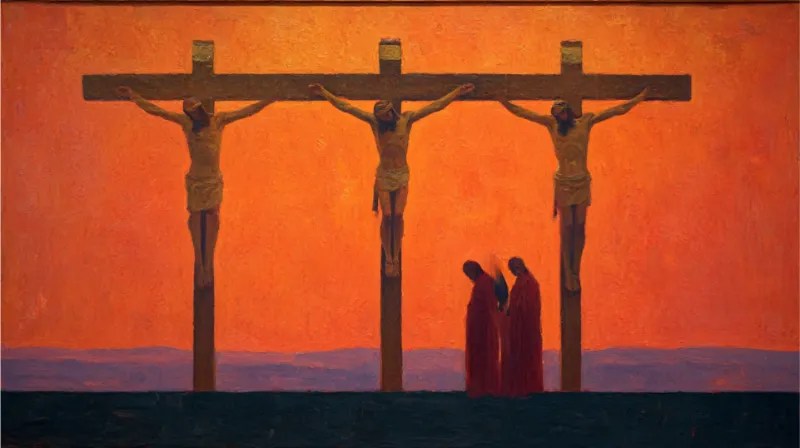
| 5. The Crucifixion and Death | Luke 23:33–46 | Sorrow for our sins |
The Glorious Mysteries (Wednesday and Sunday)
The first three are the Resurrection, the Ascension and Pentecost. The last two are not scenes from the Gospels. They are Catholic teaching about Mary, which the Catechism states this way: “when the course of her earthly life was finished,” she “was taken up body and soul into heavenly glory, and exalted by the Lord as Queen over all things.” The USCCB reads them with Mary’s own words, “from henceforth all generations shall call me blessed” (Luke 1:48), and with the vision of “a woman clothed with the sun, and the moon under her feet, and upon her head a crown of twelve stars” (Revelation 12:1).
| Mystery | Scripture | Fruit |
|---|---|---|
| 1. The Resurrection | Luke 24:1–5 | Faith |
| 2. The Ascension | Mark 16:19 | Hope |
| 3. The Descent of the Holy Spirit | Acts 2:1–4 | Wisdom |
| 4. The Assumption | Luke 1:48–49 | Devotion to Mary |
| 5. The Coronation of Mary | Revelation 12:1 | Grace of a happy death |
Which mysteries are prayed on which day?
The present pattern dates from 2002. In his apostolic letter on the Rosary, Rosarium Virginis Mariae, John Paul II noted that the Joyful Mysteries were then prayed on Monday and Thursday and the Glorious on Wednesday, Saturday and Sunday. He proposed moving the second Joyful day to Saturday, a day that “has always had a special Marian flavour,” which left Thursday free for the new Luminous Mysteries. The USCCB adds a change for the Sundays of Advent and Lent.
| Day | Mysteries | Before 2002 |
|---|---|---|
| Monday | Joyful | Joyful |
| Tuesday | Sorrowful | Sorrowful |
| Wednesday | Glorious | Glorious |
| Thursday | Luminous | Joyful |
| Friday | Sorrowful | Sorrowful |
| Saturday | Joyful | Glorious |
| Sunday | Glorious; Joyful in Advent, Sorrowful in Lent | Glorious |
John Paul II added that the pattern “is not intended to limit a rightful freedom in personal and community prayer,” so a parish or a family may choose another set when a feast calls for it.
How long does it take to pray the Rosary?
About twenty minutes for five decades, though the pace varies. Msgr. Charles Pope, a Washington pastor who answers readers’ questions in Our Sunday Visitor, gives his own norm for praying it alone as “about 20 minutes” and says “a group Rosary here at the parish usually runs about 22-25 minutes.” Repeated prayers like the Rosary, he adds, “are meant to move along,” and a steady pace helps a group pray together. Since the opening and closing prayers take part of that time, a single decade, one Our Father, ten Hail Marys and a Glory Be, takes about three minutes.
Not everyone has twenty minutes. John Paul II acknowledged that “many people will not be able to recite more than a part of the Rosary,” and Msgr. Pope says that praying it in several parts during the day “is certainly permissible,” though five decades together are “usually the best and expected way.”
What if your mind wanders during the Rosary?
Paul VI, quoted by John Paul II, warned that “without contemplation, the Rosary is a body without a soul, and its recitation runs the risk of becoming a mechanical repetition of formulas.” He cited Jesus’ warning in the Sermon on the Mount, “But when ye pray, use not vain repetitions, as the heathen do” (Matthew 6:7), and asked for “a quiet rhythm and a lingering pace.” Rosarium Virginis Mariae gives practical help for keeping the mind on the mystery:
- Announce the mystery, and look at a picture of it if one is at hand; John Paul II suggested “a suitable icon to portray it.”
- Read a short Bible passage about the mystery before the Our Father. As John Paul II put it, “No other words can ever match the efficacy of the inspired word.”
- Pause in silence for a moment before beginning the vocal prayers.
- When praying with others, add a short phrase about the mystery after the name of Jesus in each Hail Mary, a custom John Paul II called “praiseworthy,” following Paul VI.
How do you lead the Rosary for a group?
The Rosary is often prayed aloud together: by families at home, by parish groups and, in the United States, at wakes.
One person leads. A parish guide from Ottawa describes the leader “reading the first portion of a given prayer, which is then answered by those in attendance.” In the Hail Mary, the leader says the greeting down to “the fruit of thy womb, Jesus,” and everyone answers from “Holy Mary, Mother of God” to the end. The leader also announces each mystery, may read a few verses after it, as the USCCB suggests, and can leave a short silence before the Our Father, as John Paul II recommended. The verse after the Hail, Holy Queen works the same way: the leader says “Pray for us, O holy Mother of God,” and the group answers. For anyone asked to lead prayer aloud, Praying Out Loud is a paid course of ten short lessons; one covers leading a group’s prayers week after week, and another what to do if you lose your place.
Do Catholics have to pray the Rosary?
No. The Church recommends it warmly and requires it of no one. Paul VI, after pages of praise for it, wrote: “The Rosary is an excellent prayer, but the faithful should feel serenely free in its regard. They should be drawn to its calm recitation by its intrinsic appeal.” John Paul II, who called it “my favourite prayer,” wrote that it “can be recited in full every day, and there are those who most laudably do so.”
Can non-Catholics pray the Rosary?
Yes. The Rosary is a devotion that stands outside the Church’s official worship: Paul VI wrote that it “draws its motivating force from the liturgy” but “does not, however, become part of the liturgy.” About half of the words said in it come from the Gospels. Many Protestants choose not to pray it because they hold that prayer belongs to God alone, through Christ alone. The Augsburg Confession of 1530, a Lutheran statement of faith in the Book of Concord, teaches that “the memory of saints may be set before us, that we may follow their faith and good works,” but says that Scripture teaches “not the invocation of saints or to ask help of saints, since it sets before us the one Christ as the Mediator, Propitiation, High Priest, and Intercessor.” The Westminster Confession, held by Presbyterian churches such as the Orthodox Presbyterian Church, says religious worship is to be given to God “and to him alone; not to angels, saints, or any other creature.”
Catholics answer that asking Mary’s prayers is not worship. The Catechism says devotion to her “differs essentially from the adoration which is given to the incarnate Word and equally to the Father and the Holy Spirit,” and that Mary “prays for us as she prayed for herself.” What Catholics mean when they ask her to pray for them is the subject of why Catholics pray to Mary.
Where did the Rosary come from?
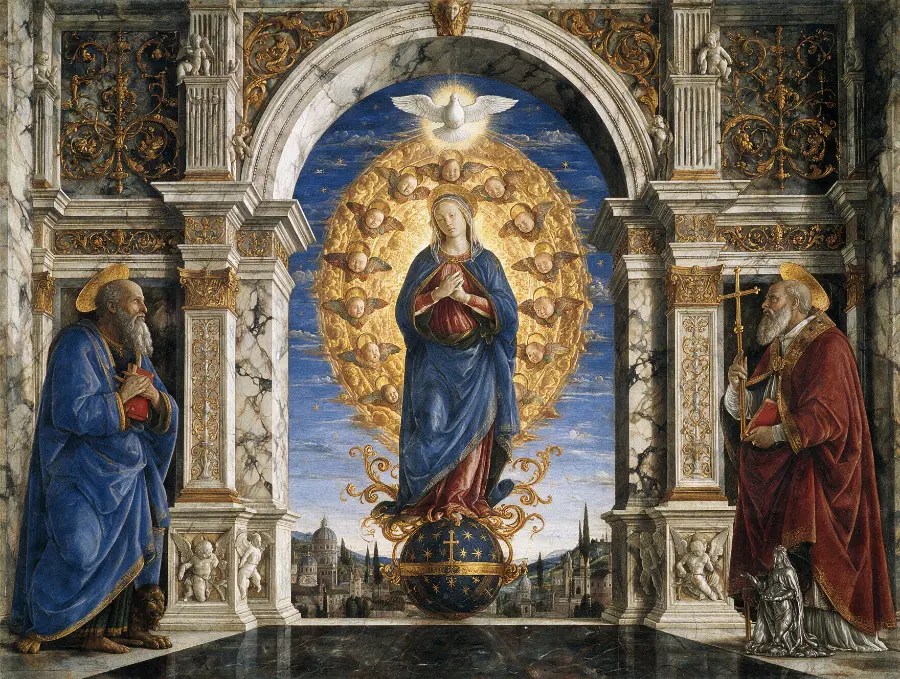
The Rosary grew over several centuries, and its name comes from the Latin for a garland of roses. Long before it, monks prayed the 150 psalms, and lay brothers who could not read said the Lord’s Prayer in their place: under the customs of the abbey of Cluny, collected in 1096, when a brother died, every monk who was not a priest was “either to say fifty psalms or to repeat fifty times the Paternoster.” Strings of beads for counting such prayers were known throughout the Middle Ages as “Paternosters.” In the course of the twelfth century, saying fifty or 150 Hail Marys, after the number of the psalms, also became a familiar practice. The Catechism calls the Rosary of the Middle Ages “a popular substitute for the Liturgy of the Hours.”
Catholic tradition holds that Mary gave the Rosary to Saint Dominic, founder of the Dominican friars, in the time of the Albigensian heresy in France and Italy. The Catholic Encyclopedia of 1912 reports the story as the Roman Breviary’s lesson for the feast of the Holy Rosary tells it: Dominic asked Our Lady’s help and “was instructed by her, so tradition asserts, to preach the Rosary among the people as an antidote to heresy and sin.” Legend also credits his Rosary with the defeat of the Albigensians at the battle of Muret in 1213. Pope Pius V’s bull Consueverunt Romani Pontifices of 17 September 1569 tells no vision. It says Dominic was prompted “as is piously believed, by the Holy Ghost,” and “looked to that simple way of praying and beseeching God, accessible to all and wholly pious, which is called the Rosary, or Psalter of the Blessed Virgin Mary.” Leo XIII’s encyclicals on the Rosary, from 1883 on, took Dominic’s authorship as historical fact, and John Paul II recalled that the Dominicans used the Rosary “at a difficult time for the Church due to the spread of heresy.” Historians have doubted the story. The Catholic Encyclopedia found that none of the “eight or nine early Lives of the saint” mentions the Rosary, and traced the story to the preaching of a Dominican, Alan de Rupe, “about the years 1470-75.” It credits “the labours and the prayers of the sons of St. Dominic” for the Rosary’s later spread, but says their interest “was only awakened in the last years of the fifteenth century.”
Meditating on a scene from the life of Christ during the Hail Marys came later still. The Catholic Encyclopedia credits a Carthusian monk, Dominic the Prussian, with introducing it, and notes that at the end of the fifteenth century the mysteries “were not uniformly adhered to even by the Dominicans themselves.” Pius V’s bull of 1569 described the Rosary as “the angelic greeting repeated one hundred and fifty times, that is, according to the number of the Davidic Psalter, and by the Lord’s Prayer with each decade,” with “certain meditations showing forth the entire life of Our Lord Jesus Christ.” The USCCB credits the same pope with officially adding the second half of the Hail Mary.
On the first Sunday of October 1571, a fleet under Don John of Austria defeated the Turkish fleet at Lepanto, on the day the Rosary confraternity was holding processions in Rome. Pius V ordered a commemoration of the Rosary for that day, and from it grew the feast of the Holy Rosary, which Clement XI extended to the whole Church after another victory over the Turks in 1716.
The newest part of the Rosary dates from October 2002. In Rosarium Virginis Mariae, John Paul II proposed the five Luminous Mysteries, “left to the freedom of individuals and communities,” so that the Rosary would include “the mysteries of Christ’s public ministry between his Baptism and his Passion.”
Related reading
- Prayers to the Virgin Mary: the Hail Mary, the Memorare, the Hail, Holy Queen and more
- Why do Catholics pray to Mary?
- Why does the Catholic Lord’s Prayer end at “deliver us from evil”?
- Did Mary go to heaven?
- Do Protestants believe in saints?


Leave a Reply