
 English
 Chinese
 Dutch
 Arabic
 Spanish
 Portuguese
 Russian
 French
 Italian
 German
 Japanese
Lord Jesus, at the gate of Nain you saw a mother walking behind her son’s body, and you had compassion on her. My son [name] has died, and I do not know how to go on. Have compassion on me, keep him in your mercy, and carry me through this day. Amen.
If your grief has turned into thoughts of ending your own life, please call or text 988 in the US, or call Samaritans on 116 123 in the UK and Ireland, today, and if you need somewhere else to turn there are more Christian and crisis lines. When you are ready for company on this road, other parents who have buried a child are waiting for you. In the United States, The Compassionate Friends has supported families after the death of a child for five decades, through more than 500 chapters. In the UK a separate charity of the same name answers a helpline on 0345 123 2304, and it has its own pages for parents grieving an adult child, a child who died by suicide and a child who died through drug or alcohol use.

Prayers for the days after your son dies
These prayers are short enough to say when you have no words of your own, and each one leaves a place for your son’s name, marked [name]. If he died as a baby or a small child, you may find more help in the prayers after losing a child, which include the churches’ burial services for a child.
When the news comes
Lord, they have told me that [name] is dead, and the words make no sense to me. When Jacob was told that his son was gone, he “mourned for his son many days,” and when all his children came to comfort him, “he refused to be comforted” (Genesis 37:34–35). You let his tears stand in your Word. Let mine stand before you tonight, and send me people who will sit with me and not leave. Amen.
Before you see him
Lord Jesus, when you met the funeral at Nain you “came and touched the bier” (Luke 7:14), and you went right up to the young man the others were carrying. I am afraid of seeing [name] like this. Come with me into that room, hold me up when I see his face, and let me remember him as the boy you made and the man you loved. Amen.
On the day of his funeral
Father, today we bury [name]. Your Son told Martha at her brother’s grave, “I am the resurrection, and the life: he that believeth in me, though he were dead, yet shall he live” (John 11:25). Let those words be stronger in me today than the coffin and the open ground, and give me strength to stand among the people who have come for him. Amen.
For his wife and his children
God, [name] has left a wife and children who needed him. You call yourself “a father of the fatherless, and a judge of the widows” (Psalm 68:5), so be that to them now. Provide for them, keep them close to us and us close to them, and let his children grow up knowing how much their father loved them. Amen.
When you wish it had been you
Lord, when David heard that Absalom was dead he cried, “O my son Absalom, my son, my son Absalom! would God I had died for thee” (2 Samuel 18:33), and I have said it too. A son should bury his father and mother, and I am burying mine. Hold me when I wish I had died in his place, and give me a reason to live the years you have still given me. Amen.
When you cannot pray, or cannot believe
God, I have nothing left but the psalm: “My tears have been my meat day and night, while they continually say unto me, Where is thy God?” (Psalm 42:3). I am asking it too, and I am angry with you, and I cannot feel you anywhere. This question is all I can bring you tonight, so take it as my prayer, and let the people who love me hope for me until I can hope again. Amen.
When you fear for his soul
Lord, [name] had wandered far from you, and I do not know what was in his heart at the end. Your psalm says, “If I ascend up into heaven, thou art there: if I make my bed in hell, behold, thou art there” (Psalm 139:8), so there was no place he went where you were absent. I give him into your mercy, which is wider than my fear and older than his wandering. Amen.
When you clear his room
Father, his clothes are still in the wardrobe and his things are where he left them, and I can neither bear to move them nor bear to leave them. Your Son said, “In my Father’s house are many mansions: if it were not so, I would have told you. I go to prepare a place for you” (John 14:2). While I sort through what [name] left here, let me trust the place your Son went to prepare, and let nobody hurry me. Amen.
On his birthday, and on the day he died
Lord, this is [name]’s day, and the people around me have gone back to their own lives as though it were any other. You asked, “Can a woman forget her sucking child, that she should not have compassion on the son of her womb?” and you answered, “yea, they may forget, yet will I not forget thee” (Isaiah 49:15). Then you have not forgotten my son either. Let me say his name aloud today, to you and to anyone who will listen, and let the tears come when they come. Amen.

The parents in Scripture who lost a son
Some of the oldest pages of the Bible belong to fathers and mothers who lost sons, or believed they had, and the first of them is Jacob. His sons brought him Joseph’s coat of many colours, dipped in a goat’s blood (Genesis 37:31–32), and he knew it at once: “It is my son’s coat; an evil beast hath devoured him” (Genesis 37:33). He “rent his clothes, and put sackcloth upon his loins, and mourned for his son many days,” and when his sons and daughters gathered round him he would not be comforted: “For I will go down into the grave unto my son mourning” (Genesis 37:34–35). Genesis lets those words stand and never tells him he was wrong to say them. If you cannot imagine ever being comforted, you are standing where Jacob stood, and God kept his words in Scripture for people standing there.
King David’s grief was harder still, because the son he wept for had raised an army against his own father and driven him out of Jerusalem (2 Samuel 15–18). Even so, before the battle David gave his captains one order, and he gave it so that all the people heard: “Deal gently for my sake with the young man, even with Absalom” (2 Samuel 18:5). When the news came, he climbed to the chamber over the gate and wept, “O my son Absalom, my son, my son Absalom! would God I had died for thee, O Absalom, my son, my son!” (2 Samuel 18:33). Some of us have lost sons who were estranged from us, or in trouble, or angry with the whole world, and David shows us that a father’s love does not wait for his son to come home before it breaks his heart.
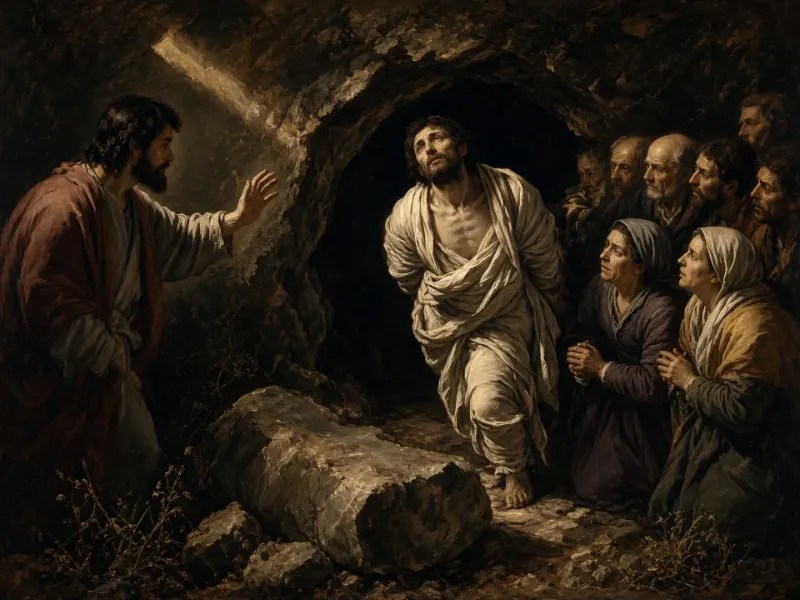
Luke tells of a funeral coming out of the gate of a small town called Nain, where “there was a dead man carried out, the only son of his mother, and she was a widow” (Luke 7:12). She had already lost her husband, and now she was walking behind her only son to his grave, with a large crowd from the town beside her. “And when the Lord saw her, he had compassion on her, and said unto her, Weep not.” Only then did he touch the bier and tell the young man to arise, “and he delivered him to his mother” (Luke 7:13–15). Read those verses again slowly, and look at the order of them, because before Jesus said one word to the dead son, he looked at the mother. The Lord we bring our own grief to is the Lord who saw her first.
When Mary and Joseph brought the infant Jesus into the Temple, Simeon took him in his arms and told her, “a sword shall pierce through thy own soul also” (Luke 2:35), and the day came when “there stood by the cross of Jesus his mother” (John 19:25). Think of what her Son did there. He was dying, and still he saw her, as he had seen the widow at Nain, and he said to her, “Woman, behold thy son!” and to the disciple he loved, “Behold thy mother!” John adds, “And from that hour that disciple took her unto his own home” (John 19:26–27). Jesus spent some of his last breath making sure his mother would not go home alone, and so the Lord we pray to has seen a mother grieve for her son from the cross itself, because he was that son.
If you have stood beside your son’s coffin and could not make yourself walk away, you already know what the Stabat Mater is about. It is a Latin hymn about Mary standing there, and Western Christians have sung it for centuries, so long that nobody knows for certain who wrote it: by the end of the fourteenth century, says the old Catholic Encyclopedia, it was “well known to all classes,” and of all the names put forward only Pope Innocent III and the poet Jacopone da Todi seem likely. Catholics still sing it as they walk the Stations of the Cross, where, the 1888 Manual of Prayers says, a verse of it “is frequently sung” between one Station and the next. What a grieving parent may love in it is that it does not hurry her away. Its first two stanzas, in the Manual’s English, simply stay with her at the foot of the cross:
At the Cross her station keeping,
Stood the mournful Mother weeping,
Close to Jesus to the last;
Through her heart, His sorrow sharing,
All his bitter anguish bearing,
Lo! the piercing sword had passed!O how sad, and sore distressed,
Now was she, that Mother Blessed
Of the Sole-begotten One;
Woe-begone, with heart’s prostration,
Mother meek, the bitter Passion
Saw she of her glorious Son.A Manual of Prayers for the Use of the Catholic Laity (1888), Hymns and Sequences, “Stabat Mater,” p. 617
In the later stanzas Catholics ask Mary to let them share her sorrow. Christians who do not ask for Mary’s prayers can still sing or read these first lines and stand there beside her, because they stay close to what John saw and Simeon foretold.
A prayer for a mother or father in sorrow
If you are sitting with someone whose son has died and cannot find the words, the 1928 Book of Common Prayer has a prayer “For a Person under Affliction” that a husband or wife, a friend or a pastor can pray over a grieving parent. It rests on a verse from Lamentations that we badly need when we are tempted to think God wanted this: “he doth not afflict willingly nor grieve the children of men” (Lamentations 3:33).
O merciful God, and heavenly Father, who hast taught us in thy holy Word that thou dost not willingly afflict or grieve the children of men; Look with pity, we beseech thee, upon the sorrows of thy servant for whom our prayers are offered. Remember him, O Lord, in mercy; endue his soul with patience; comfort him with a sense of thy goodness; lift up thy countenance upon him, and give him peace; through Jesus Christ our Lord. Amen.
The Book of Common Prayer (1928), Prayers and Thanksgivings, “For a Person under Affliction,” pp. 45–46
For a mother, say “her” where the book says “him.” If you are the one who needs it and there is nobody to pray it over you, the same prayer can be turned into your own words, like this:
O merciful God, and heavenly Father, who hast taught us in thy holy Word that thou dost not willingly afflict or grieve the children of men; Look with pity, I beseech thee, upon my sorrows. Remember me, O Lord, in mercy; endue my soul with patience; comfort me with a sense of thy goodness; lift up thy countenance upon me, and give me peace; through Jesus Christ our Lord. Amen.
Praying for your son
Catholics begin to pray for a son in the very hour he dies, and the 1888 Manual of Prayers gives this responsory, which calls the saints and angels to come and meet him, to be said “when the soul has departed”:
Come to his assistance, ye Saints of God, come forth to meet him, ye Angels of the Lord: Receiving his soul: Offering it in the sight of the Most High.
V. May Christ receive thee, who hath called thee, and may the Angels bear thee into Abraham’s bosom.
R. Receiving, etc.
V. Eternal rest grant unto him, O Lord, and let perpetual light shine upon him.
R. Offering, etc.A Manual of Prayers for the Use of the Catholic Laity (1888), The Last Agony, pp. 531–532
Orthodox Christians sing for him at his funeral, where the burial service for a layman has an anthem by John of Damascus that looks straight at how short and fragile everything on earth is before it turns to Christ. Isabel Hapgood put it into English in 1906:
What earthly sweetness remaineth unmixed with grief? What glory standeth immutable on earth? All things are but shadows most feeble, but most deluding dreams: yet one moment only, and Death shall supplant them all. But in the light of thy countenance, O Christ, and in the sweetness of thy beauty, give rest unto him (her) whom thou hast chosen: forasmuch as thou lovest mankind.
Isabel F. Hapgood, Service Book of the Holy Orthodox-Catholic Apostolic (Greco-Russian) Church (1906), The Order for the Burial of the Dead (Laymen), p. 386
You may be wondering whether you are still allowed to pray for him at all, now that he is gone, and here the churches answer differently, so it is worth hearing each one in its own words. Catholics and Orthodox Christians say yes, and the two prayers above are how they do it. Anglicans who use the 1928 prayer book say yes as well, and its burial service prays “on behalf of the soul of thy servant departed.” Presbyterians answer from the Westminster Larger Catechism of 1648, which teaches us to pray “for all sorts of men living, or that shall live hereafter; but not for the dead,” and Baptists who hold the 1689 Confession say the same thing in the same words. Among the verses that Confession gives for it is David’s answer when his baby son died and he rose from the ground and ate: “But now he is dead, wherefore should I fast? can I bring him back again? I shall go to him, but he shall not return to me” (2 Samuel 12:23). So in those churches, and in many other Protestant churches with them, a parent’s prayers turn to the living, to the wife and children he left and to your own broken heart, and you leave your son with God, holding on to David’s “I shall go to him.” You will find more prayers for loved ones who have passed away, with the reasons the churches differ. Whichever church we belong to, Paul wrote to the grieving Christians at Thessalonica for all of us, so that we would “sorrow not, even as others which have no hope” (1 Thessalonians 4:13).
If your son died by suicide or an overdose
When a son dies by his own hand, you may be carrying two griefs at once, the loss of him and the fear of what his death means for his soul. The Catechism of the Catholic Church calls suicide “gravely contrary to the just love of self,” and in the next breath it says that “grave psychological disturbances, anguish, or grave fear of hardship, suffering, or torture can diminish the responsibility of the one committing suicide.” Then, to every parent afraid for a son’s soul, it says this: “We should not despair of the eternal salvation of persons who have taken their own lives. By ways known to him alone, God can provide the opportunity for salutary repentance. The Church prays for persons who have taken their own lives” (paragraphs 2281–2283).
And when Paul names the things that cannot part us from God’s love, he names death first of all: “neither death, nor life, nor angels, nor principalities, nor powers, nor things present, nor things to come, nor height, nor depth, nor any other creature, shall be able to separate us from the love of God, which is in Christ Jesus our Lord” (Romans 8:38–39).
A prayer when he took his own life
Lord, [name] was in more pain than I knew, and now he is gone, and I keep going back over the last weeks and asking what I missed. You saw what I could not see, for “the darkness hideth not from thee; but the night shineth as the day” (Psalm 139:12). Have mercy on my son. You know which of my questions have answers and which never will, so teach me to leave in your hands the nights I cannot change. Amen.
If your son died of an overdose he did not mean to take, please hear this plainly: he did not take his own life, and the Catechism’s words about suicide are not about him. His was a different death, and yours may be a different grief, tangled up with fears that began long before the end and with people who say careless things about how he died. Paul’s “neither death, nor life” holds for him too, and the love of God that his death could not break is the same love that held him on the days he could not stop.
A prayer when he died of an overdose
Lord, [name] could not get free of the drugs, and they killed him when he did not mean to die. Of your Son it was written, “A bruised reed shall he not break, and smoking flax shall he not quench” (Matthew 12:20), and my son was bruised. Be gentle with him as you are gentle with the bruised. Do not let the way he died be the last word about him, and help me remember the whole of him, and not only his last night. Amen.
He delivered him to his mother
Luke ends the story at Nain with the sentence we would most like to read about our own sons: “And he delivered him to his mother” (Luke 7:15). The young man of Nain was raised to this life and not yet to the life that does not end, and what Jesus did for one widow at that gate he has promised to everyone who dies in him: “For if we believe that Jesus died and rose again, even so them also which sleep in Jesus will God bring with him” (1 Thessalonians 4:14).



Leave a Reply