
 Russian
 English
 Chinese
 Dutch
 Arabic
 Spanish
 Portuguese
 French
 Italian
 German
 Japanese
Halloween is All Hallows’ Eve, the night before All Hallows, which is the old English name for All Saints’ Day on 1 November. A hallow was a holy one, a saint, and the word is a cousin of the one we say whenever we pray, “Our Father which art in heaven, Hallowed be thy name” (Matthew 6:9).
The feast settled on 1 November in the ninth century, by a decree of 835 made at a pope’s request. How much of the night’s older character comes from Samhain, the Celtic feast at the turn of winter, is something historians are still arguing about.
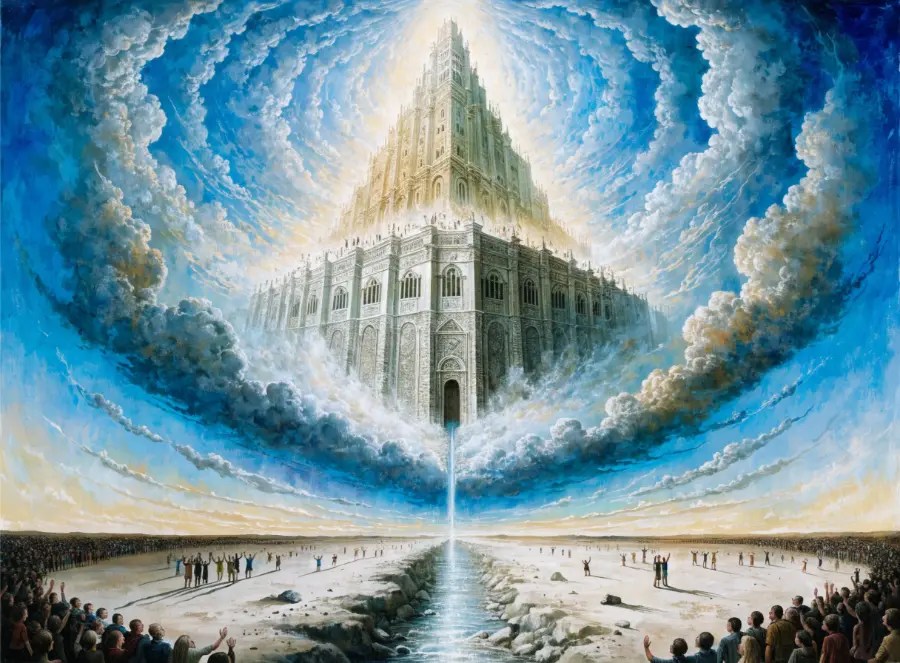
And who are the hallows? In the 730s Pope Gregory III built a chapel in St Peter’s in Rome for relics, as the old book of the popes’ lives puts it, “of the holy apostles and of all saints, martyrs and confessors, of all the just made perfect who are at rest throughout the world.” That takes in the whole family of God, the saints whose names we remember and the ones nobody remembers, the people John saw as “a great multitude, which no man could number, of all nations, and kindreds, and people, and tongues” (Revelation 7:9). Halloween is the night the Church keeps watch before their feast.
What does All Hallows’ Eve mean?
In late Old English the saints in heaven together were ealra halgan, “all saints”, and that lived on as All Hallows, with the feast day also called Hallowmas. By about 1300 its evening was being written alle halwe eue. The short form, Halloween, is Scottish and turns up there in the 1560s, and the earliest entry for it in the dictionary of older Scots is a payment in the Edinburgh accounts of 1564–5 to a trumpeter, Ihonne Waddell, for his work on “Hallowhevin”. So the word means just what Christmas Eve means: the evening before the feast.
Soon the night had its witches as well. A Scots satire of 1583 has one riding “On horsback on Hallow ewin”, and two hundred years later Robert Burns, in a note to his poem “Halloween” (1785), said that it “is thought to be a night when witches, devils, and other mischief-making beings are abroad on their baneful midnight errands”. Burns made the word famous, though he was not the first to put the customs in print; John Main had done it in Glasgow two years before.
How did All Saints’ Day come to 1 November?
It began with the martyrs. The first Christians kept the anniversary of each martyr’s death at the place where he had died, and in the fourth century neighbouring churches began to share their feasts. Then Diocletian’s persecution made so many martyrs that no separate day could be given to each, and the Church appointed a common day for them all. Its first trace is at Antioch, on the Sunday after Pentecost, and St Ephrem the Syrian preached of such a day in 373. At first it was kept for the martyrs and John the Baptist, and the other saints were added little by little. In Rome, on 13 May 609 or 610, Pope Boniface IV consecrated the old Pantheon to the Virgin Mary and all the martyrs, and Rome went on keeping that feast in May.
Then came Gregory III, pope from 731 to 741. Inside St Peter’s, beside the great arch on the men’s side of the basilica, he built an oratory, a small chapel, and laid in it the relics of the apostles, the martyrs, the confessors and “all the just made perfect”. Monks from the three monasteries that served the basilica were to keep their vigils there every day and sing the Masses of the saints’ feasts, and the pope had the rule carved on stone tablets in the chapel itself.
Many short histories say this is when Gregory fixed All Saints’ Day on 1 November. The Catholic Encyclopedia of 1907 puts it that way: he “consecrated a chapel in the Basilica of St. Peter to all the saints and fixed the anniversary for 1 November.” But the papal chronicle that tells us about the chapel, the Liber Pontificalis, gives its feast no day at all, and Louis Duchesne, the scholar who edited the chronicle in 1886, thought the passage had nothing to do with All Saints’ Day. He dated the chapel’s dedication to 732, perhaps on the pope’s own anniversary or on the feast of Saints Peter and Paul.
The date we can be sure of comes a century later. The feast “was already widely celebrated in the days of Charlemagne”, and in 835 the emperor Louis the Pious made it binding across the Frankish empire by a decree issued “at the instance of Pope Gregory IV. and with the assent of all the bishops,” which fixed it on 1 November. Gregory IV, pope from 827 to 844, carried the feast of 1 November to the whole Church, and the Catholic Encyclopedia adds that “the vigil seems to have been held as early as the feast itself.” So the feast had its eve from the start, and that eve is the night we call Halloween.
All Souls’ Day, on 2 November, came out of the monasteries. Monks prayed for their dead brothers because they believed the faithful on earth can help the departed who are not yet perfectly cleansed of their sins. Odilo, abbot of Cluny, who died in 1048, ordered a yearly commemoration of all the faithful departed in the monasteries under him, and from Cluny it spread to the other Benedictine houses and to the Carthusians.
Did Halloween come from Samhain?
Many of the pages you will find say it did. The old story, which the 1911 Britannica told as settled, is that the night’s ceremonies were older than Christianity and came from the Druids. Jack Santino, writing for the Library of Congress in 1982, went further and said the Church set its feast on top of them: All Saints’ Day “was meant to substitute for Samhain, to draw the devotion of the Celtic peoples, and, finally, to replace it forever.”
For that he cites a letter of Pope Gregory the Great from 601. Gregory told Abbot Mellitus, who was on his way to England, that “the temples of the idols in that nation ought not to be destroyed; but let the idols that are in them be destroyed”, and that the people’s old feasting should be given a Christian form on the day a church was dedicated or on the feasts of “the holy martyrs, whose relics are there deposited”. His reason is one any teacher knows: “he who endeavours to ascend to the highest place rises by degrees or steps, and not by leaps.” But the letter is about the English, their temples and their feasts, and it says nothing of the Celts, of Samhain or of November.
So what do we know about Samhain? Ronald Hutton, a historian of folklore and witchcraft at the University of Bristol, agrees that the turn of winter was one of the great festivals of the pagan north. It “was known in Irish as Samhain, summer’s end; in Welsh as Nos Galan Gaeaf, ‘winter’s eve’; in Anglo-Saxon as Blodmonath, ‘blood month’”. What rites people kept then is another matter: “we have virtually no idea, because northern European pagans were illiterate, and no record remains of their ceremonies.” And feasts for the dead, he says, “where they can be found in ancient Europe, were celebrated by both pagans and early Christians, between March and May”. The festival of the dead that does belong to this time of year is the Christian one of saints and souls, and as Hutton tells it, those two feasts took shape between the ninth and the twelfth centuries, in Germanic lands and not in Celtic ones.
Ireland’s own stories pull the other way. Its medieval tales often set feasts, fairies and the dead on Samhain night. In several sagas the High King’s feast at Tara is held then, and The Adventures of Nera, a tale dated to the tenth century, says of that night, “Great was the darkness of that night and its horror, and demons would appear on that night always.” In Irish custom the eve, Oíche Shamhna, began at sundown on 31 October, and on Halloween night the souls of a family’s dead were thought to come home, so seats were kept for them by the hearth and food was left out. Marion McGarry, writing for the Irish broadcaster RTÉ, sees the old feast living on in the new: “Christians later appropriated that day as the Feast of All Saints”.
Where does that leave us? The name, the date and the vigil are Christian, and the records show the feast coming to 1 November through Rome and the Frankish empire. Ireland had its own great feast at the turn of winter, and its stories of that night are old. How much of the one passed into the other, the scholars still argue, and we can leave the question as open as they do.
Where did souling, guising and trick-or-treating come from?
Begging at Hallowmas was familiar enough in England for Shakespeare to joke about it. In The Two Gentlemen of Verona the servant Speed teases his lovesick master for learning “to speak puling, like a beggar at Hallowmas.” John Aubrey, writing in 1686–87, recorded that in Shropshire on All Souls’ Day “there is sett on the Board a high heap of Soule-cakes, lyeing one upon another like the picture of the Sew-Bread in the old Bibles”, and nearly everyone who called that day took one. The rhyme that went with them was a prayer for the dead: “A Soule-cake, a Soule-cake, Have mercy on all Christen soules for a Soule-cake.”
In Hutton’s words, the Reformation “did away with both the doctrine of purgatory and the cult of saints, removed all these rites from most of Britain, and left nothing but a vague sense of Halloween as a time with creepy associations.” In Scotland the kirk came down hard on the night: in 1642 the session at Elgin ordered everyone who had danced on Hallowe’en to be held in ward for twenty-four hours, and in 1649 the presbytery of Cupar had it announced on the Sundays before Midsummer and Hallowe’en that no fires were to be lit on those nights. In Ireland the old ways held, “both as the Catholic feast of saints and souls and a great seasonal festival”.
Scotland and Ireland gave us the disguises and the lanterns. In Scotland children in disguise, the guisers, went from door to door at Yule, at Hogmanay and above all at Halloween, and by 1907 “the guizards with their turnip lanterns” were going round the houses singing. In Ireland, McGarry writes, people made their disguises as grotesque as they could, “rubbing their faces with soot, using false names and changed voices”, and they doused themselves with holy water and carried wooden Halloween crosses for protection. Another RTÉ page tells how the Irish carved faces into sugar beets and other root vegetables and set a candle inside. When they emigrated they took the custom with them, and in America they used pumpkins.
That emigration, in the nineteenth century, carried Halloween to America, Hutton writes, and there in the twentieth century the old custom of poor people going door to door to beg food for a feast of their own turned into the children’s trick-or-treat. The words themselves first appear on the Canadian prairie. The Calgary Daily Herald of 3 November 1927 reported children who “wandered in droves from door to door, heavily disguised and demanding ‘trick or treat.’” By the late 1940s and 1950s, the language historian David Wilton finds, the custom had spread across the whole United States.
By the 1980s, Hutton adds, some American evangelicals had begun to condemn the festival. Whether Christians should take part is a question of its own, taken up in should Christians celebrate Halloween?, and so is the rumour that Halloween is Satan’s birthday.
How have the churches kept All Hallows?
The Catholic Church keeps 1 November as the solemnity of All Saints, for “all the saints, known and unknown”, and 2 November as All Souls’ Day, when the faithful pray for the dead who are not yet perfectly cleansed, the teaching Catholics call purgatory.
The Orthodox keep All Saints on another day altogether, the first Sunday after Pentecost, the same day on which the common feast first appears at Antioch, so for them it falls in late spring or early summer. “There have been saints at all times, and they have come from every corner of the earth,” the Orthodox Church in America says of that Sunday, which honours “those who are known to us, and those who are known only to God.”
At the Reformation the Church of England kept All Saints’ Day in its calendar, and so did many Lutheran churches, though they set aside purgatory and the All Souls rites that went with it. How Protestants think of the saints is set out in Верят ли протестанты в святых?
Through the turnip lanterns, the masks and the children at the door, the night has kept the name it was given, the eve of all the hallows, the multitude no one could number. Its feast is for the saints who go before us, and Hebrews tells us what to do with their company: “Wherefore seeing we also are compassed about with so great a cloud of witnesses, let us lay aside every weight, and the sin which doth so easily beset us, and let us run with patience the race that is set before us” (Hebrews 12:1).


Добавить комментарий