
 Italian
 English
 Chinese
 Dutch
 Arabic
 Spanish
 Portuguese
 Russian
 French
 German
 Japanese
“O Holy Night” began in France as “Minuit, chrétiens”, which means “Midnight, Christians”, a Christmas poem by Placide Cappeau, a wine merchant of Roquemaure in the south of France. The opera composer Adolphe Adam set it to music, and it was first sung on Christmas Eve 1847. The English we sing is credited to John Sullivan Dwight, an American Unitarian minister who wrote about music. It sings of the night Christ was born, of the wise men following the star, and of a Saviour who breaks the slave’s chains and calls the whole world to its knees.
È uno dei canti natalizi che raccogliamo, con i loro autori e le loro date, nel nostro elenco dei grandi inni e canti natalizi.
The words of O Holy Night
The English has three verses, and the refrain of the first, “Fall on your knees”, comes round again after each. We give the first verse as a Philadelphia church printed it in its anthem book of 1909, and the second and third as the Notre Dame weekly The Ave Maria printed them on 31 December 1898.
O holy night! the stars are brightly shining,
It is the night of the dear Saviour’s birth.
A lungo il mondo giacque languendo nel peccato e nell'errore,
finché Egli apparve e l'anima sentì il suo valore.
A thrill of hope the weary world rejoices,
For yonder breaks a new and glorious morn.
Fall on your knees, O hear the angel voices!
O night divine, O night when Christ was born,
O night divine, O night, O night divine.Led by the light of Faith serenely beaming,
With glowing hearts by His cradle we stand.
So led by light of a star sweetly gleaming,
Here came the Wise Men from the Orient land.
The King of kings lay thus in lowly manger,
In all our trials born to be our friend:
He knows our need, to our weakness no stranger.
Behold your King, before the Lowly bend!
Behold your King, your King! Before Him bend!Truly He taught us to love one another;
His law is love and His Gospel is peace;
Chains shall He break, for the slave is our brother,
And in His name all oppression shall cease.
Sweet hymns of joy in grateful chorus raise we;
Let all within us praise His holy Name;
Christ is the Lord! then ever, ever praise we;
His power and glory evermore proclaim!
His power and glory evermore proclaim!
If the words you know are a little different, that is because they shifted as the carol travelled. The oldest full printing of the English we have found, a programme for a Christmas festival at Christ Church Cathedral in Montreal in 1882, sings “Long lay the world in sin and sorrow pining”. The Ave Maria in 1898 gave the fourth line as “Till He appeared on this crime-laden earth”, and the Philadelphia book of 1909 sings “He guards us from all danger” in the second verse. Hymnals of our own day, such as Our Great Redeemer’s Praise of 2022, sing “to our weakness is no stranger” in the second verse and end the third with “O praise His name forever!”
Who wrote O Holy Night?
Placide Cappeau was born in 1808, and he lived and died in Roquemaure, in the Gard. He made his living as a wine broker and wrote verse when an occasion called for it. He wrote the poem around 1843, some say to mark the end of building work in his parish, and others say for the restoring of the church’s stained glass. Cappeau himself said the idea came to him one Christmas night as he rode on the roof of a stagecoach to Avignon. The French historian of carols Noël Hervé, writing in 1905 from an article by Adolphe Pieyre, tells it in Cappeau’s way: “une nuit de Noël, tandis qu’il se rendait, sur l’impériale d’une diligence, en la ville d’Avignon”.
How the poem reached a famous composer is a story of friends. The wife of a Paris engineer was staying for a while in Roquemaure, and she knew Adolphe Adam, the composer of the opera Le Chalet. To please her friends in the provinces, she asked him to write a tune for the verses. Adam was born in Paris in 1803, and the world remembers him for the ballet Giselle. Accounts from his own day put his setting in 1843 or in 1847, and the carol was first sung on 24 December 1847, by the singer Emily Laurey. Adam died in Paris on 2 May 1856, and his memoirs, published the next year, do not mention the carol at all. French writers do not agree whether it had caught on before he died. Hervé says it had not, and the Fondation Napoléon says its success came very quickly.
The man who wrote the words did not share the faith they sing, if Hervé and Pieyre have him right. They say Cappeau was anything but a Christian. He was a follower of Voltaire and a freethinker, a good-natured socialist like the old republicans of 1848. He saw in Jesus Christ the great preacher of communism and equality, a fine philanthropist, and “rien de plus”, nothing more. He died in 1877. Whatever he believed, his poem begins at the hour “Où l’homme-Dieu descendit jusqu’à nous”, when the God-Man came down to us.
Was O Holy Night banned by the church?
French churchmen disliked it, and some dioceses dropped it. In 1864 the Revue de Musique Sacrée, a journal of Catholic church music, complained that it was sung “in the streets, social gatherings, and at bars with live entertainment” and wrote that “it might be a good thing to discard this piece whose popularity is becoming unhealthy.” Some priests asked what Cappeau meant by “Et de son Père arrêter le courroux”, that Christ came to stay his Father’s anger. Catholic hymnals seldom printed it, and as late as 1956 a Paris dictionary for Catholic homes, Le Dictionnaire du Foyer Catholique, said it “has been expunged from many dioceses due to the emphatic aspect of its lyrics as much as the music itself”. You may also come across the claim that Adam was Jewish, which America magazine calls an unfounded rumour.
Many parishes went on singing it at Midnight Mass regardless. On Christmas Eve 1856 it rang out in the church of Saint-Roch in Paris, and the musician Ernest Gagnon, who heard it at Midnight Mass in Saint-Roch the following year, carried it home to Canada in 1858. There the parishes took to choosing one of their own people to sing it at Midnight Mass, and to be chosen was an honour. We tell how that Mass is kept in Cos'è la Messa di Mezzanotte.
Who translated O Holy Night into English?
John Sullivan Dwight was born in Boston on 13 May 1813 and went to Harvard. He spent six years as a minister and six more in the Brook Farm community in Massachusetts, and from 1852 to 1881 he edited Dwight’s Journal of Music, the work people knew him for. He was an abolitionist too, and his biographer Bill F. Fawcett records him writing with horror of “three or four millions of our human brethren” held in slavery. He died in 1893.
His English is usually dated 1855, but we have not found it printed that early. The oldest full text we have found is that Montreal programme of Christmas 1882, which names no translator, and the oldest hymnal on Hymnary.org’s list to put Dwight’s name to it is the Plymouth Sunday-School Hymnal of 1892.
The Scripture behind O Holy Night
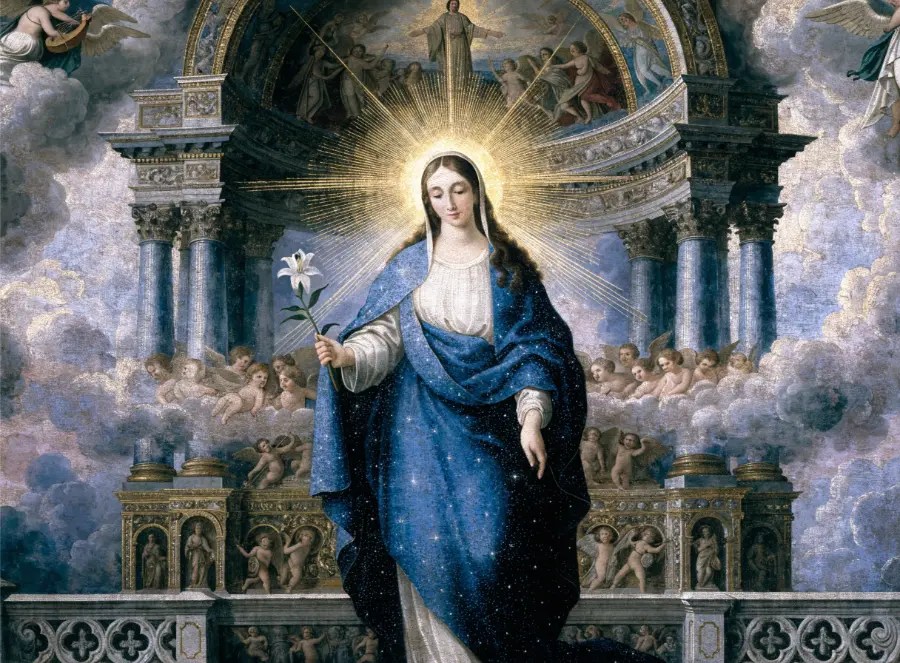
The first verse takes us to the night Luke tells of, when “there were in the same country shepherds abiding in the field, keeping watch over their flock by night” (Luke 2:8), and the “angel voices” are the “multitude of the heavenly host praising God, and saying, Glory to God in the highest, and on earth peace, good will toward men” (Luke 2:13–14). The world that “long lay” pining in sin and error is Isaiah’s world, and his promise is ours: “The people that walked in darkness have seen a great light” (Isaiah 9:2). Cappeau’s first verse said that Christ came to wipe away the stain of original sin. Dwight put a line of his own in its place, “Till he appeared and the soul felt its worth”, and we can hear in it the angel’s news to the shepherds, taken to heart by the one who hears it: “For unto you is born this day in the city of David a Saviour, which is Christ the Lord” (Luke 2:11).
Then the carol tells us to fall on our knees, which is what the wise men did when they came into the house, “saw the young child with Mary his mother, and fell down, and worshipped him” (Matthew 2:11), and what every knee will one day do, for “at the name of Jesus every knee should bow” (Philippians 2:10). The second verse follows those wise men and the star, which “went before them, till it came and stood over where the young child was” (Matthew 2:9). Matthew does not call them kings or tell us how many there were, and the carol does neither. Cappeau used this verse to turn on the proud, “Puissants du jour, fiers de votre grandeur”, you mighty of the day, proud of your greatness, and told them to bow their heads before the Redeemer. Dwight turned instead to the one who is “born to be our friend”, who “knows our need, to our weakness no stranger”. That is the Saviour we meet in the letter to the Hebrews: “For we have not an high priest which cannot be touched with the feeling of our infirmities; but was in all points tempted like as we are, yet without sin” (Hebrews 4:15).
The third verse opens with Christ’s own command, “A new commandment I give unto you, That ye love one another” (John 13:34), and then comes the line that has made the carol both loved and argued over, “Chains shall He break, for the slave is our brother”. Cappeau had written “Il voit un frère où n’était qu’un esclave”, he sees a brother where there was only a slave, and Dwight the abolitionist kept the slave and the brother in his English. Paul said much the same when he sent Onesimus back to Philemon and asked him to take him back “Not now as a servant, but above a servant, a brother beloved” (Philemon 1:16), and when he wrote that in Christ “there is neither bond nor free” (Galatians 3:28). And when Christ stood up to read in the synagogue at Nazareth, the passage he read said he was sent “to preach deliverance to the captives” (Luke 4:18). We look at what Scripture says about slavery, and how Christians have read it, in La schiavitù nella Bibbia.
Minuit, chrétiens: the French words
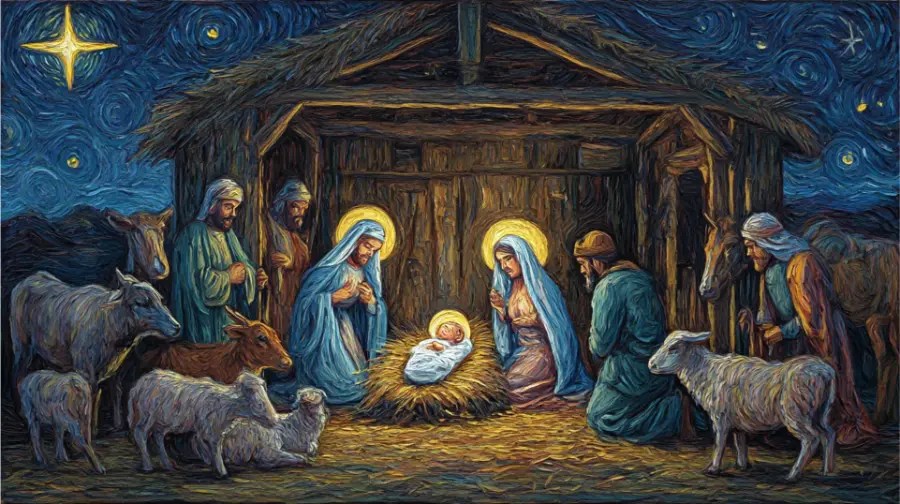
Here is Cappeau’s French as the French Episcopal Church of Saint-Sauveur in Philadelphia printed it in its hymnbook of 1890. Hervé prints only the first verse in his book of 1905, with “apaiser” for “arrêter” in its fourth line and “En cette nuit” for “À cette nuit” in its sixth, and neither change alters the sense.
Minuit, chrétiens, c’est l’heure solennelle
Où l’homme-Dieu descendit jusqu’à nous,
Pour effacer la tache originelle
Et de son Père arrêter le courroux.
Le monde entier tressaille d’espérance
À cette nuit qui lui donne un Sauveur!
Peuple, à genoux; attends ta délivrance;
Noël! Noël! voici le Rédempteur!De notre foi que la lumière ardente
Nous guide tous au berceau de l’enfant,
Comme autrefois une étoile brillante
Y conduisit les chefs de l’Orient!
Le roi des rois naît dans une humble crèche,
Puissants du jour, fiers de votre grandeur,
À votre orgueil c’est de là qu’un Dieu prêche;
Courbez vos fronts devant le Rédempteur!Le Dieu Sauveur a brisé toute entrave;
La terre est libre et le ciel est ouvert;
Il voit un frère où n’était qu’un esclave;
L’amour unit ceux qu’enchaînait le fer!
Qui lui dira notre reconnaissance?
C’est pour nous tous qu’il naît, qu’il souffre et meurt;
Peuple, debout! chante ta délivrance;
Noël! Noël! chantons le Rédempteur!
In plain English, the first verse says that at midnight the God-Man came down to us, to wipe away the stain of original sin and to stay his Father’s anger, that the whole world trembles with hope on the night that gives it a Saviour, and that the people should kneel and wait for their deliverance. The second asks that the burning light of faith lead us all to the child’s cradle, as a star once led the leaders of the East, and tells the mighty that from that manger God preaches to their pride. The third says that the Saviour has broken every fetter, that the earth is free and heaven open, that love now joins those whom iron had chained, and that he is born, suffers and dies for us all.
So Cappeau’s carol starts with a people on its knees and ends with the same people on its feet: “Peuple, debout! chante ta délivrance”, people, stand up and sing your deliverance. The shepherds made that same journey on the first Christmas night. They came with haste and found the child lying in a manger, and then “the shepherds returned, glorifying and praising God for all the things that they had heard and seen, as it was told unto them” (Luke 2:20).


Lascia un commento