
 English
 Chinese
 Dutch
 Arabic
 Spanish
 Portuguese
 Russian
 French
 Italian
 German
 Japanese
The baptism of the Holy Spirit is what John the Baptist promised when he said of Jesus, “he shall baptize you with the Holy Ghost, and with fire” (Matthew 3:11), and every church agrees that the promise was kept at Pentecost. Where the churches part is over when it comes to each of us. Catholics receive the Spirit in confirmation, and the Eastern and Coptic Orthodox in chrismation, the anointing that follows baptism. Lutherans say the Spirit comes through the Word and the sacraments, and Episcopalians, Methodists and several others tie the gift to water baptism. Southern Baptists teach that the Spirit baptizes every believer at conversion, and the Presbyterian and evangelical statements come close to that without quite saying it. The Assemblies of God and other Pentecostals teach a further experience after the new birth, first shown by speaking in tongues. The Church of the Nazarene uses the same words for a later work of holiness, and it says tongues are not its evidence.
Before he was taken up, Jesus told his disciples to stay in Jerusalem and “wait for the promise of the Father,” for “John truly baptized with water; but ye shall be baptized with the Holy Ghost not many days hence” (Acts 1:4–5). When the day came, Peter told the crowd that the promise did not stop with the people in that room: “For the promise is unto you, and to your children, and to all that are afar off, even as many as the Lord our God shall call” (Acts 2:39). We are the ones afar off, and the churches below are answering one question between them, how that promise reaches us.
| Church or family | When the Spirit is given | In its own words |
|---|---|---|
| Catholic | In confirmation, which completes baptism | “Be sealed with the Gift of the Holy Spirit” |
| Eastern Orthodox and Coptic Orthodox | In chrismation, straight after baptism | Orthodox: “the seal of the gift of the Holy Spirit”; Coptic: “the seal of the Holy Spirit” |
| Lutheran | Through the Word and the sacraments | Missouri Synod: the Spirit “creates faith” |
| Anglican and Episcopal | In baptism | Episcopal: “new life in the Holy Spirit” |
| Methodist, United Church of Christ, Disciples of Christ | In baptism, by water and the Spirit | Disciples: “Baptism conveys the gift of the Spirit” |
| Presbyterian and Reformed | As faith begins (closest statement) | Westminster Shorter Catechism: the Spirit is “working faith in us” |
| Baptist | At conversion | Southern Baptist: “At the moment of regeneration” |
| Nondenominational and evangelical | No shared statement on when | National Association of Evangelicals: “the present ministry of the Holy Spirit” |
| Adventist, Mennonite, Churches of Christ | When believers are baptized | Adventist: “our reception of the Holy Spirit” |
| Amish | Renewed by the Spirit before water baptism (closest statement) | “The renewing of the Holy Ghost” |
| Latter-day Saints | After baptism, by the laying on of hands | “Laying on of hands for the gift of the Holy Ghost” |
| Assemblies of God | A later experience, with tongues as its first sign | “Distinct from and subsequent to” the new birth |
| Oneness Pentecostal (UPCI) | Part of obeying the gospel, with tongues | “The initial sign of speaking in tongues” |
| Church of the Nazarene | Later, as entire sanctification; tongues are not its evidence | “The baptism with or infilling of the Holy Spirit” |
| Salvation Army | Once at the start, then filled again and again | “Infilling happens repeatedly” |
| Evangelical Friends (Quaker) | Inwardly, with water optional | “The inward receiving of God’s Spirit” |
| Jehovah’s Witnesses | Baptism with spirit for the anointed; the spirit given to all who ask | “Born again as spirit-begotten sons of God” |
Our free tool, Compare Christian Denominations, sets any two of 23 churches side by side on when the Spirit is received and on 54 other questions.
Where does the phrase “baptism of the Holy Spirit” come from?
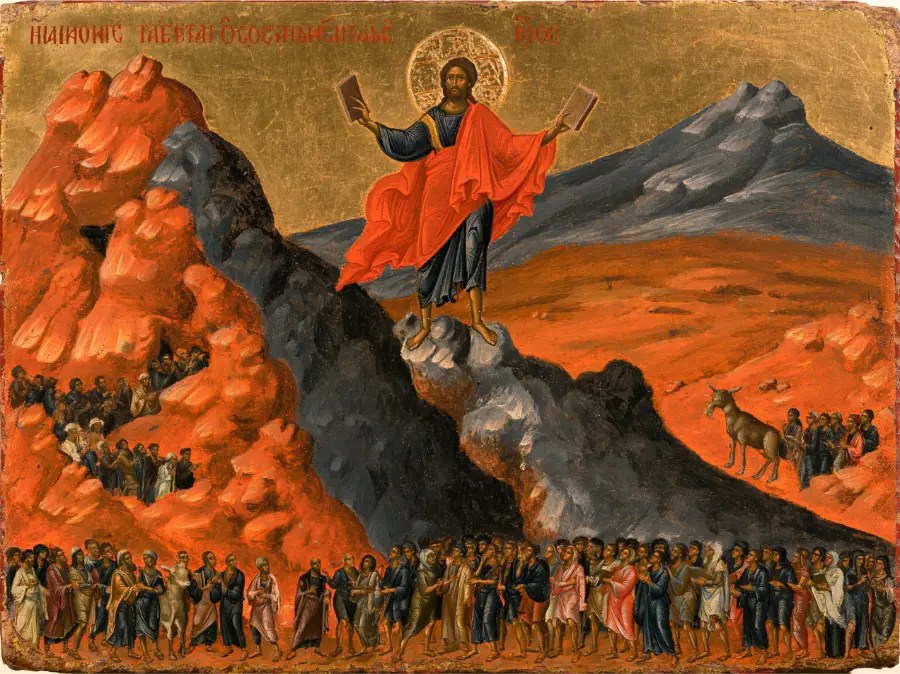
It goes back to John at the Jordan: “I indeed baptize you with water unto repentance: but he that cometh after me is mightier than I, whose shoes I am not worthy to bear: he shall baptize you with the Holy Ghost, and with fire” (Matthew 3:11). The Assemblies of God notes that “The term ‘baptism in the Holy Spirit’ does not occur in Scripture” and calls it “a convenient designation” for what John foretold, so whether a church says baptism “of”, “in” or “with” the Spirit, it means John’s promise.
The promise was kept on the day of Pentecost, with “a sound from heaven as of a rushing mighty wind” and “cloven tongues like as of fire,” when “they were all filled with the Holy Ghost, and began to speak with other tongues, as the Spirit gave them utterance” (Acts 2:2–4). Then Peter called out to the crowd, “Repent, and be baptized every one of you in the name of Jesus Christ for the remission of sins, and ye shall receive the gift of the Holy Ghost” (Acts 2:38).
Luke goes on to tell of the Spirit coming on new believers three more times, each in its own order. In Samaria the people “were baptized in the name of the Lord Jesus,” and the Spirit came only when Peter and John “laid they their hands on them” (Acts 8:16–17). In Caesarea the Holy Ghost “fell on all them which heard the word” while Peter was still preaching, and the water came afterwards (Acts 10:44–47). In Ephesus Paul met disciples who had “not so much as heard whether there be any Holy Ghost,” and when he laid his hands on them “they spake with tongues, and prophesied” (Acts 19:2, 6).
Is the baptism of the Holy Spirit the same as confirmation?
Catholics find their answer in Samaria, and the Catechism of the Catholic Church opens its summary on confirmation with that story. The Catholic Church teaches that confirmation “is the sacrament which gives the Holy Spirit,” and that its effect is “the full outpouring of the Holy Spirit as once granted to the apostles on the day of Pentecost.” An anointing with chrism was added to the laying on of hands “Very early,” the Catechism says, and our own name carries it, since “Christian” means anointed. In the first centuries baptism and confirmation were one “double sacrament,” as St. Cyprian called it. The West came to separate them. A Latin Catholic is confirmed once the age of reason has been reached, ordinarily by the bishop, with the words “Be sealed with the Gift of the Holy Spirit.” But as the Catechism says, “the East has kept them united.”
Eastern Orthodox Christians receive “the seal of the gift of the Holy Spirit” in chrismation, which the Orthodox Church in America says “is always done in the Orthodox Church together with baptism.” The OCA explains the two through two feasts: “If baptism is our personal participation in Easter—the death and resurrection of Christ, then chrismation is our personal participation in Pentecost—the coming of the Holy Spirit upon us.” The whole body is anointed, and then the newly baptized go to Holy Communion, infants as well as adults. The Coptic Orthodox Church calls it the Sacrament of Myron, “with which we receive the seal of the Holy Spirit,” and anoints the newly baptized “with 36 signs on his joints and senses.” The Copts hear its first promise in Jesus’ cry at the feast, “If any man thirst, let him come unto me, and drink,” which John explains: “this spake he of the Spirit, which they that believe on him should receive” (John 7:37–39).
Is the baptism of the Holy Spirit the same as water baptism?
Many Protestant churches hear Peter’s promise as one kept at the font, where the water and the Spirit come together. The United Methodist Church teaches in By Water and the Spirit that “God bestows upon baptized persons the presence of the Holy Spirit,” and at a Methodist baptism “the Holy Spirit is invoked with the laying on of hands in the presence of the congregation.” The Disciples of Christ put it briefly: “Baptism conveys the gift of the Spirit (Acts 2:38).” The United Church of Christ says, “Baptism with water and the Holy Spirit is the sign and seal of our common discipleship.” The Episcopal Church’s Book of Common Prayer counts “new life in the Holy Spirit” among the inward graces of baptism. Lutherans of the Missouri Synod speak a little more widely, of the Word as well as the water: “The Holy Spirit creates faith through the proclamation of the Word of God and the administration of the Sacraments.”
Adventists, Mennonites and the Churches of Christ baptize only believers, and they too look for the Spirit on the day of baptism. Seventh-day Adventists confess in their Fundamental Beliefs that baptism is “a symbol of our union with Christ, the forgiveness of our sins, and our reception of the Holy Spirit.” Mennonite Church USA says in its Confession of Faith, “By water and the Spirit, we are born anew into the family of God.” The Churches of Christ have no central body, but Christian Courier, a teaching site among them, says that “Christians receive the Holy Spirit (in a non-miraculous measure) when they are baptized into Christ.” The Amish keep the Dordrecht Confession of 1632, which never speaks of a baptism of the Spirit; the nearest it comes is to say that believers made one with God “through faith, regeneration, and the renewing of the Holy Ghost” are then to be baptized with water. Latter-day Saints keep the order of Samaria, for their fourth Article of Faith names “Baptism by immersion for the remission of sins” and then “Laying on of hands for the gift of the Holy Ghost.”
Which churches teach that every Christian is baptized by the Spirit at conversion?
The churches that place it at conversion begin with Paul: “For by one Spirit are we all baptized into one body, whether we be Jews or Gentiles, whether we be bond or free; and have been all made to drink into one Spirit” (1 Corinthians 12:13). Beside it they set “Now if any man have not the Spirit of Christ, he is none of his” (Romans 8:9). The Baptist Faith and Message, the statement of the Southern Baptist Convention, says of the Holy Spirit, “At the moment of regeneration He baptizes every believer into the Body of Christ.”
The Westminster Shorter Catechism, which Presbyterian and Reformed churches teach from, does not use the phrase “baptism of the Holy Spirit,” and the closest it comes is to put the Spirit’s work at the start of faith: “The Spirit applieth to us the redemption purchased by Christ, by working faith in us, and thereby uniting us to Christ in our effectual calling.” The National Association of Evangelicals, whose statement many nondenominational churches share, speaks of “the present ministry of the Holy Spirit by whose indwelling the Christian is enabled to live a godly life,” and does not say when that begins.
The Assemblies of God takes Paul’s verse the same way, and then speaks of a second baptism as well: “At conversion, the Spirit baptizes into Christ/the body of Christ; in a subsequent and distinct experience, Christ will baptize in the Holy Spirit.” So a Baptist and a Pentecostal agree about the first baptism and differ over whether a second one is promised, as Pentecostal vs Baptist beliefs sets out.
Is the baptism of the Holy Spirit a second experience after salvation?
A United Methodist report traces the phrase to the Methodists themselves: “The Methodists were also first to coin the phrase baptism of the Holy Spirit as applied to a second and sanctifying grace (experience) of God.” It names John Fletcher of Madeley, and it says that although they “meant by their ‘baptism’ something different from the Pentecostals,” the view “that this is an experience of grace separate from and after salvation was the same.” Speaking in tongues, it adds, “was not an experience sought or promoted by early Methodists.”
The Church of the Nazarene still uses the words in that older sense, and its Manual teaches that entire sanctification, “subsequent to regeneration,” frees believers from original sin, and that “It is wrought by the baptism with or infilling of the Holy Spirit.” The church believes “that the Holy Spirit bears witness to the new birth and to the subsequent work of heart cleansing, or entire sanctification, through the infilling of the Holy Spirit,” and it finds that cleansing in Peter’s words about the Gentiles, that God gave them the Holy Ghost, “purifying their hearts by faith” (Acts 15:8–9). There is more in Church of the Nazarene beliefs.
The Salvation Army belongs to the same Holiness family and draws its own line. Its Handbook of Doctrine teaches that the “baptism of the Holy Spirit” is “distinct from being ‘filled with the Holy Spirit’,” because “Baptism happens once at the beginning of Christian experience, while infilling happens repeatedly throughout the Christian life,” and that second word is Paul’s, “be filled with the Spirit” (Ephesians 5:18). It asks Salvationists to be “cautious about requiring for every Christian a ‘second work of grace’ that must be chronologically subsequent,” since “For some people, full salvation may be experienced at conversion while for others it happens subsequently.”
The Assemblies of God teaches in its Statement of Fundamental Truths that “All believers are entitled to and should ardently expect and earnestly seek the promise of the Father, the baptism in the Holy Spirit and fire,” and that “This experience is distinct from and subsequent to the experience of the new birth.” With it “comes the enduement of power for life and service,” as Jesus said: “ye shall receive power, after that the Holy Ghost is come upon you” (Acts 1:8). Yet its position paper asks that this not be called “a second work of grace” or “a second blessing,” because “The emphasis should be on theological, not temporal, subsequence and separability,” and it reminds its readers that “the Holy Spirit is not external to a believer not yet baptized in the Spirit.”
Is speaking in tongues the evidence?
The Assemblies of God answers yes in its eighth Fundamental Truth: “The baptism of believers in the Holy Spirit is witnessed by the initial physical sign of speaking with other tongues as the Spirit of God gives them utterance.” Others point to Paul’s question, “do all speak with tongues?” (1 Corinthians 12:30), as an answer the other way, and the Assemblies of God replies that “both the broad context and the immediate context relate the question to the exercise of the gift in corporate worship.”
The United Pentecostal Church International makes this baptism part of salvation itself: “We obey the gospel (II Thessalonians 1:8; I Peter 4:17) by repentance (death to sin), water baptism in the name of Jesus Christ (burial), and the baptism of the Holy Spirit with the initial sign of speaking in tongues as the Spirit gives the utterance (resurrection).” To the UPCI, “the gift, filling, or baptism of the Holy Spirit” are one experience with one sign. These Oneness Pentecostals also differ from the Assemblies of God about God himself, for the UPCI teaches that “There is one God, who has revealed Himself as Father; through His Son, in redemption; and as the Holy Spirit, by emanation,” where the Assemblies of God speaks of the Lord our God “as a trinity or as one Being of three persons.” Their story is in Apostolic vs Pentecostal.
The Church of the Nazarene says in its Manual, “We do not believe that speaking in unknown tongues is the evidence of being filled with the Holy Spirit,” and looks instead for a cleansed heart, “manifested by the fruit of the Spirit in a holy life.” The Salvation Army’s Handbook of Doctrine calls tongues “the clearest example of a gift that is overvalued in some Christian fellowships and undervalued in others.”
Catholics and mainline Protestants came to the phrase as well, through the charismatic movement, which the United Methodist report says “began about 1960 in mainline Christian bodies, both Protestant and Roman Catholic.” That movement kept the phrase “baptism of the Holy Spirit” but “without the elevation of ‘speaking in tongues’ as the initial evidence.” Which churches pray in tongues today is the subject of speaking in tongues: which churches practice it.
How do you receive the baptism of the Holy Spirit?
The Assemblies of God tells those still waiting that “a gift is not earned,” that they should “keep asking, keep seeking, keep knocking,” and that they “should not be discouraged or get under self-condemnation if the infilling of the Spirit does not take place when they expect.” Behind that is Jesus’ own promise: “how much more shall your heavenly Father give the Holy Spirit to them that ask him?” (Luke 11:13).
Quakers of the Evangelical Friends Church speak of asking too, but for them the baptism itself is inward: “True baptism is the inward receiving of God’s Spirit by asking in faith for Him to become Lord of one’s life.” Their Faith and Practice calls baptism and communion “spiritual realities beyond the mere physical, outward ordinances,” and Friends grant one another liberty over “the use (or non-use) of the physical elements,” so some use water and some do not.
Jehovah’s Witnesses, who speak of the holy spirit as “God’s own active force,” draw a line of their own. The Watchtower teaches that “Those who are baptized with holy spirit are born again as spirit-begotten sons of God,” and these are the anointed, chosen to reign with Christ in heaven. The millions who hope to live forever on earth are baptized in water and are to walk by spirit. The spirit is offered to them too, for The Watchtower of 1 February 1992 says, “Is not Jehovah a generous God? He says we have only to ask for holy spirit and he will give it to us.”
Whether the Spirit comes to us with oil or with water, in the moment we first believe or in a later hour of prayer, none of us was in that room in Jerusalem. We are among those Peter called “all that are afar off,” and he made the promise to us as well: “ye shall receive the gift of the Holy Ghost” (Acts 2:38).
Related reading
- Compare Christian Denominations: what 23 churches teach on 55 questions
- Pentecostal vs Charismatic vs Evangelical: how they differ
- Pentecostal vs Catholic: authority, sacraments and tongues
- Pentecostal vs Presbyterian beliefs
- Cessationism: did the spiritual gifts end?
- 19 Bible verses about the Holy Spirit


Leave a Reply