
 English
 Chinese
 Dutch
 Arabic
 Spanish
 Portuguese
 Russian
 French
 Italian
 German
 Japanese
Five hundred has no symbolic meaning in the Bible. But it appears in one sentence that is arguably the boldest claim in the New Testament, and it is worth the visit.

The five hundred witnesses
Paul is writing to Corinth, summarising what he received and passed on:
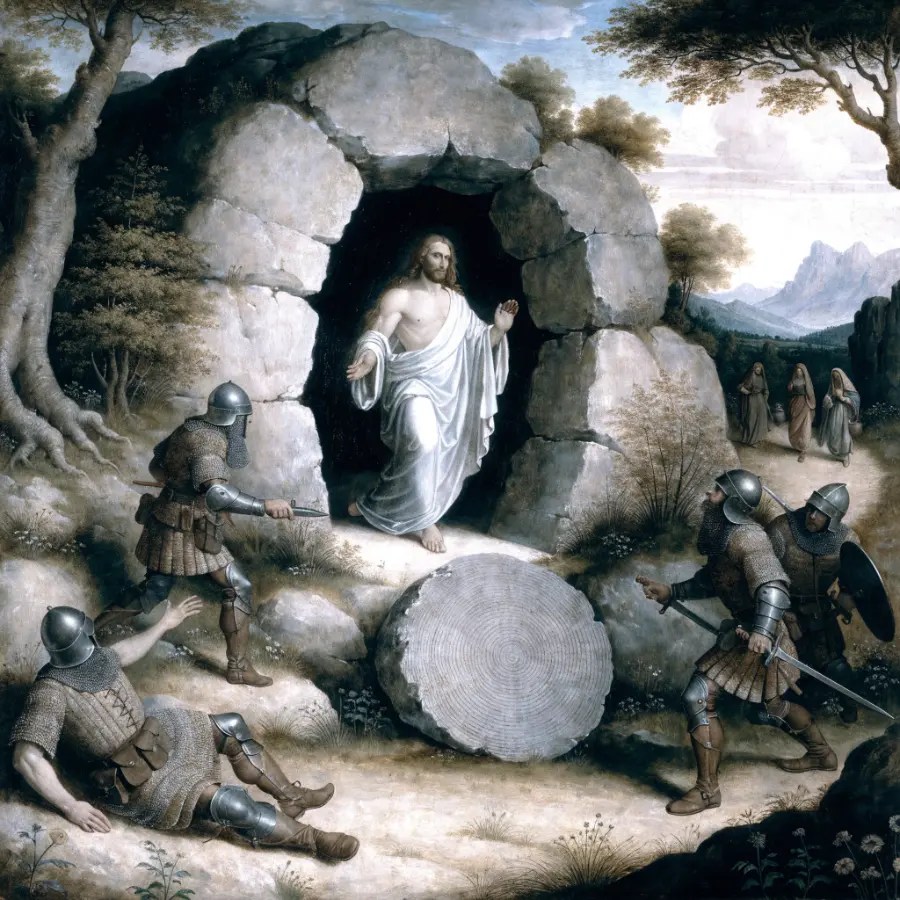
After that, he appeared to more than five hundred of the brothers and sisters at the same time, most of whom are still living, though some have fallen asleep. (1 Corinthians 15:6)
Read the second half again. Most of whom are still living.
Paul is writing about twenty-five years after the event, to a city with trade links to Judea, and he names a number of witnesses and says they can be found. That is not how a legend is written. It is an invitation to check.
The letter is one of the least disputed documents in the New Testament — even sceptical scholarship generally grants it to Paul and dates it to the mid-50s — and this passage is older than the letter, since Paul says he is handing on what he received. It is among the earliest Christian material in existence.
The number is not symbolic. Its whole weight lies in being countable.

The other five hundred
Jesus tells a small parable to a Pharisee whose dinner has been interrupted by a woman washing his feet:
Two people owed money to a certain moneylender. One owed him five hundred denarii, and the other fifty. Neither of them had the money to pay him back, so he forgave the debts of both. Now which of them will love him more? (Luke 7:41-42)
A denarius was a day’s wage, so five hundred is something like two years of work. The point of the arithmetic is the ratio, and Simon the Pharisee answers correctly and immediately, which is what makes what follows uncomfortable for him.
Elsewhere five hundred appears in measurements — the dimensions of Ezekiel’s visionary temple precinct run in units of five hundred (Ezekiel 42:15-20) — and in census-style counts.

Why 500 is not a numerology number
No verse assigns it a meaning and no pattern is built on it. It is a round figure, which is precisely why it appears: ancient counting favoured fives, tens, hundreds and thousands for the same reason ours does.
Scripture does use some numbers symbolically, and it shows which by repetition and comment. Seven runs through creation, the festivals and Revelation. Forty marks testing. Twelve counts the tribes and then the apostles. Three appears at the resurrection.
Systems that assign a meaning to every number are working from outside the text. Some borrow from gematria, a real rabbinic practice but not a biblical instruction. Most copy one another.
What the round numbers are for
There is a temptation to think a number only matters if it means something. The opposite is nearer the truth.
The counted things in Scripture — five hundred witnesses, a hundred and fifty-three fish, two hundred and seventy-six people on a ship — are the texture of documents that believe they are describing events. They resist interpretation, and that resistance is the evidence.
A number that cannot be decoded is doing a different and more useful job.
Frequently asked
Does the number 500 have a meaning in the Bible?
No. It carries no symbolism and builds no pattern. It is a round figure used as a count.
Where does 500 appear in Scripture?
Most notably in 1 Corinthians 15:6, where the risen Christ appears to more than five hundred at once, and in the parable of the two debtors (Luke 7:41-42). It also appears in the measurements of Ezekiel’s temple vision.
Why does Paul say most of them are still living?
Because he is inviting verification. He is writing roughly twenty-five years after the event and telling his readers the witnesses can be found.
Which numbers do carry meaning in Scripture?
Chiefly seven, forty, twelve and three, and in each case the meaning is built by the text’s own repeated use rather than assigned from a chart.
More from this seriesBiblical NumerologySee all 53 articles

Leave a Reply