
 English
 Chinese
 Dutch
 Arabic
 Spanish
 Portuguese
 Russian
 French
 Italian
 German
 Japanese
The Bible never gives Mary’s age, but on the usual estimates she was in her early to mid teens when Jesus was born. Because Jesus died in his thirties, she was somewhere between about 46 and 53 when she stood by the cross. Each figure is an estimate, built from Jewish custom, the Gospels’ dates and early Christian tradition.
She was a very young girl in Nazareth when she heard the angel, and a woman in her forties or early fifties when she stood at Golgotha. Between the two lie more than thirty years of raising him, and at the end the old man Simeon’s warning came true: “Yea, a sword shall pierce through thy own soul also” (Luke 2:35).
| Moment | Mary’s age (estimate) | Jesus’s age | What it rests on |
|---|---|---|---|
| Betrothal to Joseph | about 12 to 14 | – | Mishnah; Protoevangelium; Pseudo-Matthew |
| Birth of Jesus | about 13 to 16 | newborn | Jewish custom; Protoevangelium |
| Lost and found in the Temple | about 25 to 28 | 12 | Luke 2:42 |
| Start of his ministry | about 43 to 49 | about 30 to 33 | Luke 3:23 |
| The crucifixion | about 46 to 53 | about 33 to 37 | Luke 3:23; John’s Passovers |
| Her death | unknown | – | later traditions only |
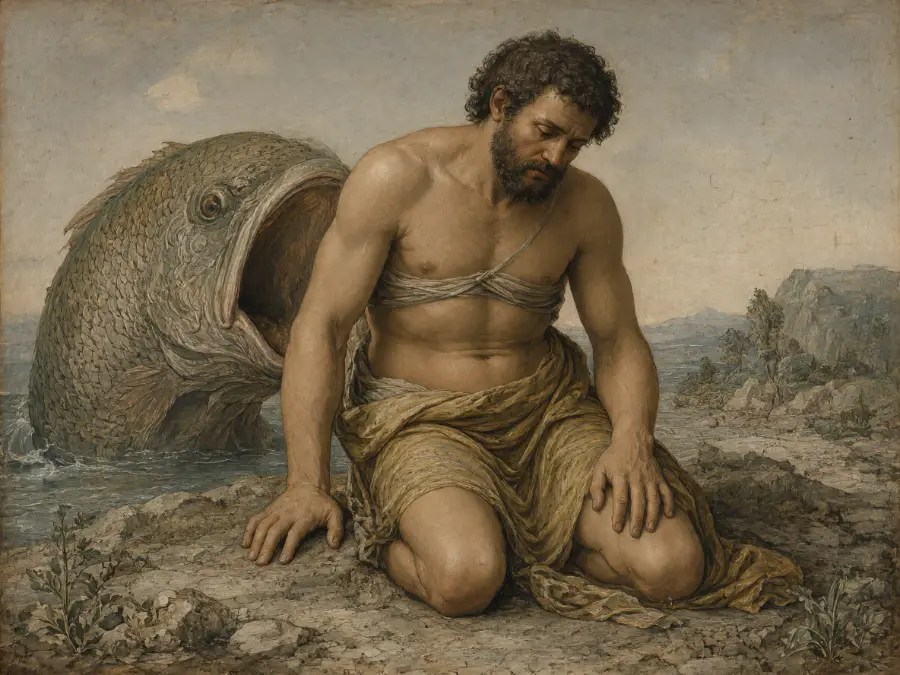
How old was Mary when Jesus was born?
She was probably between about 13 and 16, though the Gospels never say. They tell us only that when the angel Gabriel came to Nazareth he was sent “To a virgin espoused to a man whose name was Joseph” (Luke 1:27), and that Mary “was espoused to Joseph, before they came together” when she was found to be with child (Matthew 1:18). To be “espoused” was to be betrothed, and a Jewish betrothal was a binding agreement made before the couple lived together. So everything we can guess about Mary’s age rests on when girls were betrothed.
Jewish custom in Mary’s time
The Mishnah, the code of Jewish law gathered around AD 200, sets out the stages of a girl’s life. She leaves childhood for “young womanhood” at twelve years and one day, once the signs of puberty appear, and becomes a grown woman six months later (Niddah 5:7, 5:9). While she is a child or a young woman, her father arranges her betrothal, and she stays under his authority until the wedding (Ketubot 4:4–5). The same law gives a betrothed girl twelve months from the groom’s request to prepare for the wedding itself (Ketubot 5:2).
But the Mishnah was written down more than a century after Mary’s time, and it sets legal thresholds, the earliest ages at which the law treats a girl a certain way. It says nothing about the age at which most girls actually married. The Catholic Encyclopedia of 1912 put it carefully: “Jewish maidens were considered marriageable at the age of twelve years and six months, though the actual age of the bride varied with circumstances.” From there it reasoned that “it is possible that Mary gave birth to her Son when she was about thirteen or fourteen years of age”, and then admitted: “No historical document tells us how old she actually was at the time of the Nativity.”
What the Protoevangelium of James says
Only one early text gives Mary an age, the Protoevangelium of James, a second-century story of her childhood that is not part of the Bible. Origen knew it as the “Book of James”, and its stories of Mary’s parents, Joachim and Anna, and her years in the Temple shaped later devotion. In it, “when she was twelve years old there was held a council of the priests” to decide where she should go, and Joseph is chosen by a sign. He protests, “I have children, and I am an old man, and she is a young girl.” After the Annunciation and her visit to Elizabeth, the story adds, “And she was sixteen years old when these mysteries happened.”
A later Latin retelling, the Gospel of Pseudo-Matthew from the fourth or fifth century, makes her fourteen at her betrothal, and that became the popular figure. Both books mix legend into their stories, but both agree with Jewish custom that Mary was young. If she was 13 to 16 when Jesus was born, shortly before Herod’s death in 4 BC, she herself was born roughly twenty years before the start of the Christian era. Joseph’s age is a separate question, answered in how old Joseph was when Jesus was born.
Luke gives us one more fixed point when he tells us that the family went up to Jerusalem every Passover: “And when he was twelve years old, they went up to Jerusalem after the custom of the feast” (Luke 2:42). That was the year they lost him for three days and found him in the Temple. Mary was then in her mid to late twenties, and Luke tells us that afterwards “his mother kept all these sayings in her heart” (Luke 2:51).
How old was Mary when Jesus was crucified?
She was somewhere between about 46 and 53, most likely in her late forties. We reach that by adding Jesus’s age at his death to Mary’s age at his birth, and both of those are estimates.
How old was Jesus when he died?
Jesus died in his thirties, and how far into them depends on the dates. Luke dates the start of John the Baptist’s preaching to “the fifteenth year of the reign of Tiberius Caesar” (Luke 3:1) and says, “And Jesus himself began to be about thirty years of age” (Luke 3:23). John’s Gospel names three Passovers during the ministry (John 2:13; 6:4; 11:55), so it lasted at least two years and probably a little longer. If we take “about thirty” at face value, we have the traditional count of about 33. Colin Humphreys and Graeme Waddington, rebuilding the Jewish calendar from astronomy, narrowed the possible dates to two Fridays, 7 April AD 30 and 3 April AD 33, and argued for AD 33. On their dating, with Jesus born in 5 BC, he “was close to his 37th birthday when he died.” They also point out that the Greek behind “about thirty” can mean “any age between 26 and 34”, so no exact figure is possible. The full question is answered in how old Jesus was when he died.
Putting the two together
A mother of 13 with a son of 33 gives 46, and a mother of 16 with a son of 37 gives 53. In the middle of the range, a mother of about 14 or 15 and a son of 33 to 35 put Mary at about 47 to 50. Whichever figures we choose, she was in her forties or early fifties, and she had raised her son for more than thirty years.
What does the Bible say about Mary at the cross?
John names her there: “Now there stood by the cross of Jesus his mother, and his mother’s sister, Mary the wife of Cleophas, and Mary Magdalene” (John 19:25).
And from the cross, Jesus gave his mother into the care of the disciple he loved: “When Jesus therefore saw his mother, and the disciple standing by, whom he loved, he saith unto his mother, Woman, behold thy son! Then saith he to the disciple, Behold thy mother! And from that hour that disciple took her unto his own home” (John 19:26–27). Joseph is not mentioned, and many readers take this to mean that Mary was a widow by then. In his own agony, her son made sure she would have a home.
Christians have long heard her grief in Simeon’s words, spoken in the Temple more than thirty years before, about the sword that would pierce her soul. John records no word from Mary at the cross; he says only that she stood there.
The last time the New Testament names her, she is in Jerusalem with the apostles after the Ascension: “These all continued with one accord in prayer and supplication, with the women, and Mary the mother of Jesus, and with his brethren” (Acts 1:14).
How old was Mary when she died?
No one knows how old Mary was when she died, because the New Testament does not record her death, and there is no early record of it. Epiphanius of Salamis, who died in 403, said he knew nothing definite about how her life ended. “There is no certain tradition as to the year of Mary’s death,” the Catholic Encyclopedia notes, and the dates later traditions give “vary between three and fifteen years after Christ’s Ascension.” Two later scholars arrived at AD 48 by different routes: Baronius from a passage in Eusebius’s Chronicle that is now thought to be a later addition, and Nirschl from an early tradition that the apostles were to preach twelve years in Jerusalem and Palestine before going to the nations.
If those traditions are right, Mary lived to somewhere between about fifty and her late sixties: 46 to 53 at the cross, plus three to fifteen years. Any single number for her age at death rests on two estimates and a late tradition.
Where did Mary die?
Two cities claim her last years, Jerusalem and Ephesus. One tradition places her death in Jerusalem and her tomb at Gethsemane, where a church stood over the site from around 400, and the same encyclopedia judged the evidence for Jerusalem “much stronger”. The other takes her to Ephesus with John, who lived and was buried there. The house shown near Ephesus today was found by following the visions of Anne Catherine Emmerich, which are not universally accepted as history.
The Assumption and the Dormition
Catholic and Orthodox Christians both hold that Mary was taken up into heaven, and neither gives a date. In 1950 Pope Pius XII defined as Catholic doctrine “that the Immaculate Mother of God, the ever Virgin Mary, having completed the course of her earthly life, was assumed body and soul into heavenly glory” (Munificentissimus Deus 44). The definition does not say whether she died first.
The Orthodox Church keeps the Dormition, her falling asleep, on 15 August; churches that follow the old Julian calendar, the Russian Orthodox Church among them, keep it on 28 August of the everyday calendar. The Orthodox Church in America teaches that Mary “has been ‘assumed’ by God into the heavenly kingdom of Christ in the fullness of her spiritual and bodily existence.” It says plainly that “there are no biblical or historical sources for this feast”, and goes on: “The Tradition of the Church is that Mary died as all people die, not ‘voluntarily’ as her Son, but by the necessity of her mortal human nature which is indivisibly bound up with the corruption of this world.” Having truly died, it teaches, she was raised up by her Son.
Protestant churches generally require nothing as an article of faith that Scripture does not contain. The Church of England’s Thirty-nine Articles, for example, say that whatever “is not read therein, nor may be proved thereby” is not to be required as an article of faith. Scripture does not tell us how Mary’s life ended. As a general belief rather than a defined teaching, most Protestants hold that she died like other believers and awaits the resurrection. What each church means is set out in did Mary go to heaven?
So Scripture leaves her where we last saw her, in a room in Jerusalem with her son’s friends, the woman who had stood by the cross now continuing “with one accord in prayer and supplication.”


Leave a Reply