
 English
 Chinese
 Dutch
 Arabic
 Spanish
 Portuguese
 Russian
 French
 Italian
 German
 Japanese
Five is a structural number in the Bible rather than a symbolic one. It is how several books are organised, and it is how the ancient world counted with its hand.
That is more interesting than the meanings usually assigned to it.
Five as a shape, not a symbol
The Torah is five books — Genesis, Exodus, Leviticus, Numbers, Deuteronomy — which is why it is called the Pentateuch, from the Greek for five scrolls.
The book of Psalms is also arranged in five books, with a doxology closing each one (Psalms 41, 72, 89, 106, 150). The arrangement is ancient and deliberate, and the early rabbis read it as a deliberate echo: five books of law from God, five books of response from the people.
That is a real pattern, visible in the text’s own structure. It is not a code hidden in the number.
Where five appears
Five smooth stones from the brook, chosen by David before facing Goliath (1 Samuel 17:40). The text does not say why five, and readers have been guessing for centuries.
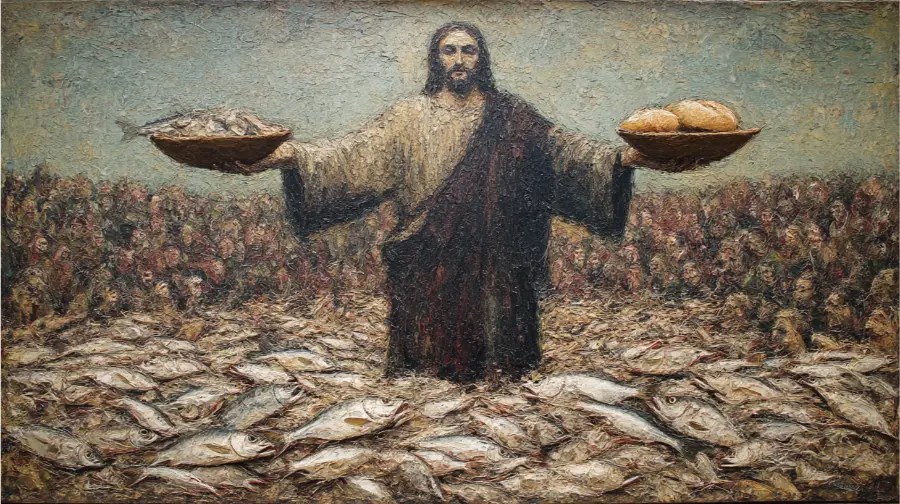
Five loaves feeding five thousand (Matthew 14:17-21) — the most famous five in Scripture, and one of very few events recorded in all four Gospels.
Five wise and five foolish young women waiting for the bridegroom (Matthew 25:2), where the number simply divides the group in half.
Joseph advises Pharaoh to take a fifth of the harvest during the seven good years (Genesis 41:34) — a rate of taxation, chosen because it is a manageable fraction.
And five is everywhere in the sacrificial and building measurements of Exodus and Ezekiel, in the way any unit of measure recurs.
Why five is so common
The plain answer: five fingers.
Ancient counting was done on the hand, and numbers built on five and ten appear constantly for the same reason our own round figures do. A herd of five, a price of five shekels, a fifth of a harvest. These are the ancient equivalent of saying “about a dozen.”
A number that shows up because it is easy to count to is not thereby a message.
What five does not mean
Popular numerology assigns five the meaning of grace, usually by counting things — five offerings in Leviticus, five wounds of Christ, the fivefold ministry of Ephesians 4:11.
Two of those are worth examining. The five wounds are a devotional tradition, movingly old, but the Gospels never count them. And Ephesians 4:11 lists apostles, prophets, evangelists, pastors and teachers — though the Greek construction may well pair the last two, which would make it four. The count is doing work the text does not ask it to do.
Scripture does use numbers symbolically, and where it does it tells you. Seven runs through creation, the festivals and Revelation with obvious intent. Forty marks testing. Twelve counts the tribes and then the apostles, deliberately. Three appears at the resurrection.
Five is not in that group. It is in the group of numbers that count things.
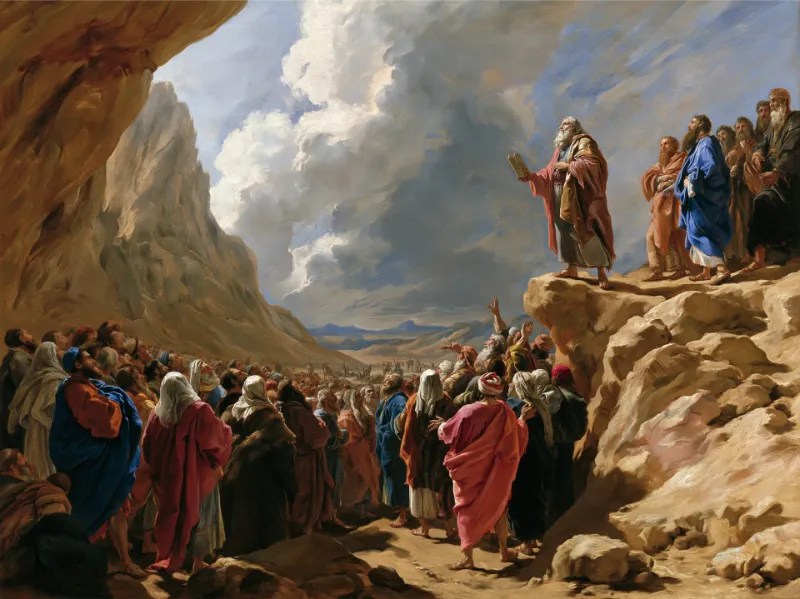
The five loaves are worth the visit anyway
If any five in Scripture repays attention, it is this one, and not because of the number.
The detail every account keeps is that the food was already there, in the hands of someone who thought it was nothing. Andrew is almost apologetic in John’s telling: Here is a boy with five small barley loaves and two small fish, but how far will they go among so many? (John 6:9)
Barley was the cheap grain, the bread of the poor. And twelve basketfuls were left over, which is more than they started with.
Nothing in that turns on the arithmetic.
Frequently asked
Does the number 5 mean grace in the Bible?
Scripture nowhere says so. That association comes from later numerology systems, built by counting things the text does not count.
Why are there five books of the Torah?
The division is ancient and structural, and the Psalter mirrors it with its own five books, each closing in a doxology.
Why did David take five stones?
The text does not say (1 Samuel 17:40). Explanations offered since are guesses, however confidently they are stated.
Which numbers do carry meaning in Scripture?
Chiefly seven, forty, twelve and three. In each case the meaning is built by the text’s own repeated use rather than assigned from outside.
More from this seriesBiblical NumerologySee all 53 articles

Leave a Reply