
 English
 Chinese
 Dutch
 Arabic
 Spanish
 Portuguese
 Russian
 French
 Italian
 German
 Japanese
Pope Francis kept a private diary for more than thirty years, and on 24 November 2026 the Vatican published it. He wrote it by hand in a black-covered planner, starting on 20 December 1992, when he was a new auxiliary bishop in Buenos Aires, and he made his last entry on 18 August 2024, eight months before he died. Cardinal Víctor Manuel Fernández, the head of the Vatican’s doctrine office and a close friend, chose the entries and wrote the commentary, and the book appeared as The Private Diary of Pope Francis in 94 countries and five languages, in English from Image Books, an imprint of Penguin Random House. Beside the diary, it describes the pictures he kept in his study and the lines he underlined in the books he read. In the diary Francis writes of seeing the devil three times, of seeing “the entrance to Hell” in June 2018, and of a spiritual crisis that ran through 2021 and 2022 and that he tied to the temptation of power. He wrote the most private parts in a code of symbols that Fernández says he cannot decipher, and those are not in the book.
It is rare for the world to read a pope’s private notes. John XXIII’s journal was published after his death, John Paul II asked in his will for his notes to be burned and his secretary published them instead, and Benedict XVI had his destroyed. So the first thing many of us want to know is simply whether this has happened before, and the answer is yes, twice, and against a pope’s own wishes once. The second thing is harder: what are we to make of a pope who writes, of the devil, “I don’t doubt that he was physically present”?
Popes’ private writings, and what became of them
| Pope | What he kept | What he asked done with it | What happened |
|---|---|---|---|
| John XXIII (died 1963) | A spiritual journal, 1895 to 1962, begun at 14 as a seminarian | Not known | Edited by his secretary Loris Capovilla and published in 1964 as Journal of a Soul |
| John Paul II (died 2005) | Two notebooks of personal notes, 1962 to 2003 | “Let my personal notes be burned,” in his will | Cardinal Stanisław Dziwisz kept them; published in Polish in February 2014, 638 pages |
| Benedict XVI (died 2022) | Private notes | Destroyed “without exceptions and without loopholes” | Destroyed by his secretary, Archbishop Georg Gänswein, who told of the order in his book of January 2023 |
| Francis (died 2025) | A diary in a planner, December 1992 to August 2024: 86 pages before his election, 55 after | Told Fernández, “From this, you will all see” | Published 24 November 2026, with Leo XIV’s leave, in Fernández’s selection |
The two books before this one are worth knowing, because they show what a pope’s notebook usually holds. John XXIII began writing at fourteen and was still examining his conscience at eighty-one. John Paul II’s notes, the Irish Times found, are “a series of his reflections rather than a daily diary,” full of the questions a priest puts to himself: “What language do I use when I speak to people?” he asked in 1974, and “Do I proclaim the Gospel with complete conviction?” His last entry, in 2003, as his hand grew weak, was about the prophet who ran from God: “Jonah, this is the fear of proclaiming the love of God.” Francis’s diary is of the same kind. Fernández says it holds hardly anything about the business of the Church, and the entries the reports quote are a man on his knees, hard on himself and leaning on mercy: “In hindsight, I realised all the harm I’ve caused in my life. How much of the Lord’s mercy I need!” he wrote on 5 January 1997.
The chapter he read most
Francis rose at four in the morning to read the Bible and kept another beside his bed for the nights he woke, and Fernández says the passage that stands out most in the diary is Ezekiel 16. It is a hard and tender chapter. God finds Jerusalem as a baby left in a field on the day of her birth, unwashed and unwanted, and says, “when I passed by thee, and saw thee polluted in thine own blood, I said unto thee when thou wast in thy blood, Live” (Ezekiel 16:6). He takes her up, grows her to womanhood, “spread my skirt over thee,” and makes a covenant with her, and she runs after other lovers. The chapter does not soften what she does. And then, at its end, God says, “Nevertheless I will remember my covenant with thee in the days of thy youth, and I will establish unto thee an everlasting covenant” (Ezekiel 16:60).
We can see why a man whose motto was Miserando atque eligendo, “By having mercy and by choosing,” would keep going back to it. His calling, America reports, began with an experience of God’s mercy on 21 September 1953, the feast of St Matthew, when he was not yet seventeen. Ezekiel 16 is that story told of a whole people: chosen in pity, unfaithful, and taken back. It is the thread that runs through the darker entries too.
What the diary says about the devil
Francis believed he had met the devil three times, and he said so without hedging. In an entry of 24 January 2021 he listed the occasions and wrote, “I don’t doubt that he was physically present.” Twice it was in Buenos Aires while he was archbishop: once from the car on his way home, when he saw “his menacing and, at the same time, seductive eyes,” and once in the Carmelite chapel during Mass, when the eyes were “like flames of fire.” The third time was in a meeting a few days after he came home from Chile in January 2018, where he heard a voice “triumphant, possessing everything: ‘Now I’ve gotten everything I wanted.’” What he wrote next is the line worth keeping: “The Lord granted me an opportunity to leave that meeting, and he thus freed me.”
It helps to remember what had happened in Chile. On that visit he defended Bishop Juan Barros against the victims of the abuser Fernando Karadima, and he came to see that he had been wrong. “It was hard for me to admit what happened in Chile; I didn’t think it was so serious,” he wrote. He sent Archbishop Charles Scicluna to find out the truth, and on the night of 20 February 2018, the day Scicluna arrived, he felt “fear, panic, fright that the devil would take revenge.” Notice when the dread came: not while he was defending Barros, but once he had set about putting the wrong right.
The vision of hell came that summer, as the reports of abuse kept growing. “Last night I saw the entrance to Hell,” he wrote on 7 June 2018. “I peeked in to look a little and it terrified me. It was before going to sleep. I grabbed the rosary as a weapon.” He did not argue with what he had seen. He picked up his beads and prayed, and he wrote, “Prayer alone makes room for the Lord to save us.” By 21 July he was writing, “What shame and what evil this has brought on the church.”
Readers will weigh these visions differently. Beside them we can set Jesus’ own prayer for Peter, whom Catholics count as the first pope: “Simon, Simon, behold, Satan hath desired to have you, that he may sift you as wheat: But I have prayed for thee, that thy faith fail not” (Luke 22:31–32). Jesus did not promise Peter that he would be spared the sifting, only that his faith would not fail, and the diary reads like a man who trusted that prayer was being made for him too.
The crisis of 2021 and 2022
The hardest stretch came later, and Fernández dates its start to the same day as that list of encounters, 24 January 2021. The Vatican said at the time that sciatica had kept the pope from his appearances; Fernández writes that he was in “insupportable” pain from the intestinal trouble that took him to hospital that July, when surgeons removed 33 centimetres of his colon. Francis said himself that the crisis “was all mixed with governance issues, pressure regarding decisions to make, and aridity and desolation.”
Underneath it he found the old temptation of power. As early as November 2018 he had caught himself “taking on problems and matters as if I’m omnipotent,” and he wrote that “this sense of self-sufficiency and I can solve everything brought me to the gates of hell.” Fernández tells one story that shows what resisting it looked like. A bishop asked Francis why he did not remove an official who spoke badly of him in public. After a long silence Francis said he felt that God “did not want him to become a puppeteer who uses and manipulates people according to his own convenience,” and he left the man where he was. It is mercy of the Ezekiel kind, shown to someone who had not earned it.
By the end of 2022 the worst had passed. On 30 December he called himself “the arrogant, self-sufficient, cynical Jorge who lies to himself,” and Fernández says Francis came to see the two years as “a powerful invitation from the Lord to become aware of an accumulation of interior darkness that he had to overcome so he could be free.” Fernández adds, “He knew the Lord would not abandon him, even though evil had played all its cards.” Gerard O’Connell of America, who has covered the Vatican since 1985, likens the two years to the dark night of the soul in St John of the Cross, and says it “will need experts in mysticism, not journalists,” to understand them.
What the Catholic Church teaches about the devil
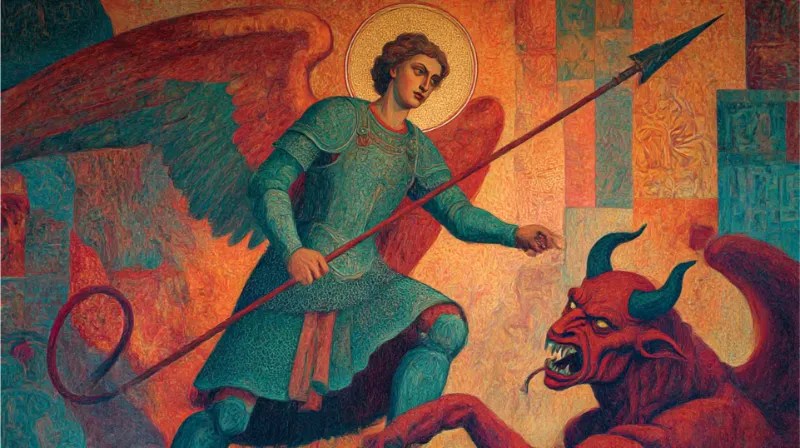
Francis spoke about the devil often as pope, and the Church he led teaches plainly that the devil is real. “Behind the disobedient choice of our first parents lurks a seductive voice, opposed to God,” the Catechism says, and “Satan was at first a good angel, made by God” (Catechism 391). It is just as plain about his limits: “The power of Satan is, nonetheless, not infinite. He is only a creature,” and “He cannot prevent the building up of God’s reign” (395). Scripture tells us the same in Peter’s own letter, “Be sober, be vigilant; because your adversary the devil, as a roaring lion, walketh about, seeking whom he may devour” (1 Peter 5:8). If you want the question taken slowly, our page on whether Satan is real sets out what Scripture says, and what the churches teach about demons and exorcism gives each tradition in its own words.
Not every Christian will read a vision the way Francis did. What every church can share is the Catechism’s last word on the matter, taken from Paul: “It is a great mystery that providence should permit diabolical activity, but ‘we know that in everything God works for good with those who love him.’”
What we do not know
We do not know what the coded entries say, and the book does not try to read them. We do not know what Fernández left out: he says he dropped entries that touched other people, and he told La Nación that Leo XIV asked him to remove sentences with “confusing things about living persons.” Some entries the reports quote carry no date, and the reports translate the same lines a little differently, because they were read in different editions. And there is the question John Paul II’s will raised in 2014 and that his secretary answered by publishing: whether a man’s prayers to God belong to the rest of us. Francis answered it himself, at least for his own, when he put the planner in his friend’s hands and said, “From this, you will all see.”
What we will see, if we read it, is a man who knew how much he needed mercy and believed it was given. Ezekiel ends his chapter there, with a people who have done everything wrong and are forgiven anyway, so that they “remember, and be confounded, and never open thy mouth any more because of thy shame, when I am pacified toward thee for all that thou hast done, saith the Lord GOD” (Ezekiel 16:63).


Leave a Reply