
 English
 Chinese
 Dutch
 Arabic
 Spanish
 Portuguese
 Russian
 French
 Italian
 German
 Japanese
Scripture does not say. Uzzah took hold of the ark of God when the oxen pulling it stumbled, and God struck him down “because of his error” (2 Samuel 6). Neither that chapter nor 1 Chronicles 13 speaks of his soul or tells us what he meant to do. Jewish and Christian commentators have offered opinions on both.
The whole story turns on the ark. Uzzah died “beside the ark of God” (2 Samuel 6:7). For the next three months the same ark rested in the house of Obed-edom, and “the Lord blessed Obed-edom and all his household” (2 Samuel 6:11). God’s nearness is a gift, and it is holy, and Israel had to learn again how he had asked to be carried.
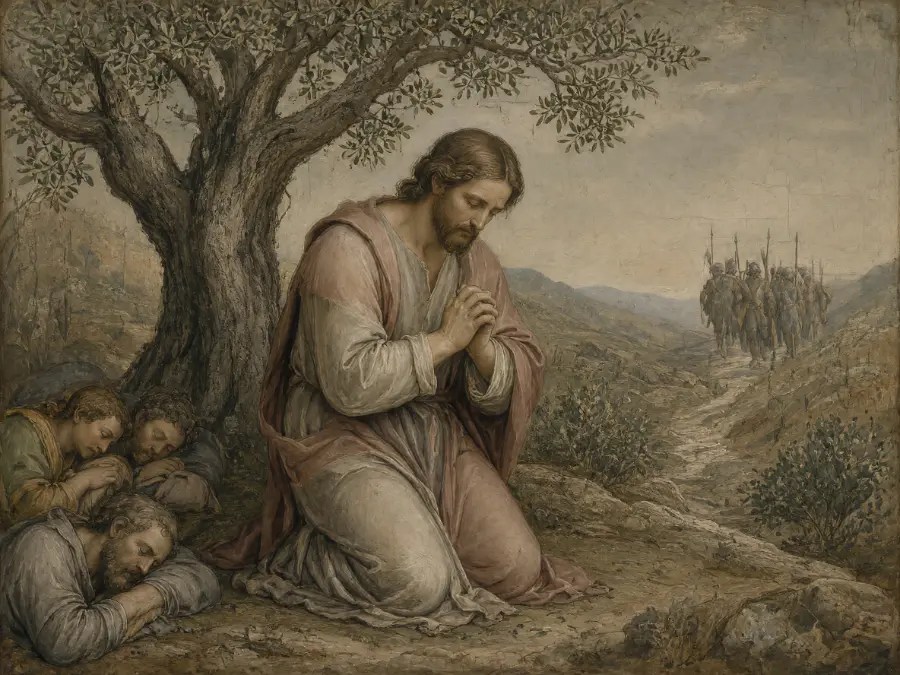
The story of Uzzah
When David set out to bring the ark to Jerusalem, it was still in the house of Abinadab at Kiriath-jearim, where it had been kept since the Philistines returned it and where Abinadab’s son Eleazar had been consecrated “to have charge of the ark of the Lord” (1 Samuel 7:1). David’s men “carried the ark of God on a new cart and brought it out of the house of Abinadab, which was on the hill. And Uzzah and Ahio, the sons of Abinadab, were driving the new cart” (2 Samuel 6:3). David and all Israel were celebrating before the Lord with songs and instruments.
Second Samuel 6:6–7 then says: “And when they came to the threshing floor of Nacon, Uzzah put out his hand to the ark of God and took hold of it, for the oxen stumbled. And the anger of the Lord was kindled against Uzzah, and God struck him down there because of his error, and he died there beside the ark of God.” David was angry, and the place was named Perez-uzzah, “the breaking out against Uzzah.” He was also afraid, and asked, “How can the ark of the Lord come to me?” (2 Samuel 6:8–9). He left the ark in the house of Obed-edom the Gittite for three months, and “the Lord blessed Obed-edom and all his household” (2 Samuel 6:11). First Chronicles 13:9–14 tells the same story and calls the place the threshing floor of Chidon.
Why did God kill Uzzah?
The two accounts give the reason differently. Second Samuel 6:7 says God struck him “because of his error,” but the Hebrew word translated “error” occurs nowhere else in the Bible, and its meaning is uncertain. The New International Version has “because of his irreverent act,” the NET Bible has “for his negligence,” and the New Revised Standard Version Updated Edition leaves the phrase out with a note that the Hebrew is uncertain. The ancient Greek translation also lacks it. First Chronicles 13:10 gives a plain reason: God struck him “because he put out his hand to the ark.”
The law of Moses had set rules for moving the ark. The ark had rings and poles for carrying (Exodus 25:14–15). The Levites of the clan of Kohath were to carry the holy things of the tabernacle, but “they must not touch the holy things, lest they die” (Numbers 4:15), and Moses gave them none of the wagons, “because they were charged with the service of the holy things that had to be carried on the shoulder” (Numbers 7:9).
David later drew the lesson himself. Before the second attempt he said that “no one but the Levites may carry the ark of God” (1 Chronicles 15:2), and he told them, “Because you did not carry it the first time, the Lord our God broke out against us, because we did not seek him according to the rule” (1 Chronicles 15:13). This time “the Levites carried the ark of God on their shoulders with the poles, as Moses had commanded” (1 Chronicles 15:15). Matthew Henry read this as David’s own admission “that Uzzah died for an error they were all guilty of, which was carrying the ark in a cart.”
Scripture tells of other deaths for mishandling holy things. Nadab and Abihu, the sons of Aaron, were consumed by fire for offering “unauthorized fire before the Lord” (Leviticus 10:1–2), and men of Beth-shemesh were struck down “because they looked upon the ark of the Lord” (1 Samuel 6:19).
Did Uzzah’s good intentions count?
The Bible does not say what Uzzah intended; it says only that he took hold of the ark “for the oxen stumbled.” Older commentators such as Matthew Henry, John Gill and Matthew Poole assumed he meant to keep it from falling. Henry, writing in the early eighteenth century, said that “Uzzah’s offence seems very small” and that he acted “we have reason to think with a very good intention,” but concluded that “a good intention will not justify a bad action; it will not suffice to say of that which is ill done that it was well meant.” John Gill likewise wrote that “though what may be done may be done with a good intention, as this was, yet that will not excuse the sin.”
R. C. Sproul, in The Holiness of God (1985), argued that Uzzah’s sin was presumption: he assumed that his hand was less polluted than the ground the ark would have fallen on. The Babylonian Talmud gives a Jewish reading. In Sotah 35a one rabbi says Uzzah was punished for forgetting that the ark could carry itself, and Rava says David was at fault, because he had called the words of the law “songs” (Psalm 119:54) and then forgot a rule that “even schoolchildren know,” that the ark must be carried on the shoulder.
Was Uzzah a Levite?
Scripture does not say. It calls him a son of Abinadab, in whose house the ark was kept, but it gives no tribe for the family. The Jewish historian Josephus, writing in the first century, called Abinadab “by birth a Levite” and said of Uzzah that “because he was not a priest and yet touched the ark, God struck him dead.” Matthew Henry wrote that “Uzzah was a Levite, but priests only might touch the ark.” John Gill was less sure, writing that it “is not clear he was” a Levite, and that in any case he was not a Kohathite. Even a Kohathite, under Numbers 4:15, was forbidden to touch the holy things.
Did Uzzah go to heaven?
The accounts end with his death: “he died there beside the ark of God” (2 Samuel 6:7), or in Chronicles, “he died there before God” (1 Chronicles 13:10). Neither passage speaks of judgment after death, and no other passage of Scripture mentions Uzzah’s fate.
A few commentators have given an opinion, and they lean toward hope. Rabbi Yohanan, in the Talmud, found it in the words “with the ark of God” (2 Samuel 6:7): “Just as the Ark exists forever, so too, Uzzah entered the World-to-Come” (Sotah 35a). Matthew Poole (1624–1679), an English Nonconformist, thought the punishment “possibly was not so great as it may seem to be,” since “for his soul, the stroke probably was not so sudden as not to give him space of repentance.” Henry and Gill, who judged his act severely, said nothing about his eternal state in their comments on the passage. And the Catholic Catechism gives a general rule for judging others: “although we can judge that an act is in itself a grave offense, we must entrust judgment of persons to the justice and mercy of God” (1861).
That is where Uzzah’s story leaves us: with a man who put out his hand to the ark of God, and with a God whose justice and mercy we can trust with him. The ark went on to Obed-edom’s door, and the house that took it in was blessed (2 Samuel 6:11).


Leave a Reply