
 French
 English
 Chinese
 Dutch
 Arabic
 Spanish
 Portuguese
 Russian
 Italian
 German
 Japanese
All Saints’ Day is the feast on which the church remembers every saint at once, the ones whose names fill the calendar and all those whose names only God knows. The Western churches keep it on 1 November, and the Orthodox Church keeps it on the first Sunday after Pentecost. The next day, 2 November, is All Souls’ Day, when Catholics pray for all the faithful departed.
On the feast Catholics hear John’s vision from Revelation 7, and so do Anglicans who keep the 1662 Book of Common Prayer and Lutherans of the Missouri Synod: “After this I beheld, and, lo, a great multitude, which no man could number, of all nations, and kindreds, and people, and tongues, stood before the throne, and before the Lamb, clothed with white robes, and palms in their hands” (Revelation 7:9). We keep the day for that whole crowd, the saints we can name and the ones we cannot.
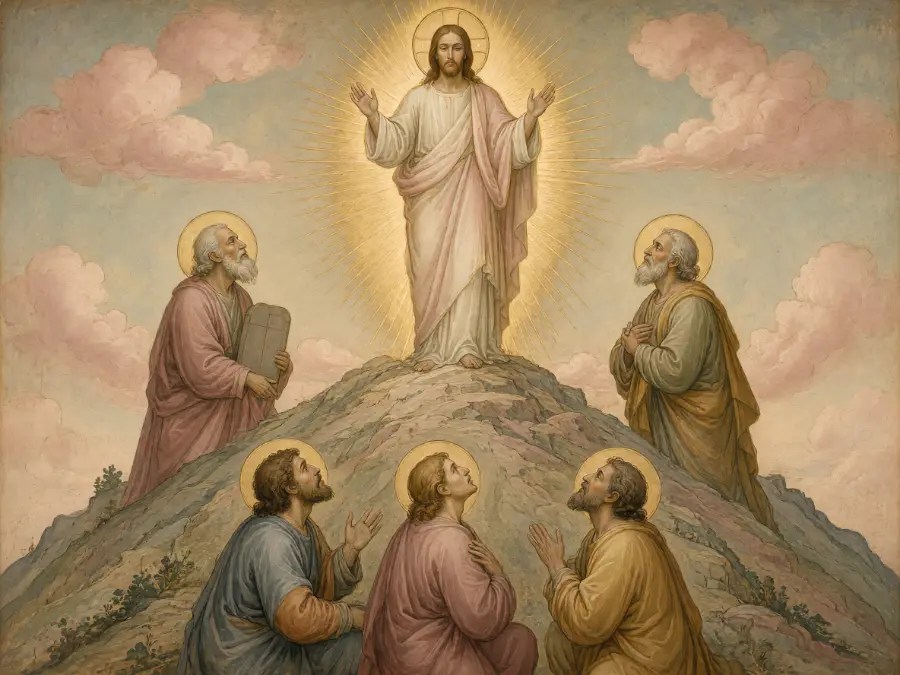
Who are the saints the day remembers?
When Paul wrote to the Christians of Rome he greeted “all that be in Rome, beloved of God, called to be saints” (Romans 1:7), and he wrote to the church at Corinth as “them that are sanctified in Christ Jesus, called to be saints” (1 Corinthians 1:2). In his letters the word belongs to whole congregations. The letter to the Hebrews pictures the faithful who have gone before us standing round us like a crowd at a race, “so great a cloud of witnesses”, and tells us to “run with patience the race that is set before us” (Hebrews 12:1).
Scripture gives the saints no feast of their own; the day grew up in the church in the centuries after the apostles, and each church keeps it in its own way. Catholics believe that the saints in glory “do not cease to intercede with the Father for us” (Catechism 956). Whether we should ask them to pray for us is a question Christians answer differently, and the page on Prière aux saints goes into it.
How did All Saints’ Day begin?
The oldest record of Christians keeping a martyr’s day comes from Smyrna, where the bishop Polycarp was put to death, most probably in February 155. The church there wrote to the other churches to tell how he died, and how afterwards they gathered up his bones, “as being more precious than the most exquisite jewels, and more purified than gold,” and laid them in a fitting place. There they hoped to meet “with joy and rejoicing” every year “to celebrate the anniversary of his martyrdom, both in memory of those who have already finished their course, and for the exercising and preparation of those yet to walk in their steps.” Those are still the two reasons we keep a saint’s day: to remember the ones who have finished, and to make ourselves ready to follow them.
In the same letter the Christians of Smyrna take care to say what that love means. “For Him indeed, as being the Son of God, we adore; but the martyrs, as disciples and followers of the Lord, we worthily love,” they wrote, and they prayed to be made the martyrs’ “companions and fellow disciples”.
For a long time Christians kept each martyr’s anniversary at the place where he died, and in the fourth century neighbouring dioceses began to share their feasts. Then came the persecution under Diocletian. So many died that a day could no longer be given to each, and the church appointed one day for them all. We first find it at Antioch, on the Sunday after Pentecost, and by the later fourth century Ephrem the Syrian was preaching about it. At first the day belonged to the martyrs and John the Baptist, and the other saints joined them little by little.
In Rome the feast came by way of a building. Pope Boniface IV received from the emperor Phocas “the temple at Rome called by the ancients Pantheon, as representing all the gods,” and dedicated it “to the holy Mother of God, and to all Christ’s martyrs”. Bede, who finished his history of the English church in 731, says it was done so that “the blessed company of the saints might have therein a perpetual memorial.” The dedication took place on 13 May, in 609 or 610, and Boniface ordered it kept every year.
Our date of 1 November came more than a century later, when Gregory III, pope from 731 to 741, consecrated a chapel in St Peter’s Basilica to all the saints and fixed its anniversary on that day, and Gregory IV (827–844) extended the feast to the whole Church. The night before, 31 October, is the feast’s vigil, and that is the night that came to be called Hallowe’en.
In the East the Sunday after Pentecost kept its place, and the Orthodox Church in America tells how it came to be fixed there. The Byzantine emperor Leo VI the Wise (886–911) began to build a church in honour of his wife, the empress Theophano, and she forbade him. She died in 893 or 894. It was Leo who decreed that the Sunday after Pentecost be dedicated to All Saints, and, “believing that his wife was one of the righteous,” he knew she would be honoured whenever the feast was kept.
When is All Saints’ Day?
At this time of year each church remembers two companies, all the saints and all who have died in faith, though not every church gives the second its own day.
| Église | All the saints | The faithful departed |
|---|---|---|
| La vie dévotionnelle | 1 November | 2 November, All Souls’ Day |
| Orthodoxe | First Sunday after Pentecost | Saturdays of Souls, chiefly before Meatfare Sunday and before Pentecost |
| Épiscopale (anglicane) | 1 November, and may also be kept the Sunday after | 2 November |
| luthériennes | 1 November | Remembered on All Saints |
| Méthodiste unie | 1 November or the first Sunday in November | Remembered on All Saints |
The Orthodox date moves from year to year, because Pentecost does. In the West the feast keeps its fixed date, though the Episcopal Church and the United Methodist Church also let a congregation keep it on a Sunday.
Is All Saints’ Day a holy day of obligation?
For Catholics it is, because canon law lists All Saints among the holy days of obligation, with Christmas, the Epiphany, the Ascension, the Body and Blood of Christ, three feasts of Mary, St Joseph, and Sts Peter and Paul (canon 1246), and on those days “the faithful are obliged to participate in the Mass” (canon 1247). A Mass on the evening before counts (canon 1248). Canon 1246 also lets each bishops’ conference, with Rome’s approval, drop a holy day or move it to a Sunday, so the rule can differ from one country to another.
In the United States the bishops decided that whenever 1 November “falls on a Saturday or on a Monday, the precept to attend Mass is abrogated,” a rule in force since 1 January 1993. The feast is still kept, but Mass that day is not required. That will happen in 2027, when 1 November is a Monday; in 2028 it falls on a Wednesday and the obligation holds. All Souls’ Day is not on the canon’s list, so it carries no obligation.
What is the difference between All Saints’ Day and All Souls’ Day?
In Catholic teaching All Saints’ Day rejoices with those already in glory, and All Souls’ Day prays for those who have died and are still being made ready for it. The Catechism speaks of one Church in three states: “some of his disciples are pilgrims on earth. Others have died and are being purified, while still others are in glory” (paragraph 954). The first of November belongs to those in glory, the second to those being purified, and we who keep both days are the pilgrims. That final purification is what Catholics call purgatory, and the teaching is set out in Qu'est-ce que le purgatoire ? Prayers for them, and for all our dead, are gathered in Prières pour les défunts.
All Souls’ Day grew up in the monasteries, out of a remembrance as old as the church itself. From the earliest days the names of the departed were entered in the diptychs, and Benedictine houses of the sixth century remembered their dead brothers at Whitsuntide. Then Odilo of Cluny, who died in 1048, ordered a yearly commemoration of all the faithful departed in the monasteries of his congregation, and from there it spread to the other Benedictines and to the Carthusians. Among the dioceses Liège took it up first, under Bishop Notger, who died in 1008.
At Mass that day the Church may read “But the souls of the just are in the hand of God, and the torment of death shall not touch them” (Wisdom 3:1), and Jesus’ promise that “of all which he hath given me I should lose nothing, but should raise it up again at the last day” (John 6:39).
Families keep these days outside church too. In Mexico the days of the dead run from the end of October into the first days of November, and families lay “flower petals, candles and offerings along the path leading from the cemetery to their homes”. UNESCO, which listed the festival in 2008, calls it a “fusion of pre-Hispanic religious rites and Catholic feasts.”
How do Orthodox Christians keep All Saints?
The Orthodox Church keeps the feast on the first Sunday after Pentecost, and the Orthodox Church in America explains why the two belong together. The saints “were Apostles, Martyrs, Prophets, Hierarchs, Monastics, and Righteous, yet all were perfected by the same Holy Spirit,” and “the Descent of the Holy Spirit makes it possible for us to rise above our fallen state and to attain sainthood.” So a week after the feast of the Spirit’s coming, the church gathers all those he made holy. Its hymns call each rank by name, “Rejoice, assembly of the Apostles, Prophets of the Lord, loyal choirs of the Martyrs, divine Hierarchs, Monastic Fathers, and the Righteous”, and the Righteous are those who became holy while living “in the world”, Abraham and Sarah, Job, Joachim and Anna, Joseph the Betrothed.
For the departed, Orthodox Christians keep Saturdays. A Greek Orthodox bishop, Athenagoras, explains that Saturday is set apart for those who have fallen asleep “because our Lord’s own salvific passing took place on Great and Holy Saturday.” The two main Saturdays of Souls are the Saturday before Meatfare Sunday and the Saturday before Pentecost, and in some places the Saturday before the feast of St Demetrios on 26 October is kept too. On them Orthodox Christians remember the dead “beginning from Adam and Eve, all the way to the most recently departed souls,” and ask God to grant them rest “in a place of green pasture.” So the second of those Saturdays comes eight days before the feast of all the saints.
How do Anglicans keep All Saints’ Day?
A parish that keeps the day by the Book of Common Prayer of 1662 hears the Beatitudes of Matthew 5 for its Gospel, as Catholics do, with an epistle from Revelation 7, and it prays this collect:
Almighty God, who hast knit together thine elect in one communion and fellowship, in the mystical body of thy Son Christ our Lord; Grant us grace so to follow thy blessed Saints in all virtuous and godly living, that we may come to those unspeakable joys, which thou hast prepared for them that unfeignedly love thee; through Jesus Christ our Lord. Amen.
In the United States the Episcopal Church sets All Saints’ Day among its Principal Feasts, beside Easter and Christmas, feasts that “take precedence of any other day or observance.” Its 1979 Prayer Book lets a parish keep the feast again on the Sunday after, for it “may always be observed on the Sunday following November 1, in addition to its observance on the fixed date,” and the next day, 2 November, its calendar keeps as the Commemoration of All Faithful Departed.
How do Lutherans keep All Saints’ Day?
On All Saints a Lutheran congregation may read out the names of its loved ones who have died in the past year, “alternating the names with a bell or a sung prayer of thanksgiving,” as Benjamin Stewart suggests in the ELCA’s magazine Living Lutheran. He calls it “an especially Lutheran accent” for the feast “to honor not only those who lived exemplary lives, but all who have been baptized into Christ’s death,” because “it is God’s grace, apart from our works, that makes us saints.” For Lutherans, he writes, the feast “resonates with the conviction that in Christ every saint is a sinner and every sinner a saint, simul justus et peccator.”
Lutherans remember the saints and follow them, but they do not ask them for help. The Augsburg Confession keeps their memory before us “that we may follow their faith and good works, according to our calling,” and it says that Scripture sets before us “the one Christ as the Mediator, Propitiation, High Priest, and Intercessor.” In the Lutheran Church–Missouri Synod the altar is dressed in white for the feast, and the readings include John’s great multitude, Revelation 7:9–17.
The night before the feast matters to Lutherans for another reason: it is Reformation Day. On 31 October 1517 Martin Luther wrote to Archbishop Albrecht of Mainz about the preaching of indulgences, and added, “If it please the Most Reverend Father he may see these my Disputations.”
How do Methodists keep All Saints’ Day?
John Wesley wrote in his journal for Sunday 1 November 1789 that All Saints’ was a day he “peculiarly” loved, and that after he preached “we rejoiced with solemn joy.” The year before, when the feast fell on a Saturday, he had preached at Snowsfields on Revelation 14:1, “a comfortable subject”.
United Methodists keep the day on 1 November or the first Sunday in November, and by saints they mean what the New Testament means, all Christian people of every time and place. A congregation may read out the names of its members who died in the past year, and it thanks God for all his servants who, “having finished their course, now rest from their labors.” Some churches light a candle or hang a bell for each one.
Whichever day our church keeps, we remember the names we know and leave the rest to God, who knows them all. John hears what the multitude sings: “Salvation to our God which sitteth upon the throne, and unto the Lamb” (Revelation 7:10).


Laisser un commentaire