
 Italian
 English
 Chinese
 Dutch
 Arabic
 Spanish
 Portuguese
 Russian
 French
 German
 Japanese
Anglicans believe what Christians have confessed since the creeds were written: one God in three persons, and Jesus Christ truly God and truly man, crucified and risen. They hold that the Bible contains everything we need to be saved, that we are made right with God by faith in Christ and not by anything we deserve, that Christ gave his Church two sacraments, Baptism and the Lord’s Supper, and that bishops, priests and deacons have served the Church since the apostles. If you want to know how Anglicans hold all this, though, look at the book they pray from together, the Book of Common Prayer. “To understand what and how Anglicans pray is to understand what they believe,” says the Anglican Church in North America, and the Episcopal Church reckons that passages of Scripture “make up about 70% of the Book of Common Prayer.”
The name goes back to the Angles, one of the old Anglo-Saxon tribes. “Their island became known as England, and their Christians were known as Anglicans,” the Anglican Church in North America explains, and it adds, “The name has nothing to do with ‘angels.’” The Church of England, whose story we tell on its own page, is the mother church of the family. Today the family is a communion of 42 member churches, each one self-governing, in more than 165 countries. Its member in the United States is the Episcopal Church, founded in 1785 in the newly independent country, with about 1.5 million members. It takes its name from its bishops, for the Greek word for a bishop is episcopos.
A third body shares the name. The Anglican Church in North America, the ACNA, was “formed in 2009 through the union of various Anglican groups in North America,” and it says what holds it together: “Our unity is found in our shared confession, the Jerusalem Declaration, rather than in institutional ties to the See of Canterbury.” It is not on the Communion’s own list of member churches. On most of what follows these three agree, because they come from the same Articles of Religion and pray from books of one family, though they hold the Articles differently. The ACNA affirms the Jerusalem Declaration, which upholds them “as authoritative for Anglicans today,” while the Episcopal prayer book prints them at the back among its “Historical Documents.” The three part on marriage, on women as bishops, and on whether the Archbishop of Canterbury still holds the family together, and when we come to those we will say who holds what.
Scripture, the creeds and the prayer book
The Bible and the three creeds
The Thirty-nine Articles, the Church of England’s statement of faith from the Reformation, say this about the Bible: “Holy Scripture containeth all things necessary to salvation: so that whatsoever is not read therein, nor may be proved thereby, is not to be required of any man, that it should be believed as an article of the Faith.” The creeds rest on the same ground. The Articles name three, the Nicene, the Athanasian and the Apostles’ Creed, and say they “ought thoroughly to be received and believed: for they may be proved by most certain warrants of holy Scripture.”
All three bodies still say that the Bible holds everything we need to be saved. Where they part is over what helps us read it. The Episcopal Church and the Church of England read it alongside tradition and reason, and the Church of England adds “scholarship” and “experience”; the ACNA calls the Bible “the final authority and unchangeable standard for Christian faith and life.” Yet all of them pray to take it in the same way. On the second Sunday of Advent the 1662 prayer book asks, “Blessed Lord, who hast caused all holy Scriptures to be written for our learning: Grant that we may in such wise hear them, read, mark, learn, and inwardly digest them, that by patience and comfort of thy holy Word, we may embrace and ever hold fast the blessed hope of everlasting life.” The words are borrowed from Paul, who wrote that “whatsoever things were written aforetime were written for our learning, that we through patience and comfort of the scriptures might have hope” (Romans 15:4).
da The Thirty-nine Articles of Religion, Articles VI and VIII
Il Libro delle Preghiere Comuni
The 1662 prayer book opens with a preface that tells us its whole temper: “It hath been the wisdom of the Church of England, ever since the first compiling of her Publick Liturgy, to keep the mean between the two extremes, of too much stiffness in refusing, and of too much easiness in admitting any variation from it.” The Episcopal Church’s dictionary has a name for that temper, the via media, “the middle way,” and describes Anglicanism as “a middle way between Roman Catholicism and Puritanism.”
There is a good deal of room inside that middle way. Anglican worship runs, in the Church of England’s words, “from simple to elaborate, or even a combination.” The ACNA traces its life to three streams: the Protestant movement, which called the Church back to the Word; the Holiness movement, which reminded it of God’s love for the poor; and the Anglo-Catholic movement, which “re-grounded the Church in the sacramental life of worship.” Of the three it says, “No strand is dispensable.”
For centuries Anglicans everywhere prayed from revisions of one Book of Common Prayer, and the newer services, such as the Church of England’s Common Worship, “still bear a family likeness” to it. The bodies differ in how close they keep to the old book. The ACNA receives the 1662 book “as a standard for Anglican doctrine and discipline,” while the Episcopal Church prays from a book of its own, made in 1979.
da The Preface, The Book of Common Prayer (1662)
Grace, faith and God’s choosing
Made right with God by faith
The Articles start with what we cannot do. Since Adam’s fall, they say, a person “cannot turn and prepare himself, by his own natural strength and good works, to faith, and calling upon God.” What we cannot do, Christ has done, and Article XI says so in one long, glad breath: “We are accounted righteous before God, only for the merit of our Lord and Saviour Jesus Christ by Faith, and not for our own works or deservings: Wherefore, that we are justified by Faith only is a most wholesome Doctrine, and very full of comfort.” Paul had said it first, that “a man is justified by faith without the deeds of the law” (Romans 3:28).
da The Thirty-nine Articles of Religion, Article XI
Predestination, and falling away
The Articles also teach that God chose his people before the world began: “Predestination to Life is the everlasting purpose of God, whereby (before the foundations of the world were laid) he hath constantly decreed by his counsel secret to us, to deliver from curse and damnation those whom he hath chosen in Christ out of mankind.” They do not hand us this as a puzzle to lie awake over. To those who feel the Spirit at work in them, the thought of our election in Christ “is full of sweet, pleasant, and unspeakable comfort to godly persons.”
Yet the article just before speaks as plainly about the believer who stumbles: “After we have received the Holy Ghost, we may depart from grace given, and fall into sin, and by the grace of God we may arise again, and amend our lives.” The Articles let both stand, God’s choosing and our falling and rising, and leave them together in God’s hands.
da The Thirty-nine Articles of Religion, Articles XVI and XVII
Two sacraments, and five rites besides
Battesimo, bambini inclusi
Anglicans baptize babies as well as adults, for “The Baptism of young Children is in any wise to be retained in the Church, as most agreeable with the institution of Christ,” says Article XXVII. In the 1662 service, once the child has been baptized and signed with the cross, the priest says, “Seeing now, dearly beloved brethren, that this Child is regenerate and grafted into the body of Christ’s Church, let us give thanks unto Almighty God for these benefits.”
At an Episcopal baptism the whole church takes part. Before the water is blessed, the priest says, “Let us join with those who are committing themselves to Christ and renew our own baptismal covenant,” and everyone answers the promises together. One of them comes from the first Christians in Jerusalem, who “continued stedfastly in the apostles’ doctrine and fellowship, and in breaking of bread, and in prayers” (Acts 2:42): “Will you continue in the apostles’ teaching and fellowship, in the breaking of bread, and in the prayers?” To each promise the answer is the same: “I will, with God’s help.”
da The Book of Common Prayer (1979), Holy Baptism
La Cena del Signore
At the Lord’s table, the Articles say, the Body of Christ is given to us, and they are careful to say how: “The Body of Christ is given, taken, and eaten, in the Supper, only after an heavenly and spiritual manner. And the mean whereby the Body of Christ is received and eaten in the Supper is Faith.” They part from the Catholic teaching that the bread and wine change in substance, for “Transubstantiation (or the change of the substance of Bread and Wine) in the Supper of the Lord, cannot be proved by holy Writ.” The Episcopal Church’s dictionary says that Anglican worship “affirms that Christ is really present in the Eucharist and allows for differing views on how that occurs.” The service goes by several names, and the Episcopal catechism lists them: it “is called the Lord’s Supper, and Holy Communion; it is also known as the Divine Liturgy, the Mass, and the Great Offering.” Our page on what each church believes happens at Communion sets this beside the other churches’ teaching.
The 1662 book puts the same faith on our lips. Before the bread and wine are given, the priest kneels at the table and prays “in the name of all them that shall receive the Communion,” borrowing the words of the woman who asked Jesus for the crumbs from the table (Matthew 15:27) and of his promise in John 6:56 that whoever eats his flesh “dwelleth in me, and I in him”: “We do not presume to come to this thy Table, O merciful Lord, trusting in our own righteousness, but in thy manifold and great mercies. We are not worthy so much as to gather up the crumbs under thy Table. But thou art the same Lord, whose property is always to have mercy … that we may evermore dwell in him, and he in us. Amen.”
da The Thirty-nine Articles of Religion, Article XXVIII
Confirmation, confession and the other rites
The Articles name five more rites, “Confirmation, Penance, Orders, Matrimony, and extreme Unction,” and say they “are not to be counted for Sacraments of the Gospel.” Anglicans keep them all the same, and the Episcopal catechism explains the difference: “Although they are means of grace, they are not necessary for all persons in the same way that Baptism and the Eucharist are.”
Confession to a priest is one of them, and it is offered to anyone who wants it. The 1662 Communion service invites anyone who “cannot quiet his own conscience herein, but requireth further comfort or counsel,” to “come to me, or to some other discreet and learned Minister of God’s Word, and open his grief; that by the ministry of God’s holy Word he may receive the benefit of absolution.” The Episcopal prayer book keeps the same door open: the rite “is available for all who desire it,” and “Confessions may be heard anytime and anywhere.”
da Reconciliation of a Penitent: Concerning the Rite, The Book of Common Prayer (1979)
Bishops, priests and deacons
Bishops since the apostles
So who governs an Anglican church? Each one governs itself. No pope stands over it, for “The Bishop of Rome hath no jurisdiction in this Realm of England,” as the Articles put it, and no other Anglican church can overrule it either: “Each province is autonomous, with its own system of governance.” What they all keep is the ministry of bishops, priests and deacons, and the 1662 ordination services trace it back to the beginning: “It is evident unto all men diligently reading holy Scripture and ancient Authors, that from the Apostles’ time there have been these Orders of Ministers in Christ’s Church; Bishops, Priests, and Deacons.” In the Episcopal Church the people of a diocese choose their own bishop, for “bishops in The Episcopal Church are elected by the members of the diocese they serve.” Our page on how churches are governed sets rule by bishops beside rule by elders and by congregations.
Married clergy, and women ordained
Article XXXII leaves marriage to the clergy themselves: “Bishops, Priests, and Deacons, are not commanded by God’s Law, either to vow the estate of single life, or to abstain from marriage: therefore it is lawful for them, as for all other Christian men, to marry at their own discretion.”
In the Episcopal Church eleven women “were ordained as priests July 29, 1974, before the 1976 General Convention authorized the ordination of women as priests and bishops,” and in 1989 Barbara Harris became “the first female bishop in the Anglican Communion.” The Church of England ordained its first women priests in 1994, and on 14 July 2014 its General Synod gave “its final approval for women to become bishops in the Church of England.” In January 2026 Sarah Mullally was formally confirmed as the 106th Archbishop of Canterbury, “the first ever woman to hold the position.” In the ACNA each diocese decides whether to ordain women as deacons and priests, and its canons require every bishop to “Be a male Presbyter at least 35 years old.”
da Church of England to have women bishops, Church of England, 14 July 2014
Mary, the saints and those who have died
Maria e i santi
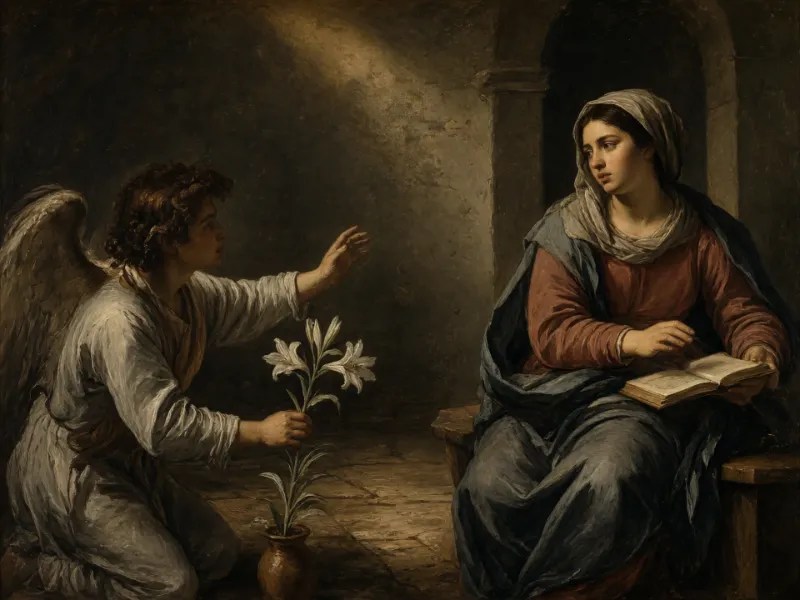
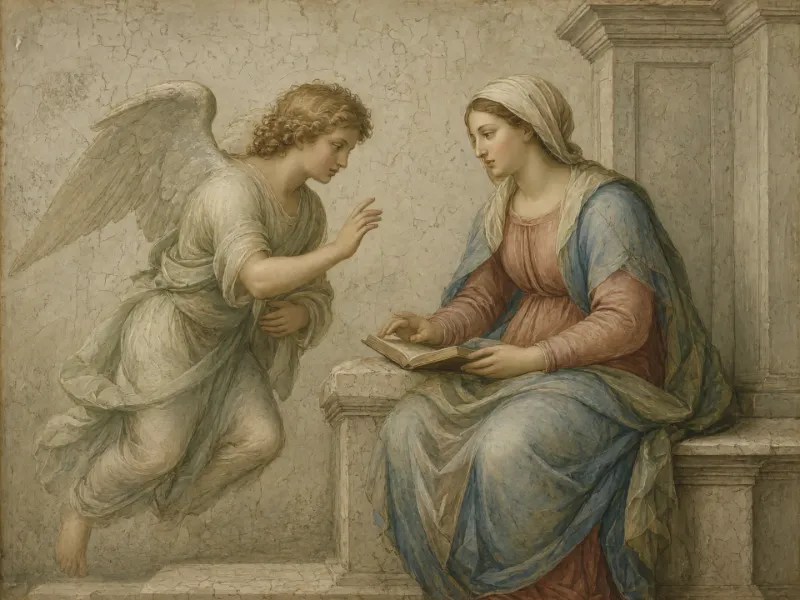
Article XXII sets aside “The Romish Doctrine concerning Purgatory, Pardons, Worshipping, and Adoration, as well of Images as of Reliques, and also invocation of Saints,” calling it “a fond thing vainly invented, and grounded upon no warranty of Scripture.” Yet the saints kept their days in the calendar, Mary first among them. The Annunciation of the Blessed Virgin Mary is one of the Church of England’s principal feasts, and on 15 August it prays, “Almighty God, who looked upon the lowliness of the Blessed Virgin Mary and chose her to be the mother of your only Son: grant that we who are redeemed by his blood may share with her in the glory of your eternal kingdom.” That prayer takes up Mary’s own song: “he hath regarded the low estate of his handmaiden: for, behold, from henceforth all generations shall call me blessed” (Luke 1:48).
da Common Worship: Festivals, The Blessed Virgin Mary, 15 August
Heaven, hell and praying for the dead
The Episcopal catechism gives heaven and hell one sentence each: “By heaven, we mean eternal life in our enjoyment of God; by hell, we mean eternal death in our rejection of God.” The Articles turned away from purgatory, but Episcopalians still pray for those they have lost, and the catechism gives the reason: “We pray for them, because we still hold them in our love, and because we trust that in God’s presence those who have chosen to serve him will grow in his love, until they see him as he is.” The last words are John’s: “we know that, when he shall appear, we shall be like him; for we shall see him as he is” (1 John 3:2).
da An Outline of the Faith, commonly called the Catechism, The Book of Common Prayer (1979)
Where Anglicans have parted
Matrimonio
In 1998 the bishops of the Lambeth Conference, gathered from across the Communion, passed Resolution I.10. “In view of the teaching of Scripture,” it “upholds faithfulness in marriage between a man and a woman in lifelong union.” It says that “all baptised, believing and faithful persons, regardless of sexual orientation, are full members of the Body of Christ,” and, “while rejecting homosexual practice as incompatible with Scripture, calls on all our people to minister pastorally and sensitively to all irrespective of sexual orientation.” It “cannot advise the legitimising or blessing of same sex unions.”
The churches have answered that resolution in different ways. On 1 July 2015 the Episcopal Church’s General Convention passed “a canonical change eliminating language defining marriage as between a man and a woman (Resolution A036)” and approved two new marriage rites for “same-sex or opposite-sex couples.” The Church of England’s canon law describes marriage as “a union permanent and lifelong, for better for worse, till death them do part, of one man with one woman.” Yet after a Synod vote in 2023 it brought in prayers of blessing for same-sex couples, the Prayers of Love and Faith, which “are now in use as part of regular Church of England services.” The ACNA’s canons hold that marriage “is a lifelong covenant between one man and one woman, binding both to self-giving love and exclusive fidelity.”
Those prayers came out of Living in Love and Faith, the Church of England’s review of its teaching on sexuality and marriage, begun in 2017. In February 2026 the General Synod voted to wind the review up and set up a new working group in its place. The House of Bishops had said the month before that separate services for same-sex couples would need “full formal authorisation under canon law,” and the Archbishop of York said the Church remains “deeply divided.” That February vote is the latest step this page reports.
da Resolutions of the Lambeth Conference 1998, Resolution I.10
Canterbury and the Global Anglican Communion
In June 2008, a month before that year’s Lambeth Conference, Anglican leaders mostly from Africa and Asia met in Jerusalem as the Global Anglican Future Conference, or Gafcon, and said that “The Episcopal Church USA and the Anglican Church of Canada, in proclaiming this false gospel, have consistently defied the 1998 Lambeth statement of biblical moral principle (Resolution 1.10),” and in the same statement, “Our fellowship is not breaking away from the Anglican Communion.” The ACNA grew out of that meeting.
On 16 October 2025, less than two weeks after Sarah Mullally was named, Gafcon’s chairman, Archbishop Laurent Mbanda of Rwanda, wrote that his movement rejected “the Archbishop of Canterbury, the Lambeth Conference,” and the other bodies that bind the Communion together, and was “now the Global Anglican Communion.” “We have not left the Anglican Communion; we are the Anglican Communion,” he wrote. That same month the Episcopal Church, the Anglican Church of Canada and the Church of Ireland said they stood with Canterbury. “We grieve that some GAFCON primates have chosen to remove themselves from the Anglican Communion,” said Sean Rowe, the Episcopal Church’s presiding bishop. “We pray for their participation in God’s mission in their contexts.”
In March 2026 Gafcon’s leaders met at Abuja in Nigeria to give the new communion its shape. They put it under a Global Anglican Council, with Mbanda as chair, rather than under a single leader. Their closing statement, the Abuja Affirmation, called a “full and public disengagement” from the Canterbury-led structures “necessary,” Christian Today reported. Mbanda put it this way: “The Global Anglican Communion is not a new Communion, but the historic Anglican Communion reordered from within.”
da The Future Has Arrived, Gafcon, 16 October 2025
Wherever they stand now, Anglicans who keep the 1662 book end Morning Prayer the same way, with a blessing taken from the close of Paul’s second letter to Corinth. Paul wrote, “The grace of the Lord Jesus Christ, and the love of God, and the communion of the Holy Ghost, be with you all” (2 Corinthians 13:14). The prayer book turns his “with you all” into “with us all evermore,” so that whoever leads the prayer stands inside the blessing with everyone else: “The grace of our Lord Jesus Christ, and the love of God, and the fellowship of the Holy Ghost, be with us all evermore. Amen.”
How Anglicans differ from their neighbours
- Anglicani contro cattolici: perché la Chiesa d'Inghilterra non è cattolica romana
- Episcopali vs Cattolici: le vere differenze a confronto
- Anglicani vs Protestanti: La Chiesa anglicana è protestante? Sì, per storia e legge
- Episcopalian: cosa significa e la Chiesa Episcopale è protestante? Sì, secondo la sua stessa dichiarazione
- Credenze luterane vs. anglicane
- Credenze anglicane vs. metodiste
- Credenze anglicane vs. presbiteriane
- Cosa credono i metodisti? Grazia per tutti, certezza, santità
See every answer for Anglicans and compare with another church
Altro da questa serieDenominazioni a confrontoVedi tutti i 163 articoli

Lascia un commento