
 English
 Chinese
 Dutch
 Arabic
 Spanish
 Portuguese
 Russian
 French
 Italian
 German
 Japanese
In the Bible, feet stand above all for the way a person lives. Scripture calls a life a walk, and Proverbs asks us to “ponder the path of thy feet” (Proverbs 4:26). Feet also stand for six other things: service, victory, good news, reverence, discipleship and sin.
It makes sense once you remember how people moved then. Nearly everyone went everywhere on foot, on dusty roads, in open sandals. So the ordinary Hebrew word for foot, regel, came to carry a step, a journey and a whole way of life. When Scripture talks about feet, it is usually talking about where a person is going, and who goes with them.
The meanings of feet at a glance
| Meaning | Key verses | The picture behind it |
|---|---|---|
| A person’s life and conduct | Psalm 119:105; Proverbs 4:26; Psalm 40:2 | Feet show where a person goes |
| Humility and service | John 13:5–15; Luke 7:38; 1 Timothy 5:10 | Washing feet was a servant’s work |
| Authority and victory | Joshua 1:3; Psalm 110:1; Romans 16:20 | What lies under your feet is yours |
| The bringer of good news | Isaiah 52:7; Romans 10:15; Ephesians 6:15 | A runner arriving with word of peace |
| Reverence before God | Exodus 3:5; Joshua 5:15 | Shoes come off on holy ground |
| Discipleship and worship | Luke 10:39; Acts 22:3; Revelation 1:17 | A pupil sits at the teacher’s feet |
| Sin pursued in haste | Proverbs 6:18; Romans 3:15 | Feet that run toward harm |
How do feet stand for the way a person lives?
Proverbs says it most plainly: “Ponder the path of thy feet, and let all thy ways be established. Turn not to the right hand nor to the left: remove thy foot from evil” (Proverbs 4:26–27). Where your feet go, you go.
The psalms take the same picture and put God beside the walker. “Thy word is a lamp unto my feet, and a light unto my path” (Psalm 119:105). A lamp carried at night does not light the whole road. It lights the next step, and that is enough to keep walking. A man pulled out of trouble says God “set my feet upon a rock, and established my goings” (Psalm 40:2). Another is honest about how near he came to falling away: “my feet were almost gone; my steps had well nigh slipped” (Psalm 73:2). And Psalm 121 makes a promise to every traveller: “He will not suffer thy foot to be moved: he that keepeth thee will not slumber” (Psalm 121:3).
The early Church heard it the same way. John Chrysostom, preaching on Ephesians, said that “the feet are usually a token of the way of life,” and that this is why Paul keeps urging Christians to watch how they walk.
Why does washing feet mean humility and service?
Because feet got dirty, washing them was the first kindness a host offered. Abraham greets three strangers with “Let a little water, I pray you, be fetched, and wash your feet, and rest yourselves under the tree” (Genesis 18:4). But the washing itself was a servant’s job. When David sends for Abigail to be his wife, she answers, “let thine handmaid be a servant to wash the feet of the servants of my lord” (1 Samuel 25:41).
At the Last Supper, Jesus took that job himself. He “poureth water into a bason, and began to wash the disciples’ feet, and to wipe them with the towel wherewith he was girded” (John 13:5). Peter refuses, and Jesus tells him, “If I wash thee not, thou hast no part with me” (John 13:8). Then he draws the lesson for all of us: “If I then, your Lord and Master, have washed your feet; ye also ought to wash one another’s feet. For I have given you an example, that ye should do as I have done to you” (John 13:14–15). The feet that walk the dusty road are the ones he kneels to wash.
Augustine saw the whole Christian life in Jesus’ words about the one who “needeth not save to wash his feet” (John 13:10). In baptism a person is washed “every whit; and yet, while thereafter living in this human state, he cannot fail to tread on the ground with his feet.” We are clean, and still we walk in the dust, and still we need him. Why Jesus did it, and what each church makes of his command, is told in why Jesus washed his disciples’ feet.
Others in the New Testament take the same low place. A woman of the town, known as a sinner, “stood at his feet behind him weeping, and began to wash his feet with tears, and did wipe them with the hairs of her head, and kissed his feet, and anointed them with the ointment” (Luke 7:38). And Paul counts it among the marks of a faithful widow “if she have washed the saints’ feet” (1 Timothy 5:10).

What does it mean to have enemies under your feet?
To stand on something was to own it, or to have beaten it. God promises Joshua the land in just those words: “Every place that the sole of your foot shall tread upon, that have I given unto you” (Joshua 1:3). After a battle, Joshua tells his captains, “Come near, put your feet upon the necks of these kings” (Joshua 10:24). It is a hard, old picture of war, and the Bible does not soften it.
Psalm 110 gives the picture to the king God enthrones: “The Lord said unto my Lord, Sit thou at my right hand, until I make thine enemies thy footstool” (Psalm 110:1). The New Testament reads it of Christ (Matthew 22:44; Acts 2:34–35; Hebrews 1:13). Paul tells how the story ends: “For he must reign, till he hath put all enemies under his feet. The last enemy that shall be destroyed is death” (1 Corinthians 15:25–26). And he hands a share of that victory to ordinary believers: “And the God of peace shall bruise Satan under your feet shortly” (Romans 16:20).
Why does the Bible call the earth God’s footstool?
“The heaven is my throne, and the earth is my footstool,” God says through Isaiah (Isaiah 66:1). He is a king whose throne is too high for any temple to hold, and the whole earth is where his feet rest. Exodus tells of the elders of Israel seeing a vision of God with “under his feet as it were a paved work of a sapphire stone” (Exodus 24:10). These are pictures of his rule as king, and Jesus reminds us what lies behind them: “God is a Spirit” (John 4:24).
Why are the feet of messengers called beautiful?
Isaiah sees a runner coming over the hills toward a ruined Jerusalem, carrying word that the Lord has “redeemed Jerusalem” (Isaiah 52:9): “How beautiful upon the mountains are the feet of him that bringeth good tidings, that publisheth peace; that bringeth good tidings of good, that publisheth salvation; that saith unto Zion, Thy God reigneth!” (Isaiah 52:7). Tired, dusty feet, and Isaiah calls them beautiful because of what they carry.
Paul gives the verse to everyone who carries the gospel: “And how shall they preach, except they be sent? as it is written, How beautiful are the feet of them that preach the gospel of peace, and bring glad tidings of good things!” (Romans 10:15). In the armour of God he gives every Christian the same footwear, “your feet shod with the preparation of the gospel of peace” (Ephesians 6:15). Our feet are meant to take the news of peace where it needs to go.

What does sitting at someone’s feet mean?
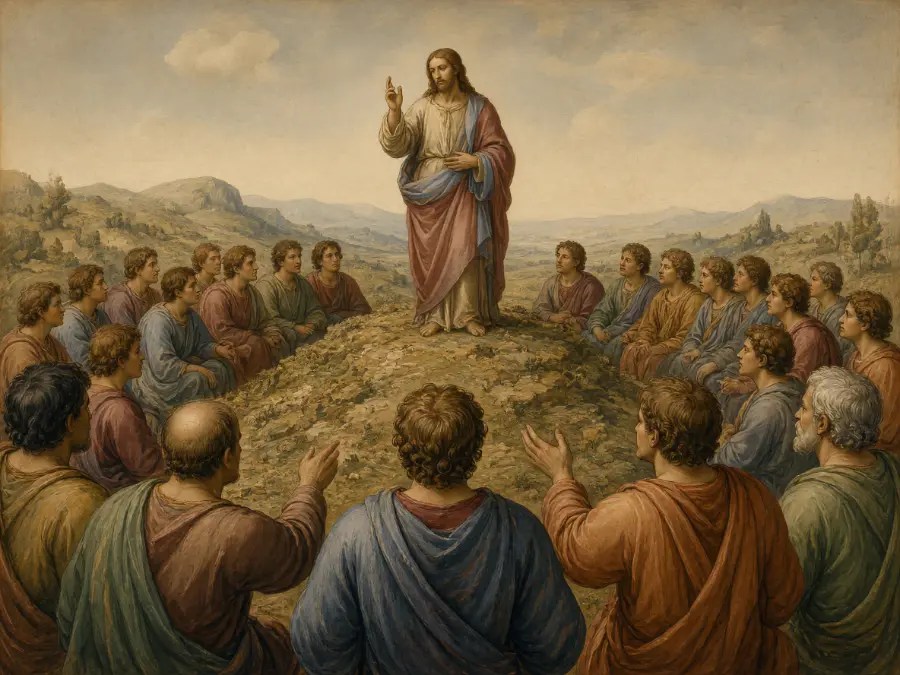
A pupil sat at the teacher’s feet. Martha’s sister Mary “sat at Jesus’ feet, and heard his word” (Luke 10:39), taking the place of a disciple. Paul describes his own schooling the same way: he was “brought up in this city at the feet of Gamaliel, and taught according to the perfect manner of the law of the fathers” (Acts 22:3).
Falling at someone’s feet goes further. It is worship, or the awe of a person who cannot stand. On Easter morning the women “came and held him by the feet, and worshipped him” (Matthew 28:9). John, seeing the risen Christ in glory, says, “I fell at his feet as dead. And he laid his right hand upon me, saying unto me, Fear not; I am the first and the last” (Revelation 1:17). When John later falls before an angel, the angel stops him: “See thou do it not: I am thy fellowservant … worship God” (Revelation 19:10).
The feet of Jesus himself matter in the Gospels for one more reason. Mary anointed them before his death (John 12:3), and after he rose he showed them to his friends as proof: “Behold my hands and my feet, that it is I myself: handle me, and see; for a spirit hath not flesh and bones, as ye see me have” (Luke 24:39). The feet that had walked every road with them were the ones he held out to them. The verses are gathered in one place in Bible verses about feet.
Do feet ever stand for sin?
Yes. Among the seven things Proverbs says the Lord hates are “feet that be swift in running to mischief” (Proverbs 6:18). Isaiah says of a people gone wrong, “Their feet run to evil, and they make haste to shed innocent blood” (Isaiah 59:7), and Paul borrows the line when he describes human sin: “Their feet are swift to shed blood” (Romans 3:15). What these verses condemn is the hurry, the eagerness. The feet go where the heart already wants to go. That is why Proverbs says, “remove thy foot from evil” (Proverbs 4:27).
What do bare feet mean in the Bible?
It depends on the scene.
- Reverence on holy ground. At the burning bush God tells Moses, “put off thy shoes from off thy feet, for the place whereon thou standest is holy ground” (Exodus 3:5). Joshua hears almost the same words before Jericho: “Loose thy shoe from off thy foot; for the place whereon thou standest is holy. And Joshua did so” (Joshua 5:15).
- Mourning. When David fled Jerusalem from his son Absalom, he “went up by the ascent of mount Olivet, and wept as he went up, and had his head covered, and he went barefoot” (2 Samuel 15:30).
- Humiliation and captivity. Isaiah walked “naked and barefoot three years for a sign” that Assyria would lead the people of Egypt and Ethiopia away as prisoners, “naked and barefoot” (Isaiah 20:3–4).
Shoes, on the other hand, could mark a free son. When the prodigal comes home, his father calls for “the best robe, and put it on him; and put a ring on his hand, and shoes on his feet” (Luke 15:22). “Slaves went barefoot,” as the nineteenth-century commentary of Jamieson, Fausset and Brown explains, so the robe, the ring and the shoes together are “a threefold symbol of freedom and honor.” The boy walked home expecting to be a servant, and his father put shoes on him. Shoes carry other meanings too, from sealing a sale (Ruth 4:7) to the soldier’s readiness in Ephesians, and they are gathered in what shoes symbolise in the Bible.
You will find no rule in Scripture that Christians must take off their shoes to pray or to enter a church. The commands to Moses and Joshua belong to those two places and moments. Nor does the Bible give any meaning to dreaming of bare feet, or to pain in the left or right foot.
What does shaking the dust off your feet mean?
When Jesus sent out the twelve, he told them, “whosoever shall not receive you, nor hear your words, when ye depart out of that house or city, shake off the dust of your feet” (Matthew 10:14). Mark adds why: “for a testimony against them” (Mark 6:11). Paul and Barnabas did exactly this when they were driven out of Antioch in Pisidia: “they shook off the dust of their feet against them, and came unto Iconium” (Acts 13:51).
It was a warning, and a sober one. In Matthew, Jesus goes straight on to compare such a town with Sodom and Gomorrah: “It shall be more tolerable for the land of Sodom and Gomorrha in the day of judgment, than for that city” (Matthew 10:15). Ellicott’s commentary notes a Jewish teaching “that even the very dust of a heathen land brought defilement with it,” which gave the gesture its force.
Is “feet” ever a euphemism in the Hebrew Bible?
Yes, in two ways. The first is relieving oneself. Saul goes into a cave “to cover his feet” (1 Samuel 24:3), and King Eglon’s servants assume he “covereth his feet in his summer chamber” (Judges 3:24). The Cambridge Bible calls the phrase “An euphemism for performing the necessities of nature,” Keil and Delitzsch note that most of the ancient versions read it so, and the NIV and the ESV both say Saul went in “to relieve himself.”
The second is the genitals. Strong’s concordance gives “the external genital organs” as one meaning of regel, and the Brown-Driver-Briggs lexicon reads Isaiah’s “hair of the feet” (Isaiah 7:20) as “hair of the private parts.”
Isaiah 6:2 is something else. Each seraph has six wings: “with twain he covered his face, and with twain he covered his feet, and with twain he did fly.” Barnes takes “feet” there to mean “not the feet only, but the lower extremities,” covered as “an expression of reverence” before God. Even the angels hide their feet in his presence.
Ruth 3 is the passage people ask about most. Naomi tells Ruth to go to the threshing floor and “uncover his feet, and lay thee down” (Ruth 3:4), and at midnight Boaz wakes to find “a woman lay at his feet” (Ruth 3:8). The Hebrew word here is not regel but margeloth, “the place of his feet,” a word found elsewhere only in Daniel 10:6. Because the Hebrew words for uncover, feet and lie down carry sexual overtones in other places, some scholars read the scene that way. Jan de Waard and Eugene Nida, in their handbook on Ruth for Bible translators, grant that these terms “are often associated with sexual acts, and therefore the expression lends itself to this type of interpretation.” But they conclude that “there is no clear evidence that this expression is a euphemism for sexual intercourse,” and that what Ruth did “was essentially to ask for Boaz’s protection.” They add that “it surely was a hazardous act from the standard of Jewish ethical thinking.” The notes of the Catholic New American Bible say that Israelite custom and moral expectations “strongly suggest that there is no loss of virtue involved in the scene.” A widow lay down at a good man’s feet and asked for shelter, and he gave it. He promised to act as her kinsman, and the next morning he settled the matter before the elders at the town gate and took Ruth as his wife (Ruth 3:11–13; 4:1–10).
What do toes and heels mean in the Bible?
The great toe appears when Israel’s first priests are ordained. Moses was to put the blood of a ram “upon the tip of the right ear of Aaron, and upon the tip of the right ear of his sons, and upon the thumb of their right hand, and upon the great toe of their right foot” (Exodus 29:20). Leviticus 8 records the same rite, and neither book says why. Cutting off thumbs and great toes was the opposite of honour. The Canaanite king Adonibezek did it to seventy kings, suffered the same himself, and said, “as I have done, so God hath requited me” (Judges 1:7).
The heel appears in the Bible’s first promise. God tells the serpent that the woman’s offspring “shall bruise thy head, and thou shalt bruise his heel” (Genesis 3:15). Ellicott’s commentary and Barnes’ Notes both hear that verse behind Paul’s words to the church in Rome. A wounded heel at the start of the story; at its end, a promise to ordinary believers walking their ordinary roads: “And the God of peace shall bruise Satan under your feet shortly” (Romans 16:20).


Leave a Reply