
 English
 Chinese
 Dutch
 Arabic
 Spanish
 Portuguese
 Russian
 French
 Italian
 German
 Japanese
The ark of the covenant was a wooden chest overlaid with gold that held the two stone tablets of the Ten Commandments. It stood in the Most Holy Place of the tabernacle, and later of Solomon’s temple, and God promised to meet Moses above its lid. The Bible never says what became of it.
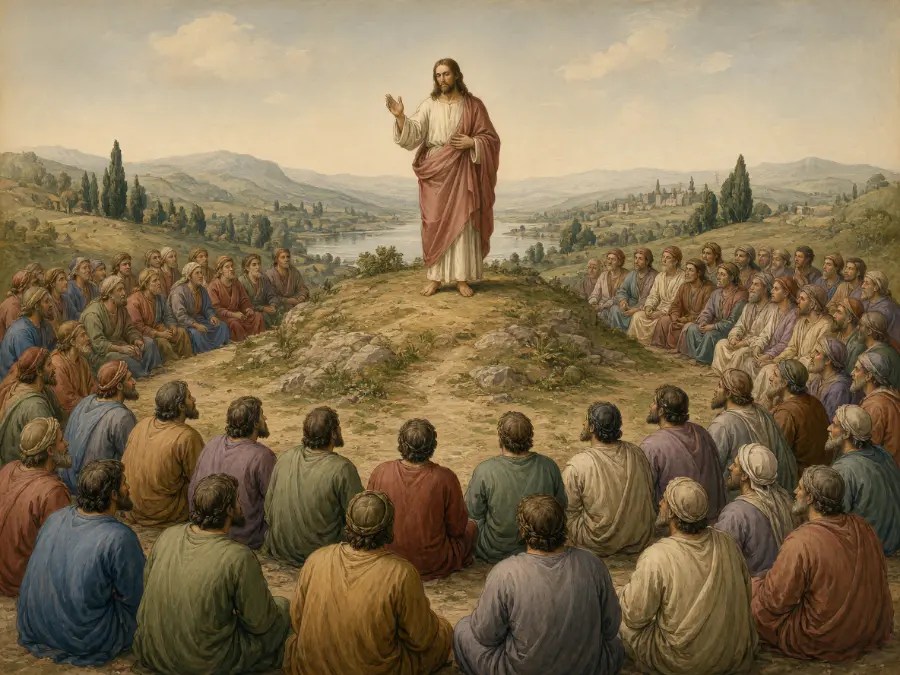
What did the ark of the covenant look like?
God gave Moses its design at Mount Sinai. The ark was a chest of acacia wood two and a half cubits long and a cubit and a half wide and high, overlaid with pure gold inside and out, with a gold molding around it (Exodus 25:10–11). A cubit is generally taken as about 18 inches, so the ark was roughly 3¾ feet long and 2¼ feet wide and high. Exodus names the craftsman who made it: “Bezalel made the ark of acacia wood” (Exodus 37:1).
Gold rings on its four feet held two gold-covered poles for carrying, and the poles stayed in place: “they shall not be taken from it” (Exodus 25:12–15). The lid, called the mercy seat, was a slab of pure gold the same length and width as the chest. Two cherubim of hammered gold, made in one piece with the lid, faced each other from its two ends, their wings “overshadowing the mercy seat” (Exodus 25:17–20).
Scripture calls it the ark of the testimony (Numbers 4:5), the ark of the covenant of the Lord (Numbers 10:33) and the ark of God (1 Samuel 4:22). The Hebrew word is ‘ārôn, a chest or box. Noah’s ark is a different word, tēḇâ, which also names the basket in which the infant Moses was placed. English uses “ark” for both because it comes from arca, “large box, chest,” the word in the Latin Bible.
What was inside the ark of the covenant?
God told Moses, “in the ark you shall put the testimony that I shall give you” (Exodus 25:21). The testimony was the two stone tablets of the Ten Commandments. After Moses broke the first pair, he cut two more and put them in the ark: “And there they are, as the Lord commanded me” (Deuteronomy 10:5).
Two other objects were kept with it. Aaron placed a jar of manna “before the testimony to be kept” (Exodus 16:34), and Moses was told to put Aaron’s staff “before the testimony” as a sign (Numbers 17:10). The Letter to the Hebrews says the ark held “a golden urn holding the manna, and Aaron’s staff that budded, and the tablets of the covenant” (Hebrews 9:4). When the ark was brought into Solomon’s temple, though, 1 Kings reports: “There was nothing in the ark except the two tablets of stone that Moses put there at Horeb” (1 Kings 8:9). The Book of the Law was kept outside it, “by the side of the ark” (Deuteronomy 31:26).
Why could no one touch the ark?
The ark was the place where God met his people. “There I will meet with you,” he told Moses, “and from above the mercy seat, from between the two cherubim that are on the ark of the testimony, I will speak with you” (Exodus 25:22). Scripture calls him “the Lord of hosts, who is enthroned on the cherubim” (1 Samuel 4:4). Once a year, on the Day of Atonement, the high priest carried blood inside the veil and sprinkled it “on the front of the mercy seat” (Leviticus 16:14–15, 34).
When Israel broke camp, the priests covered the ark with the veil, a goatskin and a blue cloth. Only then did the sons of Kohath, one of the Levite clans, carry it, and even they “must not touch the holy things, lest they die” (Numbers 4:5–6, 15). Two episodes show the rule in force. At Beth-shemesh, God struck seventy men “because they looked upon the ark of the Lord” (1 Samuel 6:19). When David moved the ark on a new cart and the oxen stumbled, Uzzah took hold of it, and “God struck him down there because of his error” (2 Samuel 6:6–7). The next time, David followed the law of Moses: “the Levites carried the ark of God on their shoulders with the poles, as Moses had commanded” (1 Chronicles 15:15).
Where did the ark travel?
The ark went ahead of the people. When they left Sinai, it “went before them three days’ journey, to seek out a resting place for them,” and whenever it set out, Moses said, “Arise, O Lord, and let your enemies be scattered” (Numbers 10:33, 35). At the Jordan, as soon as the feet of the priests carrying it touched the water, the river upstream “stood and rose up in a heap,” and Israel crossed on dry ground (Joshua 3:15–17). At Jericho, seven priests with trumpets went before the ark around the city until “the wall fell down flat” (Joshua 6:6, 20).
After a defeat by the Philistines, the elders sent for the ark from Shiloh “that it may come among us and save us from the power of our enemies” (1 Samuel 4:3). The Philistines captured it instead, and Eli’s daughter-in-law named her newborn son Ichabod, saying, “The glory has departed from Israel, for the ark of God has been captured” (1 Samuel 4:21–22). In the house of Dagon at Ashdod, the idol twice fell on its face before the ark (1 Samuel 5:2–4). The ark spent seven months in Philistine country (1 Samuel 6:1), then some twenty years at Kiriath-jearim (1 Samuel 7:1–2).
David brought it to Jerusalem. After Uzzah’s death he left it for three months in the house of Obed-edom, and “the Lord blessed Obed-edom and all his household” (2 Samuel 6:11). When the ark finally went up to the city, “David danced before the Lord with all his might” (2 Samuel 6:14). Solomon’s priests set it “in the inner sanctuary of the house, in the Most Holy Place, underneath the wings of the cherubim” (1 Kings 8:6). The last time Chronicles mentions it, King Josiah tells the Levites, “Put the holy ark in the house that Solomon the son of David, king of Israel, built” (2 Chronicles 35:3).
Where is the ark of the covenant now?
No one knows. The Babylonians burned the temple in 586 BC (2 Kings 25:9), and the list of what they carried away names bronze pillars, stands, pots and bowls, but not the ark (2 Kings 25:13–17). As Encyclopaedia Britannica says, “The final fate of the Ark is unknown.” Jewish tradition holds that it disappeared when Babylon sacked Jerusalem. The prophet Jeremiah had foreseen a day when “they shall no more say, ‘The ark of the covenant of the Lord.’ It shall not come to mind or be remembered or missed; it shall not be made again” (Jeremiah 3:16).
Several traditions try to answer the question. Second Maccabees, which Catholic and Orthodox Christians count as Scripture and Protestants place in the Apocrypha, says Jeremiah hid “the tent and the ark and the altar of incense” in a cave on the mountain where Moses “had seen the inheritance of God,” and declared, “The place shall be unknown until God gathers his people together again and shows his mercy” (2 Maccabees 2:4–7). The Mishnah records that after the ark was taken, a stone called the foundation stone stood in the Holy of Holies, three fingerbreadths high, and the high priest set the incense on it (Mishnah Yoma 5:2).
The Ethiopian Orthodox Tewahedo Church holds that the ark is in the Church of St. Mary of Zion in Aksum. Its account comes from the Kebra Negast, a 14th-century Ethiopian epic, in which companions of Menelik, the son of Solomon and the Queen of Sheba, take the ark from Jerusalem and Menelik brings it to Aksum. According to church leaders, its only custodian is a monk who may not leave the grounds until he dies, and not even Aksum’s high priest may enter its chamber. Every Ethiopian Orthodox church keeps a tabot, a sacred replica of the ark, in its own Holy of Holies. Because no one may examine it, Britannica calls the claim unverifiable, and it adds that most historians think the ark, if it existed, either disintegrated or was destroyed.
Is the ark mentioned in the New Testament?
The Greek word Hebrews uses for the mercy seat, hilastērion, is the word Paul uses for Christ in Romans, where the ESV translates it “propitiation”: Christ is the one “whom God put forward as a propitiation by his blood” (Romans 3:25). In John’s vision of heaven, “God’s temple in heaven was opened, and the ark of his covenant was seen within his temple” (Revelation 11:19).
Why is Mary called the ark of the covenant?
Catholic teaching calls Mary the ark of the covenant: “Mary, in whom the Lord himself has just made his dwelling, is the daughter of Zion in person, the ark of the covenant, the place where the glory of the Lord dwells” (Catechism of the Catholic Church, 2676). Luke’s account of Mary’s visit to Elizabeth shares details with the ark’s journey in 2 Samuel 6. David asked, “How can the ark of the Lord come to me?” (2 Samuel 6:9), and Elizabeth asks, “And why is this granted to me that the mother of my Lord should come to me?” (Luke 1:43). The ark stayed in the house of Obed-edom three months (2 Samuel 6:11), and Mary “remained with her about three months” (Luke 1:56).


Leave a Reply