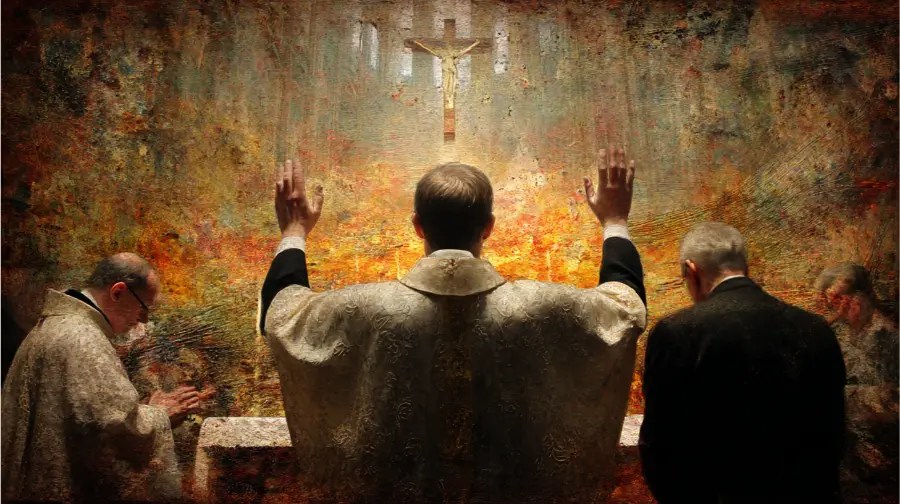
Lutherisch vs. Römisch-Katholisch: Ein Vergleich


  • Salvation and Authority: Lutherans emphasize salvation through faith alone (sola fide) and Scripture as the sole authority (sola scriptura). Catholics believe salvation involves faith and good works, recognizing Scripture, Tradition, and the Church’s teachings as authoritative.
  • Sacraments and the Eucharist: Catholics recognize seven sacraments, including transubstantiation (bread and wine becoming Christ’s body and blood) in the Eucharist. Lutherans typically recognize two or three, understanding Christ’s presence in the Eucharist as real but without defining the transformation.
  • Church Structure and Mary/Saints: The Catholic Church has a hierarchical structure with the Pope as its head, venerates Mary and the saints, and believes in their intercession. Lutheran churches are more decentralized, emphasizing the priesthood of all believers, and while honoring Mary and saints, do not pray to them.
  • Ecumenical Dialogue: Despite these differences, both traditions have engaged in significant ecumenical dialogue, leading to greater understanding and some reconciliation, particularly regarding justification. However, differences remain, such as the issue of shared communion.
This entry is part 22 of 40 in the series Katholizismus entmystifiziert

A Heartfelt Guide to Lutheran and Catholic Beliefs: Finding Unity in Understanding

Welcome, dear friend. If you are reading this, it is likely because the great story of Christian faith has touched your life in a powerful way. Perhaps you are a Lutheran in love with a Catholic, a Catholic with a Lutheran son-in-law, or simply a soul on a journey, seeking to understand the paths of your brothers and sisters in Christ. This journey into the heart of Lutheran and Catholic beliefs is not a debate to be won, but a family story to be understood. It is a story of a shared love for Jesus Christ, a common heritage, and a painful separation that, even after 500 years, still echoes in our churches and our homes.¹

For fifteen centuries, Western Christians were part of one, undivided family. The Protestant Reformation in the 16th century was a tragic and complex family split, born from a deep desire for reform and a passionate love for the Gospel.³ The wounds of that separation have been deep. Yet, in our own time, a new spirit has moved among us. Through prayer, dialogue, and a shared desire to follow Christ, Lutherans and Catholics have made monumental strides toward healing and understanding. Landmark agreements like the Joint Declaration on the Doctrine of Justification show us that what unites us is infinitely greater than what divides us.²

So let us walk this path together, not as adversaries, but as fellow pilgrims. Let us seek to understand each other’s deepest convictions with charity, to see the beauty in each other’s traditions, and to find, in our shared story, a deeper love for the One who calls us all by name.

Key Doctrinal Differences at a Glance

For those seeking a quick overview, the table below summarizes the core distinctions that we will explore with love and care throughout this guide. It serves as a helpful map for the journey ahead.

Doctrine/TopicCatholic BeliefLutheran Belief
Höchste AutoritätScripture, Sacred Tradition, and the Magisterium (teaching office of the Church). 7Allein die Schrift (Sola Scriptura). 7
RechtfertigungBy God’s grace through faith, which is active in love and good works. 10By God’s grace alone, through faith alone (sola fide). 10
Der PapstThe successor of St. Peter, with supreme, universal authority over the Church. 1A bishop of Rome, but without divine authority over the whole Church. 7
SakramenteSeven sacraments: Baptism, Confirmation, Eucharist, Penance, Anointing of the Sick, Holy Orders, Matrimony. 1Two primary sacraments: Baptism and the Lord’s Supper. Confession is often included as a third. 1
die EucharistieThe bread and wine become the true Body and Blood of Christ (Transsubstantiation). 17Christ is truly present “in, with, and under” the bread and wine (Sacramental Union). 17
Mary & the SaintsVeneration (Hyperdulie for Mary, Dulie for saints) and prayer for their intercession is a cherished practice. 20Honored as examples of faith, but prayer is directed to God alone. 1
JenseitsHeaven, Hell, and a temporary state of final purification called Purgatory. 1Heaven and Hell. The doctrine of Purgatory is rejected. 7

Where Do We Begin? A Shared History and a Painful Split

To understand the differences between Lutherans and Catholics, we must first appreciate their shared story. For a millennium and a half, there was no “Lutheran” or “Roman Catholic” as we know them today; there was simply the Western a vast and varied family united in its profession of the apostolic faith.¹ Both traditions trace their lineage directly back to Jesus Christ and the apostles He chose. They share the same foundational Scriptures, the same ancient creeds (the Apostles’, Nicene, and Athanasian Creeds), and the same heritage of the early Church Fathers.²⁶ This is not a story of two different religions, but of two expressions of one faith that grew from a single, ancient root.

The story of their separation begins with a man named Martin Luther. It is easy to caricature him, but to do so misses the heart of the story. Luther was not a revolutionary seeking to start a new church; he was a devout Augustinian monk, a brilliant professor of the Bible, and a soul tormented by a deep, personal question: “How can I, a sinner, be right with a holy God?”.⁴ His spiritual anxiety was amplified by practices he witnessed in the Church of his day, particularly the sale of “indulgences.” These were certificates promoted as a way to reduce the temporal punishment for sins, either for oneself or for a loved one believed to be in Purgatory.²⁹ To Luther, this practice seemed to make God’s forgiveness a commodity to be bought and sold, cheapening the powerful sacrifice of Christ and the need for true, heartfelt repentance.²⁹

On October 31, 1517, in an act that was common for academics of his day, Luther posted his Ninety-five Theses on the door of the Castle Church in Wittenberg, Germany.⁴ These were points for scholarly debate, written in Latin, challenging the theological underpinnings of indulgences. He had no idea of the firestorm he was about to ignite. But his questions touched a nerve across Europe. Aided by the revolutionary new technology of the printing press, the theses were translated into German and spread with astonishing speed.³ What began as a call for academic debate became a continent-wide movement for reform.

The situation escalated quickly. The Church demanded that Luther recant his teachings. The pivotal moment came in 1521 at the Diet of Worms, a formal assembly of the Holy Roman Empire.³² Standing before Emperor Charles V, the most powerful man in Europe, Luther was presented with his writings and asked a simple question: would he recant? In a moment of world-changing courage, Luther refused, famously declaring that unless he could be convinced by Scripture and plain reason, his conscience was captive to the Word of God. He could not and would not go against his conscience.³³ With this stand, the formal break became inevitable. Luther was declared a heretic and an outlaw, and the Edict of Worms condemned his teachings.³²

The survival of Luther and his movement was not merely a matter of theological conviction; it was also a matter of politics and technology. Unlike earlier reformers who were swiftly executed, Luther was protected by powerful German princes, like Frederick the Wise, who had their own political reasons for challenging the authority of the Pope and the Emperor.³⁴ This protection gave the Reformation time to take root and flourish.

The Catholic Church responded to this powerful challenge with its own period of intense reform, often called the Counter-Reformation. From 1545 to 1563, the Church convened the Council of Trent. This council addressed many of the corruptions and abuses that had fueled the Reformation in the first place, such as instituting better education for priests. At the same time, it decisively rejected the Protestant theological positions and authoritatively defined Catholic doctrine on the very issues Luther had raised.³⁶ The Council of Trent clarified Catholic teaching for centuries to come and, in so doing, solidified the walls of division that had now been erected between these two Christian families.³⁸

How Do We Know God’s Truth? The Bible, Tradition, and Authority

At the very heart of the divide between Lutherans and Catholics lies a fundamental question: How do we know what is true? Where does ultimate authority reside in the life of the Church? The different answers to this question form the foundation upon which almost all other disagreements are built. To understand this is to hold the key to understanding the entire landscape of their differences.

The Lutheran Foundation: Sola Scriptura (Scripture Alone)

For Lutherans, the answer is clear and singular: the Holy Scriptures of the Old and New Testaments are the only source and standard for Christian faith and life. This principle is known by the Latin phrase Sola Scriptura, meaning “Scripture alone”.⁷ This does not mean that Lutherans disregard tradition, the wisdom of the early Church Fathers, or the historic creeds. On the contrary, they hold these in high esteem.⁴⁰ But they believe that all traditions, all councils, and all teachings of any pastor or theologian must be judged by the ultimate standard of the Word of God.⁴¹ The Bible is the “norming norm” ( norma normans)—the rule that judges all other things.

Lutheran churches have a collection of confessional documents from the Reformation era, such as the Augsburg Confession and Luther’s Catechisms, which are gathered in the Konkordienbuch.²⁷ These confessions are deeply cherished, and pastors pledge to teach in accordance with them. But these documents are not seen as a second source of authority equal to the Bible. Instead, they are considered a faithful and correct exposition of what the Bible teaches. They are the “normed norm” ( norma normata)—a standard that is itself judged and validated by Scripture.²⁷

The Catholic Foundation: Scripture, Sacred Tradition, and the Magisterium

The Catholic Church understands the transmission of God’s truth differently. Its foundation is often described as a “three-legged stool,” with each leg essential for stability: Sacred Scripture, Sacred Tradition, and the Magisterium (the teaching authority of the Church).¹

Catholics believe that the Word of God—the divine revelation given to us in Jesus Christ—is transmitted in two ways. The first is through the written word, which is Sacred Scripture. The second is through the living, oral word, which is Sacred Tradition.⁴⁶ This Tradition is the faith that Jesus entrusted to the Apostles, which they in turn “handed on” (the literal meaning of “tradition”) to their successors through their preaching, their example, and the life of the early Church.⁴⁸ The Katechismus der Katholischen Kirche teaches that Scripture and Tradition flow from the “same divine well-spring” and are to be “accepted and honoured with equal sentiments of devotion and reverence”.⁴⁶

It is vital to distinguish this “big-T” Tradition from “little-t” traditions, which are the customs, disciplines, and devotional practices that can change over time, like styles of priestly vestments or specific forms of prayer.⁴⁶ Sacred Tradition, in contrast, is part of the unchangeable deposit of faith.

The third leg of the stool is the Magisterium. This is the living teaching office of the embodied by the bishops in communion with the Pope.¹ Catholics believe that Christ gave the Magisterium the unique authority to authentically interpret the Word of God, whether it is found in Scripture or Tradition. The Magisterium is not the master of God’s Word, but its servant, charged with faithfully guarding and explaining the one “deposit of faith” for every generation.⁸

This foundational difference in authority is the wellspring from which most other doctrinal disagreements flow. Consider, for example, the doctrine of Purgatory. A Catholic will point to passages in Scripture that seem to suggest a post-death purification, such as in 1 Corinthians 3, and to the ancient practice of praying for the dead, found in books like 2 Maccabees and in the early Church’s life.⁵⁰ For them, the authority of Sacred Tradition and the Magisterium allows the Church to definitively interpret these sources and define Purgatory as a doctrine. A Lutheran, applying the principle of Sola Scriptura, will argue that the evidence in the canonical Bible is not clear enough to establish such a doctrine.²⁴ They do not consider 2 Maccabees to be part of the inspired canon of Scripture and believe that passages like 1 Corinthians 3 can be interpreted differently. Without a clear biblical mandate, they cannot accept Purgatory as a required belief. The same pattern holds true for doctrines concerning the papacy, the number of sacraments, and the dogmas about the Virgin Mary. Each disagreement, when traced to its root, ultimately leads back to this fundamental question: Is the Bible the sole infallible authority, or does it stand alongside Sacred Tradition and the teaching Church as part of a three-fold channel of God’s truth?

How Are We Saved? The Deeply Personal Question of Justification

No question was more central to Martin Luther’s soul, and to the entire Reformation, than this: How is a sinful person made right with a holy and just God? This doctrine, known as justification, is called the “material principle” of the Reformation because it deals with the very substance of the Gospel message. While both Lutherans and Catholics agree that we are saved by God’s grace through Christ, their understanding of wie that grace works in our lives reveals a powerful and deeply personal difference in spiritual emphasis.

The Lutheran Heartbeat: sola fide (Faith Alone)

For Lutherans, justification is a beautiful and liberating legal declaration. They see it as a “forensic” act, meaning it takes place in the courtroom of heaven.²⁴ God the Father, the righteous Judge, looks upon a sinful human being, who by their own merits deserves only condemnation. But because of Jesus Christ’s perfect life and sacrificial death, God declares that sinner to be righteous.⁵² This righteousness is not something that comes from within the person; it is Christ’s own perfect righteousness, which is angerechnet, or credited, to the believer’s account.¹² It is as if the sinner stands before the judge clothed in the perfect righteousness of Christ Himself.

This incredible gift is received by one means alone: faith. This is the principle of sola fide, or “faith alone”.⁷ For Lutherans, faith is not a good work we perform to earn salvation. Rather, it is like an empty, open hand that simply receives the free gift that God offers.⁵⁴ It is trust in the promise of God that, for Christ’s sake, our sins are forgiven and we are accepted as His beloved children.

This leads to a crucial clarification that is often misunderstood. When Lutherans say “faith alone,” they do not mean that a Christian’s life will be devoid of good works. Martin Luther himself famously said, “Faith alone saves, but faith is never alone”.⁷ A true, living faith will inevitably and spontaneously produce good works of love and service to the neighbor, just as a healthy apple tree naturally produces apples.¹² These good works are the beautiful and necessary Frucht und Beweis of a justified life, but they are never the verursacht oder root of it.⁵⁶

The Catholic Understanding: A Lifelong Journey of Grace

The Catholic Church understands justification not just as a legal declaration, but as a powerful inner transformation. The Katechismus der Katholischen Kirche teaches that justification is “not only the remission of sins, but also the sanctification and renewal of the interior man”.⁵⁷ Through the sacrament of Baptism, God’s own divine life and love—what theology calls “infused grace”—is poured into the soul.⁵⁸ This grace cleanses the soul from sin and makes the person truly, inwardly righteous and a participant in the divine nature.¹⁰

For Catholics, faith is the absolute beginning, the foundation, and the root of justification. Without faith, it is impossible to please God.⁵⁹ But this faith is not a static event but the start of a lifelong journey. To be saving, faith must be a fides caritate formata—a faith that is “formed by” or “active in” love.⁵⁵ As the Apostle James writes, “faith by itself, if it does not have works, is dead” (James 2:17). Aided by God’s continual grace, the good works a believer does in love are not merely evidence of salvation; they are a genuine cooperation with God’s grace that can “merit” for us and for others an increase in holiness and the gift of eternal life.¹¹ This is not seen as “earning” salvation by one’s own power—an idea the Church has always condemned—but as a free and loving response to the grace that God has already freely given.⁵⁸

A Bridge of Hope: The Joint Declaration

For nearly 500 years, this difference over justification was the source of the most bitter condemnations between the two traditions. But in an act of powerful reconciliation, on October 31, 1999, the Lutheran World Federation and the Catholic Church signed the Joint Declaration on the Doctrine of Justification.⁶ This historic document declared a consensus on the basic truths of this core doctrine. Its central, unifying statement proclaims: “By grace alone, in faith in Christ’s saving work and not because of any merit on our part, we are accepted by God and receive the Holy Spirit, who renews our hearts while equipping and calling us to good works”.⁵ This showed the world that much of the historic conflict was rooted in different language and emphasis, rather than a contradiction on the most fundamental truth of God’s saving grace. It must be noted, with pastoral sensitivity, that some more conservative Lutheran bodies, such as The Lutheran Church—Missouri Synod, did not sign the declaration, believing that major differences still remain, particularly over the Catholic understanding of infused grace and merit.⁶²

The different theological approaches to justification can shape the inner spiritual life of a believer in powerful ways. Personal stories from those who have moved between the two traditions often reveal this. Some who have journeyed from Catholicism to Lutheranism speak of being “wracked with anxiety” over the state of their soul, constantly fearing mortal sin and never feeling the peace of forgiveness. For them, the Lutheran teaching of a salvation already completed and secured by Christ comes as a powerful and liberating relief, a true “coming up for fresh air”.⁶³ Conversely, some who have made the journey from Lutheranism to Catholicism express a feeling that their former faith lacked a strong “incentive to amend your life.” They are drawn to the Catholic call to actively cooperate with God’s grace in a lifelong, transformative journey of becoming holier.⁶⁴ This reveals a beautiful tension in Christian spirituality. The Lutheran emphasis provides a deep and powerful sense of Gewissheit—a rest in the finished work of Christ. The Catholic emphasis provides a deep and powerful impetus for transformation—a call to a dynamic journey with Christ. Both speak to a powerful human need and a deep truth about our relationship with God.

Who Leads the Church on Earth? Understanding the Pope’s Role

After the questions of authority and salvation, perhaps no issue more visibly distinguishes Catholics and Lutherans than their view of the papacy. This is not simply a matter of church organization; it touches on the very nature of the its unity, and its leadership as established by Christ. The Roman Catholic Church sees the papacy as a divinely instituted authority, with the pope as the successor of Saint Peter holding a unique role in guiding the universal church. In contrast, Lutherans tend to view the church’s authority as residing in the Word of God rather than in a singular papal figure, advocating for a more decentralized leadership structure. This fundamental difference highlights the broader theological debates between the two traditions, leading to discussions around ‘römisch-katholisch vs. katholisch erklärt‘ in terms of scriptural interpretation and church governance.

The Catholic View: The Successor of Peter, the Vicar of Christ

For Catholics, the Pope is far more than just the bishop of the city of Rome. He is the successor to the Apostle Peter, the “rock” upon whom Jesus promised to build His Church.⁶⁵ In the Gospel of Matthew, Jesus says to Simon, “You are Peter, and on this rock I will build my and the gates of hell shall not prevail against it. I will give you the keys of the kingdom of heaven” (Matthew 16:18-19). Catholics understand this to mean that Christ established a unique office of leadership in Peter, which has been passed down through an unbroken line of succession to the present-day Pope.¹

The Pope, therefore, holds a position of “full, supreme, and universal power over the whole Church”.¹³ He is the “Vicar of Christ,” meaning he acts as Christ’s earthly representative and shepherd of the entire flock.¹³ He is the visible source and foundation of unity for all the bishops and for all the faithful.⁶⁵ This authority includes a special divine protection from error known as “papal infallibility.” This does not mean the Pope is without sin or that his every utterance is perfect. It is a specific charism that applies only when he, in his official capacity as supreme pastor, solemnly proclaims a definitive doctrine concerning faith or morals.¹³ This is understood as Christ’s promise to keep His Church from straying from the truth.

The Lutheran View: Christ is the Only Head

Lutherans, in contrast, confess that Jesus Christ is the one and only Head of the Church.²⁶ Although they acknowledge the historical role of the bishop of Rome, they do not believe that the office of the papacy as it exists today was divinely instituted by Christ or that the Pope holds any divine authority over all of Christianity.⁷ For Lutherans, the “rock” upon which the Church is built is not Peter the man, but Peter’s confession of faith: “You are the Christ, the Son of the living God.”

The Lutheran Confessions, written during the heat of the 16th-century conflict, are particularly forceful on this point. The Smalcald Articles, written by Martin Luther himself, identify the papacy of his day as the Antichrist.¹⁴ This strong language can be jarring to modern ears, but it’s essential to understand its theological context. For the Reformers, the Pope had become the Antichrist because he had, in their view, usurped the unique role of Christ by demanding obedience to himself and his office as necessary for salvation.¹⁴ By placing the institution of the papacy between the believer and Christ, he was acting “against Christ.” While many Lutherans today would use more ecumenical language, the core theological conviction remains: no human being or office can claim the headship that belongs to Christ alone.

The disagreement over the papacy reflects two different understandings of the Church itself. The Catholic view of the papacy is essential to its understanding of the Church as a single, visible, hierarchical institution, whose unity and doctrinal integrity are guaranteed by the apostolic succession passed down through the bishops in communion with the Pope.⁷¹ The Lutheran view, with its emphasis on the “priesthood of all believers,” understands the true Church to be the “assembly of saints in which the Gospel is taught purely and the sacraments are administered rightly”.⁷³ For them, the Church’s unity is not guaranteed by a human office, but by the invisible work of the Holy Spirit wherever the pure Word of God is proclaimed. The debate over the Pope, therefore, is fundamentally a debate about what holds the Church together: a visible, hierarchical office, or the invisible power of the Gospel itself. This divergence in understanding leads to a broader discussion about the nature of authority and tradition within Christianity, influencing not just these two perspectives, but also the myriad of catholicism branches and sects that have emerged over time. Each group navigates the tension between adherence to visible structures and the pursuit of spiritual authenticity in diverse ways. Ultimately, this ongoing dialogue reflects the complexities of faith and community, as well as the varying interpretations of what it means to be part of the Church.

How Do We Experience God’s Grace? A Look at the Sacraments

Both Lutherans and Catholics share a powerful, sacramental view of the Christian faith. They both believe that God uses physical, tangible things—water, bread, wine—as channels for His divine and invisible grace. For both traditions, sacraments are not merely symbolic reminders; they are sacred acts, instituted by Christ Himself, that truly convey what they signify, strengthening faith and uniting the believer to God.⁷⁴ Where they differ is in how many such rites can properly be called sacraments, a difference that flows directly from their foundational views on authority.

Die sieben katholischen Sakramente

The Catholic Church recognizes seven sacraments, which are seen as marking the key moments and stages of a Christian’s life, from birth to death.¹⁵ They are:

  1. Taufe: The gateway to all other sacraments, it frees from sin, makes one a child of God, and incorporates them into the Church.¹⁵
  2. Firmung: Strengthens the baptized with the gifts of the Holy Spirit, perfecting the grace of Baptism and empowering the person for Christian witness.¹⁵
  3. Eucharist: Considered the “source and summit of the Christian life,” it is the true Body and Blood of Christ, which nourishes the soul and unites the Church.¹⁵
  4. Penance (or Reconciliation): Offers the forgiveness of sins committed after Baptism through the absolution of a priest.¹
  5. Krankensalbung: Provides grace, strength, and comfort to those who are seriously ill or in danger of death.¹
  6. Weihesakrament (Priesterweihe): Consecrates men as bishops, priests, or deacons to serve the Church in the person of Christ.¹
  7. Ehe: A sacred covenant that unites a man and a woman in a lifelong partnership, signifying the union of Christ and the Church.¹

The Church teaches that these seven rites are efficacious signs of grace, instituted by Christ and entrusted to the through which divine life is dispensed.⁷⁹ The identification of these seven sacraments comes from the Church’s careful reflection on both Scripture and its own living Sacred Tradition over many centuries.

The Lutheran Sacraments

The Lutheran Reformers, applying the principle of Sola Scriptura, developed a stricter definition of a sacrament. For something to be considered a sacrament in the fullest sense, they argued, it must meet three criteria: it must be a physical or visible sign, it must have been directly instituted by Christ in the Gospels, and it must be connected to a clear promise of the forgiveness of sins.¹⁶

Based on this more narrow definition, Lutherans identify two rites as sacraments without any reservation:

  1. Taufe: Commanded by Christ, using the visible sign of water, and connected to the promise of regeneration and forgiveness.¹
  2. The Lord’s Supper (or Eucharist): Instituted by Christ, using the visible signs of bread and wine, and connected to His promise, “given and shed for you for the forgiveness of sins”.¹

Many Lutherans also speak of a third sacrament: Confession and Absolution. Although It lacks a unique visible sign like water or bread, it has the direct command of Christ (John 20:23) and the clear promise of forgiveness, and so is often held in the same high regard.¹⁶

What about the other four rites that Catholics call sacraments? Lutherans hold them as valuable and holy practices within the but not as sacraments in the same sense. Confirmation is a valuable rite for publicly affirming one’s baptismal faith. Marriage is a holy institution blessed by God. Ordination is the necessary public call to the ministry of Word and Sacrament. But in the Lutheran view, these rites, while sacred, do not have a visible sign attached to a specific promise of forgiveness in the way that Baptism and the Lord’s Supper do.¹⁶

This difference in the Anzahl of sacraments is a perfect illustration of the difference in Autorität. The Catholic drawing on the combined witness of Scripture and Sacred Tradition, identifies seven channels of grace. The Lutheran holding to Scripture alone as the definitive source, identifies two (or three) that meet its strict biblical criteria. What may seem like a simple disagreement over numbers is, in fact, a powerful demonstration of the two different ways these traditions approach the very foundation of Christian truth.

What Happens During Holy Communion? The Mystery of the Eucharist

There is perhaps no moment in Christian worship more sacred, more mysterious, or more central than Holy Communion. And Although It has been a source of painful division, it is also a place of powerful and surprising agreement between Catholics and confessional Lutherans. Both traditions passionately reject the idea that the Eucharist is merely a symbol or a memorial. Both firmly believe in what is called the Real Presence: that in the Lord’s Supper, we truly and substantially receive the very Body and Blood of Jesus Christ for the forgiveness of our sins.¹⁷ The difference, nuanced but major, lies in wie they understand this mystery to occur.

The Catholic Doctrine: Transubstantiation

To explain the mystery of the Real Presence, the Catholic Church uses the term Transsubstantiation.¹⁷ This is a philosophical term, drawing on the thought of Aristotle, that distinguishes between the “substance” of a thing and its “accidents.” The Substanz is the fundamental reality of what something is, its essential “what-it-is-ness.” The accidents are its external, physical properties that we can perceive with our senses—its look, taste, feel, and smell.¹⁸

Catholic teaching holds that during the Eucharistic Prayer at Mass, when the priest speaks the words of consecration that Jesus spoke at the Last Supper, the Substanz of the bread and wine is completely and totally changed into the substance of the Body, Blood, Soul, and Divinity of Jesus Christ.¹⁸ The accidents of bread and wine, But remain unchanged. So, Although It continues to look, taste, and feel like bread and wine, its deepest reality is no longer bread and wine, but the living Christ Himself.¹⁷

This belief that the change is complete and permanent has important practical consequences. Because the consecrated bread and wine SEID the Body and Blood of Christ in their very substance, the remaining Hosts are reserved with great reverence in a special locked box called a tabernacle.¹⁷ This Real Presence in the tabernacle becomes a focal point for prayer and devotion, leading to the cherished Catholic practice of Eucharistic Adoration, where the faithful pray in the presence of the reserved sacrament.⁸²

The Lutheran Doctrine: Sacramental Union

Lutherans also believe with all their hearts that Christ is truly present in the Lord’s Supper. But they do not attempt to explain the mechanics of the mystery with philosophical categories. They prefer the term Sacramental Union.¹⁷ This doctrine affirms that Christ’s true Body and Blood are present “in, with, and under” the consecrated bread and wine.¹⁹ In this sacred union, the bread remains truly bread and the wine remains truly wine, but at the same time, they are the true carriers of the Body and Blood of Christ, received by the communicant.⁸²

Lutherans strongly reject the term consubstantiation, which is often mistakenly used to describe their view.⁸¹ They see this as another human philosophical explanation that tries to rationalize a divine mystery. For Lutherans, it is enough to trust the plain and powerful words of Jesus: “This is my body… This is my blood”.¹⁹ How this is so is a sacred mystery that we are to believe, not explain.

This understanding also has practical consequences. Since the Real Presence is tied to the sacramental action of eating and drinking as Christ commanded, Lutherans traditionally do not reserve the consecrated elements after the service is over. Any remaining bread and wine are reverently consumed by the pastor or assistants.¹⁷ Because the presence is for the use within the Divine Service, the practice of Eucharistic Adoration is not part of the Lutheran tradition.

With pastoral sensitivity, it is also important to acknowledge the Catholic Church’s position on the validity of these services. Because the Catholic Church holds that a valid Eucharist requires a priest ordained in the line of apostolic succession, it does not recognize the Lutheran celebration as a valid sacrament, even while acknowledging the sincere faith of Lutherans in Christ’s presence.⁸⁴

These theological distinctions, while subtle, create visibly different cultures of worship. The Catholic belief in an enduring change leads to the tabernacle, the sanctuary lamp, and the practice of adoration—tangible expressions of a permanent presence. The Lutheran focus on the sacramental act itself leads to a piety centered on the reception of the elements during the Divine Service. In this way, the abstract theology of the Eucharist becomes a lived and felt reality in the pews.

What is the Catholic Church’s Official Stance on Scripture and Tradition?

To truly grasp the Catholic worldview, it is essential to understand its teaching on how God’s revelation is passed down through the ages. This is not a matter of opinion but is clearly and authoritatively laid out in the Katechismus der Katholischen Kirche. This section will explore that official teaching, which forms the basis for so many other Catholic beliefs and practices.

The foundation of the Catholic position is that God’s Word comes to us through a single divine source that flows in two distinct but inseparable streams: Sacred Scripture and Sacred Tradition. The Katechismus uses a beautiful image to explain this: “‘Sacred Tradition and Sacred Scripture, then, are bound closely together, and communicate one with the other. For both of them, flowing out from the same divine well-spring, come together in some fashion to form one thing, and move towards the same goal’” (CCC 80).⁴⁶ They are not two competing sources of truth, but two modes of transmitting the one Word of God. This foundational understanding highlights the unity of Sacred Scripture and Sacred Tradition in the Catholic faith, contrasting with other Christian denominations. In discussions of presbyterianischen und katholischen Glaubensvorstellungen im Vergleich, one often finds that while both uphold the authority of Scripture, Catholics emphasize Tradition’s role in interpreting and safeguarding the faith. This difference illustrates the broader theological divergence in how these communities perceive the transmission of divine revelation.

Sacred Scripture is defined as “the speech of God as it is put down in writing under the breath of the Holy Spirit” (CCC 81).⁴⁸ Sacred Tradition, on the other hand, “transmits in its entirety the Word of God which has been entrusted to the apostles by Christ the Lord and the Holy Spirit” (CCC 81).⁴⁸ This includes everything the apostles received from Jesus’ teaching and example, and what they learned from the Holy Spirit. It was this living, breathing Tradition that sustained the first generation of Christians before the New Testament was even written.⁴⁶

Because of this, the Church “does not derive her certainty about all revealed truths from the holy Scriptures alone. Both Scripture and Tradition must be accepted and honoured with equal sentiments of devotion and reverence” (CCC 82).⁴⁷ This is a pivotal point. From the Catholic perspective, to limit God’s revelation to only what was written down is to ignore the living voice of the Gospel that has resounded in the Church from the very beginning.

Das Katechismus makes a crucial distinction between this unchangeable Apostolic Tradition (often called “big-T” Tradition) and the various “theological, disciplinary, liturgical or devotional traditions” (often called “little-t” traditions) that have developed in local churches over time (CCC 83).⁴⁶ These smaller traditions, like clerical celibacy in the Western Church or specific styles of liturgical music, can be retained, modified, or even abandoned under the guidance of the Church’s teaching authority. Apostolic Tradition, But is part of the permanent “deposit of faith” and cannot be changed.

Who, then, has the authority to interpret this deposit of faith? The Katechismus is unequivocal: “‘The task of giving an authentic interpretation of the Word of God, whether in its written form or in the form of Tradition, has been entrusted to the living teaching office of the Church alone’” (CCC 85).⁸ This teaching office, the Magisterium, consists of the bishops in communion with the Pope. It is important to understand that the Magisterium is not above the Word of God, but is its servant. It “teaches only what has been handed on to it” (CCC 86).⁴⁹

This entire framework rests on a particular understanding of history. The Catholic Church sees itself as the community that was born from the life and teaching of Christ and the Apostles. This living community, guided by the Holy Spirit, existed vor the New Testament was finalized. It was this living drawing on its own Tradition, that discerned over several centuries which books were truly inspired by God and belonged in the canon of Scripture.⁸ Therefore, from a Catholic viewpoint, the Bible is the book of the Church. The Church is the mother who gave birth to the New Testament, not the child created by it. To then take the Bible and use it as the sole rule to judge the very Church that produced and canonized it is seen not just as a theological error, but as a logical contradiction. This historical understanding is the key to why the Catholic Church cannot accept the principle of Sola Scriptura.

What is the Role of Mary and the Saints in Our Faith Journey?

For many people exploring the differences between Catholicism and Lutheranism, the role of the Blessed Virgin Mary and the saints can be a source of both confusion and fascination. The practices of prayer and devotion look very different from the outside, but they flow logically from the core theological principles of each tradition.

The Catholic View: The Great Cloud of Witnesses

The first and most important thing to understand about the Catholic view is a point of clarification: Catholics do not worship Mary or the saints. Worship and adoration are reserved for God alone.²¹ To make this distinction clear, Catholic theology uses precise terms. Latrie is the adoration and worship that is due to the Triune God alone. Dulie is the honor and veneration given to the who are heroic examples of faith and virtue. And Hyperdulie (meaning “super-veneration”) is the unique and special honor given to the Blessed Virgin Mary, because of her unique role as the Theotokos, the God-bearer or Mother of God.²⁰

This veneration is rooted in the belief in the “Communion of Saints,” which is professed in the Apostles’ Creed. This doctrine teaches that the Church is one family, united in Christ, spanning heaven, earth, and purgatory.⁵⁵ Just as a Christian on earth might ask a friend or pastor to pray for them, Catholics believe they can ask their friends and family members who are now in heaven—the saints—to pray for them as well. This is not seen as bypassing Christ, the one Mediator, but as approaching Him surrounded by the prayers of the whole family of God.⁸⁷

Mary holds a special place within this communion. Because she was chosen by God for the singular role of bearing His Son, she is seen as the greatest of all saints.⁸⁸ Catholic teaching, drawing on Sacred Tradition, holds several dogmas about her that highlight her unique grace: her Immaculate Conception (that she was conceived without original sin), her Perpetual Virginity, and her Assumption (that at the end of her earthly life, she was taken body and soul into heaven).⁴⁰ All of these honors are understood not for her own sake, but in light of her relationship to her Son, Jesus.²¹

The Lutheran View: Honored Examples of Faith

Lutherans also hold the and especially the Virgin Mary, in high honor. They are seen as inspiring examples of God’s grace at work in the lives of ordinary, sinful people.¹ Their lives are to be remembered and their faith emulated. The Lutheran Confessions themselves speak of Mary in the most exalted terms, affirming her as the Theotokos (Mother of God) and acknowledging her perpetual virginity, a belief Martin Luther himself held throughout his life.⁹⁰

The key difference lies in the practice of prayer. Following the principle of Sola Scriptura, Lutherans teach that prayer is to be directed to the Triune God alone, through the one and only Mediator between God and humanity, Jesus Christ (1 Timothy 2:5).²² Because they find no command or clear example in the Bible of praying to saints or asking for their intercession, they do not practice it.²² Although they believe the saints in heaven pray for the Church as a whole, they do not direct personal petitions to them.

Once again, this difference in devotional practice is a direct consequence of the foundational disagreement on authority. The Catholic dogmas concerning Mary, such as the Immaculate Conception and the Assumption, were formally defined by Popes based on the authority of centuries of Sacred Tradition. The practice of invoking the saints is likewise a “big-T” Tradition of the Church. Lutherans, bound by their commitment to Scripture alone as the source of doctrine, cannot accept these beliefs as necessary for all Christians, because they do not find them explicitly taught in the Bible. What appears as a difference in piety is, at its root, another manifestation of the fundamental divergence over how God’s truth is known and defined.

What Happens After We Die? Beliefs About Purgatory, Heaven, and Hell

The question of our final destiny is one that touches the deepest parts of the human heart. Both Lutheran and Catholic traditions stand together in the great Christian hope of the resurrection and eternal life, and both affirm the solemn reality of a final judgment that leads to either the eternal joy of Heaven or the eternal tragedy of Hell.²⁶ But they differ significantly on what may happen for some souls in the transition between their earthly death and their final entry into heavenly glory. This difference centers on the Catholic doctrine of Purgatory.

The Catholic Doctrine of Purgatory

For Catholics, Purgatory is not a “third place” alongside Heaven and Hell, nor is it a “second chance” for salvation.²³ Rather, the Katechismus der Katholischen Kirche defines it as a “final purification of the elect”.⁹⁴ It is a state for those “who die in God’s grace and friendship, but still imperfectly purified”.⁹⁵ These souls are already saved and are assured of their eternal salvation, but they are not yet ready to enter the full joy of Heaven, because, as Scripture teaches, “nothing unclean will enter it” (Revelation 21:27).⁹⁵

The purpose of this purification is to cleanse the soul of two things: any remaining venial (lesser) sins, and what is called the “temporal punishment” due to sins that have already been forgiven.⁹⁴ Catholic teaching holds that even when a grave sin is forgiven, it can leave behind an “unhealthy attachment to creatures” that needs to be healed. This purification is a manifestation of God’s intense love, a cleansing fire that burns away all that is not of Him, so that the soul can experience the unmitigated joy of seeing God face-to-face.⁹⁶

The Church finds the basis for this doctrine in both Scripture and Tradition. Passages like 1 Corinthians 3:15, which speaks of a righteous person being “saved, but only as through fire,” are seen as pointing to such a purifying state.⁵⁰ the ancient practice of praying for the dead, which is explicitly commended in the deuterocanonical book of 2 Maccabees (12:46), implies that the dead can be helped by our prayers. Such prayers would be unnecessary for those in Heaven and futile for those in Hell, suggesting an intermediate state where they can be of benefit.⁵⁰

The Lutheran Rejection of Purgatory

Lutherans reject the doctrine of Purgatory for two primary reasons, both of which flow directly from the core principles of the Reformation.

The first reason is Sola Scriptura. Lutherans argue that the doctrine of Purgatory as taught by the Catholic Church is not found in the canonical books of the Bible.²⁴ The primary text used to support it, 2 Maccabees, is part of the Apocrypha, which Lutherans consider useful for reading but not authoritative for establishing doctrine.²⁴ Without what they see as clear scriptural support, they cannot accept it as a necessary Christian belief.

The second and more powerful reason is sola fide. The doctrine of Purgatory is seen as a direct challenge to the complete sufficiency of Christ’s atoning work on the cross.⁵¹ If a believer is justified by faith alone, and is clothed in the perfect righteousness of Christ, then upon death, they are ready for heaven. There is no further punishment to be endured or purification to be undergone, because Christ endured it all.²⁴ To suggest that something more is needed after death seems to diminish the “It is finished” reality of the cross. As Jesus said to the penitent thief, “Today you will be with me in paradise” (Luke 23:43), with no mention of an intermediate state of purification.⁹⁷

This disagreement over the afterlife is, at its core, a disagreement about the nature of salvation itself. The Catholic belief in Purgatory is the logical conclusion of their understanding of justification as a lifelong process of transformation. If that transformation into holiness is incomplete at the moment of death, it must be brought to completion before one can enter the perfect holiness of heaven.⁹⁶ The Lutheran rejection of Purgatory is the logical conclusion of their understanding of justification as a forensic declaration. The believer is saved and welcomed into heaven not based on their own level of achieved holiness, but solely on the basis of the perfect, imputed righteousness of Christ, which is fully credited to them by faith.²⁴ Thus, what we believe about the end of our journey is shaped entirely by what we believe about how that journey of salvation works.

How Do Our Churches Worship? A Comparison of the Mass and the Divine Service

For many Christians, theology can feel abstract, but it becomes wonderfully tangible in the act of worship. The liturgy is where belief takes on flesh and blood, where doctrines are sung, prayed, and enacted. A visitor walking into a traditional Catholic Mass and then into a traditional Lutheran Divine Service might be struck more by the similarities than the differences. This is because both traditions are heirs to the same ancient Western liturgical heritage, a pattern of worship that has been prayed for nearly two millennia.¹ Both services are structured around two great pillars: the Liturgy of the Word and the Liturgy of the Eucharist (or Service of the Sacrament). Yet, within this shared framework, subtle but major differences in emphasis reveal their distinct theological hearts.

The Catholic Mass

The Catholic Church calls the Mass the “source and summit of the Christian life”.⁷⁷ It is the central act of worship, a sacred ritual that makes present again the one, perfect sacrifice of Jesus Christ on the cross.⁹⁹ The structure of the Mass is designed to lead the faithful into this powerful mystery:  Introductory Rites: This part gathers the community. It includes an entrance procession, a greeting, the Penitential Act (where sins are confessed and mercy is sought), the singing of the ancient Gloria, and a concluding prayer called the Collect.¹⁰¹

  • Liturgy of the Word: Here, God speaks to His people. There are readings from the Old Testament, the Psalms, the New Testament Epistles, and finally, the Gospel. A homily, or sermon, is preached to explain the Scriptures, followed by the Profession of Faith (the Creed) and the Universal Prayer (Prayers of the Faithful).¹⁰¹
  • Liturgy of the Eucharist: This is the heart of the Mass. It begins with the Presentation of the Gifts, where bread and wine are brought to the altar. Then follows the great Eucharistic Prayer, in which the priest, acting in the person of Christ, calls upon the Holy Spirit to transform the bread and wine into the Body and Blood of Christ (Transsubstantiation). This prayer is rich with sacrificial language, offering the Son to the Father.⁹⁸ The rite concludes with the Lord’s Prayer, the Sign of Peace, and the reception of Holy Communion.¹⁰¹
  • Concluding Rites: The service ends with a final blessing and a dismissal, where the faithful are sent out on a “mission” to bring the love of Christ to the world.¹⁰¹

The Lutheran Divine Service

The very name “Divine Service” reveals the core of Lutheran liturgical theology. The primary actor in worship is not the congregation, but God. It is a “Divine Service” because God is serving His people with His life-giving gifts of Word and Sacrament.⁷³ The structure mirrors the Mass, but the emphasis shifts:  Confession and Absolution: The service often begins with a corporate confession of sin, followed by the pastor’s declaration of Absolution. This is not just a prayer for forgiveness; it is understood as the very voice of Christ forgiving sins, a powerful moment of grace.¹⁰⁷

  • Service of the Word: Like the Mass, this includes readings from the Old Testament, Epistle, and Gospel, interspersed with ancient chants like the Kyrie (“Lord, have mercy”) and the Gloria. The sermon is central, as it is the primary means by which the Gospel is proclaimed and faith is created and sustained.¹⁰⁹
  • Service of the Sacrament: After the sermon and creed, the service moves to the sacrament. The Offertory is a response of thanksgiving. The Preface and sanctus (“Holy, Holy, Holy”) lead into the Words of Institution. Here, the focus is on Christ’s own words from the Last Supper, which are believed to effect His Real Presence.¹⁰⁹ The distribution of the sacrament is the climax, where God gives His people the very Body and Blood of His Son for the forgiveness of sins.¹⁰⁹
  • Benediction: The service concludes with the ancient Aaronic blessing from the book of Numbers, sending the people out with God’s peace.¹⁰⁹

The liturgy is theology in motion. The Catholic Eucharistic Prayer’s strong sacrificial language reflects the theology of the Mass as a re-presentation of Calvary.⁹⁸ The Lutheran liturgy’s emphasis on the spoken word—the Absolution, the sermon, the Words of Institution—reflects the core principle of salvation coming through the proclaimed Word of God.¹⁰⁹ The Catholic practice of genuflecting before the tabernacle is a physical expression of belief in the enduring Real Presence achieved through transubstantiation, a practice absent in Lutheran churches where the presence is understood to be for the sacramental meal itself.¹⁰⁵ In these small but major details of worship, the deepest theological convictions of each tradition are made beautifully and powerfully visible.

What Does It Feel Like to Change? Personal Stories of Faith

Theology can sometimes feel like a map of a distant country. But for those who have journeyed from one Christian tradition to another, that map becomes a deeply personal story of heart, soul, and conscience. These stories are not about who is “right” or “wrong,” but about the mysterious ways God leads individuals to what they perceive as a fuller or more authentic expression of their faith. Listening to these voices with empathy offers a unique window into the lived reality of these beliefs.

The Journey to Catholicism

When Lutherans feel a pull toward the Catholic their stories often revolve around a search for unity, history, and authority. Many speak of a growing weariness with the constant division within Protestantism. One convert, a former member of the Lutheran Church—Missouri Synod, described the feeling of inconsistency: why accept some ancient traditions like infant baptism and the Real Presence, but reject others like the authority of the Pope? This search for a consistent, historical foundation often leads to studying the early Church Fathers, where they discover a Church that was liturgical, hierarchical, and deeply Eucharistic in a way that feels profoundly Catholic.¹¹⁰ This can lead to a sense of finding the “fullness” of the faith, a feeling that, as one convert put it, “Catholicism was more”.¹¹¹

A central and powerful theme in these stories is the Eucharist. Many are drawn to the deep reverence of the Mass and the Catholic understanding of the Real Presence. One woman shared how attending an Easter Vigil Mass “literally changed my mind about the Mass overnight,” overwhelmed by the beauty, the joy, and the powerful focus on Christ’s passion and resurrection.¹¹² For many, the desire to receive Jesus in the Eucharist becomes an irresistible pull toward full communion with the Catholic Church.¹¹⁰ The search for a single, unified, and divinely instituted teaching authority—the Magisterium—is another common thread. After wrestling with competing interpretations of Scripture, the idea of a Church with a living, authoritative voice to guard the deposit of faith offers a sense of peace, certainty, and a solution to the “unanswered questions” they felt within Lutheranism.¹¹³

The Journey to Lutheranism

The stories of Catholics who become Lutheran often sound like a mirror image, revolving around a search for freedom, assurance, and a return to what they see as the core of the Gospel. A frequent and powerful theme is a feeling of being burdened by spiritual anxiety within the Catholic system. One former Catholic described being “wracked with anxiety over salvation,” constantly worried about committing a mortal sin and never truly feeling forgiven even after confession. For this person, discovering the Lutheran understanding of justification by grace through faith alone was like “coming up for fresh air,” a powerful relief from the pressure of having to contribute to one’s own salvation.⁶³

This is often connected to the discovery of the Lutheran distinction between Law and Gospel. The Law is God’s perfect command, which shows us our sin and our inability to save ourselves. The Gospel is the free and unconditional promise of forgiveness in Christ. Many converts from Catholicism express that this theological framework brought immense clarity and peace to their spiritual lives, freeing them from a sense of scrupulosity.⁶³

Finally, many who make this journey do so because of theological convictions rooted in their reading of Scripture. Doctrines such as the infallibility of the Pope, the veneration of Purgatory, and the sacrificial nature of the Mass are often cited as beliefs they simply could not reconcile with the Bible.¹¹⁶ For them, the Reformation was a necessary and justified return to a purer, more biblical form of Christianity, and in becoming Lutheran, they feel they are embracing the “purest form of Christianity that currently exists”.¹¹⁷

These conversion journeys, though moving in opposite directions, circle around the same powerful spiritual poles. One person seeks rest from the perceived chaos of private interpretation and finds it in the authority of the Church. Another seeks rest from the perceived legalism of a hierarchical system and finds it in the authority of Scripture alone. One is drawn to the powerful call to a lifelong journey of transformation and sanctification. Another is drawn to the liberating peace of a salvation that is a free and finished gift. Both paths, pursued with sincerity and love, reveal the deep spiritual needs that these two great traditions of the Christian faith have met for millions of souls throughout history.

Conclusion: Traveling Together Still

The journey through the landscapes of Lutheran and Catholic belief is a journey through a shared, and sometimes sorrowful history. The differences are real, and they touch upon the most powerful questions of our faith: How do we know God’s truth? How are we saved? How do we meet Him in worship? To gloss over these differences would be a disservice to the deep convictions of both traditions.

Yet, to end on the differences would be to miss the most important truth of all. Both Lutherans and Catholics are, Christians. Both are baptized into the same Triune God: the Father, creator of all; Jesus Christ, the Son, who died for our sins and rose in victory; and the Holy Spirit, who creates and sustains our faith.⁹ Both build their faith on the foundation of Jesus Christ, the one Lord and Savior of the world.¹¹⁹ While there may be theological distinctions between them, the core tenets of love, grace, and redemption unite their faith journeys. In exploring the nuances of catholic and protestant beliefs compared, it becomes evident that dialogue and understanding can lead to a deeper appreciation of each tradition. Ultimately, these shared foundations encourage a spirit of unity in Christ, emphasizing the importance of grace in both communities. This spirit of unity does not negate the reality of katholischen und protestantischen Unterschieden; rather, it invites believers to engage with one another in a respectful exchange of faith experiences. By recognizing these differences while celebrating shared beliefs, both communities can foster deeper relationships that transcend historical divides. Such dialogue enriches the faith of both Lutherans and Catholics, encouraging all to grow in their understanding and love of God.

The disagreements on authority—whether it lies in Sola Scriptura or in the three-legged stool of Scripture, Tradition, and Magisterium—are the headwaters from which most other differences flow. The differing views on justification reflect a tension between the powerful assurance of a gift already given and the powerful call to a life of transformation. The varying understandings of the the sacraments, and our life in Christ are different answers to the same fundamental questions, developed over centuries of prayer, study, and lived experience.

In our time, we are blessed to witness a new spring of hope. The decades of heartfelt ecumenical dialogue have cleared away centuries of misunderstanding and have reminded us of the vast common ground we share.² We are learning to speak of our differences not with the language of condemnation, but with the language of love and respect. We are learning to see in each other not a rival, but a brother and sister in Christ.

The path to full, visible unity may still be long, but we are no longer strangers. As we continue to pray together, to serve the poor together, and to witness to the love of Christ in a broken world together, we can trust that the Holy Spirit is mending what has been broken. We travel together still, in the one Body of Christ, longing for the day when we can all gather around the one Table of the Lord, fully and joyfully united in the faith that He has given us.¹⁷


Entdecke mehr von Christian Pure

Jetzt abonnieren, um weiterzulesen und auf das gesamte Archiv zuzugreifen.

Weiterlesen

Teilen auf...