
 French
 English
 Chinese
 Dutch
 Arabic
 Spanish
 Portuguese
 Russian
 Italian
 German
 Japanese
“We Three Kings of Orient Are” was written, words and tune together, by John Henry Hopkins Jr., an Episcopal clergyman. The church newspaper he helped to edit announced it as a new carol in December 1858, though you will often see it dated 1857. In its five verses three travellers follow a star to Bethlehem, each sings of the gift he brings, gold for a king, frankincense for God and myrrh for a death, and in the last verse they see him risen from the tomb, “King, and God, and Sacrifice”.
Matthew gives the carol its story, for in his gospel “there came wise men from the east to Jerusalem”, and the early Church gave it the meaning of the gifts, which Matthew leaves unspoken. It stands beside the other great carols in our list of Christmas hymns and carols, with their writers and dates.
The words of We Three Kings
This is the carol as Hopkins printed it in his Carols, Hymns, and Songs (New York, 1863), pages 12 and 13, with the name of the wise man who sings each of the three middle verses. Hopkins wrote it in parts. The first and last verses are sung by all three together as a trio, he wrote, while “Each of verses 2, 3, and 4, is sung as a solo”, and the refrain comes after every verse.
We Three Kings of Orient are,
Bearing gifts we traverse afar,
Field and fountain,
Moor and mountain,
Following yonder Star.Refrain:
O Star of Wonder, Star of Night,
Star with Royal Beauty bright,
Westward leading,
Still proceeding,
Guide us to Thy perfect Light.Gaspard:
Born a King on Bethlehem plain,
Gold I bring to crown Him again,
King for ever,
Ceasing never
Over us all to reign.Melchior:
Frankincense to offer have I,
Incense owns a Deity nigh:
Prayer and praising
All men raising,
Worship Him God on High.Balthazar:
Myrrh is mine; its bitter perfume
Breathes a life of gathering gloom;
Sorrowing, sighing,
Bleeding, dying,
Sealed in the stone-cold tomb.Glorious now behold Him arise,
King, and God, and Sacrifice;
Heav’n sings Hallelujah:
Hallelujah the earth replies.
He added a word about who should sing the kings. Men’s voices, he wrote, “are best for the parts” of the three kings, “but the music is set in the G clef for the accommodation of children.”
Many of us know the end of the last verse in other words. In 1865 William Bradbury’s Plymouth Sabbath School Collection printed “Hallelujah, hallelujah, Heaven and earth replies”, and the lines now often appear as “Alleluia, alleluia, Sounds through the earth and skies”. As the carol went into the hymnals of the twentieth century, the editors also set it in four parts for a whole congregation and dropped the three kings’ names from the middle verses.
Hopkins had asked that nobody change it. The preface of his 1863 book lets other compilers take any of its pieces “provided they leave what they take unaltered”, and goes on, “If any change be made in either words or music without my permission, I shall prosecute the offender to the extent of the law.” A Sunday school songbook printed in New York had already altered the last two lines in 1862, a year before his book came out, and the changes went on all the same.
Who wrote We Three Kings, and when?
John Henry Hopkins Jr. was born in Pittsburgh in 1820, the son of the Episcopal bishop of Vermont, and he died in 1891. In the 1850s he helped to edit The Church Journal, a church newspaper, and on 1 December 1858 the paper told its readers, “Another Christmas Carol, The Three Kings of Orient, by the editors of The Church Journal … will be issued in a few days by Mr. Dana.” Before the New Year, Trinity School in New York closed its term with carols and sang it as a new one. It came out as a single sheet, and Hopkins gathered it into his own book in 1863.
So the carol is a year younger than the date you usually see. Nobody has found 1857 in print before a hymnbook of 1911, and nothing written at the time backs the stories that Hopkins wrote it for a Christmas pageant at the seminary where he taught music, or as a present for his nephews and nieces in Vermont. We owe the newspaper’s notices to David W. Music, who searched The Church Journal for the Hymnology Archive in 2024.
Within twenty years the carol had crossed to England, where John Stainer and Henry Ramsden Bramley put it in the third series of their Christmas Carols New and Old in 1878, the only American piece they included, even though in the combined edition of 1879 they placed it among songs better kept for “less sacred places and occasions”. The English took it to heart regardless, and the hymn scholar Erik Routley wrote in 1959 that it was one of two American carols “that have become irreplaceable” and that “are among the very first Christmas carols learnt by English children”.
Were the wise men kings, and were there three?
Matthew calls them wise men, magi, and he does not call them kings or say how many there were. “When Jesus was born in Bethlehem of Judaea in the days of Herod the king,” he tells us, “behold, there came wise men from the east to Jerusalem, Saying, Where is he that is born King of the Jews? for we have seen his star in the east, and are come to worship him” (Matthew 2:1–2). The carol’s “Orient” is Matthew’s east, and its star goes “westward leading” because they followed it from there towards Judea. How old the child was by the time they found him we take up in l'âge de Jésus lors de la venue des mages.
Early Christians read Matthew beside the psalm that says, “The kings of Tarshish and of the isles shall bring presents: the kings of Sheba and Seba shall offer gifts. Yea, all kings shall fall down before him” (Psalm 72:10–11), and we can read it beside Isaiah’s promise too, that “kings to the brightness of thy rising” would come, bringing “gold and incense” (Isaiah 60:3, 6). Tertullian of Carthage, writing against Marcion early in the third century, could already say that “the East generally regarded the magi as kings”. The number came from the gifts. By the end of the third century or the start of the fourth, the three gifts had led Christians in the West to picture three men, as a fresco and a carved slab in the Catacomb of Priscilla in Rome show, and by the sixth century the three had names, Balthasar, Melchior and Gaspar. Hopkins took all of this into his carol, and gave the gold to Gaspard, the frankincense to Melchior and the myrrh to Balthazar.
What do gold, frankincense and myrrh mean in the carol?
Matthew tells us only that the wise men “fell down, and worshipped him: and when they had opened their treasures, they presented unto him gifts; gold, and frankincense and myrrh” (Matthew 2:11). What the gifts meant he leaves to us, and the earliest Christian answers we have come from the end of the second century. Irenaeus, who was bishop of Lyons in the last years of the second century, says the wise men “showed, by these gifts which they offered, who it was that was worshipped; myrrh, because it was He who should die and be buried for the mortal human race; gold, because He was a King, of whose kingdom is no end … and frankincense, because He was God”. Origen, half a century later, says the same in fewer words: they brought “gold, viz., as to a king; myrrh, as to one who was mortal; and incense, as to a God”. The three solo verses of the carol sing those same three things, one wise man at a time.
Gaspard sings of the gold. His “Born a King on Bethlehem plain” answers the wise men’s own question, “Where is he that is born King of the Jews?”, and his “King for ever, Ceasing never” is the angel’s promise to Mary: “he shall reign over the house of Jacob for ever; and of his kingdom there shall be no end” (Luke 1:33). Irenaeus echoes that verse when he writes of a King “of whose kingdom is no end”.
Melchior brings the frankincense, and his “Incense owns a Deity nigh” means that the incense owns, or acknowledges, that God is near. Frankincense was one of the sweet spices of the holy incense God told Moses to make (Exodus 30:34), and the carol’s “Prayer and praising” follows the psalm that turns incense into prayer: “Let my prayer be set forth before thee as incense” (Psalm 141:2).
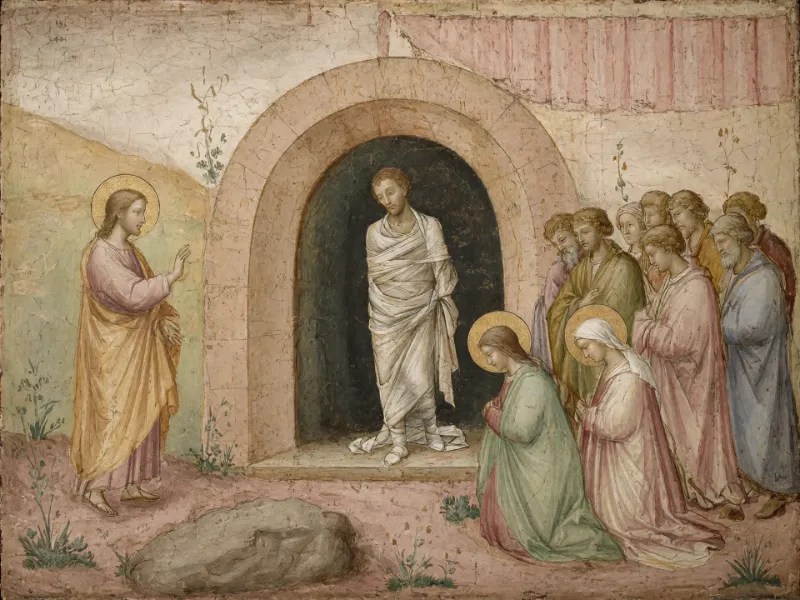
Balthazar’s myrrh takes the carol somewhere few carols go, straight from the cradle to the grave, and myrrh comes back at the end of the gospels. At the cross “they gave him to drink wine mingled with myrrh: but he received it not” (Mark 15:23), and after he died Nicodemus “brought a mixture of myrrh and aloes, about an hundred pound weight”, and they wound his body in linen “with the spices, as the manner of the Jews is to bury” (John 19:39–40). “Sealed in the stone-cold tomb” is Matthew’s ending too, for Joseph laid the body in his own new tomb and “rolled a great stone to the door of the sepulchre”, and the next day the chief priests and Pharisees made it sure, “sealing the stone, and setting a watch” (Matthew 27:60, 66).
Then the last verse gathers all three gifts into one line, “King, and God, and Sacrifice”, and the tomb is open. The hymn scholar Carl P. Daw Jr. called the carol a “mini-opera” and said that the three travellers are “not searching for a child so much as for what that child will become, a Savior whom they acknowledge as royal, divine, and dying.” We sing it at the manger, and it has already seen the cross and the empty tomb.
Is We Three Kings a Christmas carol or an Epiphany hymn?
Hopkins sold it as “A Carol for Christmas Tide”, and it was first sung in the last week of December. But the visit of the wise men is the story of Epiphany, and hymnals set the carol for that feast too, so churches sing it in both seasons. The dates and customs of that feast are in ce qu'est l'Épiphanie et pourquoi les chrétiens la célèbrent.
For all the carol’s drama, Matthew tells the end of the journey in a single line, and it is full of the same gladness: “When they saw the star, they rejoiced with exceeding great joy” (Matthew 2:10).


Laisser un commentaire