
 English
 Chinese
 Dutch
 Arabic
 Spanish
 Portuguese
 Russian
 French
 Italian
 German
 Japanese
Jesus was born in Bethlehem while Herod still ruled, a few years before the year our calendar counts from. Most historians place the birth around 6 to 4 BC. Only two of the four Gospels tell the story, in fewer than 150 verses, and they name no day, never count the wise men and mention no innkeeper.
Our calendar counts its years from his birth and still missed it by a few, which tells us how quietly he came. Everything about this birth is small when you count it. In the King James Version, Matthew tells the birth and the months after it in 31 verses (Matthew 1:18–2:23), and Luke, from the angel’s visit to Zacharias to the family’s return to Nazareth, in 116 (Luke 1:5–2:40). The night itself, with the manger, the shepherds and the angels, fills twenty verses of Luke 2, about 400 words, so a child can hear it read in three minutes. Christians have kept the feast of that night since at least the fourth century, and those three minutes of Luke are still read aloud at it.
The birth of Jesus in figures
| Fact | Figure | How we know |
|---|---|---|
| Gospels that tell the birth | 2 of 4 | Matthew 1–2 and Luke 1–2; Mark and John do not tell it |
| Verses on the birth and infancy | Matthew 31, Luke 116 | Our count, King James Version |
| Year of the birth | About 6 to 4 BC | Before Herod died, in 4 BC as most historians hold (Matthew 2:1, 2:16) |
| First record of 25 December | AD 354 | A Roman calendar of that year |
| Bethlehem’s people | About 300 to 3,000 | Scholars’ estimates |
| Bethlehem to Jerusalem | 9 to 10 km (5 to 6 miles) | Today’s map |
| “Manger” in the whole Bible | 3, all in Luke 2 | Our count, King James Version |
| Dreams in Matthew 1–2 | 5 | Matthew 1:20; 2:12, 13, 19, 22 |
| Gifts of the wise men | 3 kinds; the men are not counted | Matthew 2:11 |
| Christians in the world, 2020 | 2.3 billion | Pew Research Center, 2025 |
Most of these figures you can check for yourself with a Bible open on the table: the verses, the dreams, the three times Luke says “manger”. The year, the size of the village and the date of the oldest calendar rest on historians, and we give their names below. And look at the first row beside the last. Two Gospels told the birth in fewer than 150 verses, and in 2020 Pew counted 2.3 billion Christians, 28.8% of the world’s people.
Where does the Bible tell the story?
Mark opens with “The beginning of the gospel of Jesus Christ, the Son of God” (Mark 1:1) and goes straight to John the Baptist and the grown Jesus. John goes back further than anyone, to the Word who was with God in the beginning, and then tells the whole of Christmas in a single line: “And the Word was made flesh, and dwelt among us” (John 1:14). The story of the birth itself comes from Matthew and Luke alone.
Matthew and Luke tell it from different sides, Matthew with Joseph’s dreams, the star, the wise men, Herod’s killing of the children and the flight into Egypt, and Luke with the angel Gabriel, the census, the manger, the shepherds and the angels’ song. Yet they agree on the things that matter most to us: Mary was a virgin when she conceived by the Holy Spirit, Joseph was of the house of David, the child was born in Bethlehem in Herod’s days, and he grew up in Nazareth. Where the two accounts meet and where each goes its own way is set out in the Christmas story in the Bible.
Before Matthew tells the birth, he counts Jesus’ ancestors and sums them up himself: “So all the generations from Abraham to David are fourteen generations; and from David until the carrying away into Babylon are fourteen generations; and from the carrying away into Babylon unto Christ are fourteen generations” (Matthew 1:17). In that list stand four women before Mary: Thamar, Rachab, Ruth and “her that had been the wife of Urias” (Matthew 1:3, 5, 6). Then, in two short chapters, he quotes the prophets five times, four of them with the words “that it might be fulfilled” or “then was fulfilled” (Matthew 1:22; 2:15, 17, 23). The fifth comes from “the chief priests and scribes of the people” (Matthew 2:4), who answer Herod with Micah’s prophecy when he asks where the Christ is to be born (Matthew 2:5–6), so that the man who wanted the child dead learned his birthplace from Scripture.
The word “Bethlehem” comes eight times in the New Testament: five in Matthew 2, twice in Luke 2, and once in John, where the crowd in Jerusalem argues about Jesus: “Hath not the scripture said, That Christ cometh of the seed of David, and out of the town of Bethlehem, where David was?” (John 7:42). They had the right verse and the right town, and the man they were arguing about had been born in it.
When was Jesus born?
Matthew says Jesus was born “in the days of Herod the king” (Matthew 2:1), and that Herod killed the boys of Bethlehem “from two years old and under” (Matthew 2:16). Most historians date Herod’s death to 4 BC, so the birth falls around 6 to 4 BC. Luke ties it to a decree of Augustus and a census “first made when Cyrenius was governor of Syria” (Luke 2:2). Cyrenius is Quirinius, and the census Josephus records under him came in the thirty-seventh year after the battle of Actium, about AD 6, some ten years after Herod died. Scholars still argue over how the two fit. That we can argue over it at all is its own small wonder: God’s Son was born into a reign with a name and an end, under a king and a governor whose years historians still count. The question is set out in full in when Jesus was born.
The Gospels give no day and no month. Not until 354 do we find 25 December written down as the day of Christ’s birth, in a Roman calendar of that year. Why the Church chose that day is a separate question, and historians still debate it. Churches that keep the old Julian calendar keep the same 25 December, which falls on 7 January in ours, and the Armenian Church celebrates the Nativity on 6 January. Whichever of those mornings our own church keeps, we are giving thanks for the same night in Bethlehem.
We do not know the season either. Some argue that flocks were not kept out at night in winter, and so the birth cannot have been in December, but Luke names no month, so the argument rests on what shepherds did in winter rather than on anything Luke says. What Luke gives us instead is the people the news reached first: “shepherds abiding in the field, keeping watch over their flock by night” (Luke 2:8).
Where was Jesus born?
Jesus was born in Bethlehem, a village in the Judean hills about 9 to 10 km (5 to 6 miles) south of Jerusalem. Scholars’ estimates of its people at the time run from about 300 (William F. Albright) to 2,000 or 3,000 (Stephen Pfann and Jerome Murphy-O’Connor). Long before, Micah had named the place, and named it for its smallness: “But thou, Bethlehem Ephratah, though thou be little among the thousands of Judah, yet out of thee shall he come forth unto me that is to be ruler in Israel” (Micah 5:2). Luke calls it “the city of David” (Luke 2:4), and both names fit, a little place that carried a great king’s name. Many critical scholars doubt that Jesus was born there and think the Gospel writers placed the birth in Bethlehem to match Micah; the Church has always held to what both Gospels say. More on the village is in how big Bethlehem was.
Joseph and Mary came from Nazareth, in Galilee, about 90 miles (145 km) away by the usual route down the Jordan valley and up through the hills near Jerusalem. James F. Strange, an archaeologist who dug at Sepphoris near Nazareth, told the Tampa Bay Times in 1995, “In antiquity, the most we find people traveling is 20 miles a day.” He reckoned that Joseph and Mary likely went only 10 miles a day because of Mary’s due date, which makes the journey about nine days, and he said, “I would be reluctant if my wife were that pregnant to press it more than that.” An archaeologist talking about ancient roads ended by speaking as a husband would, and Luke tells us why it mattered: Joseph went “with Mary his espoused wife, being great with child” (Luke 2:5).
The word “manger” appears three times in the whole King James Bible, and all three are in Luke 2: Mary “laid him in a manger” (2:7), the angel gives it as the sign (2:12), and the shepherds find him there (2:16). A manger is a feeding trough, and God chose it as the sign by which the shepherds would know his Son. Luke says there was “no room for them in the inn” (2:7). The Greek word is kataluma, which the King James Version translates “guestchamber” when Jesus asks for a room to eat the Passover (Luke 22:11), and many scholars read it as a guest room in a house. Luke’s words allow a house’s lower room or a cave. Justin Martyr, who died in Rome about 165, is the first to place the birth in a cave near the village, and the first Church of the Nativity was completed over that cave in 339.
Who came to see him?
Luke counts neither the shepherds nor the angels; he says only that “suddenly there was with the angel a multitude of the heavenly host praising God” (Luke 2:13), and we are left with the picture he gives: the host of heaven praising God, and the news of it given to shepherds in a field.
Matthew calls the visitors “wise men from the east” (Matthew 2:1). He does not call them kings and does not say how many came. They brought “gold, and frankincense and myrrh” (Matthew 2:11), three gifts, and the number three probably came from the gifts. The Catholic Encyclopedia notes that the Gospel “omits to mention the number of the Magi”, that tradition in the East favoured twelve, and that the names Gaspar, Melchior and Balthasar appear among Latin writers from the seventh century. So the three figures in our nativity scenes come from the gifts and from later tradition, and we can keep them gladly while knowing which is which. Matthew says the wise men came “into the house” (Matthew 2:11), and Herod’s order reached back two years, so they may have come some months after the birth.
Matthew gives no number for the children Herod killed. In a village of a few hundred to a few thousand people, Paul Maier estimated “probably no more than 15 male children 2 years old or younger”; Albright put it at six or seven. The numbers are small, and Matthew does not let us pass over them: “Rachel weeping for her children, and would not be comforted, because they are not” (Matthew 2:18). Every one of those boys was a mother’s son.
Matthew mentions the star four times in chapter 2 (2:2, 7, 9, 10), and what it was is still argued. Johannes Kepler argued in 1606 that a new star had appeared with a meeting of Jupiter and Saturn. Mark Matney, a planetary scientist at NASA, has argued from Chinese records of a “broom star” in 5 BC that it was a comet, and other astronomers doubt that the old records can bear the weight. Whatever it was, Matthew tells us where it stopped: it “went before them, till it came and stood over where the young child was” (Matthew 2:9). Wise men followed a light across the sky, and it brought them to a child in a house.
What do we know about Mary and Joseph?
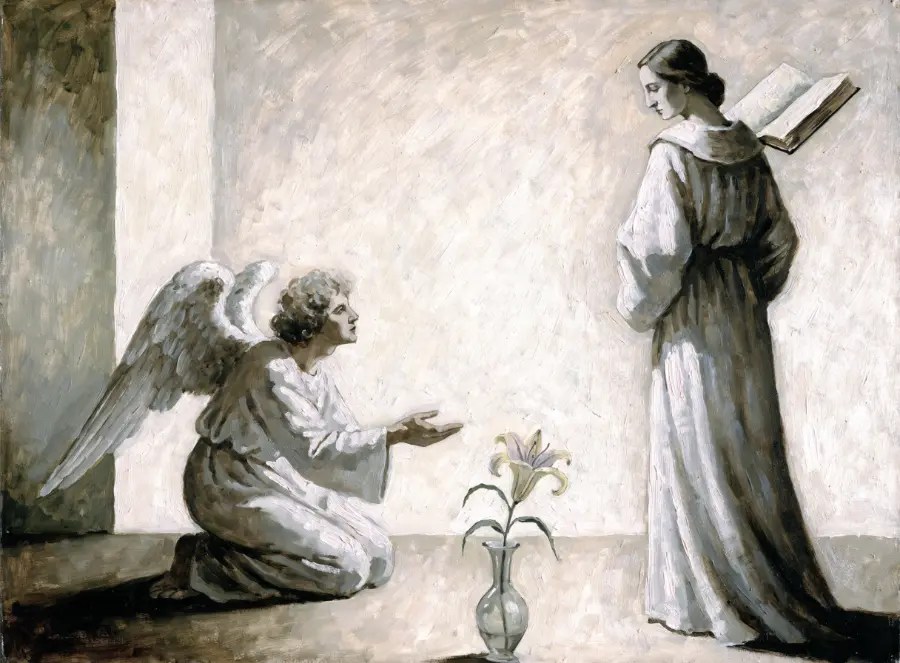
Luke introduces Mary as “a virgin espoused to a man whose name was Joseph, of the house of David” (Luke 1:27). When Gabriel tells her she will bear a son, she asks, “How shall this be, seeing I know not a man?” (Luke 1:34), and he answers, “The Holy Ghost shall come upon thee, and the power of the Highest shall overshadow thee” (Luke 1:35). Hers is the question any of us would ask, and the answer comes without a word of rebuke.
Matthew tells us Joseph was “a just man, and not willing to make her a public example” (Matthew 1:19), so before any angel spoke to him he meant to end the betrothal quietly rather than shame her. His justice showed itself first as mercy. Neither Gospel gives the age of Mary or of Joseph. Figures often repeated, such as a Mary of twelve or fourteen, are guesses that Scripture does not give.
What do people believe about the birth today?
The Pew Research Center asked 1,503 American adults in late 2017 which parts of the Christmas story they believed happened. 66% said they believe Jesus was born to a virgin, down from 73% in 2014, and 68% that wise men guided by a star brought him gifts, down from 75%. 57% believed all four parts the survey asked about (the virgin birth, the wise men, the angel’s announcement to the shepherds and the manger), down from 65%; among Christians it was 76%, down from 81%. Nine in ten said they celebrate Christmas, 55% as a religious holiday, and half planned to go to church on Christmas Eve or Christmas Day. Belief has slipped, and still two in three Americans believe in the virgin birth. Pew’s own summary speaks of “three wise men”, a number Matthew never gives, so even the survey counts them as later tradition does.
Worldwide, Pew counted 2.3 billion Christians in 2020, 28.8% of the world’s people, and it all began in the village Micah called little among the thousands of Judah. When we open Luke 2 this December, twenty verses that take three minutes to read, we look for the same small sign the shepherds were given: “Ye shall find the babe wrapped in swaddling clothes, lying in a manger” (Luke 2:12).


Leave a Reply