
 English
 Chinese
 Dutch
 Arabic
 Spanish
 Portuguese
 Russian
 French
 Italian
 German
 Japanese
No. The Bible never asks Christians to be poor, and some of the faithful in it were rich: Abraham, Job, Joseph of Arimathea. What it warns against is loving money, for “the love of money is a root of all kinds of evils” (1 Timothy 6:10), and Jesus said, “You cannot serve God and money” (Matthew 6:24).
Our Lord knew both sides of it. Paul wrote that Christ, “though he was rich, yet for your sake he became poor” (2 Corinthians 8:9), and the Gospels show what that meant: a baby whose parents could not afford a lamb for the temple offering, and a grown man with “nowhere to lay his head.” So the question for us was never how much we hold. It is whom we serve with it, and whether our hand stays open.
Is it a sin to be poor?
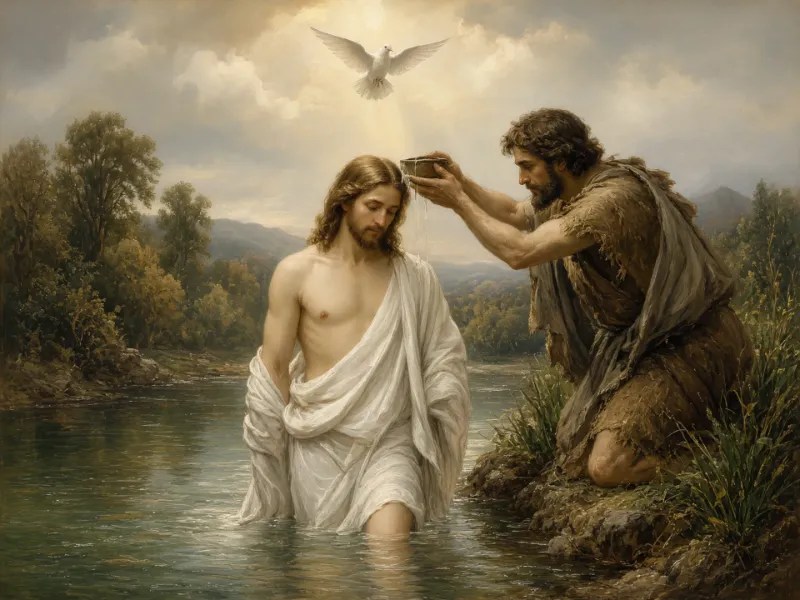
No. Scripture never treats poverty as a sin in itself, and the New Testament speaks of the poor with honor. When Mary and Joseph presented the infant Jesus at the temple, they offered “a pair of turtledoves, or two young pigeons” (Luke 2:24), the offering the law allowed a mother who could not afford a lamb (Leviticus 12:8). As an adult Jesus said, “Foxes have holes, and birds of the air have nests, but the Son of Man has nowhere to lay his head” (Matthew 8:20). In Luke he says, “Blessed are you who are poor, for yours is the kingdom of God” (Luke 6:20), and James asks, “Has not God chosen those who are poor in the world to be rich in faith and heirs of the kingdom?” (James 2:5). Paul wrote that Christ, “though he was rich, yet for your sake he became poor” (2 Corinthians 8:9).
The Bible does name some causes of poverty that involve wrongdoing. Proverbs says that “a slack hand causes poverty” (Proverbs 10:4), and Paul told the Thessalonians, “If anyone is not willing to work, let him not eat” (2 Thessalonians 3:10). Proverbs also says that the field of the poor “would yield much food, but it is swept away through injustice” (Proverbs 13:23), and that “whoever oppresses a poor man insults his Maker” (Proverbs 14:31). In these passages the sin is idleness or oppression, not poverty.

Is it a sin to be rich?
No, but the New Testament treats wealth as dangerous. Genesis says that “Abram was very rich in livestock, in silver, and in gold” (Genesis 13:2), and Job was “the greatest of all the people of the east” (Job 1:3). Some of Jesus’ followers had money. A group of women, including Joanna, the wife of Herod’s household manager, “provided for them out of their means” (Luke 8:3), and Joseph of Arimathea, “a rich man” who “also was a disciple of Jesus,” laid Jesus’ body in “his own new tomb” (Matthew 27:57–60). Lydia, whom Paul met at Philippi, was “a seller of purple goods” with a house large enough to lodge Paul and his companions (Acts 16:14–15).
The warnings are strong. When a man asked Jesus what he must do to inherit eternal life, Jesus told him, “Go, sell all that you have and give to the poor, and you will have treasure in heaven; and come, follow me,” and the man “went away sorrowful, for he had great possessions.” Jesus then said, “It is easier for a camel to go through the eye of a needle than for a rich person to enter the kingdom of God” (Mark 10:17–25). In Luke the blessing on the poor is paired with “woe to you who are rich, for you have received your consolation” (Luke 6:24). Paul told Timothy to charge the rich “not to be haughty, nor to set their hopes on the uncertainty of riches, but on God,” and “to be generous and ready to share” (1 Timothy 6:17–18). A prayer in Proverbs asks for the middle: “give me neither poverty nor riches,” lest the one praying “be full and deny you” or “be poor and steal” (Proverbs 30:8–9).

Does the Bible say money is the root of all evil?
No. The saying misquotes 1 Timothy 6:10. The King James Version reads, “For the love of money is the root of all evil,” and the English Standard Version, “For the love of money is a root of all kinds of evils.” Either way, the verse blames the love of money, not money itself. The verses before it make the same point: “godliness with contentment is great gain,” while “those who desire to be rich fall into temptation, into a snare” (1 Timothy 6:6–9). Hebrews says, “Keep your life free from love of money, and be content with what you have” (Hebrews 13:5).

Is it wrong for a Christian to want money?
The New Testament separates earning a living, which it expects of Christians, from the desire to be rich, which it warns against. Paul told idle members of the church in Thessalonica “to do their work quietly and to earn their own living” (2 Thessalonians 3:12), and wrote that anyone who “does not provide for his relatives, and especially for members of his household,” has “denied the faith and is worse than an unbeliever” (1 Timothy 5:8). He told thieves to stop stealing and work instead, “so that he may have something to share with anyone in need” (Ephesians 4:28). Money also paid for the spread of the gospel. The church at Philippi sent Paul help “once and again” (Philippians 4:16), and he told the Corinthians that “God loves a cheerful giver” (2 Corinthians 9:7).
What the New Testament forbids is serving money. “No one can serve two masters,” Jesus said (Matthew 6:24), and “one’s life does not consist in the abundance of his possessions” (Luke 12:15). John Wesley, the founder of Methodism, put a Christian use of money into three rules in his sermon “The Use of Money”: “Gain all you can,” “Save all you can,” and “Give all you can.” He reasoned that God placed each person in the world “not as a proprietor, but a steward.”
The teaching that God wants every believer to be wealthy, often called the prosperity gospel, has been rejected by evangelical leaders in the Lausanne Movement. Its theology working group, meeting in Ghana in 2008 and 2009, defined the teaching as the claim “that believers have a right to the blessings of health and wealth” and can obtain them through “positive confessions of faith and the ‘sowing of seeds’ through the faithful payments of tithes and offerings,” and called it “false and gravely distorting of the Bible.”

Why do some Christians choose to be poor?
Some Christians give up their property for the sake of the gospel, following Jesus’ words, “If you would be perfect, go, sell what you possess and give to the poor” (Matthew 19:21). The first believers in Jerusalem “had all things in common” and sold “their possessions and belongings” to share “as any had need” (Acts 2:44–45). Catholic monks, nuns and other religious take vows of poverty, chastity and obedience, which the Catechism calls evangelical counsels, binding on “those who freely follow the call to consecrated life” (915). Orthodox monks and nuns live, in the words of the Orthodox Church in America, by “the Christian virtues of poverty, chastity, humility and obedience.”
The Catechism does not ask vowed poverty of every Christian, but it does ask all of them for detachment. “The precept of detachment from riches is obligatory for entrance into the Kingdom of heaven,” it says, and all the faithful are to avoid “an adherence to riches which is contrary to the spirit of evangelical poverty” (2544–2545).
What does the Bible say about helping the poor?
Scripture presents God as the defender of the poor: “I know that the Lord will maintain the cause of the afflicted, and will execute justice for the needy” (Psalm 140:12). He gives the work of helping them to his people, and the charge runs unbroken from the law to the letters. “There will never cease to be poor in the land,” the law of Moses says. “Therefore I command you, ‘You shall open wide your hand to your brother, to the needy and to the poor’” (Deuteronomy 15:11). Proverbs promises that “whoever is generous to the poor lends to the Lord” (Proverbs 19:17). The apostles in Jerusalem asked Paul “to remember the poor, the very thing I was eager to do” (Galatians 2:10), and John asks, “If anyone has the world’s goods and sees his brother in need, yet closes his heart against him, how does God’s love abide in him?” (1 John 3:17). The Catholic Church, for its part, calls those oppressed by poverty “the object of a preferential love on the part of the Church” (Catechism 2448).
The one who became poor for our sake is waiting for us in them. In the parable of the sheep and the goats the King says, “As you did it to one of the least of these my brothers, you did it to me” (Matthew 25:40).


Leave a Reply