
 English
 Chinese
 Dutch
 Arabic
 Spanish
 Portuguese
 Russian
 French
 Italian
 German
 Japanese
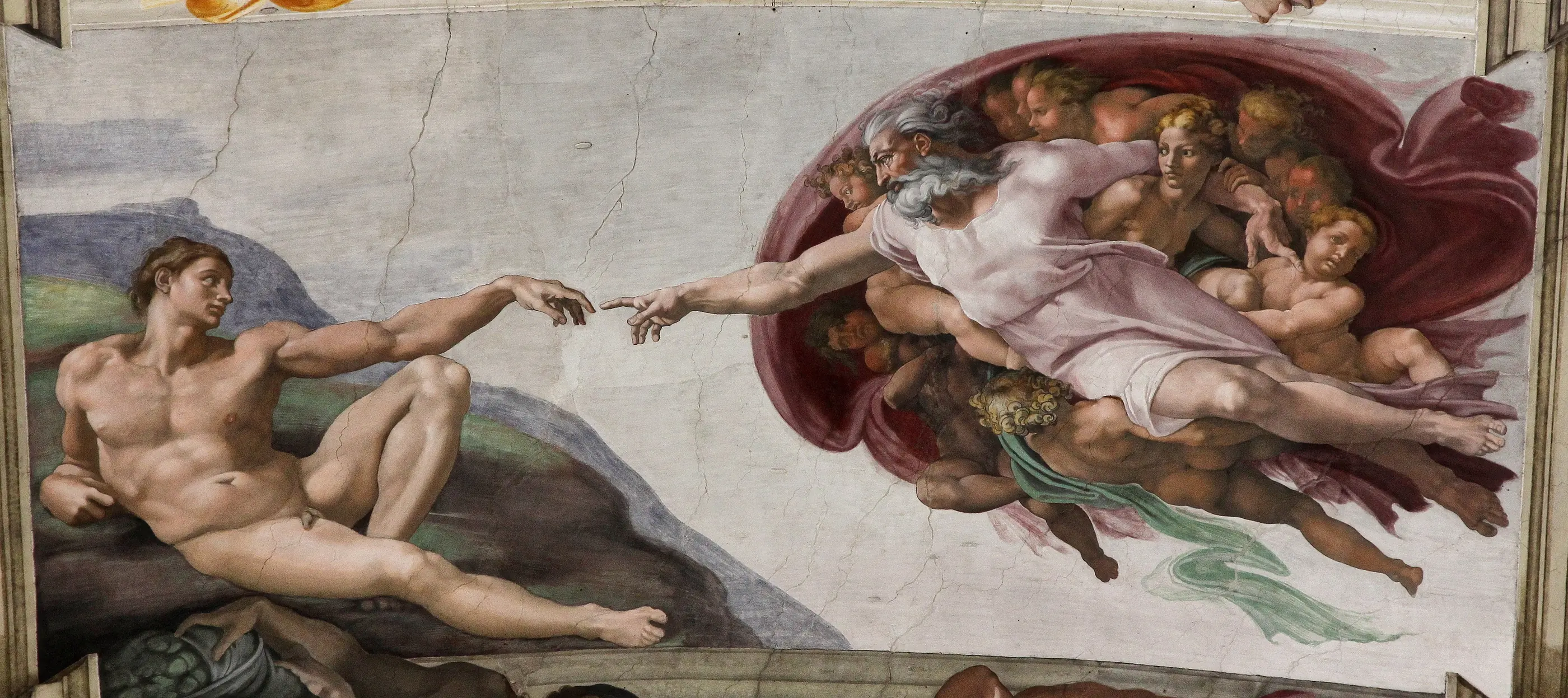
Michelangelo painted The Creation of Adam in about 1511, on the ceiling of the Sistine Chapel in Vatican City, and it is still there for anyone who visits the Vatican Museums. To find it, count the scenes from Genesis that run down the middle of the vault, starting at the altar end. The first three show God making the world, and the fourth is this one. God comes across the sky on a crowd of angels who fly without wings, an old man with grey hair and a long beard, wrapped in his mantle, and he stretches out his right hand. Adam lies on a bare hillside and lifts his hand to meet him, and their forefingers stop a finger’s breadth apart.
It was painted when the work was about half done. Michelangelo signed the contract with Pope Julius II on 8 May 1508 and worked from the entrance wall toward the altar, and by August 1510 he had come as far as the Creation of Eve, the panel beside this one. Vasari says the Pope could not wait any longer and insisted that the ceiling be thrown open, and then “all Rome was drawn to see it.” Adam came next. The British Museum keeps the red-chalk drawing Michelangelo made for him from a living model, and dates it to about 1511. Its curator points out how thickly the outlines are drawn, so that the figure would stand out clearly to people on the chapel floor. The whole ceiling was finished by 31 October 1512, and on All Saints’ Day, 1 November, Julius II celebrated Mass beneath it.
What Michelangelo painted is the line in Genesis where “God created man in his own image, in the image of God created he him” (Genesis 1:27). The Vatican Museums describe his Adam as “a resting athlete” whose beauty “seems to confirm” those words. God leans toward Adam, and Adam’s body curves back toward God’s, so that the one seems made in the likeness of the other.
Open the fresco full screen and look closer, one detail at a time: what each part shows, the verse of Genesis behind it, and who says so.
What Michelangelo painted, and what Genesis says
Genesis tells the making of man twice. First God speaks: “Let us make man in our image, after our likeness” (Genesis 1:26). Then the story comes down to the ground: “And the LORD God formed man of the dust of the ground, and breathed into his nostrils the breath of life; and man became a living soul” (Genesis 2:7). Up on the ceiling there is no dust and no breathing. Michelangelo’s Adam is already made, a whole body lying on the earth he was taken from, and God reaches toward him with one finger. The Vatican Museums file the scene under the first account, and they read that meeting of the fingers as the moment “through which the breath of life is transmitted”. On their reading the breath of Genesis 2 is there after all, given with the hand.
Two men who knew Michelangelo wrote about the painting. Giorgio Vasari, his friend, put a life of him into his Lives of the painters in 1550, and on 16 July 1553 Ascanio Condivi, his friend and pupil, published a Life of his own. Condivi counts the scenes from the altar just as we did, and when he reaches this one he sees God giving orders: “In the fourth is the creation of Man. God is seen with arm and hand stretched forth as if giving His commandments to Adam, what to do and what not to do; with His other arm He draws His angels about Him.” Condivi names no verse, but we can hear Genesis behind his words, in the garden where “the LORD God commanded the man, saying, Of every tree of the garden thou mayest freely eat: But of the tree of the knowledge of good and evil, thou shalt not eat of it” (Genesis 2:16–17).
Vasari, in the second edition of his book in 1568, looked first at how God is carried. He saw him “borne by a group of nude Angels of tender age, which appear to be supporting not one figure only, but the whole weight of the world”, and he said that Adam is “a figure of such a kind in its beauty, in the attitude, and in the outlines, that it appears as if newly fashioned by the first and supreme Creator rather than by the brush and design of a mortal man.” Neither Vasari nor Condivi says a word about a spark, a woman or a brain.
What does The Creation of Adam mean?
Condivi and Vasari gave the painting its first two readings. Most of the others people see in it now were found centuries later.
| Year | Who | What they saw |
|---|---|---|
| 1553 | Ascanio Condivi | God giving Adam his commandments |
| 1568 | Giorgio Vasari | An Adam who looks made by God himself |
| 1801 | Henry Fuseli | A spark passing to Adam |
| 1873 | Walter Pater | Eve and her children under God’s arm |
| 1990 | Frank Lynn Meshberger | God in the shape of a brain |
| 1994 | Maria Rzepińska | Divine Wisdom under God’s arm |
| 2015 | Stefano Di Bella and colleagues | A womb just after birth |
A Christian standing under the ceiling starts with the meaning that is older than all of them, the one Genesis gives: a man made in the image and likeness of God. There is more on that teaching in what it means to be created in the image of God. And we cannot look long at the first Adam without thinking of another. Paul calls Adam “the figure of him that was to come” (Romans 5:14), and he writes, “The first man Adam was made a living soul; the last Adam was made a quickening spirit” (1 Corinthians 15:45).
The painting itself does not show Christ, but Pope John Paul II brought Adam and the eternal Word together in this room. The chapel’s frescoes were restored completely between 1979 and 1999, and on 8 April 1994 he said Mass there, telling the people with him, “Today we are entering the Sistine Chapel to admire the marvellously restored frescoes.” Of this scene he said: “Adam was created in the image and likeness of God (cf. Gn 1:26). While the eternal Word is the invisible icon of the Father, the man Adam is his visible icon.”

Why don’t the fingers touch?
They stop a finger’s breadth apart, about three-quarters of an inch on the painted surface, though the Vatican Museums still speak of the “contact between the fingers of the Creator and those of Adam”.
Most of us, looking at that small space, see a spark jumping across it. That spark goes back to the Swiss-British painter Henry Fuseli. In 1801, nearly three centuries after the painting and not long after Luigi Galvani had made frogs’ legs twitch with electric current, Fuseli wrote of “the immortal spark, issuing from his extended arm”. Other writers took the image up after him, and it was probably Kenneth Clark’s television series Civilisation that made it everyone’s in 1969.
Walter Pater, writing on the Renaissance in 1873, looked at the gap from Adam’s side. To him Adam “has hardly strength enough to lift his finger to touch the finger of the creator; yet a touch of the finger-tips will suffice.” The critic Tom Lubbock, writing in The Independent in 2007, saw both hands reaching out, a little uncertainly, and thought Michelangelo had painted the creation of man as “the hopeful beginning of a relationship”.
Whichever way we read the gap, the giving is all on God’s side. In Genesis he forms the man and breathes into him, and only then does the man become “a living soul” (Genesis 2:7). On the ceiling, too, it is God who has crossed the whole sky with his angels, while Adam, who has nothing yet that he did not receive, can barely raise his hand.
Who is the woman under God’s arm?
Look inside God’s mantle, under the arm he holds back, and you will find a woman there, with a child under God’s fingers beside her. Vasari saw God embracing “some of the little Angels with one arm, as if to support Himself”. The art historian Leo Steinberg showed in 1992 how long it took anyone to see more: “Not until the 1870s, following the first publication of photographs of the Sistine Ceiling, did anyone notice significant presences under God’s backward arm in the Creation of Adam.”
The earliest answer we have is Walter Pater’s, in 1873, and it is still the traditional one. He saw God coming “with the forms of things to be, woman and her progeny, in the fold of his garment”, which is Eve, not yet made, with the children she will bear. It suits the ceiling, because the very next panel shows her being made, when “the rib, which the LORD God had taken from man, made he a woman, and brought her unto the man” (Genesis 2:22).
In 1994 the art historian Maria Rzepińska read her through Proverbs 8 instead, “as Sophia, or Divine Wisdom, who accompanied the Lord from the beginning of Creation”. In that chapter Wisdom says of the Creator, “When he prepared the heavens, I was there,” and, “Then I was by him, as one brought up with him: and I was daily his delight, rejoicing always before him” (Proverbs 8:27, 30). Others have suggested that she is the Virgin Mary, and the child under God’s fingers the Christ Child. The painting itself does not tell us who she is.
Is there a brain in The Creation of Adam?
Doctors have looked at the great cloak around God and his angels, and they have seen two parts of the human body in it. One is a brain. Frank Lynn Meshberger, a physician in Anderson, Indiana, argued in a cover story for the Journal of the American Medical Association on 10 October 1990 that Michelangelo had painted God in the form of a brain. The other is a womb. In 2015 Stefano Di Bella, a doctor at the Spallanzani institute for infectious diseases in Rome, and five colleagues wrote in Mayo Clinic Proceedings that they found “a postpartum uterus and adjacent anatomy” there, and with it the birth of mankind. They rested their reading on Michelangelo’s skill at dissection, writing that “Michelangelo’s proficiency in anatomical dissection is reflected in his artwork”.
In July 2026 three neurosurgeons in Athens put the question plainly: did Michelangelo hide a brain in the painting, or do we build one ourselves? Their answer was that the hidden brain “may reflect either intentional symbolic design or the observer’s cognitive tendency to impose structure on ambiguous imagery”.
Should God the Father be painted at all?
“Thou shalt not make unto thee any graven image, or any likeness of any thing that is in heaven above,” God told Israel (Exodus 20:4). Under this ceiling we are looking at God the Father painted as an old man with a grey beard, and Christians answer differently whether he should be painted at all.
Catholics paint him, and this is a pope’s own chapel. John Paul II took up the question here, in the same homily of 1994. He recalled that the Old Testament had ruled out any image of the invisible Creator, and that the Second Council of Nicaea “definitively rejected the position of the iconoclasts”. Of Michelangelo he said, “With great daring he even transferred this visible and corporal beauty to the Creator himself,” and then he asked it aloud: “Would this not be blasphemy?” His answer was, “It is difficult however, not to recognize in the visible and humanized Creator, God clad in infinite majesty,” and he tied the painter’s daring to what Jesus told Philip, “he that hath seen me hath seen the Father” (John 14:9).
The Reformed churches teach that images have no place in their churches. Their Heidelberg Catechism says God requires “That we in no wise represent God by images”, and when it asks whether images may be tolerated in the churches “as books to the laity”, it answers no. Of God himself it says, “God neither can, nor may be represented by any means.”
An Orthodox church has icons of Christ and of the archangels, but the Father is not meant to be among them. The Synod of Moscow forbade it in 1667, and St Elisabeth Convent in Minsk gives the reason from the same words of Jesus to Philip: “the Son is the natural image of the Father”. The convent admits that “this canonical decision has not always been obeyed”, and it guesses that the old man who stands for God in Western cartoons drew on this very ceiling: “Perhaps drawing inspiration from Michelangelo’s famous painting of the Creation of Adam in the Sistine Chapel”.
Michelangelo’s Adam, beautiful as he is, still lies on the ground with his hand half raised. For the image of the unseen Father we look where Paul looked, to Christ, who “is the image of the invisible God, the firstborn of every creature” (Colossians 1:15).


Leave a Reply