
 English
 Chinese
 Dutch
 Arabic
 Spanish
 Portuguese
 Russian
 French
 Italian
 German
 Japanese
Jesus answered the Pharisees’ question about when the kingdom of God would come by telling them it was already here, not something to watch for. “The kingdom of God is within you,” says the King James Version of Luke 17:21; most modern Bibles say “in the midst of you” or “among you.” The Greek word, entos, can mean either.
Near its end the verse has a word that is easy to read past: “behold,” which means look. What Jesus asked them to look at had just come through their country. He had passed “through the midst of Samaria and Galilee” (Luke 17:11), and at the edge of a village ten lepers called to him from a distance and were cleansed on the road. One of them “turned back, and with a loud voice glorified God, And fell down on his face at his feet, giving him thanks: and he was a Samaritan” (Luke 17:15–16). A few verses later the Pharisees ask when the kingdom will come. The Samaritan had already found where it was. He was on his face at the King’s feet.

What were the Pharisees asking in Luke 17:20?
They wanted a date. Luke tells it in two verses, where “demanded of the Pharisees” is old English for “asked by the Pharisees”:
And when he was demanded of the Pharisees, when the kingdom of God should come, he answered them and said, The kingdom of God cometh not with observation: Neither shall they say, Lo here! or, lo there! for, behold, the kingdom of God is within you. (Luke 17:20–21)
“Observation” means watching for signs, the way people watch the sky for weather. Jesus says the kingdom will not arrive in a way they can track and announce, with someone pointing and saying “here it is.” Then he turns to his disciples and speaks of a day still to come: “as the lightning, that lighteneth out of the one part under heaven, shineth unto the other part under heaven; so shall also the Son of man be in his day. But first must he suffer many things, and be rejected of this generation” (Luke 17:24–25).
So the passage holds two answers side by side. To the Pharisees: it is here, look. To the disciples: there is a day ahead that no one will need to point out, because it will light the whole sky. The question did not go away. Two chapters later, near Jerusalem, Jesus tells a parable “because they thought that the kingdom of God should immediately appear” (Luke 19:11).
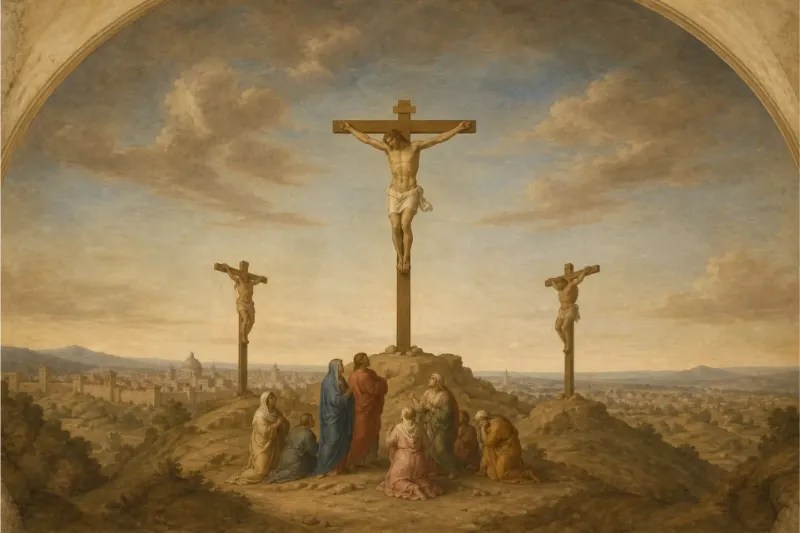
What does the Greek word entos mean?
Luke’s Greek reads idou gar hē basileia tou theou entos hymōn estin, which the King James renders “behold, the kingdom of God is within you,” with “within” for entos. Entos means inside or within. It appears only twice in the New Testament. The other time is Jesus’ rebuke in Matthew, where it is the inside of a dish: “cleanse first that which is within the cup and platter, that the outside of them may be clean also” (Matthew 23:26). The “you” in Luke 17:21 is plural: Jesus is speaking to a group of men gathered around him. A plural “within you” could still mean within each of them, so the grammar alone does not settle it.
Most modern translators let the setting decide, and so does Thayer’s Greek lexicon. It gives the sense “within you, i.e. in the midst of you.” It grants that the other reading, “within you (i.e. in your souls),” is “a meaning which the use of the word permits,” and decides against it because of the context. Some modern Bibles, among them the English Standard Version and the New Living Translation, also note a third possibility in the margin: within your grasp.
How do different Bible translations word Luke 17:21?
Most of the modern Bibles below put “among you” or “in your midst” in the text and “within you” in a footnote. The King James Version and the Douay-Rheims say “within you” with no note; the New King James Version says “within you” and notes “in your midst.” The footnotes are given as each Bible prints them.
| Bible | Luke 17:21 says | Footnote offers |
|---|---|---|
| King James Version | within you | no note |
| Douay-Rheims (Catholic) | within you | no note |
| New King James Version | within you | in your midst |
| Revised Standard Version | in the midst of you | within you |
| English Standard Version | in the midst of you | within you, or within your grasp |
| New International Version | in your midst | is within you |
| New American Standard Bible | in your midst | among you |
| Christian Standard Bible | in your midst | within you |
| New Revised Standard Version (Updated) | among you | within |
| New American Bible (Catholic) | among you | “within” (see below) |
| New Living Translation | already among you | is within you, or is in your grasp |
If your Bible says one thing and your friend’s says the other, neither translator has made a mistake. Both readings are honest English for the same Greek. The choice depends on how each team read the setting.
Why do many Bibles say “in the midst of you”?
Because of who was listening, and because of who was standing there. The Pharisees in this scene had not received Jesus, and it is hard to hear him telling them that God’s reign was already ruling in their hearts. What was among them was Jesus himself, healing and preaching in their villages. Luke’s Gospel says this plainly elsewhere. Jesus sends out seventy disciples “two and two” (Luke 10:1) to heal the sick and tell each town, “The kingdom of God is come nigh unto you” (Luke 10:9). When he casts out a demon and some say he does it “through Beelzebub the chief of the devils” (Luke 11:15), he answers, “if I with the finger of God cast out devils, no doubt the kingdom of God is come upon you” (Luke 11:20).
The New American Bible, the translation of the Catholic bishops of the United States, makes the same case in its note on the verse: “the Greek preposition translated as among can also be translated as ‘within.’ In the light of other statements in Luke’s gospel about the presence of the kingdom (see Lk 10:9, 11; 11:20) ‘among’ is to be preferred.” John the Baptist had said something like it beyond the Jordan, to the priests and Levites sent from Jerusalem to question him: “there standeth one among you, whom ye know not” (John 1:26).
The Catechism of the Catholic Church hears the kingdom and the King as nearly one. Explaining “Thy kingdom come,” it quotes Saint Cyprian: “It may even be . . . that the Kingdom of God means Christ himself, whom we daily desire to come.” Read that way, Luke 17:21 says something both simple and startling. The Pharisees asked when the kingdom would come, and the answer was standing in front of them.

Did early Christians read it as “within you”?
Many did, and they drew real teaching from it. In his Life of Antony, Athanasius records the hermit telling his monks that holiness does not require a journey: “we have no need to depart from home for the sake of the kingdom of heaven, nor to cross the sea for the sake of virtue. For the Lord aforetime has said, The kingdom of heaven is within you.” That fits the verse’s own warning against running after “Lo here! or, lo there!”
Others took entos to mean within reach. Tertullian, writing against Marcion, asked, “who will not interpret the words within you to mean in your hand, within your power, if you hear, and do the commandment of God?” He heard in it the voice of Moses: “the word is very nigh unto thee, in thy mouth, and in thy heart, that thou mayest do it” (Deuteronomy 30:14). Cyril of Alexandria, preaching on this passage, said much the same about the Pharisees’ question: “it depends upon your own wills, and is in your own power, whether or not you receive it.”
The phrase reached far beyond the churches when Leo Tolstoy made it the title of a book, The Kingdom of God Is Within You, whose preface is dated 1893. It is a long plea that Jesus’ command not to resist evil by force be taken literally, and many people meet the words there before they meet them in Luke.

Does Luke 17:21 mean God is within everyone?
The verse does not say that. It speaks of the kingdom of God, which in Luke is God’s reign arriving in Jesus, and it is spoken to men who were refusing him. Where the New Testament does speak of God dwelling in people, it speaks of those who love Christ: “If a man love me, he will keep my words: and my Father will love him, and we will come unto him, and make our abode with him” (John 14:23).
Christians do believe that God’s reign takes hold inside the people who receive it. Paul describes it in inward words: “the kingdom of God is not meat and drink; but righteousness, and peace, and joy in the Holy Ghost” (Romans 14:17). The Orthodox Church in America speaks of the kingdom “mystically reigning already in the faithful disciples of Christ by the presence and power of the Holy Spirit.” So the “within you” reading points to something true. It is true of disciples, and it comes from outside us, as a gift.

Does Luke 17 also speak of a kingdom still to come?
Yes, in the same conversation. It is among us now, because Jesus has come. It is still to come, because the day of the Son of Man lies ahead, as sudden and as plain as lightning. Later Jesus tells his disciples to watch for its signs, “know ye that the kingdom of God is nigh at hand” (Luke 21:31). The fuller question of what the kingdom is, and how the churches teach its present and future, has its own page: what is the kingdom of God?
We are still tempted to ask the Pharisees’ question, and to look for the kingdom in the next movement, the next revival, the next sign in the news. Luke 17:21 turns our eyes back to Jesus. The Samaritan in the village did not ask when. He saw that he was healed, came back, and “fell down on his face at his feet, giving him thanks” (Luke 17:16).



Leave a Reply