
 English
 Chinese
 Dutch
 Arabic
 Spanish
 Portuguese
 Russian
 French
 Italian
 German
 Japanese
If a couple has asked you, a friend or relative, to lead their Christian wedding, every word you say is in this complete script, in order. It opens with the 1928 Book of Common Prayer’s welcome and moves through one reading, a homily outline, the declaration, traditional vows, the rings and prayers to the pronouncement and the Aaronic blessing.
The promises are not yours to invent, and that is a gift to the one who leads. The ones at the center, “for better for worse, for richer for poorer, in sickness and in health,” were already in the 1928 Prayer Book, and the 1979 book kept them. Paul wrote the reading to a church where there were “contentions,” about a love that “endures all things.” Your part is to say these words clearly, and to stand with the two of them while they make the promises their own.
Read aloud with a six-minute homily, the ceremony runs about 15 minutes, not counting music. Replace every name in square brackets. The words to say are set apart as quotations, and the plain lines between them tell you what happens. Notes marked Legal point to the parts the law cares about; before the day, ask the clerk who issued the license whether your state needs anything more.
The script suits a Protestant or non-denominational wedding. If either partner is Catholic or Orthodox, their church has its own rite and its own clergy. In an Episcopal church a priest normally presides, and in a United Methodist church a friend leads only with the pastor’s consent. Our guide to how to officiate a Christian wedding explains why, along with how to become authorized.
The ceremony
Before the guests arrive
Read the license with the couple and check the spelling of both names. Give the rings to whoever will hold them. Stand facing the guests, with the couple in front of you.
1. The processional
Music plays and the wedding party walks in, in the order you rehearsed, with the bride last. When everyone is in place and the music stops, begin.
2. The welcome
To the guests:
Dearly beloved, we are gathered together here in the sight of God, and in the face of this company, to join together this Man and this Woman in holy Matrimony.
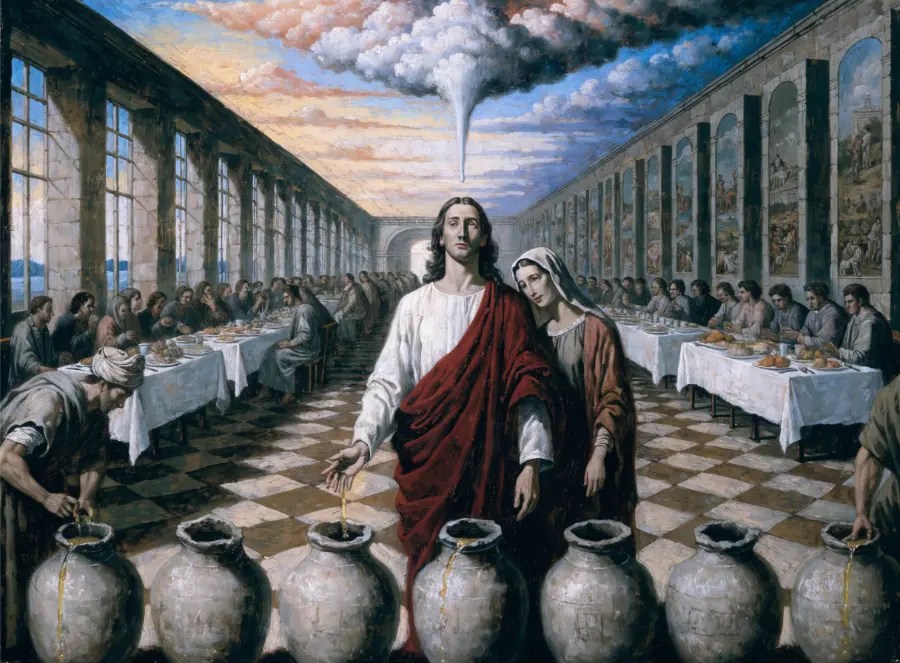
[Groom] and [Bride] have asked us here to witness their promises and to pray for them. Marriage is God’s gift, given at the beginning. Jesus honored it with his presence at a wedding in Cana, where he did his first miracle, and the Church has long seen in a husband and wife a picture of the love between Christ and his people. So we come to this day with joy, and we do not come to it lightly.
Into this holy estate these two persons present come now to be joined.
The first and last sentences are the 1928 Book of Common Prayer’s own words. The middle paragraph is ours, a plain retelling of what the Prayer Book says between them. The 1928 book then asks whether anyone knows a reason the couple may not lawfully marry. This script leaves that question out; ask the couple whether they want it.
3. The reading
A friend or relative of the couple says, “A reading from Paul’s first letter to the Corinthians,” and reads:
Love is patient and is kind. Love doesn’t envy. Love doesn’t brag, is not proud, doesn’t behave itself inappropriately, doesn’t seek its own way, is not provoked, takes no account of evil; doesn’t rejoice in unrighteousness, but rejoices with the truth; bears all things, believes all things, hopes all things, and endures all things. Love never fails.
1 Corinthians 13:4–8a, World English Bible. The reader’s opening line is ours.
4. The homily
Five to seven minutes in your own words, built on the reading and on the couple. Fill in this outline:
- The passage. One or two sentences on what the reading says. Paul wrote these lines to a church, not to a bride and groom, after hearing “that there are contentions among you” (1 Corinthians 1:11); the love he describes is the kind that keeps going when people are hard to live with. [Your sentences.]
- The couple. One true story that shows a line of the reading in them: a time one of them was patient, or kind, or kept going. Ask them first whether you may tell it. [Their story.]
- The charge. What the passage asks of the two of them, in a sentence or two, and what it asks of everyone here who will stand by them. [Your charge.]
- The turn. Close by facing the couple and saying, in words of ours you may change, “[Groom] and [Bride], you are about to make your promises before God and all of us. Let us hear them.”
5. The declaration of intent
To the bride:
[Bride], will you have this man to be your husband; to live together in the covenant of marriage? Will you love him, comfort him, honor and keep him, in sickness and in health; and, forsaking all others, be faithful to him as long as you both shall live?
She answers, “I will.” Then to the groom:
[Groom], will you have this woman to be your wife; to live together in the covenant of marriage? Will you love her, comfort her, honor and keep her, in sickness and in health; and, forsaking all others, be faithful to her as long as you both shall live?
He answers, “I will.” These questions, and the vows and ring words that follow, are from the 1979 Book of Common Prayer, which asks the bride first.
Legal. This is the part state laws commonly require. California’s Family Code, for example, requires that the couple “declare, in the physical presence of the person solemnizing the marriage and necessary witnesses, that they take each other as spouses.” The declaration and the vows do that. If the couple replace the vows with their own, keep this declaration word for word.
6. The vows
The couple face each other. The groom takes the bride’s right hand and repeats after you, a phrase at a time:
In the Name of God, I, [Groom], take you, [Bride], to be my wife, to have and to hold from this day forward, for better for worse, for richer for poorer, in sickness and in health, to love and to cherish, until we are parted by death. This is my solemn vow.
They let go. The bride takes the groom’s right hand and repeats after you:
In the Name of God, I, [Bride], take you, [Groom], to be my husband, to have and to hold from this day forward, for better for worse, for richer for poorer, in sickness and in health, to love and to cherish, until we are parted by death. This is my solemn vow.
7. The rings
Take the rings from whoever holds them. Give the bride’s ring to the groom. He puts it on her ring finger and repeats after you:
[Bride], I give you this ring as a symbol of my vow, and with all that I am, and all that I have, I honor you, in the Name of the Father, and of the Son, and of the Holy Spirit.
Give the groom’s ring to the bride. She puts it on his ring finger and says the same words to him, with his name.
8. The Lord’s Prayer
Let us pray together in the words our Savior taught us.
Everyone says it together:
Our Father, who art in heaven, Hallowed be thy Name. Thy kingdom come. Thy will be done, On earth as it is in heaven. Give us this day our daily bread. And forgive us our trespasses, As we forgive those who trespass against us. And lead us not into temptation, But deliver us from evil. For thine is the kingdom, and the power, and the glory, for ever and ever. Amen.
The invitation is from the 1979 Prayer Book, the prayer in its traditional words from the 1928 book. Guests from different churches may end it at different places; here is why the Catholic and Protestant forms differ.
9. The prayer
Then pray for the couple:
O God, who hast so consecrated the state of Matrimony that in it is represented the spiritual marriage and unity betwixt Christ and his Church; Look mercifully upon these thy servants, that they may love, honour, and cherish each other, and so live together in faithfulness and patience, in wisdom and true godliness, that their home may be a haven of blessing and of peace; through the same Jesus Christ our Lord, who liveth and reigneth with thee and the Holy Spirit ever, one God, world without end. Amen.
This prayer is from the 1928 Book of Common Prayer. You may say the couple’s names after “these thy servants.”
10. The pronouncement
Join the couple’s right hands and say to the guests:
Now that [Groom] and [Bride] have given themselves to each other by solemn vows, with the joining of hands and the giving and receiving of a ring, I pronounce that they are husband and wife, in the Name of the Father, and of the Son, and of the Holy Spirit.
Those whom God has joined together let no one put asunder.
Both lines are from the 1979 Book of Common Prayer. If both of them give rings, say “rings.” The second line echoes Jesus in Matthew 19:6: “What therefore God has joined together, don’t let man tear apart.”
Legal. The pronouncement declares the marriage made. California’s law sets no words for it (“No particular form for the ceremony of marriage is required”), and Texas law, says the state’s law library, “does not provide many details about the actual marriage ceremony.” Ask the clerk whether your state prescribes any.
11. The blessing
Facing the couple, say:
The LORD bless you, and keep you. The LORD make his face to shine on you, and be gracious to you. The LORD lift up his face towards you, and give you peace.
This is the blessing God gave Aaron and his sons to speak over Israel, in Numbers 6:24–26. The words are from the British edition of the World English Bible; the American edition reads “Yahweh” for “the LORD.” Some churches keep a blessing spoken over people in this form for their ordained ministers. If the couple’s church or yours does, turn it into a prayer, asking the Lord to bless and keep them, or say it with us in place of you.
12. The kiss and the presentation
[Groom], you may kiss your bride.
Then, to the guests:
Friends, it is my joy to present to you, for the first time as husband and wife, [Groom] and [Bride].
These two lines are ours.
13. The recessional and the license
The couple walk out, followed by the wedding party. Before the reception, sign the license with the couple and the witnesses wherever it asks.
Legal. Keep the license in your own hands until you have returned it to the office that issued it, before that office’s deadline. As of October 2026, California allows 10 days and Texas 30. Ask the clerk for yours.
What the law asks of these words
The usual pattern across the states has three parts: you are authorized to officiate where the wedding takes place, the couple declare before you and the witnesses that they take each other in marriage, and the license is signed and returned on time. The script covers the second; the other two happen off the page. Who may officiate varies most, and a few places, among them Tennessee, Virginia, Clark County in Nevada, Hawaii and New York City, have rules a friend can trip over. Ask the clerk who issued the license.
Where the words come from
The opening and closing sentences of the welcome, the prayer and the Lord’s Prayer come from the 1928 Book of Common Prayer of the Episcopal Church in the United States. The declaration, the vows, the ring words and the pronouncement come from its 1979 successor, whose vows keep the 1928 promises, “for better for worse, for richer for poorer, in sickness and in health,” in modern English. Scripture is from the World English Bible. The rest is ours: the middle of the welcome, the reader’s opening line, the homily outline, the kiss and the presentation.
If the couple want to write their own Christian wedding vows, they can say them after the traditional ones.
Writing a ceremony of your own
This is one ceremony. Our course Marry Them Well: How to Officiate a Christian Wedding teaches a friend to write their own: how to plan with the couple, choose readings and vows, write a homily about the two people in front of you, and lead the day, with a script builder that prints your finished ceremony.
Whatever words you choose, the heart of the day is the love Paul described to a church that was hard to live with. Two people promise to keep loving each other in sickness and in health, and everyone who hears them is asked to stand by them. “Love never fails.”


Leave a Reply