
 English
 Chinese
 Dutch
 Arabic
 Spanish
 Portuguese
 Russian
 French
 Italian
 German
 Japanese
Here are eight Christmas stories from the Bible, short enough to read one a night at bedtime. They come from Luke and Matthew, in the order the Gospels tell them, from the angel who met Zechariah in the temple to the wise men who followed the star. By our count, each one takes two to four minutes, read slowly as you would to a small child. Under each heading is the passage it comes from, so you can open the Bible beside it, and each ends with a one-line prayer to close the night.
More than once in these chapters Luke tells us that people kept what they had heard. Zechariah’s neighbours “laid them up in their hearts” (Luke 1:66), and when the shepherds had gone, “Mary kept all these things, and pondered them in her heart” (Luke 2:19). A story a night lets us do the same with our children, a little at a time, with a night’s sleep in between.
When someone speaks in these stories, they speak in the words of the King James Version, so your child hears the angel say “Fear not” just as Scripture has it, and nobody says anything the Bible does not give them to say. You won’t meet the ox and the donkey here; Luke and Matthew don’t mention them. The King James spells two of the names Zacharias and Elisabeth. In the telling we say Zechariah and Elizabeth, as most of us do, and you will meet the old spellings only in the angel’s words on the first night.
If you would rather read the whole of it in one sitting, our Christmas story for children tells it from beginning to end. And if you are wondering what suits a two-year-old and what suits a ten-year-old, we have written about how to tell the Christmas story to kids, age by age.
When to begin, so the birth comes on Christmas Eve
Start on 20 December and the fifth story, the birth of Jesus, falls on Christmas Eve, with the shepherds on Christmas night. That works in any year. In 2026 it means beginning on Sunday 20 December, reading the birth on Thursday 24 December and the shepherds on Friday 25 December. The wise men then come on Sunday 27 December. Or you can keep them for Epiphany, Wednesday 6 January 2027, the feast on which the Western churches have long remembered the wise men. Each story also stands on its own, so any eight nights in Advent or Christmas will do.
Night 1: The angel and Zechariah (Luke 1:5–25)
Long ago, when Herod was king of Judaea, there lived a priest named Zechariah. His wife’s name was Elizabeth. They were both good and faithful before God, and they kept all his commandments. But they had no children. And now they were both very old.
One day it was Zechariah’s turn to serve in the temple, the house of the Lord. He was chosen to go inside and burn the incense before God. All the people stood outside, praying.
Then an angel of the Lord was there, standing on the right side of the altar of incense. When Zechariah saw him, he was troubled, and fear fell upon him. But the angel said, “Fear not, Zacharias: for thy prayer is heard; and thy wife Elisabeth shall bear thee a son, and thou shalt call his name John.”
Many people would be glad when John was born, the angel said. John would be great in the sight of the Lord. He would turn many people back to the Lord their God. He would make them ready for the Lord.
But Zechariah did not believe it. “Whereby shall I know this?” he asked. “For I am an old man, and my wife well stricken in years.”
The angel answered, “I am Gabriel, that stand in the presence of God.” God had sent him with good news. Because Zechariah had not believed it, he would not be able to speak until the day it all came true.
Outside, the people waited. They wondered why he was taking so long. When at last he came out, he could not say a word to them. He could only beckon to them and make signs. And they understood that he had seen a vision in the temple.
When his days of serving were over, Zechariah went home. Soon Elizabeth knew that she was going to have a baby. For five months she kept herself hidden. She said that the Lord had looked on her and taken away her shame, for people had looked down on her because she had no children. And all that time, Zechariah could not speak.
A prayer to end: Dear God, thank you for hearing our prayers, even the ones we have prayed for a long time. Amen.
Night 2: The angel and Mary (Luke 1:26–38)
When Elizabeth was in her sixth month, God sent the angel Gabriel again. This time he went to a town in Galilee called Nazareth. He was sent to Mary. Mary was promised in marriage to a man named Joseph, from the family of King David.
The angel came in and said to her, “Hail, thou that art highly favoured, the Lord is with thee: blessed art thou among women.”
Mary was troubled by his words. She wondered what kind of greeting this could be.
“Fear not, Mary,” said the angel, “for thou hast found favour with God.” She would have a baby boy, and she was to call him Jesus. He would be great. He would be called the Son of the Highest. God would give him the throne of his father David, and his kingdom would never end.
Mary asked the angel how this could be, for she was a virgin. The angel told her that the Holy Ghost would come upon her, and the power of the Highest would overshadow her. So the holy child would be called the Son of God.
Then the angel told her something more. Mary’s cousin Elizabeth, the one everyone said could never have a child, was going to have a baby too. It was already her sixth month. “For with God nothing shall be impossible.”
Then Mary said, “Behold the handmaid of the Lord; be it unto me according to thy word.” A handmaid is a servant. Mary was saying that she belonged to the Lord: let it be just as the angel had said. And the angel went away.
A prayer to end: Dear God, nothing is impossible for you. Help me to say yes to you, as Mary did. Amen.
Night 3: Mary visits Elizabeth, and John is born (Luke 1:39–66)
In those days Mary got up and hurried into the hill country. She went to a town in Judah, to the house of Zechariah and Elizabeth, and she went in and greeted Elizabeth.
The moment Elizabeth heard Mary’s greeting, the baby inside her leaped. Elizabeth was filled with the Holy Ghost, and she called out in a loud voice, “Blessed art thou among women, and blessed is the fruit of thy womb.” She meant the baby Mary was carrying. How could it be, she asked, that the mother of her Lord had come to her? And she told Mary that her baby had leaped for joy at the sound of her voice.
Then Mary praised God. “My soul doth magnify the Lord,” she said, “and my spirit hath rejoiced in God my Saviour.” God, who is mighty, had done great things for her, she said, and his name is holy. He lifts up the lowly, and he fills the hungry with good things.
Mary stayed with Elizabeth about three months. Then she went back to her own home.
Soon Elizabeth’s baby was born, a son. All her neighbours and cousins were glad with her, because the Lord had shown her great mercy. When the baby was eight days old, they wanted to call him Zechariah, after his father. “Not so,” said Elizabeth, “but he shall be called John.”
“There is none of thy kindred that is called by this name,” they said. Kindred means family. So they made signs to his father, to ask what he wanted the baby to be called.
Zechariah asked for a writing tablet, and he wrote, “His name is John.” Everyone was amazed. And at once his mouth was opened. He spoke, and he praised God.
All the people who heard about it kept it in their hearts. And they wondered, “What manner of child shall this be!”
A prayer to end: My soul doth magnify the Lord. Thank you, God, for the great things you have done. Amen.
Night 4: Joseph’s dream (Matthew 1:18–25)
Now Matthew tells us what happened to Joseph. Mary was promised in marriage to Joseph. But before they lived together, she was going to have a baby, and the baby was from the Holy Ghost.
Joseph was a just man, a good man who did what was right. He did not want to shame Mary in front of everyone. So he made up his mind to call off their marriage quietly.
But while he was thinking about these things, the angel of the Lord came to him in a dream. “Joseph, thou son of David,” said the angel, “fear not to take unto thee Mary thy wife: for that which is conceived in her is of the Holy Ghost.” She would have a son, and Joseph was to call him Jesus, “for he shall save his people from their sins.”
Matthew says that all this happened so that the words of the prophet, spoken long before, would come true: “Behold, a virgin shall be with child, and shall bring forth a son, and they shall call his name Emmanuel, which being interpreted is, God with us.”
When Joseph woke up, he did just what the angel of the Lord had told him. He took Mary to be his wife. And when her son was born, Joseph called him Jesus.
A prayer to end: Dear God, thank you for Jesus, who saves his people from their sins, and thank you that you are God with us, here tonight. Amen.
Night 5: Jesus is born in Bethlehem (Luke 2:1–7)
In those days Caesar Augustus sent out an order. Everyone in all the world was to be counted and taxed. Each person had to go to his own city to be written down.
So Joseph went up from the town of Nazareth in Galilee to Judaea, to Bethlehem, the city of David. He went there because he belonged to the family of King David. And he went with Mary, who was soon to have her baby.
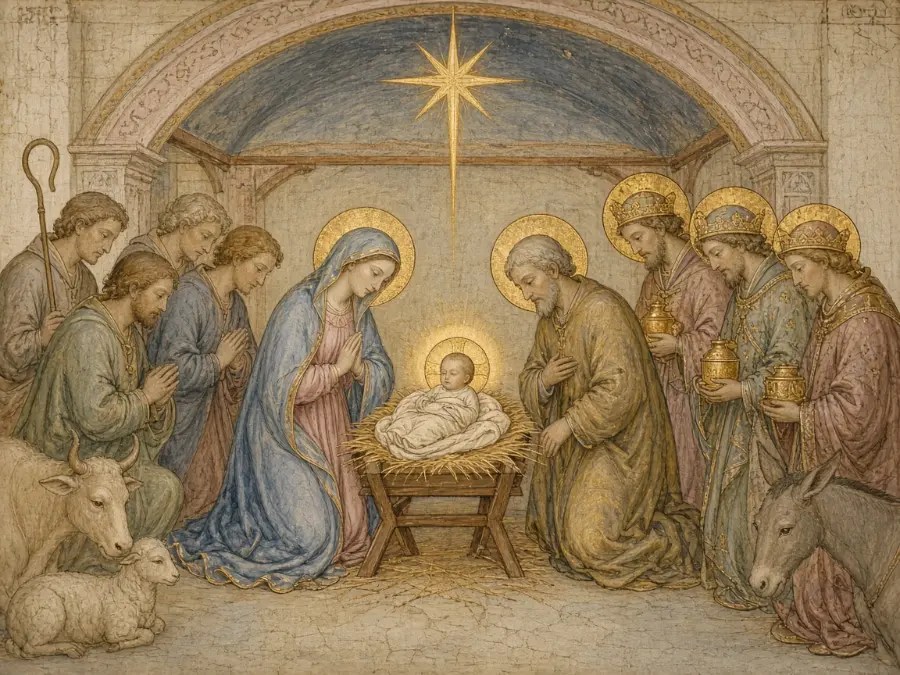
While they were there in Bethlehem, the time came for the baby to be born. Mary gave birth to her firstborn son. She wrapped him in swaddling clothes, the cloth and bands that a newborn baby was wrapped in. And she laid him in a manger, the place where the animals’ food was put, “because there was no room for them in the inn.”
That is all Luke tells us about the birth itself. The child the angel had called the Son of the Highest, whose kingdom would never end, was lying in a manger in Bethlehem.
A prayer to end: Dear Jesus, there was no room for you that night. There is room for you in our home, and in our hearts. Amen.
Night 6: The angels and the shepherds (Luke 2:8–20)
In the same country there were shepherds out in the fields, keeping watch over their flock by night.
Suddenly the angel of the Lord came to them. The glory of the Lord shone all around them, and they were very much afraid.
And the angel said to them, “Fear not: for, behold, I bring you good tidings of great joy, which shall be to all people. For unto you is born this day in the city of David a Saviour, which is Christ the Lord. And this shall be a sign unto you; Ye shall find the babe wrapped in swaddling clothes, lying in a manger.”
Then all at once there was with the angel a great crowd of the angels of heaven. They were praising God and saying, “Glory to God in the highest, and on earth peace, good will toward men.”
When the angels had gone away into heaven, the shepherds said to one another, “Let us now go even unto Bethlehem, and see this thing which is come to pass, which the Lord hath made known unto us.”
They hurried, and they found Mary and Joseph, and the baby lying in a manger. Then they told everyone what they had been told about this child. And all who heard it were amazed at what the shepherds said.
“But Mary kept all these things, and pondered them in her heart.” And the shepherds went back, glorifying and praising God for everything they had heard and seen, just as it had been told to them.
A prayer to end: Glory to God in the highest! Thank you, God, for good news of great joy for everyone. Amen.
Night 7: Simeon and Anna in the temple (Luke 2:21–40)
When the baby was eight days old, he was given the name Jesus. It was the name the angel had given him before he was born.
When the time came that the law of Moses set, Mary and Joseph brought him to the temple in Jerusalem. They came to present him to the Lord, and to give the offering the law asked for: a pair of turtledoves, or two young pigeons.
In Jerusalem there lived a man named Simeon. He was good and faithful, and he was waiting for God to comfort his people Israel. The Holy Ghost was upon him. God had shown him that he would not die until he had seen the Christ, the one the Lord had promised.
That day the Spirit led Simeon into the temple. When Mary and Joseph brought the child Jesus in, Simeon took him up in his arms and blessed God, and said, “Lord, now lettest thou thy servant depart in peace, according to thy word: For mine eyes have seen thy salvation, Which thou hast prepared before the face of all people; A light to lighten the Gentiles, and the glory of thy people Israel.” The Gentiles are all the nations of the world beyond Israel. Joseph and Mary marvelled at what was said about their child.
There was also a prophetess named Anna, who was very old. She never left the temple. She served God there night and day, with fasting and prayers. She came up at that very moment, and she gave thanks to the Lord. And she spoke about the child to everyone in Jerusalem who was waiting for God to set his people free.
When they had done everything the law of the Lord asked, they went home to Nazareth in Galilee. “And the child grew, and waxed strong in spirit, filled with wisdom: and the grace of God was upon him.”
A prayer to end: Save us, Lord, while we are awake; protect us while we sleep. Let us go to sleep in peace, for you keep your word. Amen.
Tonight’s prayer borrows the Church’s own words for the end of the day, because Simeon’s song has been said at night for centuries. The Book of Common Prayer of 1662 sets it in Evening Prayer as “the Song of Simeon”, and in the Catholic Church it is sung at Compline, the last prayer of the day, with these words before and after it: “Save us, Lord, while we are awake; protect us while we sleep.”
Night 8: The wise men and the star (Matthew 2:1–12)
After Jesus was born in Bethlehem, in the days of Herod the king, wise men came from the east to Jerusalem. “Where is he that is born King of the Jews?” they asked. “For we have seen his star in the east, and are come to worship him.”
When King Herod heard this, he was troubled, and all Jerusalem with him. He called together the chief priests and the scribes, and he asked them where the Christ was to be born. In Bethlehem of Judaea, they told him. Long ago the prophet had written that out of Bethlehem would come a ruler, who would rule God’s people Israel.
Then Herod called the wise men in secret. He asked them exactly when the star had appeared. He sent them to Bethlehem and said, “Go and search diligently for the young child; and when ye have found him, bring me word again, that I may come and worship him also.”
So the wise men set off. The star they had seen in the east went ahead of them, until it came and stood over the place where the young child was. When they saw the star, “they rejoiced with exceeding great joy.”
They came into the house and saw the young child with Mary his mother, and they fell down and worshipped him. Then they opened their treasures and gave him gifts: gold, and frankincense, and myrrh.
But God warned them in a dream not to go back to Herod. So they went home to their own country another way.
A prayer to end: Dear Jesus, the wise men brought you their treasures. Tonight I give you my heart. Amen.
For parents: the manger, the inn and the wise men
Luke does not say where the manger stood, whether in a stable, a cave or the end of a room in a house where the animals were kept. An old tradition places it in a cave near Bethlehem, and our page on why Jesus was born in a manger tells where that tradition comes from.
The inn is worth a word too. Where the King James Version says “inn”, Luke uses the same word he uses later for the “guestchamber” where Jesus ate the Passover with his disciples (Luke 22:11), and scholars have argued for more than five hundred years over which he meant: an inn, or a guest room in a house.
How many wise men were there? Matthew does not count them, and he does not call them kings. He names three gifts, gold, frankincense and myrrh. He also says the wise men found the child in a house.
We make Halo, a children’s app with audio Bible stories, prayers and songs for bedtime; it is free to download, with a paid annual plan ($77.99 a year as of November 2026), on the App Store.
Matthew’s story does not stop where Night 8 does. He goes on to tell how an angel sent Joseph in another dream to take the child and his mother into Egypt, and how Herod in his anger killed the children of Bethlehem who were two years old and under (Matthew 2:13–18). We have stopped at the wise men going home. An older child can hear the rest with you by daylight.
Related reading
- How to tell the Christmas story to kids, age by age
- The Christmas story for children, to read aloud
- Where the Christmas story is in the Bible: Matthew 1–2 and Luke 1–2
- Why Jesus was born in a manger, and what a manger is
- How old Jesus was when the wise men came
- Bedtime prayers for kids


Leave a Reply