
 English
 Chinese
 Dutch
 Arabic
 Spanish
 Portuguese
 Russian
 French
 Italian
 German
 Japanese
No one named Lisa appears in the Bible, but the name it comes from does. Lisa is a short form of Elizabeth, the mother of John the Baptist in the first chapter of Luke. Elizabeth is the Greek form of the Hebrew Elisheba, “my God is an oath,” the name of Aaron’s wife in Exodus 6:23.

Elizabeth in the Gospel of Luke
Luke introduces Elizabeth as the wife of Zechariah, a priest, and says she was descended from Aaron: “he had a wife from the daughters of Aaron, and her name was Elizabeth” (Luke 1:5). Both were “righteous before God,” but they had no child, “because Elizabeth was barren, and both were advanced in years” (Luke 1:6–7). While Zechariah was burning incense in the temple, an angel told him that his wife would bear a son and that he was to call him John (Luke 1:13).
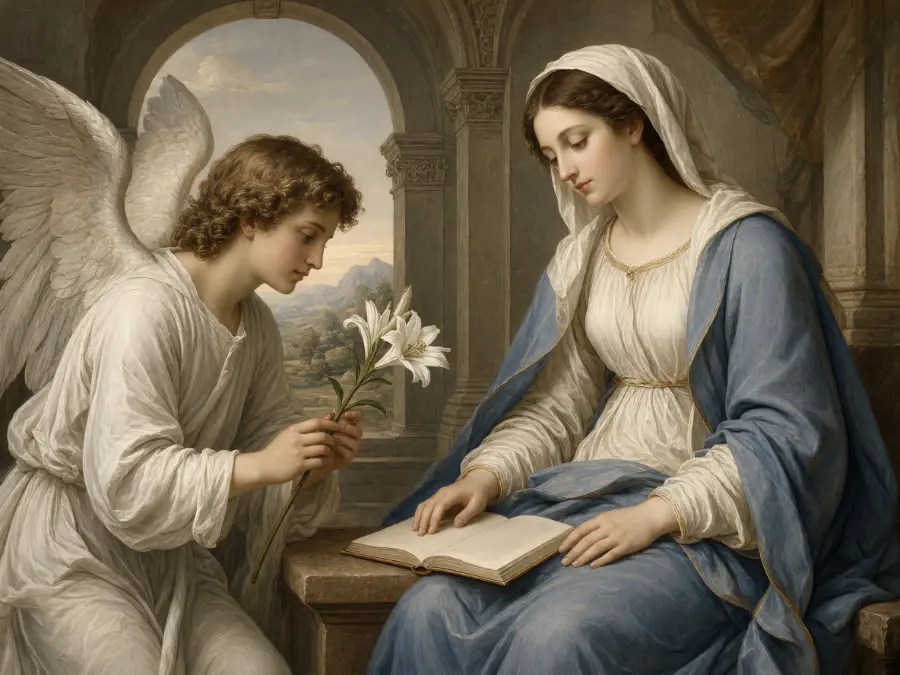
When the angel Gabriel told Mary that she would bear Jesus, he added that her “relative Elizabeth” had also conceived a son in her old age (Luke 1:36). The King James Version calls Elizabeth Mary’s “cousin,” but Luke’s Greek word, syngenis, means a relative without saying how the two women were related. Mary went to visit her, and when Elizabeth heard Mary’s greeting, “the baby leaped in her womb.” Filled with the Holy Spirit, Elizabeth cried out, “Blessed are you among women, and blessed is the fruit of your womb!” (Luke 1:41–42). When the child was circumcised, the relatives wanted to name him Zechariah after his father, but Elizabeth answered, “No; he shall be called John,” and Zechariah, who had been unable to speak since the angel’s visit, wrote on a tablet, “His name is John” (Luke 1:59–63).
A blessing card for Lisa
Lisa
means my God is an oath
Hebrew, from Elisheba via Elizabeth
In the Bible in another formAs Elizabeth, mother of John the Baptist (Luke 1), and Elisheba, the wife of Aaron (Exodus 6:23)
In the time of Herod king of Judea there was a priest named Zechariah, who belonged to the priestly division of Abijah, and whose wife Elizabeth was a descendant of Aaron.
Luke 1:5 Berean Standard Bible
Lisa, may the LORD bless you and keep you. Numbers 6:24
The card is on its way
Look for an email from Christian Pure in the next few minutes.
What does Lisa mean?
Lisa means what Elizabeth means. The Hebrew Elisheba is built from el, “God,” and shava’, “oath,” so the name means “my God is an oath.” It is also given as “God is my oath” or “God’s promise.” The Greek form, Elisabet, is the one the New Testament uses, and the English Elizabeth comes from it.
Lisa began as a short form of Elizabeth and of its forms in other languages, such as Elisabeth and the Italian Elisabetta, and it is often given as a name in its own right. Elisa, Elise and the German Liesel are other short forms from the same source. Lisa is also the name of the subject of one of the world’s most famous paintings: Lisa del Giocondo (1479–1542), the Florentine woman traditionally identified as Leonardo da Vinci’s Mona Lisa. Mona, properly monna, is a shortened form of the Italian ma donna, “my lady.”
In the United States Lisa was more popular than Elizabeth from 1958 to 1978, and it was the most common name for girls every year from 1962 to 1969. It left the top 100 in 1994 and ranked 987th in 2025.
Is Lisa a Christian name?
Lisa is a form of a biblical name, and Elizabeth has a long Christian history. Behind the Name notes that among Christians it was at first more common in Eastern Europe. Saint Elizabeth of Hungary (1207–1231), a daughter of King Andrew II of Hungary, was widowed at 20, used her dowry to build a hospital, and served the sick there herself; she was canonized in 1235. Elizabeth Ann Seton (1774–1821), who founded the Sisters of Charity in Emmitsburg, Maryland, was canonized in 1975, the first person born in what became the United States to be made a saint.
Name-day calendars treat Lisa in different ways. In Austria its name day is 19 November, the same as Elisabeth’s, while Sweden and Norway give Lisa days of its own, 20 September and 2 September.
Related reading
- Does the Name Elizabeth Hold Biblical Significance? Yes, She Is John’s Mother
- Is Beth a Biblical Name? Not on Its Own, Though Beth Means House
- Is Your Name in the Bible? A Directory of 231 Names


Leave a Reply