
 Dutch
 English
 Chinese
 Arabic
 Spanish
 Portuguese
 Russian
 French
 Italian
 German
 Japanese
Advent 2026 begins on Sunday 29 November and ends on Christmas Eve, Thursday 24 December, which gives us 26 days. Below is one short Bible reading for each of them, a verse or two a day, and they take the story in order. On the first morning we wait with a psalm for the Lord “more than they that watch for the morning” (Psalm 130:6), and on Christmas Eve we come to the shepherds “keeping watch over their flock by night” who hear that a Saviour is born (Luke 2:8–11).
A few minutes a day is all it asks. Read the day’s verse aloud, slowly, and if you have a little more time, open your Bible and read the verses around it, because each of these lines sits inside a longer story. You might read alone first thing in the morning, or light a candle, or the candles of your Advent wreath, and read with the family at supper or at bedtime, when a verse or two is short enough for the youngest at the table. We quote the King James Version here, but the Bible you have at home will do. If a day slips past, read it with the next day’s verse and carry on. Our free Advent emails send the same verse on the same mornings, if you would rather have each day’s reading sent to you.
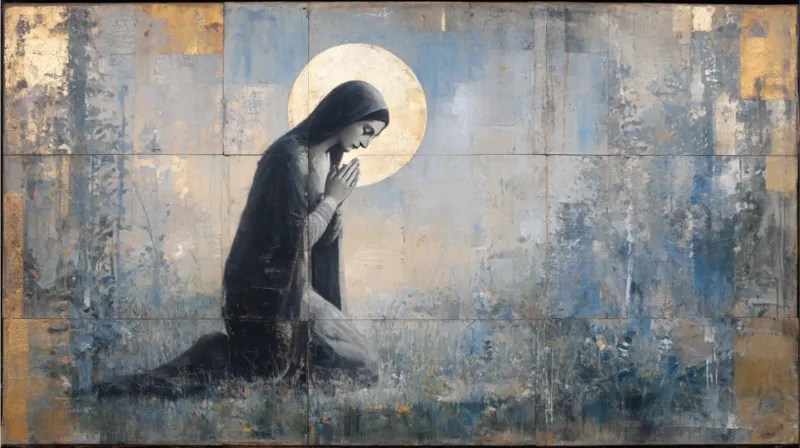
The readings for each day of Advent 2026
| Day and date | Lezing | What it gives the day |
|---|---|---|
| Day 1, Sun 29 Nov | Psalm 130:5–6 | The first Sunday: we wait for the Lord more than the night watch waits for morning. |
| Day 2, Mon 30 Nov | Genesis 15:5–6 | Abram, still without a child, is told to count the stars, and he believes God. |
| Day 3, Tue 1 Dec | 2 Samuel 7:16 | God promises David a house and a throne that will last for ever. |
| Day 4, Wed 2 Dec | Psalm 80:3 | A people in trouble asks God to turn them back and let his face shine. |
| Day 5, Thu 3 Dec | Lamentations 3:25–26 | Even in grief for Jerusalem, it is good to hope and wait quietly. |
| Day 6, Fri 4 Dec | Jesaja 64:4 | No eye has seen what God has ready for those who wait for him. |
| Day 7, Sat 5 Dec | Habakuk 2:3 | A prophet on his watch is told that the answer may be slow, but it will come. |
| Day 8, Sun 6 Dec | Isaiah 40:3 | The second Sunday: a voice cries in the wilderness, “Prepare ye the way”. |
| Day 9, Mon 7 Dec | Jesaja 40:11 | God as a shepherd, carrying the lambs in his arms. |
| Day 10, Tue 8 Dec | Isaiah 11:1–2 | A new branch grows from Jesse’s roots, and God’s Spirit rests on him. |
| Day 11, Wed 9 Dec | Isaiah 9:2 | People who have walked in the dark see a great light. |
| Day 12, Thu 10 Dec | Jesaja 9:6 | A child is born to us, and Isaiah tells us his names. |
| Day 13, Fri 11 Dec | Micha 5:2 | Bethlehem, “little among the thousands of Judah”, will send Israel’s ruler. |
| Day 14, Sat 12 Dec | Malachi 3:1 | God promises to send a messenger ahead to get the way ready. |
| Day 15, Sun 13 Dec | Philippians 4:4–5 | The third Sunday: rejoice, says Paul, for the Lord is at hand. |
| Day 16, Mon 14 Dec | Zefanja 3:17 | We sing to God, and here God sings over his people. |
| Day 17, Tue 15 Dec | Isaiah 35:5–6 | The blind will see, and the lame will leap like a deer. |
| Day 18, Wed 16 Dec | Luke 1:57–58 | Elisabeth, well on in years, has her son, and her neighbours rejoice with her. |
| Day 19, Thu 17 Dec | Matthew 3:1–2 | John preaches in the wilderness: repent, for the kingdom is at hand. |
| Day 20, Fri 18 Dec | John 1:35–36 | John sees Jesus and points him out: “Behold the Lamb of God!” |
| Day 21, Sat 19 Dec | John 3:30 | Told that everyone is going to Jesus, John says he must become less. |
| Day 22, Sun 20 Dec | Lucas 1:38 | The fourth Sunday: Mary says yes to the angel. |
| Day 23, Mon 21 Dec | Matthew 1:20–21 | In a dream an angel tells Joseph not to be afraid to take Mary home. |
| Day 24, Tue 22 Dec | Luke 1:46–47 | Mary begins her song: my soul doth magnify the Lord. |
| Day 25, Wed 23 Dec | Luke 2:4–5 | Joseph takes Mary from Nazareth to Bethlehem, the city of David. |
| Day 26, Thu 24 Dec | Lucas 2:11 | Christmas Eve: the angel tells the shepherds a Saviour is born. |

How the readings move through Advent
Everyone in the first week is waiting for something God has promised, and for each of them the promise is slow in coming. Abram has no child when God brings him out under the night sky and says, “Look now toward heaven, and tell the stars, if thou be able to number them,” and Abram “believed in the Lord” (Genesis 15:5–6). David is promised a throne for ever. A people in trouble prays, “Turn us again, O God, and cause thy face to shine; and we shall be saved” (Psalm 80:3), a line the psalm says three times. The writer of Lamentations, grieving over Jerusalem, says, “It is good that a man should both hope and quietly wait for the salvation of the Lord” (Lamentations 3:26), and on the Saturday Habakkuk, who has cried “how long”, stands on his watch and is told of God’s answer, “though it tarry, wait for it; because it will surely come, it will not tarry” (Habakkuk 2:3).
In the second week the prophets speak, and nearly every day it is Isaiah. Seven of our 26 readings are his, more than from any other book, and in the old Breviary the night office read chapters of Isaiah all through Advent too. He gives us the voice in the wilderness, the shepherd with the lambs, the branch from Jesse, the light in the darkness and the child with his names; Micah names little Bethlehem, and Malachi promises the messenger. Many of these lines come back later in the Bible. All four Gospels hear the voice of Isaiah 40:3 in John the Baptist (Matthew 3:3, Mark 1:3, Luke 3:4, John 1:23). When wise men from the east come to Jerusalem asking, “Where is he that is born King of the Jews?”, the chief priests and scribes answer Herod with Micah 5:2 (Matthew 2:2–6). Matthew sees the light of Isaiah 9:2 rise in Galilee when Jesus makes his home in Capernaum (Matthew 4:13–16). Our page on de verzen uit Jesaja die de geboorte van Jezus voorspellen reads 9:6 and 11:1 closely, with 7:14.
The third week turns to joy with Paul’s “Rejoice in the Lord always” on its Sunday, and on the Monday Zephaniah turns it round: we rejoice in God, and God “will rejoice over thee with joy; he will rest in his love, he will joy over thee with singing” (Zephaniah 3:17). On Tuesday the lame man leaps “as an hart”, and when John the Baptist sends from prison to ask whether Jesus is the one who should come, Jesus answers him with the same signs: “The blind receive their sight, and the lame walk” (Matthew 11:5). From Wednesday the readings stay in the Gospels, and for four days they follow John himself. He is born to Elisabeth and Zacharias, who “both were now well stricken in years” (Luke 1:7); he preaches in the wilderness; he sees Jesus and says “Behold the Lamb of God!”, and two of his disciples follow Jesus (John 1:36–37); and when he hears that all men are going to Jesus he answers, “He must increase, but I must decrease” (John 3:30).
In the last days we are with Mary and Joseph, and so is the church’s own calendar. The Catholic Church’s norms for the liturgical year say that “the weekdays from 17 December up to and including 24 December are ordered in a more direct way to preparing for the Nativity of the Lord”, and they call the whole season “a period of devout and expectant delight.” On seven of those last days the old antiphons sung with Mary’s song call on Christ as Wisdom, the Key of David and the Rising Sun, the prayers behind the carol O Come, O Come, Emmanuel. Yet Advent looks two ways at once. It is a time of preparation for Christmas, “in which the First Coming of the Son of God to humanity is remembered”, and a time when “minds and hearts are led to look forward to Christ’s Second Coming at the end of time”. So the waiting in these readings is ours too. We remember how long Abram and Habakkuk waited for the Lord’s first coming, and we wait ourselves for the Lord who, Paul says, “is at hand” (Philippians 4:5).
When does Advent begin in other years?
Advent begins on the Sunday that falls on or closest to 30 November, the feast of St Andrew, so its first Sunday can come as early as 27 November or as late as 3 December, and the season runs from 22 to 28 days, counting Christmas Eve. The dates in the table are for 2026. In 2027 Advent begins on Sunday 28 November, and in 2028 on Sunday 3 December. In another year, start Day 1 on the first Sunday of Advent and read on in order, so that the four Sunday readings, Days 1, 8, 15 and 22, fall on the four Sundays, then read the last four in the days that are left and keep Luke 2:11 for Christmas Eve. In 2027 that leaves a day to spare. In a short Advent like 2028’s, the fourth Sunday is Christmas Eve itself, and Days 22 to 26 all belong to that one day.
The Orthodox churches prepare for Christmas with the Nativity Fast, which, in the words of the Orthodox Church in America, “begins on November 15 and continues through the Eve of the Nativity”. In the churches that keep the old calendar, its forty days, 15 November to 24 December by that calendar, fall from 28 November to 6 January in ours. These readings can be kept alongside the fast.
The four Sundays of Advent 2026
On the Sundays the plan stays close to what is read in church. We set it beside the 2026 readings of the Revised Common Lectionary and of the Catholic Lectionary for Mass, and seven of our 26 readings are verses from the very passages read in church on the Sundays of this Advent. The meaning of Advent and the Gospel for each Sunday are set out in full on our What Is Advent page.
29 November: the first Sunday
Our first reading is Psalm 130 and its watchmen, and the Gospel in church this Sunday ends on the same word. Jesus tells his disciples to watch, for they do not know when the master of the house will come, “at even, or at midnight, or at the cockcrowing, or in the morning”, and he finishes, “And what I say unto you I say unto all, Watch” (Mark 13:35, 37). Both lectionaries sing Psalm 80 today, and in the Catholic Mass the people’s response is the prayer we read on Wednesday 2 December. Catholic Bibles number that verse 80:4, because they count the psalm’s title as its first verse. The Douay-Rheims calls the whole psalm 79, so there it is Psalm 79:4. Our verse for Friday 4 December, Isaiah 64:4, comes from this Sunday’s first reading too. In the King James Version that chapter begins, “Oh that thou wouldest rend the heavens, that thou wouldest come down” (Isaiah 64:1), and in the Catholic reading the same line is numbered 63:19b.
6 December: the second Sunday
Isaiah 40 is read in church today, and our Sunday and Monday verses both come from it: the voice that cries, “Prepare ye the way of the Lord” (Isaiah 40:3), and the shepherd who will “gather the lambs with his arm, and carry them in his bosom” (Isaiah 40:11). The Gospel is the first page of Mark, which opens with the messenger of Malachi 3:1, our reading for the Saturday that ends this week, and then brings John the Baptist out into the wilderness.
13 December: the third Sunday, Gaudete Sunday
This Sunday takes its old name from the first word of its Latin entrance chant, “Gaudete in Domino semper”, which are the words of our reading: “Rejoice in the Lord always: and again I say, Rejoice” (Philippians 4:4). Paul wrote them in chains, for he speaks in the same letter of “my bonds in Christ” (Philippians 1:13). The priest’s vestments may be rose instead of violet today, and our page on Gaudete Sunday and its rose candle tells why. At Mass today Mary’s song, the Magnificat, is sung in place of a psalm, and the Revised Common Lectionary offers it too, nine days before we reach it ourselves.
20 December: the fourth Sunday
In both lectionaries the Gospel today is the angel Gabriel’s visit to Mary, and it ends with our reading, her answer: “Behold the handmaid of the Lord; be it unto me according to thy word” (Luke 1:38). The first reading is God’s promise to David, and it ends with the verse we read on 1 December, “thy throne shall be established for ever” (2 Samuel 7:16). The Revised Common Lectionary offers the Magnificat again as today’s psalm, and two days later, on Tuesday 22 December, it is the Catholic weekday Gospel, on the same morning our plan comes to it.
After that come Joseph’s dream, Mary’s song and the road to Bethlehem, and on Christmas Eve the watching ends where it began, in the night. On the first morning we waited for the Lord more than the watchmen wait for dawn. On the last, shepherds are keeping watch in the fields when the angel comes to them, and the first thing he says is what all those days of waiting were for: “Fear not: for, behold, I bring you good tidings of great joy, which shall be to all people” (Luke 2:10).


Een reactie plaatsen