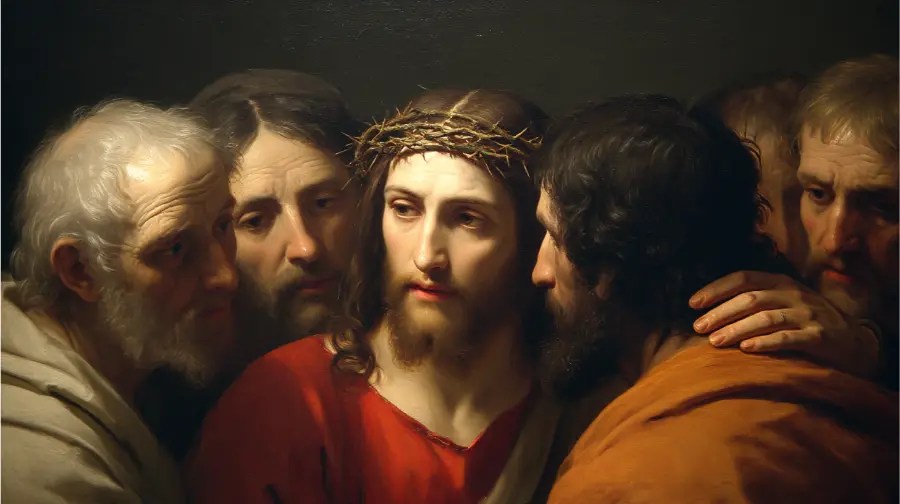
The Bible vs. The Book of Mormon: A Compassionate Exploration of Two Different Stories
It is a familiar scene in many neighborhoods: the doorbell rings, and on the doorstep stand two polite, earnest, and well-dressed young people. They are missionaries from The Church of Jesus Christ of Latter-day Saints (LDS), and they have come to share a message they believe with all their hearts. They speak of Jesus Christ, the importance of family, and a book they call “Another Testament of Jesus Christ”—the Book of Mormon. This interaction often leaves Christian families with a mix of warmth toward the sincere individuals and a deep sense of confusion about their message.
The confusion is understandable because the language used often sounds so familiar. Words like God, Jezus, Redding, Genade, en Verzoening are central to their vocabulary, just as they are to ours.¹ Yet, beneath this shared surface, these words represent fundamentally different beliefs and tell two profoundly different stories.² One story, found in the Holy Bible, is about a transcendent Creator God who graciously saves sinful humanity through the finished work of His divine Son. The other, founded on the Book of Mormon, tells a story of human progression toward godhood, achieved through personal effort and obedience.
This article is a heartfelt and thorough exploration of those differences. It is written not to attack the character or sincerity of our Latter-day Saint neighbors to lovingly and clearly compare the claims of the Book of Mormon and the doctrines of the LDS Church with the timeless, historical, and life-giving truths of the Bible. By journeying through the origins, historical claims, and core teachings of both books, we can arrive at a place of confident understanding, equipped to engage in compassionate conversations grounded in truth and love.

How Were the Bible and the Book of Mormon Written?
The foundation of any sacred text lies in its origin. How a book came to be—who wrote it, when, and under what circumstances—profoundly shapes its authority and reliability. When we place the Bible and the Book of Mormon side by side, we find two radically different stories of creation.
The Bible: A Divine Library Forged Through History
The Bible is not a single book dropped from heaven but a library—a collection of 66 distinct books written by approximately 40 different authors over a span of 1,500 years.⁴ These authors were not a monolithic group; they came from every walk of life. Moses was a shepherd and a prince, David was a king and a poet, Isaiah was a prophet in a royal court, Matthew was a tax collector, Luke was a physician, John was a fisherman, and Paul was a tentmaker and a scholar.⁴ They wrote in different times, from different continents, and in three different languages: Hebrew, Aramaic, and Greek.⁵
Despite this incredible diversity of authors, cultures, and centuries, Christian faith holds that there is a single, divine Author behind it all. The Bible teaches that its human writers were “carried along by the Holy Spirit” (2 Peter 1:21), so that the resulting text is “God-breathed” (2 Tim. 3:16).⁴ This process is one of divine superintendence, where God worked through the personalities, styles, and circumstances of the human authors to produce His intended Word. The authorship is therefore wonderfully dual: fully human and fully divine.⁵
The collection of these books into the canon of Scripture was a careful, organic process. The books of the Old Testament were recognized as authoritative by the Jewish people over centuries, a collection that Jesus Himself affirmed and treated as the Word of God (Luke 24:44).⁷ Similarly, the books of the New Testament were recognized by the early church based on clear criteria: Was the book written by an apostle or a close associate of an apostle? Was it consistent with the established teaching of the church? Was it widely accepted and used by churches everywhere?.⁹ This was not a process of men deciding what would be Scripture of the church recognizing the authority God had already placed upon these texts.⁹
The Book of Mormon: A 19th-Century Revelation
The origin of the Book of Mormon is the story of one man: Joseph Smith. Unlike the Bible’s 1,500-year composition, the Book of Mormon was produced in a very short time, with the bulk of the dictation taking place over roughly three months in 1829.¹² Smith, a young man with a limited education, claimed he was led by an angel to a set of buried golden plates.¹³ These plates, he said, were inscribed with a language he called “Reformed Egyptian”—a language that remains unknown to linguists, Egyptologists, and historians.¹⁵
The process of creating the English text was not a translation in the conventional sense. Numerous eyewitnesses, including Joseph Smith’s wife Emma and his primary scribes, testified that Smith did not typically consult the plates directly.¹⁷ Instead, he would place a “seer stone”—either one he had previously used for treasure-seeking or the “interpreters” that he said came with the plates—into the crown of his hat. He would then put his face into the hat to block out all light and dictate, word for word, the English sentences that he claimed appeared on the stone.¹⁸ According to these witnesses, the golden plates themselves often lay covered on the table or were not even in the room during the dictation process.¹⁷
| Attribuut | De Bijbel | The Book of Mormon |
|---|---|---|
| Authorship | Approx. 40 authors from diverse backgrounds | 1 author/translator (Joseph Smith) |
| Time Span | Approx. 1,500 years (c. 1400 B.C. to A.D. 100\) | Approx. 3 months for dictation (1829) |
| Original Languages | Hebrew, Aramaic, Greek | “Reformed Egyptian” (unknown to scholarship) |
| Manuscriptbewijs | Thousands of ancient manuscripts and fragments | No original manuscripts exist (plates returned to angel) |
The stark contrast in origins reveals a fundamental difference. The Bible’s authority is rooted in a long, public history of God speaking through many voices, with its claims anchored by thousands of manuscripts and a verifiable historical and archaeological record. The Book of Mormon’s authority, in contrast, rests entirely on the personal claim of one 19th-century man and a supernatural process that has no external evidence or parallel in history.
A further challenge to the Book of Mormon’s origin story arises from its writing style. Published in 1830, the book is written in an archaic English that mimics the King James Version (KJV) of the Bible, which was published in 1611.¹⁶ This stylistic choice is peculiar for a text supposedly translated in the 19th century. More critically, the Book of Mormon contains lengthy, word-for-word quotations from the KJV Bible.²² This includes passages that modern scholarship, using older and more reliable manuscripts than the KJV translators had, has identified as containing translation errors.¹⁶
If the Book of Mormon were a direct, divine translation from an ancient record, it would not contain the specific translation errors of a 17th-century English Bible. A translation guided by the “gift and power of God” would presumably be more accurate, providing a corrected rendering rather than replicating known mistakes. The presence of these KJV errors strongly suggests that the Book of Mormon is not a translation of an ancient document at all a 19th-century composition that used the popular King James Bible as a primary source text and stylistic model.¹⁶

Can We Trust the Historical Claims of the Book of Mormon?
A sacred text that claims to be a record of historical events invites historical scrutiny. The Bible’s narrative unfolds in a world we can explore today. Its cities, peoples, and empires are part of the historical record. The Book of Mormon describes a world that has never been found.
The Bible’s Verifiable World
The Bible’s story is deeply embedded in the soil of the ancient Near East. Archaeologists have unearthed cities like Jerusalem, Jericho, Bethel, and Capernaum, confirming their existence as described in the biblical text.²² Inscriptions and records from other ancient cultures corroborate the existence of biblical figures like King David of Israel, King Hezekiah of Judah, and Roman governor Pontius Pilate. The customs, laws, political structures, and geographical landscapes detailed in the Bible are consistent with what historians have painstakingly reconstructed about the ancient world. While faith is required to believe in the miracles, the stage on which those miracles occurred is demonstrably real.
The Book of Mormon’s Unseen World
In stark contrast, the Book of Mormon tells of vast civilizations—the Nephites, Lamanites, and Jaredites—that supposedly flourished in the ancient Americas for a thousand years.¹³ It describes a history filled with massive cities (such as the capital, Zarahemla), widespread agriculture, metallurgy, and epic battles where hundreds of thousands of soldiers perished in a single conflict.¹³
Yet, after more than a century of dedicated searching, often funded by LDS institutions, there is no mainstream archaeological, historical, or scientific evidence to support these claims.¹⁴ The Smithsonian Institution, in a 1996 statement, noted that “archaeological evidence does not support the history of the Book of Mormon.” There are no maps in the Book of Mormon that correspond to any known ancient American geography.²² The grand cities, the temples, and the battlefields remain undiscovered.
The book is filled with what are known as anachronisms—elements that are out of place in their supposed historical setting.¹⁴ The Book of Mormon describes ancient American peoples using animals, plants, and technologies that all credible scientific and archaeological evidence shows did not exist in the pre-Columbian Americas. These include:
- Animals: Horses, elephants, cattle, sheep, and swine.¹⁴
- Plants: Wheat and barley.¹⁴
- Technologie: Steel swords and bows, chariots, and wheeled vehicles.¹⁴
LDS apologists have attempted to address these issues, pointing to a few potential, though highly contested, pieces of evidence. They highlight the discovery of an ancient altar in Yemen bearing the Semitic consonants “NHM,” which they claim is the “Nahom” mentioned in the book of 1 Nephi.²⁷ They also point to the use of cement in some Mesoamerican cultures and the existence of a native species of barley.²⁷ But these isolated and ambiguous points are far from the kind of widespread evidence needed to validate the existence of continent-spanning, literate, metal-working civilizations. They do not account for the overwhelming lack of evidence and the host of anachronisms that contradict the Book of Mormon’s historical narrative.
The historical context of the Book of Mormon’s creation offers a compelling explanation for its narrative. The book’s story aligns remarkably well with a popular 19th-century theory known as the “Mound Builder” myth.¹⁴ As American settlers moved west, they encountered large, sophisticated earthen mounds and were reluctant to believe they were built by the ancestors of the Native Americans they considered “savages.” Instead, a popular myth arose that a lost, more advanced race—often imagined to be white and of Israelite origin—had built the mounds before being exterminated by the ancestors of the Native Americans.²⁶
The Book of Mormon’s central plot—a righteous, light-skinned people (the Nephites) being destroyed by a wicked, dark-skinned people (the Lamanites), who are identified as the principal ancestors of the American Indians—is a direct reflection of this 19th-century myth.¹³ This places the Book of Mormon not as an ancient historical record as a product of its time, a work of American literature that gave theological expression to the cultural and racial ideas prevalent in Joseph Smith’s world.¹⁴

Do Mormons Believe the Bible Is the Infallible Word of God?
A crucial point of divergence lies in how each faith views the authority and integrity of the Bible itself. While Christians hold the Bible as the final and sufficient Word of God, the LDS Church’s position is significantly more qualified.
The eighth of the LDS Articles of Faith famously states: “We believe the Bible to be the word of God as far as it is translated correctly; we also believe the Book of Mormon to be the word of God”.²⁸ On the surface, this sounds reasonable. Christians also believe the Bible should be translated correctly. But the meaning and application of this phrase within Mormonism are profoundly different.
For Latter-day this qualifier is not primarily about comparing Greek manuscripts or debating the best English rendering of a Hebrew verb. Instead, it serves as a theological escape hatch, allowing any biblical passage that contradicts LDS doctrine to be dismissed as incorrectly translated or corrupted.²⁸ The foundational LDS narrative is that after the death of the apostles, a “Great Apostasy” occurred, during which a “great and abominable church” deliberately removed “plain and precious” truths from the biblical text to “pervert the right ways of the Lord”.²⁸
This belief system effectively subordinates the Bible to other sources of authority. In practice, if a conflict arises between the Bible and the Book of Mormon, the Bible is assumed to be the flawed text.²⁸ The Book of Mormon—which Joseph Smith called “the most correct of any book on earth”—along with the Doctrine and Covenants, the Pearl of Great Price, and the teachings of living LDS prophets, are used to “restore” the truths the Bible has supposedly lost.³¹ The Bible is revered and used its authority is always conditional and secondary.³⁰
In contrast, historic Christianity affirms the inspiration, inerrancy, and sufficiency of the 66 books of the Bible. While acknowledging that minor copyist errors exist in the manuscript tradition (which the science of textual criticism has shown do not affect any core doctrine), the church has always held that God has faithfully preserved His Word. The Bible is seen as a complete and trustworthy guide for faith and life, and it closes with a solemn warning against adding to or taking away from its words (Revelation 22:18-19).²⁹

Aanbidden we dezelfde God en dezelfde Jezus?
This is the most important question of all. While both faiths use the name “Jesus Christ” and speak of “God the Father,” the beings they describe are fundamentally different. The definitions of God and Jesus in Mormonism are not only different from but also mutually exclusive with the teachings of the Bible.
The Nature of God: Trinity vs. Godhead
The Bible teaches that there is one, and only one, true God.⁶ The prophet Isaiah records God’s own declaration: “Before me no god was formed, nor shall there be any after me” (Isaiah 43:10). This one God has revealed Himself as eternally existing in three distinct, co-equal, and co-eternal Persons: the Father, the Son (Jesus Christ), and the Holy Spirit. This is the doctrine of the Trinity. The three Persons are not three separate gods; they are one God, sharing the same divine essence or being. The Bible also teaches that “God is spirit” (John 4:24), meaning He is not a being of physical matter.³³
The Church of Jesus Christ of Latter-day Saints explicitly rejects the doctrine of the Trinity.³⁵ Instead, they teach a concept called the Godhead. In this view, the Father, the Son, and the Holy Ghost are three separate and distinct beings—three separate gods.³⁷ They are described as being “one in purpose,” but they are not one in essence or substance.⁴⁰ Mormon doctrine teaches that God the Father has a physical body of “flesh and bones as tangible as man’s”.⁶
The Identity of God the Father and Jesus Christ
The differences become even more stark when we examine the specific identities of the Father and the Son.
- God the Father: In biblical Christianity, God the Father is the eternal, uncreated Creator of everything that exists. He has always been God. In Mormonism a core doctrine is that God the Father was once a mortal man who lived on another world. Through obedience and progression, he was exalted to become a god.⁶ This teaching is encapsulated in a famous aphorism by LDS President Lorenzo Snow: “As man is, God once was; as God is, man may become”.⁴³ This doctrine of “eternal progression” implies that there are countless gods presiding over countless worlds, making Mormonism a polytheistic religion.¹³
- Jezus Christus: In the Bible, Jesus Christ is the eternal Son of God, the second Person of the Trinity. He is uncreated, fully God from all eternity, who took on human flesh to save humanity (John 1:1, 14). In Mormon doctrine, Jesus is the firstborn “spirit child” of Heavenly Father and a heavenly mother in a pre-mortal existence.⁴³ In this framework, Jesus and Lucifer are spirit brothers, both sons of God.³⁵ Jesus, like the Father, progressed to become a god, thereby providing the pattern for all other spirit children (including humans) to follow.⁴³
These distinctions lead to a critical theological conclusion. The most fundamental dividing line between biblical Christianity and Mormonism is the Mormon rejection of the absolute distinction between the Creator and the creature. The Bible presents a God who is transcendent—a being of a completely different nature and order from His creation. He is infinite, eternal, and uncreated; we are finite, temporal, and created. This is the very basis for worship. We worship God because He alone is God, our Creator.
Mormonism collapses this distinction. By teaching that God is an exalted man and that men can become gods, it presents God as being of the same “species” as us, simply further along an evolutionary path.⁶ This changes everything. God is no longer the transcendent Creator but the most successful graduate of a cosmic program. The very definitions of “God,” “worship,” and “salvation” are redefined. It becomes clear that Christians and Mormons are not simply disagreeing about the characteristics of the same being; they are worshipping two entirely different beings.³

Is Salvation a Free Gift of Grace or Something We Must Earn?
The path to salvation—how a person is made right with God—is another area of powerful difference. The biblical gospel is a message of rescue, Although the Mormon gospel is a message of progression.
Biblical Christianity: Salvation by Grace Through Faith
The Bible’s message is radically God-centered. It declares that all have sinned and fall short of God’s glory (Romans 3:23) and that the wages of sin is death (Romans 6:23). Because of our sin, we are spiritually dead and completely unable to save ourselves. But God, in His great love, sent His Son, Jesus Christ, to live a perfect life and die on the cross as a substitute, taking the punishment our sins deserved.
Salvation, therefore, is a free gift, offered by God’s grace (His unmerited favor) and received simply by faith (trust) in Jesus Christ and His finished work.²² The apostle Paul makes this crystal clear: “For by grace you have been saved through faith. And this is not your own doing; it is the gift of God, not a result of works, so that no one may boast” (Ephesians 2:8-9).⁴⁶ Good works are not the
toestand for salvation; they are the beautiful and necessary bewijs of a heart that has been truly saved and transformed by God’s grace.
Mormonism: A System of Works and Progression
The LDS “Plan of Salvation” is intricate and uses familiar words in unfamiliar ways.⁴⁷ It is essential to understand that they define “salvation” on at least two different levels.⁴⁸
- General Salvation (Immortality): This refers to the resurrection of the body. In Mormon teaching, Christ’s atonement guarantees this gift for almost every person who has ever lived, regardless of their beliefs or actions in this life.⁶ When a Mormon says they are “saved by grace,” this is often what they mean.
- Individual Salvation (Exaltation): This is the ultimate goal for a faithful Mormon. It is not merely going to heaven but achieving exaltation, which means progressing to become a god, living in the highest of three heavenly kingdoms (the Celestial Kingdom), and being able to have spirit children in an eternal family.⁶ This is not a free gift. It is conditional and must be earned through a lifetime of strict obedience to Mormon laws and ordinances.⁶
The key to understanding this system is a verse from the Book of Mormon: “…for we know that it is by grace that we are saved, na alles wat wij kunnen doen” (2 Nephi 25:23).⁴⁶ In Mormon theology, grace is not the sole basis of salvation but a divine assistance that makes up the difference only after a person has exhausted their own best efforts to keep all of God’s laws.⁴⁶ “All we can do” includes a long list of requirements: faith, repentance, baptism into the LDS receiving the gift of the Holy Ghost through the laying on of hands by a priesthood holder, receiving secret temple endowments, celestial marriage in a temple, paying a full tithe, observing the “Word of Wisdom” (health code), and enduring to the end in total obedience.⁴⁹
| Attribuut | Biblical Christianity | Mormonism |
|---|---|---|
| Basis van redding | Grace alone through faith alone | Grace plus works (“after all we can do”) |
| Role of Christ | Atoning substitute who paid the full penalty for sin | Provides general resurrection and opens the path for progression |
| Role of Humanity | Repent and believe; faith is the instrument to receive the gift | Obey all laws and ordinances to earn exaltation |
| Ultimate Goal | Eternal life in fellowship with God in heaven | Exaltation to godhood in the Celestial Kingdom |
This works-based system has a powerful emotional and spiritual impact. The standard for exaltation is essentially perfection, a standard no human can meet. Consequently, a faithful Mormon can never be truly sure if they have done “enough” to qualify.⁵¹ This lack of assurance is a theme that emerges repeatedly in the stories of those who have left the LDS Church. They speak of a constant spiritual anxiety, a heavy burden of performance, and even a deep self-hatred for their inability to measure up to the church’s demands.⁵¹ This stands in stark contrast to the biblical promise of rest and peace offered by Jesus, who said, “Come to me, all who labor and are heavy laden, and I will give you rest” (Matthew 11:28).

What Is the Catholic Church’s Stance on the Book of Mormon?
The Roman Catholic representing the largest and oldest branch of Christianity, unequivocally rejects the Book of Mormon and the claims of the LDS Church. From a Catholic perspective, the issues are historical, doctrinal, and ecclesiological.²⁴
Catholic teaching aligns with mainstream scholarship in finding a complete lack of historical and archaeological support for the Book of Mormon’s narrative.²⁴ The absence of evidence for Nephite civilizations, their cities, and their wars stands in contrast to the rich archaeological record that illuminates the world of the Bible.
The doctrines founded upon the Book of Mormon and later LDS revelations are seen as a direct contradiction of fundamental Christian truths that the Catholic Church has defined and defended for two millennia. This includes the nature of God as a Trinity, the eternal divinity of Jesus Christ, and the means of salvation.²⁴
And perhaps most critically, the Catholic Church fundamentally rejects the Mormon concept of a “Great Apostasy”.²⁴ The LDS Church’s entire reason for existence is the claim that the original church founded by Christ completely fell away from the truth shortly after the apostles died, necessitating a “restoration” through Joseph Smith.²⁸ The Catholic Church views this as a denial of Christ’s own promise to Peter: “You are Peter, and on this rock I will build my and the gates of hell shall not prevail against it” (Matthew 16:18). If Christ’s promise is true, a total apostasy is impossible. The Catholic Church claims an unbroken historical succession from the apostles and sees itself as the visible continuation of the Church Christ founded, making the idea of a 19th-century “restoration” both theologically unnecessary and historically false.²⁴
Finally, Catholic apologists point out a major internal problem: many of the most distinctive and controversial doctrines of modern Mormonism are not actually found in the Book of Mormon itself. Doctrines such as God having once been a man, humans progressing to godhood, the existence of a heavenly mother, celestial marriage for eternity, and baptism for the dead are all absent from the Book of Mormon, which is supposed to contain the “fullness of the everlasting gospel”.²² These core tenets of Mormonism come from later revelations in the Doctrine and Covenants and the Pearl of Great Price, which calls into question the sufficiency and foundational role of the Book of Mormon itself.

Didn’t Eleven Witnesses Testify They Saw the Golden Plates?
One of the most common pieces of evidence presented by LDS missionaries is the testimony of the witnesses printed in the front of every Book of Mormon. These statements, from the “Three Witnesses” and the “Eight Witnesses,” seem to provide powerful, tangible proof for Joseph Smith’s claims.⁵⁴ But when examined in their full historical context, these testimonies are far less convincing than they first appear.
The Three Witnesses—Oliver Cowdery, David Whitmer, and Martin Harris—testified that an angel of God appeared and showed them the plates.⁵⁶ The Eight Witnesses—all members of the Whitmer or Smith families—testified that Joseph Smith showed them the plates and that they were able to handle them.⁵⁶
Although these claims seem straightforward, several critical facts are often omitted:
- All Witnesses Were Personally Invested: The eleven witnesses were not a panel of neutral, objective observers. They were all close family members, or financial backers of Joseph Smith, deeply invested in the success of his project.⁵⁴
- A “Spiritual” Vision: The experience of the Three Witnesses was explicitly visionary, not purely physical. When pressed, Martin Harris and David Whitmer clarified that they saw the plates with their “spiritual eyes” or “by the eye of faith” while “in the spirit”.⁵⁶ This describes a subjective, internal experience rather than an objective, empirical observation of a physical artifact.
- A World of Folk Magic: Many of the witnesses, including Joseph Smith himself, were active participants in the 19th-century folk magic culture of their region. This worldview included a belief in “second sight”—the ability to see spirits and hidden things—and the use of seer stones and divining rods to find lost objects or treasure.⁵⁴ Their understanding of “seeing” was shaped by this magical framework, which is very different from our modern understanding of physical sight.
- The Witnesses’ Later History: This is a devastating blow to their credibility as exclusive witnesses to Joseph Smith’s divine calling. All three of the Three Witnesses and several of the Eight were later excommunicated from the church. Joseph Smith declared some of them were “too mean to mention”.⁵⁷ More importantly, after leaving Smith’s many of these same witnesses, including Martin Harris and David Whitmer, went on to accept the claims of James J. Strang, another charismatic leader who claimed to have been visited by an angel and given a set of buried metal plates to translate.⁵⁴
The fact that the witnesses were willing to endorse another prophet with a nearly identical story reveals that their testimony was not about Joseph Smith’s unique role as God’s one true prophet. Rather, it was a testimony to a type of spiritual event that they were culturally and personally primed to believe in. Their experience was consistent with their 19th-century magical worldview, a worldview that could be applied to Joseph Smith, James Strang, or any other figure who made similar claims.

Does the Book of Mormon Contradict the Bible?
A core attribute of God is that He is a God of truth who cannot lie or contradict Himself. Therefore, if both the Bible and the Book of Mormon are from God, they must be in perfect harmony. When we compare them we find numerous direct and irreconcilable contradictions, both factual and theological.²⁹
Here are a few conspicuous examples:
- Jesus’s Birthplace: The Bible is clear that Jesus was prophesied to be born in Bethlehem (Micah 5:2) and that this prophecy was fulfilled (Matthew 2:1). The Book of Mormon states that He would be born “at Jerusalem” (Alma 7:10). These are two distinct towns, several miles apart.²⁴
- The Darkness at the Crucifixion: The Gospels of Matthew, Mark, and Luke all record that a supernatural darkness covered the land for three hours while Jesus was on the cross (Matthew 27:45). The Book of Mormon repeatedly states that the sign of His death in the Americas was darkness that lasted for three dagen (Helaman 14:20, 27; 3 Nephi 8:3).²⁹
- The Origin of the Name “Christian”: The book of Acts explicitly states that “the disciples were called Christians eerste in Antioch” (Acts 11:26), an event that took place around A.D. 40. The Book of Mormon claims that believers were called “Christians” more than a century earlier, around 73 B.C. (Alma 46:15).²⁹
- The Tower of Babel: The book of Genesis records that at the Tower of Babel, God confused the language of “all the earth” (Genesis 11:9). The Book of Mormon claims that the language of one specific group, the Jaredites, was miraculously preserved and niet confounded (Ether 1:33-37).²⁹
These are not minor discrepancies or matters of interpretation. They are direct factual contradictions on points of history and geography. Since God is the author of all truth, He cannot be the author of two books that contradict each other. One or both must be in error.

What Can We Learn from Those Who Have Left the LDS Church?
The theological and historical analysis is crucial perhaps nothing illuminates the differences between the two faiths more powerfully than the personal stories of those who have lived in Mormonism and have since left. Their journeys are often marked by deep pain, sincere searching, and powerful discovery.⁵⁸
Many former Mormons describe a process where troubling questions and historical problems accumulate on a mental “shelf” over many years.⁵⁹ These unresolved issues often include the lack of archaeological evidence for the Book of Mormon, the troubling aspects of Joseph Smith’s life (such as his practice of polygamy with teenagers and the wives of other men), the ever-changing official history of the and the realization that the church actively discourages members from consulting outside, “unapproved” sources.⁵⁹
For many, the journey out of Mormonism is a search for intellectual honesty and personal authenticity.⁵⁹ It is a desire to ask hard questions without fear and to follow the evidence wherever it leads, even if it means dismantling their entire worldview. A recurring theme in their stories is the immense relief they feel upon being freed from the spiritual and psychological weight of a works-based religious system.⁵¹ They speak of the constant anxiety of never knowing if you have done enough, the burden of trying to earn God’s love, and the pervasive feelings of guilt and shame for not measuring up to an impossible standard of perfection.⁵¹
For those who find their way to biblical Christianity, their testimonies are often filled with the joy of discovering the true gospel of grace for the first time. They speak of finding a personal, intimate relationship with the biblical Jesus, a relationship not mediated by a church hierarchy or dependent on their own performance.⁶² They describe the powerful peace that comes from understanding that their salvation is not something they must achieve “after all we can do,” but a finished work accomplished by Christ that they can receive as a free gift.
Their stories reveal that the gospel of grace is not just a different theological framework; it is a source of deep spiritual and psychological healing. It directly addresses the wounds of religious anxiety, shame, and fear inflicted by a system of works. The biblical message that our standing with God depends not on our flawed performance but on Christ’s perfect righteousness is, for many, the very medicine that brings rest to their souls. It is the discovery that Jesus is not just an example to follow on a long path of progression a Savior who has already reached the finish line for us.

Conclusion: How Should We Respond with Truth and Love?
The evidence is clear: the Bible and the Book of Mormon do not tell two versions of the same story. They present two different Gods, two different Jesuses, and two different gospels. The Bible tells the story of the one, true, transcendent Creator God who, out of sheer grace, rescues sinful creatures who cannot save themselves. He does this through the atoning sacrifice of His one and only Son, Jesus Christ, who is Himself fully God. Salvation is a gift, received by faith. The Book of Mormon lays the foundation for a story of eternal progression, where human beings, as spirit children of a human-like god, strive to become gods themselves through a lifetime of obedience and religious works.
Our response to this reality should be twofold. We should have a deep and settled confidence in the Word of God. The Christian faith is not built on the private visions of a single man or a book with no historical footprint. It is grounded in the public, verifiable events of history, testified to by prophets and apostles over centuries, and confirmed by the life, death, and triumphant resurrection of Jesus Christ. The Bible is a trustworthy, sufficient, and life-giving revelation from the God who made us and loves us.
Our confidence in the truth should be matched by our compassion for people. Our Latter-day Saint friends and neighbors are often sincere, dedicated, and moral people who genuinely believe they are following Jesus. Our conversations should never be marked by arrogance, anger, or a desire to “win” an argument. Instead, guided by the Holy Spirit, we should seek to speak the truth in love (Ephesians 4:15).
Often, the most powerful bridge we can build is our own personal story. We can share the peace, joy, and assurance we have found in the biblical Jesus. We can testify to the freedom that comes from knowing that our relationship with God is not based on our works on His grace. We can lovingly explain the good news that salvation is not a distant reward to be earned “after all we can do,” but a present reality to be received by simply trusting in what Jesus has already done. In doing so, we hold out the true story of the gospel, inviting others to find their rest and their hope not in a plan of progression in a person—the Lord Jesus Christ.