 English
  Chinese
  Dutch
Dutch  Arabic
  Spanish
  Portuguese
  Russian
  French
  Italian
  German
  Japanese
 The Catholic and Eastern Orthodox churches were one communion for about a thousand years, and both still have the same seven sacraments, bishops in apostolic succession and the first seven councils. They separated in a break usually dated to 1054, chiefly over the authority of the Pope and the words “and the Son” in the Creed.
Most of the other differences are smaller: purgatory, the Immaculate Conception, married priests, the bread used at Communion and the date of Easter. The Catholic Church describes the two as so close that the communion between them “lacks little to attain the fullness that would permit a common celebration of the Lord’s Eucharist.” The Orthodox Church does not share Communion with Catholics, because it sees shared Communion as the result of full unity, not a step toward it.
Catholic and Orthodox side by side
| Topic | Catholic | Eastern Orthodox |
|---|---|---|
| Leadership | The Pope, with authority over the whole Church | Fourteen self-governing churches recognized by all, plus two recognized by some; the Ecumenical Patriarch is first among equals |
| Size | About 1.4 billion | About 200 million |
| The Holy Spirit in the Creed | Proceeds from the Father and the Son | Proceeds from the Father |
| Ecumenical councils | 21, the last Vatican II (1962–1965) | 7, the last Nicaea II (787) |
| After death | Purgatory for those not yet fully purified | No purgatory; prayer for the dead continues |
| Mary | Mother of God; Immaculate Conception; Assumption | Mother of God; sinless in life; Dormition |
| Priests | Normally celibate in the Latin Church; Eastern Catholic churches ordain married men | Married men may be ordained; bishops are celibate |
| Communion bread | Unleavened in the Latin Church | Leavened |
| Infants | In the Latin Church, first Communion at the age of reason | Baptism, chrismation and Communion together |
| Easter date | Gregorian calendar | Julian calendar, except in Finland |
| Communion for the other | Orthodox may receive if they ask | Not offered to Catholics |
Is the Greek Orthodox Church Catholic?
No. The Greek Orthodox Church, the Russian Orthodox Church and the other Eastern Orthodox churches are not part of the Catholic Church and are not in communion with the Pope. Each belongs to a family of self-governing Orthodox churches whose senior bishop is the Ecumenical Patriarch of Constantinople.
The Orthodox also call their church catholic. Their Creed ends with belief “in one, holy, catholic and apostolic Church,” and the Orthodox writer Thomas Hopko explains that “the word catholic means full, complete, whole, with nothing lacking.” In that sense an Orthodox Christian is catholic without being Roman Catholic.
A second source of confusion is the name “Greek Catholic.” Several churches with Byzantine worship, such as the Ukrainian Greek Catholic Church and the Melkite Greek Catholic Church, look Orthodox from the pews but are in full communion with Rome. They are Eastern Catholic churches, described further below.
Why did the Orthodox and Catholic churches split?
They split over two questions that had been building for centuries: how much authority the bishop of Rome holds over the other churches, and whether the West could add words to the Creed without the East.
The date usually given is 1054. That year the legates of Rome, led by Cardinal Humbert, excommunicated Patriarch Michael Cerularius of Constantinople, and the patriarch and his synod answered with an excommunication of their own. When Pope Paul VI and Patriarch Athenagoras I lifted those sentences in 1965, they noted that the censures of 1054 had been “directed … against the persons concerned and not the Churches.” The final break came gradually.
Later events hardened it. In 1204 crusaders from the West sacked Constantinople; the Orthodox Church in America records that the city “was brutally sacked during the first three days of Holy Week.” Pope John Paul II spoke of it in Athens in 2001: “The fact that they were Latin Christians fills Catholics with deep regret.” Reunions agreed at the councils of Lyons in 1274 and Florence in 1439 did not last; Florence asked the Greeks to accept papal authority, the filioque and purgatory, and the Orthodox Church rejected it. The Catholic definitions of Mary’s Immaculate Conception in 1854 and of papal infallibility in 1870 added two more doctrines that the Orthodox do not accept.
The Pope and the patriarchs
This is the difference that matters most. The Catholic Church teaches that the Pope, as the successor of Peter, “has full, supreme, and universal power over the whole Church, a power which he can always exercise unhindered.” Catholics ground this office in Christ’s words to Peter: “you are Peter, and on this rock I will build my church, and the gates of hell shall not prevail against it” (Matthew 16:18). In 1870 the First Vatican Council defined that the Pope is infallible when he defines a doctrine of faith or morals for the whole Church.
The Orthodox Church is governed by councils of bishops. Fourteen churches are recognized by all the others as autocephalous, or self-governing: the ancient patriarchates of Constantinople, Alexandria, Antioch and Jerusalem; the patriarchates of Russia, Serbia, Romania, Bulgaria and Georgia; and the churches of Cyprus, Greece, Poland, Albania, and the Czech Lands and Slovakia. Two more are recognized by some. The Orthodox Church in America received autocephaly from the Russian Church in 1970, and some patriarchates do not recognize it, though they stay in communion with it. The Orthodox Church of Ukraine received autocephaly from Constantinople in January 2019; Alexandria and Greece recognize it, and Serbia and Poland are among those that reject it. The Ecumenical Patriarch, currently Bartholomew I, holds what the Orthodox call “a primacy of honor.” He convenes and presides over councils of the whole Orthodox Church, but each church governs itself through its own synod of bishops. The Orthodox Church in America says: “Orthodoxy does not believe in the infallibility of the Pope of Rome, nor of any other individual.”
At Ravenna in 2007 the official Catholic–Orthodox dialogue commission agreed that in the undivided Church, Rome “occupied the first place” and its bishop was “the protos among the patriarchs.” The commission added that the two churches disagree about what powers that first place carried.
“And the Son”: the filioque
The Nicene Creed of 381 says that the Holy Spirit proceeds from the Father, echoing Jesus’ words about “the Spirit of truth, who proceeds from the Father” (John 15:26). The Latin churches later added the word filioque, “and the Son.” The Catechism of the Catholic Church notes that the phrase “does not appear in the Creed confessed in 381,” that it entered the Latin liturgy between the eighth and eleventh centuries, and that it remains “a point of disagreement with the Orthodox Churches.”
The Catechism calls the two traditions a “legitimate complementarity”: the East stresses that the Father is the first source of the Spirit, and the West stresses the unity of the Father and the Son. The Orthodox objection concerns both the doctrine and the way it was added. Hopko calls the filioque “a doctrinal addition unacceptable to Orthodoxy since it is both unscriptural and inconsistent with the Orthodox vision of God,” and the Orthodox also object that the West changed, on its own, a creed agreed by councils of the whole Church.
Purgatory, Mary and becoming like God
The Catholic Church teaches that those who die in God’s friendship “but still imperfectly purified” are “assured of their eternal salvation” and are purified after death, and it calls this final purification purgatory. The Orthodox Church does not accept purgatory as a state between heaven and hell. Both churches pray for the dead.
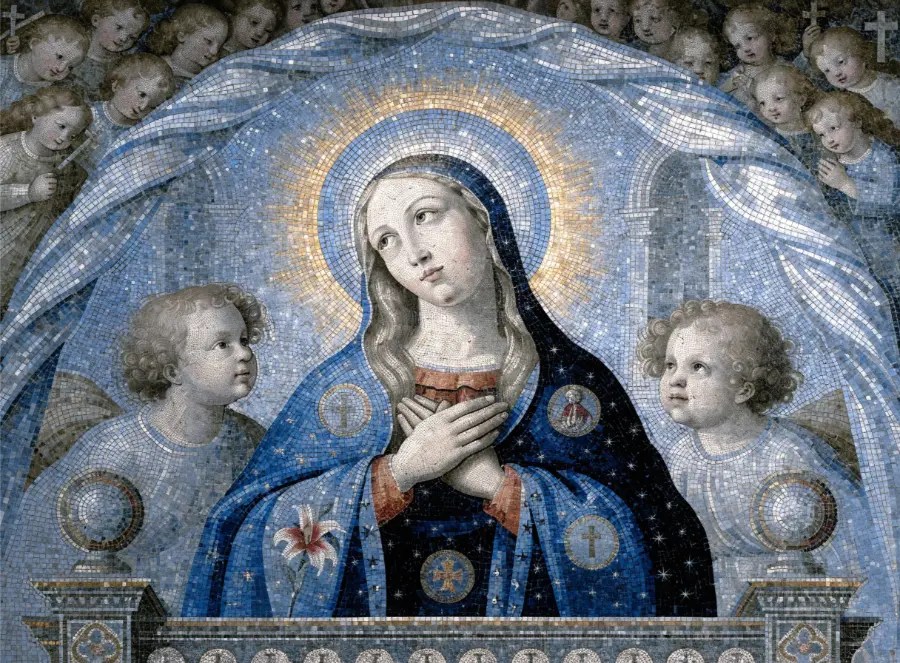
Both churches call Mary the Mother of God and honor her as ever-virgin. The Catholic Church also teaches, as a dogma defined by Pius IX in 1854, that Mary was “preserved immune from all stain of original sin” from the first moment of her conception. The Orthodox reject the Immaculate Conception, but they teach that “Mary is without personal sins.” Their objection rests partly on a different view of original sin: the Orthodox hold that humans inherit the consequences of Adam’s sin but not its guilt. At the end of Mary’s life, Catholics speak of her Assumption, “taken up body and soul into heavenly glory.” The Orthodox keep the feast of the Dormition, or falling asleep, on 15 August, and teach that Mary “died as all people die” and was raised by her Son.
On salvation the two churches draw on the same sources. Orthodox teaching describes the Christian life as theosis, the “deification” of man by the grace of God, and it cites the promise that believers “may become partakers of the divine nature” (2 Peter 1:4). The Catholic Catechism quotes the same verse and the Church Fathers who wrote that “the Son of God became man so that we might become God.”
Priests, bread and the calendar
Both churches allow married priests, but in different measure. In the Latin Church, priests are “normally chosen from among men of faith who live a celibate life.” In the Eastern churches, as the Catechism itself notes, “married men can be ordained as deacons and priests,” while “bishops are chosen solely from among celibates.” In both, a man who is already ordained may not marry.
The Latin Church uses unleavened bread for the Eucharist, “according to the ancient tradition of the Latin Church.” The Orthodox Church has always used leavened bread, and the difference once caused a bitter controversy between East and West.
Orthodox infants receive baptism, chrismation (the Eastern name for confirmation) and Communion in the same service. In the Latin Church, a child receives Communion for the first time after reaching the age of reason.
Almost all the Orthodox churches calculate the date of Orthodox Easter, which they call Pascha, by the older Julian calendar, even those that use the newer calendar for fixed feasts. The exception is the Finnish Orthodox Church, which has dated Pascha by the Gregorian calendar since 1923. As a result, Orthodox and Western Easter sometimes fall on the same Sunday and sometimes as much as five weeks apart. In 2025 they coincided, and Pope Leo XIV and Patriarch Bartholomew said they wanted to keep “exploring a possible solution for celebrating together the Feast of Feasts every year.”
Eastern Catholic churches
The Catholic Church is not only Latin. It is made up of 24 self-governing churches: the Latin Church and 23 Eastern Catholic churches, including the Ukrainian Greek Catholic Church, the Maronite Church of Lebanon and the Syro-Malabar Church of India. Many of them share the Byzantine liturgy of the Orthodox and ordain married men as priests, yet they are in full communion with the Pope. The Second Vatican Council declared that the Eastern churches “have the power to govern themselves according to the disciplines proper to them.”
Can a Catholic take Communion in an Orthodox church?
Ordinarily no, and the reason lies on the Orthodox side. Catholic canon law allows it in principle. Canon 844 says that Catholic ministers may give the sacraments of penance, the Eucharist and anointing to members of the Eastern churches “if they seek such on their own accord and are properly disposed.” It also allows Catholics who cannot reach a Catholic priest to receive those sacraments from ministers of churches in which they are valid, “whenever necessity requires it or true spiritual advantage suggests it.” The Catholic Church recognizes Orthodox sacraments as true sacraments.
The Orthodox Church does not offer Communion to Catholics and does not allow its own members to receive it in Catholic churches. The Orthodox Church in America gives the reason: “The Eucharist is the result of unity, not the means by which unity is achieved.” It adds that receiving in a church to which one does not belong “would imply a unity that in fact does not yet exist.”
Which church is older?
Each church regards itself as the original Church, not as a branch that broke away. Both trace their bishops to the apostles, both hold the councils of the first millennium, and in 1965 the Pope and the Patriarch looked back together to the “full communion of faith, fraternal accord and sacramental life which existed among them during the first thousand years of the life of the Church.” Neither is older in any simple sense: the two share one history until the eleventh century.
“Orthodox” is sometimes used for a second family of churches, the Oriental Orthodox, such as the Coptic, Ethiopian and Armenian churches. They separated from both Rome and Constantinople after the Council of Chalcedon in 451 over how to describe Christ’s divine and human natures. Pew Research counts them as about 20 percent of the nearly 260 million Orthodox Christians in the world, which leaves the Eastern Orthodox at about 80 percent, or roughly 200 million.
Are the two churches moving closer?
Their leaders are, slowly; most Orthodox believers are less sure. In 1965 Paul VI and Athenagoras I declared that they “commit these excommunications to oblivion,” while admitting that the gesture was “not sufficient to end both old and more recent differences.” The joint commission for theological dialogue first met on Rhodes in 1980, and its 2007 Ravenna document on primacy is the work of the commission and, in the commission’s own words, “should not be understood as an official declaration of the Church’s teaching.” In November 2025 Pope Leo XIV and Patriarch Bartholomew marked the 1,700th anniversary of the Council of Nicaea together at İznik, the ancient Nicaea, and the next day signed a joint declaration in Istanbul that looks toward “the hoped-for restoration of full communion between our sister Churches.”
Among ordinary Orthodox Christians, support for reunion is weak. In a 2015–2016 Pew survey of Central and Eastern Europe, the view that the churches should reunite was a minority position in most countries. In Russia only 17 percent of Orthodox Christians wanted communion with the Catholic Church; Romania, at 62 percent, was the only country with a majority in favor.
The two sides do not all describe the goal the same way. Catholic leaders speak of the Orthodox churches as sister churches, and Patriarch Bartholomew signed the 2025 declaration in the same terms. Other Orthodox reject the idea. One answer on the Orthodox Church in America’s site says that Orthodoxy “sees herself as the fullness of the Church, not the ‘other half’ of the Church,” while granting that “there are some Orthodox who would perhaps ascribe to these notions.” The 2025 declaration asks the members of both churches to seek the fulfilment of Jesus’ prayer “that they may all be one” (John 17:21).
Where Protestants fit
Protestant churches came out of the Western, Catholic side of the split in the sixteenth century. Like the Orthodox, Protestants reject the Pope’s authority; the Westminster Confession of the Presbyterian and Reformed churches says the Pope cannot “in any sense, be head” of the Church. Like Catholics, most Protestant churches kept the Western Creed with the filioque; the same confession says the Holy Spirit is “eternally proceeding from the Father and the Son.” Unlike both, most Protestants reject purgatory and do not pray to the saints. The Catholic and Protestant comparison covers that side in detail.