
 English
 Chinese
 Dutch
 Arabic
 Spanish
 Portuguese
 Russian
 French
 Italian
 German
 Japanese
Jesus says that a man who divorces his wife, except for sexual immorality, makes her commit adultery, and that whoever marries her commits adultery. In Matthew 5:31-32 he sets this against the old rule that a divorcing husband must hand his wife a bill of divorce. Churches agree he is upholding lifelong marriage and differ over the exception.
It hath been said, Whosoever shall put away his wife, let him give her a writing of divorcement: But I say unto you, That whosoever shall put away his wife, saving for the cause of fornication, causeth her to commit adultery: and whosoever shall marry her that is divorced committeth adultery.
Matthew 5:31-32 (King James Version)
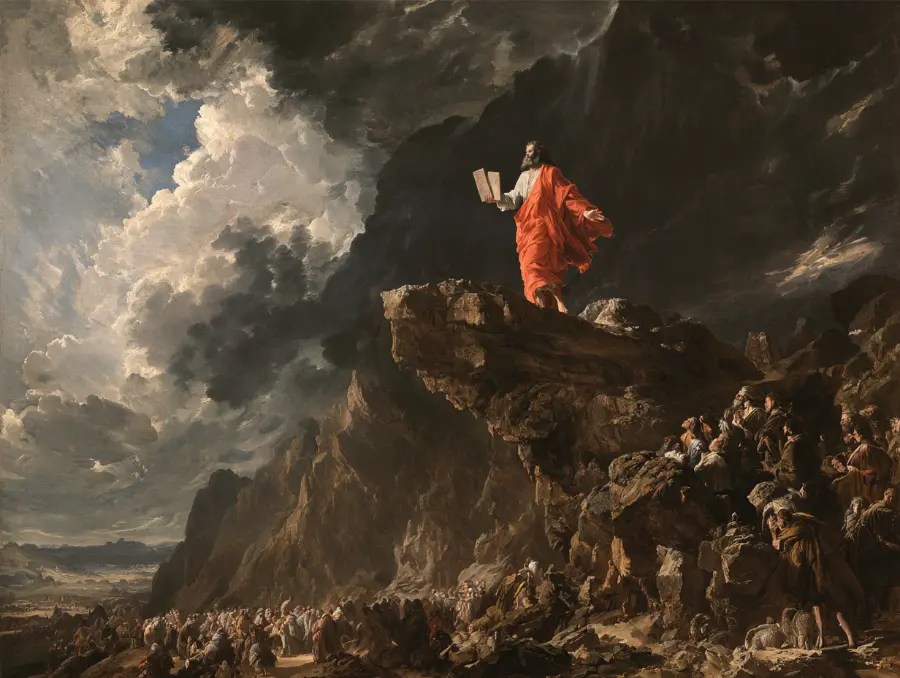
What does Matthew 5:31-32 mean, line by line?
“It hath been said … But I say unto you”
The verses belong to the Sermon on the Mount. They are the third of six sayings in Matthew 5:21-48 that set what “was said” in the Law beside Jesus’ own “But I say unto you.” The saying just before concerns adultery, and Jesus applies it even to a lustful look: “whosoever looketh on a woman to lust after her hath committed adultery with her already in his heart” (Matthew 5:28). The divorce saying comes next.
The notes of the New American Bible, the Catholic translation published by the United States bishops, observe that three of the six sayings “accept the Mosaic law but extend or deepen it,” while the divorce saying is one of three that “reject it as a standard of conduct for the disciples.” Earlier in the same sermon Jesus had said, “I am not come to destroy, but to fulfil” (Matthew 5:17).
“Whosoever shall put away his wife, let him give her a writing of divorcement”
“Put away” is the King James phrase for divorce; the New American Bible has “Whoever divorces his wife must give her a bill of divorce.” Jesus is summing up Deuteronomy 24:1, where a husband who finds “some uncleanness” in his wife is to “write her a bill of divorcement, and give it in her hand, and send her out of his house.” The bill was the wife’s proof that she was free: the next verse says that once she has left, “she may go and be another man’s wife.”
“saving for the cause of fornication”
“Saving” means except. Matthew’s Greek reads parektos logou porneias, except for a matter of porneia, a word for sexual sin. Christians read these verses differently on two questions: what this exception covers, and whether a divorced person may marry again.
“causeth her to commit adultery”
Jesus speaks to the husband. John Chrysostom, in his sermons on Matthew, told his hearers to “observe Him everywhere addressing His discourse to the man.” A husband who sends away a faithful wife, Chrysostom reasoned, “though he take not another wife, by that act alone has made himself liable to blame, having made the first an adulteress.”
The same wording explains the place of the exception. If the wife has already been unfaithful, her husband does not make her an adulteress. John Piper, a Baptist pastor who reads the clause another way, sums up the common view: “on the traditional interpretation of the clause, it may simply mean that a man makes his wife an adulteress except in the case where she has made herself one.”
“whosoever shall marry her that is divorced committeth adultery”
The second husband commits adultery because, in Jesus’ words, the first marriage still binds. Chrysostom put it plainly: “when cast out she continues to be the wife of him that expelled her.” Luke records the same saying with no exception: “whosoever marrieth her that is put away from her husband committeth adultery” (Luke 16:18). Churches apply this line in different ways to people who have divorced and married again.
What was the bill of divorce in Deuteronomy 24:1-4?
The law of Moses that Jesus sums up regulated divorce without commanding it:
When a man hath taken a wife, and married her, and it come to pass that she find no favour in his eyes, because he hath found some uncleanness in her: then let him write her a bill of divorcement, and give it in her hand, and send her out of his house. And when she is departed out of his house, she may go and be another man’s wife. And if the latter husband hate her, and write her a bill of divorcement, and giveth it in her hand, and sendeth her out of his house; or if the latter husband die, which took her to be his wife; Her former husband, which sent her away, may not take her again to be his wife, after that she is defiled; for that is abomination before the Lord: and thou shalt not cause the land to sin, which the Lord thy God giveth thee for an inheritance.
Deuteronomy 24:1-4 (King James Version)
The law takes divorce as something that happens and sets out how it works. The husband must write a bill and put it in his wife’s hand. She may then marry again. If that second marriage ends, the first husband “may not take her again to be his wife.” The New American Bible’s note on Matthew 5:31-32 says what Jesus changes: “The Old Testament commandment that a bill of divorce be given to the woman assumes the legitimacy of divorce itself. It is this that Jesus denies.”
In Matthew 19 the Pharisees ask Jesus about this law: “Why did Moses then command to give a writing of divorcement, and to put her away?” Jesus answers that “Moses because of the hardness of your hearts suffered you to put away your wives: but from the beginning it was not so” (Matthew 19:7-8). “Suffered” here means allowed.
How did Jewish teachers read “some uncleanness”?
The Hebrew behind those words is ervat davar, and the rabbis disagreed over what it covered. The Mishnah, the code of Jewish law compiled around AD 200, records three views in its tractate on divorce, Gittin. The school of Shammai held that a man “may not divorce his wife unless he finds out about her having engaged in a matter of forbidden sexual intercourse.” The school of Hillel said “He may divorce her even due to a minor issue, e.g., because she burned or over-salted his dish.” Rabbi Akiva allowed divorce “even if he found another woman who is better looking than her.”
The Pharisees’ question in Matthew 19:3, “Is it lawful for a man to put away his wife for every cause?”, touches the same debate. Matthew’s wording of the exception, a matter of porneia, stands close to Shammai’s matter of forbidden intercourse.
What does the exception for fornication cover?
In Matthew, the exception names the one case in which sending a wife away does not make her an adulteress. The disagreement is over what porneia means here. Thayer’s Greek lexicon defines it as “illicit sexual intercourse in general” and lists Matthew 5:32 and 19:9 among the places where it is used of adultery. Strong’s concordance gives “harlotry (including adultery and incest).” Matthew also has a separate word for adultery, moicheia, and sets the two side by side in Jesus’ list of sins that come out of the heart: “adulteries, fornications” (Matthew 15:19).
Christians have read the exception in four main ways.
- Adultery or other sexual sin by a spouse. If a husband or wife is unfaithful, divorce is allowed, and the innocent party may marry again. This is the reading of the Westminster Confession.
- Separation, but no new marriage. Augustine read the exception alongside Paul’s charge that a wife who leaves should “remain unmarried, or be reconciled.” A husband may put away his wife “for the cause of fornication, which our Lord wished to make an exception of,” but, Augustine wrote, “he is to remain unmarried, or be reconciled to his wife.” The Council of Trent in 1563 defended this as the Church’s teaching: the bond “cannot be dissolved on account of the adultery of one of the married parties,” and even “the innocent one who gave not occasion to the adultery” cannot marry again while the other spouse lives. Canon law today urges forgiveness but gives the innocent spouse “the right to sever conjugal living” after adultery (canon 1152).
- A marriage that was unlawful from the start. The New American Bible translates the clause “unless the marriage is unlawful.” Its note offers this reading with a hedge: “It seems, however, that the unlawfulness that Matthew gives as a reason why a marriage must be broken refers to a situation peculiar to his community,” namely marriages within the degrees of kinship forbidden in Leviticus 18, which “were regarded as incest.” It continues: “In this interpretation, the clause constitutes no exception to the absolute prohibition of divorce when the marriage is lawful.”
- Unfaithfulness during betrothal. Some evangelicals read it of a betrothed couple, like Joseph, who found Mary with child before they came together and “was minded to put her away privily” (Matthew 1:19). Piper argued in 1986 that the clause refers to “premarital sexual fornication which a man or a woman discovers in the betrothed partner.”
Paul adds a case of his own, a believer left by an unbelieving spouse: “But if the unbelieving depart, let him depart. A brother or a sister is not under bondage in such cases: but God hath called us to peace” (1 Corinthians 7:15). Wilful desertion is, with adultery, one of the two biblical grounds for divorce that the Westminster Confession accepts.
How do the churches read the exception?
Catholic, Orthodox and Protestant teaching all hold that Jesus is defending marriage for life. They differ over whether a marriage can end before death, and over who may marry again.
| Church | Divorce | Remarriage while a former spouse lives |
|---|---|---|
| Catholic | A valid, consummated marriage between baptized people cannot be dissolved; separation is allowed | Normally only after a church tribunal declares the first marriage null |
| Orthodox (OCA) | The Church grants none, but accepts that civil divorce ends some marriages | A second marriage, rarely a third, with the bishop’s permission; never a fourth |
| Reformed (Westminster) | For adultery or wilful desertion | Allowed to the innocent party |
| Lutheran (Book of Concord) | Not defined in the confessions | Allowed to the innocent party |
| Church of England | Accepts that some marriages fail | In church since 2002, if the vicar agrees |
Catholic teaching: a bond only death ends
The Catechism of the Catholic Church starts from Jesus’ words: “The Lord Jesus insisted on the original intention of the Creator who willed that marriage be indissoluble.” Quoting canon law, it adds that “a ratified and consummated marriage cannot be dissolved by any human power or for any reason other than death” (2382). It calls divorce “a grave offense against the natural law” (2384).
It does not blame every divorced person. “It can happen that one of the spouses is the innocent victim of a divorce decreed by civil law; this spouse therefore has not contravened the moral law” (2386). Separation can be legitimate (2383), and canon law gives a spouse the right to end shared life after adultery, while it “earnestly” recommends forgiveness (canon 1152). Where a civil divorce “remains the only possible way of ensuring certain legal rights, the care of the children, or the protection of inheritance, it can be tolerated and does not constitute a moral offense” (2383).
The Catechism does not accept a second marriage while a valid first marriage stands. The Church “maintains that a new union cannot be recognized as valid, if the first marriage was,” and Catholics who remarry civilly “cannot receive Eucharistic communion as long as this situation persists” (1650). The next paragraph asks priests and the whole community to care for them, “so that they do not consider themselves separated from the Church” (1651).
An annulment is not a Catholic name for divorce. A church tribunal examines whether a true marriage ever came into being, and if it finds that one did not, the Church “can declare the nullity of a marriage, i.e., that the marriage never existed. In this case the contracting parties are free to marry, provided the natural obligations of a previous union are discharged” (1629). Canon law also lets the pope dissolve a marriage that was never consummated (canon 1142), and treats a marriage between two unbaptized people as dissolved when one of them is later baptized, the other leaves, and the baptized one marries again (canon 1143). The US bishops encourage divorced people who suffered abuse to look into it, because an annulment “can frequently open the door to healing.”
Orthodox Church in America: a second marriage as mercy
The Orthodox Church in America teaches that Christ “abrogated the practice of divorce which was permitted in the old covenant due to the people’s ‘hardness of heart,’” and quotes Matthew 5:32 with its exception, explaining the word as “porneia, i.e. sexual immorality.” Its guidelines for clergy then describe what happens when a marriage breaks down: “The Church does not grant divorces. However, it recognizes that because of human weaknesses and sin marriages sometimes disintegrate and are ended by civil decree (divorce).”
A second marriage can follow. “The Orthodox norm for those who marry is one marriage. A second marriage is tolerated under certain conditions. A third marriage is extended under certain precise circumstances.” Its bishops ask that people whose marriages have broken be counselled “to repent of the evils which caused the failure” and “to seek God’s mercy and guidance in transforming the defeat into spiritual victory.” Permission for a second marriage comes from the diocesan bishop, after the divorced person makes “a clear statement of repentance … whether or not he/she is considered the culpable one in the divorce,” and “Under no circumstances can there be a fourth marriage.” The bishops’ 1992 affirmations explain the spirit of the practice: those who remarry “do so not as their right but as recipients of a special gift of God’s mercy.” Details vary between Orthodox churches; the Orthodox Church in America itself says the Greek Orthodox Archdiocese’s rules are “somewhat different.”
Protestant confessions: the innocent party may remarry
The Westminster Confession of 1646, the Reformed statement of faith, reads the exception as adultery and states the consequence: “In the case of adultery after marriage, it is lawful for the innocent party to sue out a divorce: and, after the divorce, to marry another, as if the offending party were dead” (24.5). It admits one other ground: “nothing but adultery, or such willful desertion as can no way be remedied by the church, or civil magistrate, is cause sufficient of dissolving the bond of marriage” (24.6). In the same paragraph it warns that people are “apt to study arguments unduly to put asunder those whom God hath joined together in marriage.”
The Lutheran confessions in the Book of Concord list among the unjust marriage laws of the bishops’ courts “the tradition forbidding an innocent person to marry after divorce,” with Matthew 5:32 cited beside it (Treatise on the Power and Primacy of the Pope, 1537). The Church of England has accepted since 2002 that “in certain circumstances … a divorced person may marry again in church,” and leaves the decision with each vicar, some of whom “don’t feel able to offer a wedding” in that case.
Not every Protestant holds the innocent-party view. Piper writes that he once held “the prevailing Protestant view that remarriage after divorce was biblically sanctioned in cases where divorce had resulted from desertion or persistent adultery.” After studying the texts as a pastor, he concluded that the New Testament forbids “all remarriage except in the case where a spouse has died,” while granting that “men more godly than I have taken different views.”
Where else does Jesus teach about divorce?
| Passage | Setting | Exception |
|---|---|---|
| Matthew 5:31-32 | Sermon on the Mount | “saving for the cause of fornication” |
| Matthew 19:3-9 | The Pharisees test him | “except it be for fornication” |
| Mark 10:2-12 | The Pharisees, then the disciples in the house | None; the wife’s side is added |
| Luke 16:18 | A single saying | None |
| 1 Corinthians 7:10-11 | Paul, passing on the Lord’s charge | None |
Matthew 19 gives the reason behind the rule. Asked whether a man may divorce “for every cause,” Jesus appeals to creation, which came before the law of Moses: “he which made them at the beginning made them male and female,” and “they twain shall be one flesh.” His verdict follows: “What therefore God hath joined together, let not man put asunder” (Matthew 19:4-6). He then repeats the saying of Matthew 5, exception included: “Whosoever shall put away his wife, except it be for fornication, and shall marry another, committeth adultery” (19:9). The disciples found it hard: “If the case of the man be so with his wife, it is not good to marry” (19:10).
Matthew 5 speaks only of a husband who divorces. Mark’s account has no exception and adds the wife’s side: “if a woman shall put away her husband, and be married to another, she committeth adultery” (Mark 10:12). Paul passes it on as the Lord’s own command: “And unto the married I command, yet not I, but the Lord, Let not the wife depart from her husband: But and if she depart, let her remain unmarried or be reconciled to her husband: and let not the husband put away his wife” (1 Corinthians 7:10-11).
The New American Bible’s note weighs these texts. The sayings in Mark, Luke and Paul “prohibit it absolutely,” it says, “and most scholars agree that they represent the stand of Jesus,” while Matthew’s exceptions “are understood by some as a modification of the absolute prohibition.” The Westminster Confession reads Matthew’s exception in that second way.

What do these verses say to someone already divorced?
The verses address the one who sends a spouse away, and the Catechism makes the same distinction. It speaks of “a considerable difference between a spouse who has sincerely tried to be faithful to the sacrament of marriage and is unjustly abandoned, and one who through his own grave fault destroys a canonically valid marriage” (2386). The Church of England’s page for divorced couples who hope to marry in church says: “we recognise that some marriages do fail for all sorts of sad and painful reasons.” Each church’s answer to whether remarrying after divorce is a sin follows from how it reads this verse.
Must a Christian stay in a dangerous marriage?
No. The Catholic Church says so in its own law, the Church of England’s bishops say so in their guidance on abuse, and the Orthodox Church in America condemns abuse in the home. The Catholic Church allows no remarriage after a valid marriage, yet its law provides for a spouse in danger to leave. The Catechism allows separation “in certain cases provided for by canon law” (2383), and canon law names danger as one of them: “If either of the spouses causes grave mental or physical danger to the other spouse or to the offspring or otherwise renders common life too difficult, that spouse gives the other a legitimate cause for leaving … even on his or her own authority if there is danger in delay” (canon 1153).
The US Catholic bishops wrote in 2002: “we emphasize that no person is expected to stay in an abusive marriage,” and “Violence and abuse, not divorce, break up a marriage.” Someone being assaulted, they add, “needs to know that acting to end the abuse does not violate the marriage promises.” The bishops of the Orthodox Church in America condemn “all forms of physical, spiritual, psychological and emotional abuse of men, women and children,” and say that the teaching on a husband’s headship is “not to be interpreted as supportive in any way of abusive behavior.”
The Church of England’s House of Bishops guidance, Responding Well to Domestic Abuse (2017), makes “the safety of individuals suffering abuse or seeking help” the “first priority” and tells clergy: “Do emphasize that the marriage covenant is broken by the violence from their partner.” Its appendix on Scripture takes up Matthew 5:32 itself: “When a man chooses to be abusive, he breaks the covenant. If his wife chooses to divorce him, she is making public his breaking of the covenant, not going against what the Bible says about divorce.”
If someone at home is hurting or threatening you, call your local emergency number: 112 anywhere in the European Union. In the United States, the National Domestic Violence Hotline answers day and night at 1-800-799-7233; for women facing violence, France’s helpline is 3919, Germany’s 116 016 and Brazil’s 180.
Related reading
- Divorce in Christianity: What Are the Biblical Grounds?
- Is Remarrying After Divorce A Sin?
- Bible Study: Jesus’ Teachings On Marriage
- Prayers for Divorce: Saving a Marriage, Going Through It and Healing After
- What does the Bible say about adultery?
- Bible Study: What Are the Beatitudes? Jesus Christ’s Beatitudes Explained


Leave a Reply