
 English
 Chinese
 Dutch
 Arabic
 Spanish
 Portuguese
 Russian
 French
 Italian
 German
 Japanese
Orthodox Christmas is on 25 December. The churches that keep the old Julian calendar count that day by the old calendar, and the old Julian calendar’s 25 December falls on 7 January in ours. They do not believe Christ was born on a different day; they are using a different calendar. This winter the old calendar’s Christmas falls on Thursday 7 January 2027, with Christmas Eve on Wednesday 6 January, for the Russian, Serbian and Georgian churches, the Church of Jerusalem and the monasteries of Mount Athos. The churches of Constantinople, Alexandria, Antioch, Greece, Cyprus, Romania and Bulgaria follow a revised calendar, so their Christmas comes on Friday 25 December 2026, the same day as for Catholics and Protestants. Since 2023 the Orthodox Church of Ukraine has kept that day too.
On either morning, many Orthodox Christians will meet each other with the words “Christ is born!” and answer “Glorify Him!”
Why does Orthodox Christmas fall on 7 January?
The calendar of Julius Caesar counts the year as 365 and a quarter days, with a leap day every fourth year. The year of the sun is a little more than eleven minutes shorter. Eleven minutes is very little in one year, but over the centuries they moved the seasons back by almost a day every hundred years. In 1582 Pope Gregory XIII corrected this in a papal bull, Inter gravissimas. The day after 4 October 1582 was counted as 15 October, and from then on a century year would be a leap year only if it could be divided by 400.
Protestant and Orthodox countries refused the new calendar at first. Great Britain changed in 1752 and Greece in 1923. In Russia the civil calendar changed in 1918, but the Church kept the old one.
So the two calendars began ten days apart, and the gap has grown since. The old calendar kept a leap day in 1700, 1800 and 1900, and the new calendar did not, so each of those years added one more day. That is why the gap is thirteen days today, and why the old calendar’s 25 December is 7 January in ours. The year 2000 was a leap year in both calendars, so nothing changed then. The year 2100 will be a leap year only in the old calendar. Its extra day, 29 February 2100 by the old count, is 14 March 2100 in ours, and after it the gap will be fourteen days. The last old-calendar Christmas on 7 January will come in January 2100, and the Christmas of 2100 will fall on Saturday 8 January 2101. Until then, add thirteen days to 25 December and you have the date.
How the Church first came to keep the birth of Christ on 25 December is a different question.
That question has its own page: why Christmas is on December 25.
Which churches follow the old calendar, and which the new?
The Orthodox churches went different ways in 1923. In May of that year Ecumenical Patriarch Meletios IV called the churches to a congress at Constantinople. Only four came, the churches of Serbia, Romania, Greece and Cyprus, and even they could not all agree. Alexandria, Antioch and Jerusalem had been invited and stayed away, and Bulgaria was never asked. What the congress put forward was a revised Julian calendar, which the Serbian scientist Milutin Milankovitch set out in Belgrade that year. It drops the thirteen days, so Christmas stays on 25 December and falls on the same day as in the West.
The Church of Greece and the Romanian Church took up the new calendar in 1924. The churches of Constantinople, Alexandria, Antioch and Cyprus adopted it as well, and the Bulgarian Church in 1968. The churches of Jerusalem, Russia and Serbia kept the old calendar, and so did the monasteries of Mount Athos, which remain in communion with Constantinople all the same. In Greece, those who refused the change are called the Old Calendarists. This is where each church stands for Christmas this winter:
| Church | Christmas Day, 2026–27 | Calendar |
|---|---|---|
| Russian Orthodox | Thursday 7 January 2027 | Julian (old) |
| Serbian Orthodox | Thursday 7 January 2027 | Julian (old) |
| Georgian Orthodox | Thursday 7 January 2027 | Julian (old) |
| Patriarchate of Jerusalem | Thursday 7 January 2027 | Julian (old) |
| Monasteries of Mount Athos | Thursday 7 January 2027 | Julian (old) |
| Ecumenical Patriarchate of Constantinople | Friday 25 December 2026 | Revised Julian |
| Patriarchates of Alexandria and Antioch | Friday 25 December 2026 | Revised Julian |
| Church of Greece | Friday 25 December 2026 | Revised Julian, since 1924 |
| Church of Cyprus | Friday 25 December 2026 | Revised Julian |
| Romanian Orthodox | Friday 25 December 2026 | Revised Julian, since 1924 |
| Bulgarian Orthodox | Friday 25 December 2026 | Revised Julian, since 1968 |
| Orthodox Church of Ukraine | Friday 25 December 2026 (7 January 2027 in parishes that keep the old calendar) | Revised Julian, since 1 September 2023 |
The most recent change came in Ukraine, and each church there made its own decision. The Ukrainian Greek Catholic Church is an Eastern Catholic church: it keeps the Eastern feasts and fasts much as the Orthodox do, but it belongs to the Catholic Church. Its synod met on 1 and 2 February 2023 and decided to celebrate Christmas on 25 December instead of 7 January, and Epiphany on 6 January instead of the 19th, from 1 September 2023, and it allowed parishes to make the change step by step. On 27 July 2023 the Local Council of the Orthodox Church of Ukraine, 161 delegates meeting in St Sophia’s in Kyiv, gave its final approval to the move to the New Julian calendar, as the council calls the revised one, from 1 September that year. The council also kept the right of parishes and monasteries that wish it to use the old Julian calendar. The Ukrainian Orthodox Church, a separate body from the Orthodox Church of Ukraine, has kept the old calendar: in November 2025 its own news service announced that the Nativity Fast would begin on 28 November and last until Christmas on 7 January. The government moved the public holiday to 25 December in 2023, and many Ukrainians still keep the January date.
Easter did not move. All the Orthodox churches except the Church of Finland still reckon Pascha by the old calendar, so whichever Christmas they keep, they keep Pascha together. If you are not sure which calendar your own parish follows, its church calendar for the year will tell you.
Eastern Orthodox Easter explains how the date of Pascha is found.
When does the Nativity Fast start?
Forty days of fasting go before the feast, from 15 November to 24 December by the church’s own calendar. For the old-calendar churches that is Saturday 28 November 2026 to Wednesday 6 January 2027. For the new-calendar churches it is 15 November to 24 December, as written. St Simeon of Thessalonica saw in these forty days the forty days Moses spent with the Lord on the mountain, when “he did neither eat bread, nor drink water”, and the words of the covenant were written on the tables of stone (Exodus 34:28). Then Simeon turns to us: “But having fasted for forty days, we gaze upon and receive the living Word from the Virgin, inscribed not on stones, but incarnate and born, and we partake of His Divine flesh.”
A Russian Orthodox article on the fast, published by Orthochristian.com, sets out its rules this way. For all forty days there is no meat and no dairy food. On Mondays, Wednesdays and Fridays there is also no fish, oil or wine. On Tuesdays and Thursdays food may be cooked with vegetable oil. Fish is allowed on Saturdays and Sundays, and on great feasts such as the Entry of the Mother of God on 21 November. In the last week before Christmas Eve the fast becomes stricter, and there is no fish even on Saturday and Sunday.
The same article says the point of the fast is to fight against sin, not to wear the body out, and it asks anyone who wants to keep the fast to talk first with an experienced priest about the state of their soul and body and ask his blessing. “Without prayers and penance fasting becomes only a ‘diet’,” it says. The Ukrainian Greek Catholic Church, as a Catholic church, sets its own rules, and it has moderated the strict ones of the past. Its members give up meat on every Wednesday and Friday of the fast and decide the rest for themselves, and in special cases a bishop or a trusted priest may excuse a person from the fast.
If you are thinking of a strict fast, or of eating nothing on Christmas Eve until the evening, speak to your doctor as well as your priest. Johns Hopkins Medicine, writing about going without food for set hours, says to “talk to your doctor before you consider starting”. It also says that this kind of fasting is not for children and teens under 18, women who are pregnant or breastfeeding, people with type 1 diabetes who take insulin, or anyone with a history of eating disorders.
The fast is also a season of song. The first songs of Christ’s birth are sung on 21 November, the feast of the Entry, which for the old-calendar churches is Friday 4 December 2026. On St Andrew’s Day and St Nicholas Day, 30 November and 6 December by the church’s calendar (13 and 19 December for the old-calendar churches), more songs announce that the birth is near, and at Vespers on St Nicholas Day the church sings, “Adorn yourself, O Cavern. Make ready, O Manger. O Shepherds and wisemen, bring your gifts and bear witness. For the Virgin is coming bearing Christ in her womb.”
How is Orthodox Christmas Eve kept on 6 January?
In Russian the day is called сочельник (sochelnik). The name comes from сочиво (sochivo): grains of wheat or barley, lentils or peas soaked in water, the food the church’s rules give for that day. Many Orthodox Christians eat nothing until the first star appears, because it reminds them of the star the wise men saw: “for we have seen his star in the east, and are come to worship him” (Matthew 2:2). Hieromonk Job Gumerov, who explains the custom, adds, “This is not something that is prescribed in the Church rubrics”. Each person, he says, should take on as much as suits his or her own strength.
In the morning the church reads the Royal Hours and serves the Liturgy of St Basil the Great together with Vespers. The prophecies of the birth are read aloud: Micah, who names Bethlehem; Isaiah, who speaks of the virgin who will bear a son; and Isaiah again, “For unto us a child is born, unto us a son is given” (Isaiah 9:6). Then comes the Vigil of Christmas. It begins with Great Compline, where the church sings “God is with us”. Five loaves, wheat, wine and oil are blessed, and Matins opens with the song of the angels: “Glory to God in the highest, and on earth peace, good will toward men” (Luke 2:14).
At home the meal of Christmas Eve is still a meal without meat. In Ukraine it is the holy supper of Sviat-Vechir: twelve dishes made without meat or milk, which differ from region to region. One of them is kutia, whole wheat grains cooked with honey and ground poppy seeds. Hay or straw is spread on the table under the cloth, and there is carolling, with a handmade star. These customs are still kept, in a changed form, and they came back after Ukraine became independent. Families who follow the 2023 change now keep the holy supper on 24 December.
For Serbs and Montenegrins the day is Badnji Dan, the last day of the fast. In the morning the head of the house cuts oak branches, the badnjak, and they are burned in the hearth. Since the 1990s the badnjak has also been burned in public in churchyards, as in front of St Sava’s in Belgrade. Straw goes under the tablecloth here too, to recall the place where Christ was born. In Georgia, on the night before Christmas, groups of men used to go around their villages singing festive songs and collecting alms for the poor. That custom, Alilo, has become a great parade through Tbilisi on Christmas morning.
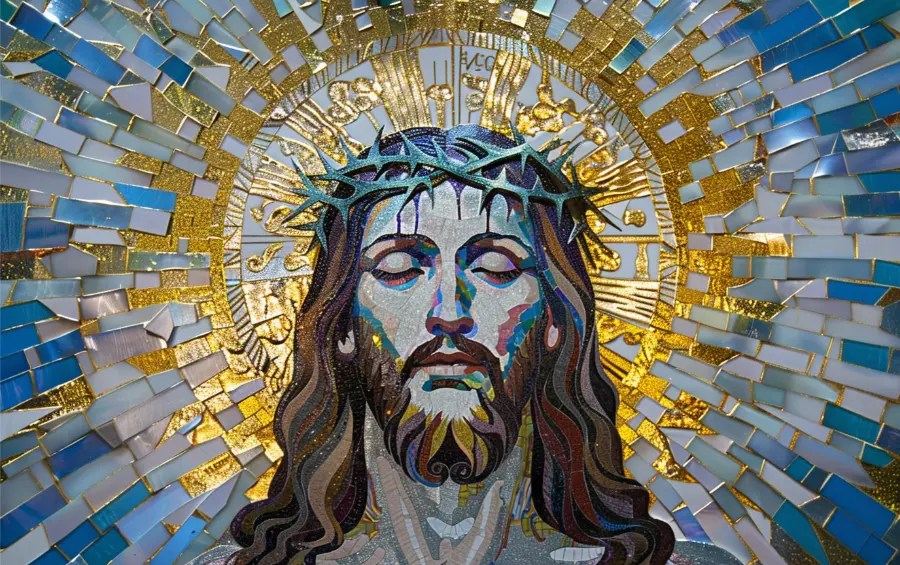
What do Orthodox Christians say to each other at Christmas?
They say “Christ is born!” and the answer is “Glorify Him!”, which Fr John Konkle calls “the only proper response to such a proclamation”. He writes that the greeting comes more directly from the opening of a Christmas sermon by St Gregory the Theologian, as the Orthodox call Gregory of Nazianzus. Gregory preached the sermon on 25 December 380 or on 6 January 381; his English translators could not tell which from its title. This is how he began:
“Christ is born, glorify Him. Christ from heaven, go out to meet Him. Christ on earth; be exalted. Sing unto the Lord all the whole earth; and that I may join both in one word, Let the heavens rejoice, and let the earth be glad, for Him Who is of heaven and then of earth. Christ in the flesh, rejoice with trembling and with joy; with trembling because of your sins, with joy because of your hope.”
A little later Gregory gives the feast two names, “the Theophany or Birth-day”, and says why both fit in a single sentence: “For God was manifested to man by birth.”
About four centuries after Gregory, St Cosmas the Melodist, bishop of Maiuma, who died in 773 or 794, began the first Christmas canon with nearly the same words. The church still sings them: “Christ is born, glorify Him. Christ is from heaven, go to meet Him. Christ is on earth, be ye lifted up. Sing to the Lord, all the earth.”
So the words are sung in church every Christmas, but greeting each other with them is a local custom, and not every Orthodox people has it. Dr Christopher Veniamin, who finds nothing wrong with the greeting, says it “is not the practice of the wider Orthodox world community”, and that it can never stand beside the Easter greeting, “Christ is risen! Truly, He is risen!”, because Pascha has a place no other feast has. In the Orthodox Church in America it is at home: Metropolitan Tikhon opened his Nativity letter of 2024 with “Christ is born! Glorify him!”
On Christmas morning the Liturgy reads Paul’s words on the fulness of the time (Galatians 4:4–7) and Matthew’s story of the wise men. The troparion of the feast takes up their star: “Thy Nativity, O Christ our God, has shone to the world the light of wisdom! For by it, those who worshiped the stars were taught by a star to adore Thee, the Sun of Righteousness”. The kontakion says, “Today the Virgin gives birth to the Transcendent One, and the earth offers a cave to the Unapproachable One!” Two days follow, for the Mother of God and for St Stephen, the first martyr. The days of Christmas joy last until Theophany, and in those days the church does not call for fasting or for kneeling in prayer. The old-calendar churches keep Theophany on 19 January.
Epiphany and Theophany tells the story of that feast.
Why do Armenians celebrate Christmas on 6 January?
The Armenian Church keeps the older custom of the East, when the birth of Christ and his baptism were one feast on 6 January. In the words of its Eastern Diocese in America, “The Armenian Church has maintained that ancient tradition to this day”. So on 6 January Armenians celebrate the holy birth, Sourp Dznount, and the baptism together, with the Blessing of Water after the Liturgy. The faithful fast for the seven days before. On the evening of 5 January they go to the Christmas Eve Liturgy, the Jrakalouyts, “the lighting of the lamps service”, with candles in their hands.
In the Holy Land the Armenians count 6 January by the old calendar, and that day falls on 19 January in ours. On 18 January the Armenian Patriarch of Jerusalem makes his solemn entry into Bethlehem, and the feast reaches its height with the midnight Liturgy. In 2027 that is the night of Monday 18 January into Tuesday 19 January.
Christmas also falls on 7 January for the Coptic Orthodox Church, whose home is mainly in Egypt, and for the Ethiopian and Eritrean Orthodox Tewahedo Churches. Al Jazeera counts some 250 to 300 million Christians whose Christmas falls on that day.
Near the end of his sermon Gregory told his people where to go: “honour little Bethlehem, which has led you back to Paradise; and worship the manger”, and “run with the Star, and bear your Gifts with the Magi, gold and frankincense and myrrh”. On 25 December or 7 January, on 6 January or the 19th, every church that keeps the feast follows that star to the same village and the same Child. Matthew tells us how the wise men felt when they saw it stop over the place: “When they saw the star, they rejoiced with exceeding great joy” (Matthew 2:10).


Leave a Reply