
 Japanese
 English
 Chinese
 Dutch
 Arabic
 Spanish
 Portuguese
 Russian
 French
 Italian
 German
Genesis says Adam died at 930 and gives no cause. The whole account is one line: “And all the days that Adam lived were nine hundred and thirty years: and he died” (Genesis 5:5). Eve’s death is never recorded. Adam’s illness, and Eve dying six days after him, come from the Life of Adam and Eve, outside the Bible.
Genesis does not need to tell us more, because it has already told us what his death would be. After the first sin God said to Adam, “In the sweat of thy face shalt thou eat bread, till thou return unto the ground; for out of it wast thou taken: for dust thou art, and unto dust shalt thou return” (Genesis 3:19). Nine centuries later, that sentence was carried out. Dust he was, and to dust he went.
聖書によると、アダムはどのようにして死んだのでしょうか?
All the Bible tells us is that he died, and how old he was. Genesis 5 puts him first in the line from Adam to Noah: “And Adam lived an hundred and thirty years, and begat a son in his own likeness, and after his image; and called his name Seth: And the days of Adam after he had begotten Seth were eight hundred years: and he begat sons and daughters: And all the days that Adam lived were nine hundred and thirty years: and he died” (Genesis 5:3–5). There is no illness, no deathbed, no place of burial.
Then the same words, “and he died”, close the life of every father in the chapter from Adam to Lamech, like a bell tolling down the generations. Only Enoch is spared them; of him Genesis says “God took him”. How the 930 years fit the Bible’s chronology, and how Christians read so long a life, is taken up in アダムとエバの年齢.
エバはどのようにして死んだのでしょうか?
The Bible does not say. Genesis last names Eve at the birth of Cain (Genesis 4:1) and last lets her speak at the birth of Seth, when she says that “God … hath appointed me another seed instead of Abel, whom Cain slew” (Genesis 4:25). A mother who has lost one son by the hand of the other names a third, and then she walks out of the story. No verse gives her age, the year of her death or where she was laid.
The Life of Adam and Eve gives her a death of her own. In its Greek version, known as the Apocalypse of Moses, Eve grieves because she does not know where Adam has been buried, and she prays to lie beside him: “Lord, Master, God of all rule, estrange not me thy handmaid from the body of Adam, for from his members didst thou make me.” They sinned together, she says; they “were (both) led astray and transgressed thy command, but were not separated.” Let them not be separated now. Then she says, “God of All, receive my spirit,” and dies. Three angels bury her where Adam and Abel lie.
The Latin version gives her a little longer. She gathers her children and tells them to write the story of her life and Adam’s on “tables of stone and others of clay,” and she dies at prayer: “while she worshipped the Lord and gave him thanks, she gave up the ghost.”
アダムとエバ、どちらが先に死んだのでしょうか?
Scripture does not say, because it never records Eve’s death. The only old answer comes from the Life of Adam and Eve, and in both its Greek and Latin versions Adam goes first. The Greek text says that after his burial “Eve also, when the six days were fulfilled, fell asleep.” In that telling she outlived her husband by six days.
| 質問 | 創世記 | アダムとエバの生涯 |
|---|---|---|
| アダムの死亡時の年齢 | 930 (5:5) | 930 |
| アダムの死因 | 記載なし | 罰として送られた病気 |
| エバの死 | 記録なし | アダムの死後6日目(ギリシャ語版) |
| どちらが先に死んだか | 記載なし | アダム |
| 埋葬 | 記載なし | 天使がアダムを埋葬し、エバは彼と共に安置される(ギリシャ語版) |
『アダムとエバの生涯』において、アダムはどのようにして死んだのでしょうか?
He falls ill at the end of his life. The Greek version says, “Adam lived nine hundred and thirty years; and he fell sick and cried with a loud voice and said, ‘Let all my sons come to me that I may see them before I die.’” In the Latin he tells them, “My sons, I am sick and in pain,” and explains that the pain is the punishment God laid on his body for the first sin.
So Adam sends Eve and Seth back to the gates of Paradise to beg for a drop of oil from “the tree of His mercy” to ease him. On the way a beast attacks Seth and bites him. At the gates the archangel Michael turns them away: “in no wise wilt thou be able to receive thereof save in the last days.” Not now, but not never. In the Latin text a passage follows, set in brackets in R. H. Charles’s 1913 edition, which says that Christ, “the most beloved king,” will come and anoint believers with “the oil of mercy” and lead Adam back to Paradise. Michael tells Seth that his father will die in six days, and he does. The sun, the moon and the stars go dark for seven days.
The two versions bury him differently. In the Latin, the angels Michael and Uriel “buried Adam and Abel in the parts of Paradise, before the eyes of Seth and his mother.” In the Greek, God hands Adam to Michael with the words, “Lift him up into Paradise unto the third Heaven, and leave him there until that fearful day of my reckoning,” and his body goes into the ground at the spot “where God found the dust” from which he was made. The man returns to the very earth he was taken from. The Book of Jubilees, a Jewish retelling of Genesis from the second century BC, has his sons bury him “in the land of his creation,” and adds that “he was the first to be buried in the earth.” Whether Adam and Eve were saved, which the Life answers with God’s pity on Adam, is a separate question, taken up in アダムとエバは天国に行ったのか.
『アダムとエバの生涯』はいつ書かれたのか?
Nobody knows exactly. Many scholars date a lost Jewish original to the first century BC or AD. Encyclopaedia Britannica calls the basic material “presumably of Jewish authorship” and places the supposed original “probably composed sometime between 20 bc and ad 70,” because one passage seems to assume the Temple in Jerusalem was still standing. James Charlesworth wrote in 1976 of “wide agreement that the original dates from the first century A.D.”
Not everyone agrees. In 2000 Marinus de Jonge argued that the Greek Life was Christian from the start, which would mean no Jewish original lies behind it. The versions we have are later in any case: the Latin one “is thought to have emerged in the fourth century,” and its oldest known manuscripts are from the ninth (Halford-Macleod, 1981). Every surviving copy was made by Christians, and the book is noncanonical.
It survives in Greek, Latin, Slavonic, Armenian and Georgian. In the Slavonic version, which R. H. Charles printed in English in 1913, Eve tells the story herself. She and Adam both do penance standing in rivers, and when the devil comes to her a second time she is wiser: “I (Eve) perceived that he was the devil and answered him nothing.”
アダムとエバは、禁断の果実を食べたその日に死んだのでしょうか?
God had warned, “of the tree of the knowledge of good and evil, thou shalt not eat of it: for in the day that thou eatest thereof thou shalt surely die” (Genesis 2:17). Yet by the Bible’s count Adam lived to 930, and readers since ancient times have asked how the warning came true. Christians have given three main answers, and you need not choose only one.
The first is that death began that day. The Hebrew repeats the verb, which the Douay-Rheims translates “thou shalt die the death” and the Baptist commentator John Gill rendered “in dying, die.” From the moment of the sin, Gill wrote, “death at once began to work in him.” The man who could have lived for ever became mortal, and he was barred from the tree of life (Genesis 3:22–24).
The second is that the death that came at once was spiritual. Gill again: “a spiritual or moral death immediately ensued.” You can see it in the same chapter, when Adam and Eve hide “from the presence of the LORD God amongst the trees of the garden” (Genesis 3:8). Before their bodies failed, they were already hiding from the God who made them.
The third reads “day” as a thousand years. “For a thousand years in thy sight are but as yesterday when it is past,” says Psalm 90:4, and Peter, “one day is with the Lord as a thousand years” (2 Peter 3:8). Jubilees says that Adam “lacked seventy years of one thousand years; for one thousand years are as one day in the testimony of the heavens,” so he “died during it.” Justin Martyr wrote in the second century, “as Adam was told that in the day he ate of the tree he would die, we know that he did not complete a thousand years” (Dialogue with Trypho 81). Irenaeus reported that some Christians held the same view: Adam “did not overstep the thousand years, but died within them, thus bearing out the sentence of his sin” (Against Heresies 5.23.2).
アダムとエバはどこに埋葬されましたか?
The Bible names no grave. Old traditions place it in several spots, from Paradise itself to Golgotha outside Jerusalem, and those claims are weighed in アダムとエバの墓はどこにあるのか.
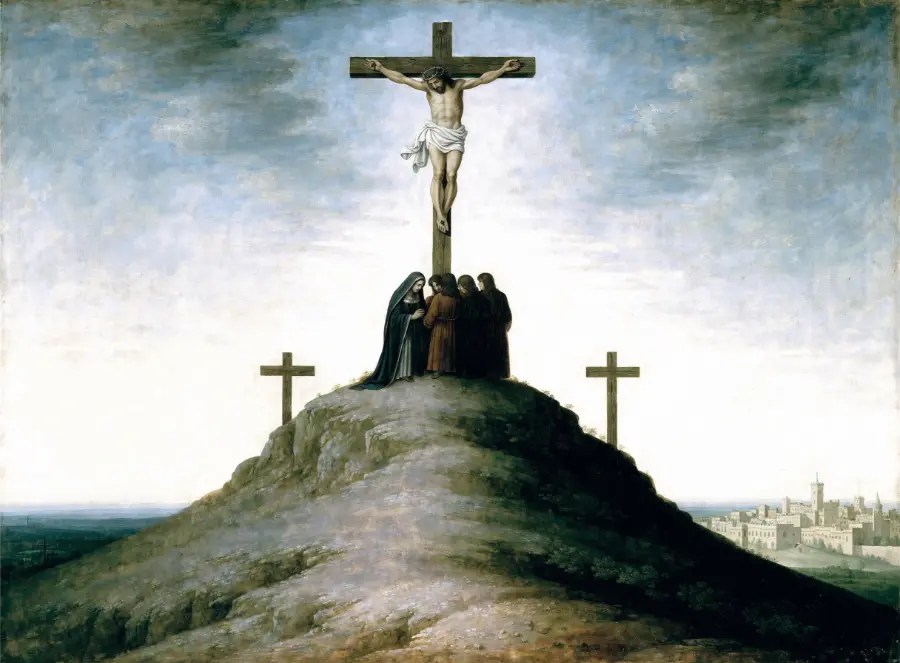
You can see the Golgotha tradition in Orthodox icons of the crucifixion, where a skull lies at the foot of the cross. Fr. John Shandra explains that it “symbolically represents the skull of Adam” and that some believe Jesus was crucified where Adam was buried, “although this is not a dogma of the Orthodox Church, but rather a pious tradition.” The picture is plain enough without the dogma: the first man’s dust, and above it the blood of the second. Shandra ties it to Paul, who calls Jesus the second Adam and puts it this way: “For as in Adam all die, even so in Christ shall all be made alive” (1 Corinthians 15:22).


コメントを残す