
 English
 Chinese
 Dutch
 Arabic
 Spanish
 Portuguese
 Russian
 French
 Italian
 German
 Japanese
Barabbas was the prisoner whom Pilate set free at Passover when the crowd asked for him instead of Jesus. Mark and Luke say he was held for an uprising in Jerusalem and for murder, and John calls him a robber. The Bible says nothing about him after his release, and no ancient record tells how he lived or died.
His name holds the whole scene. Barabbas means “son of the father,” and the crowd chose him over the one Christians confess as the Son of the Father. One man walked out of prison that day, and the other carried a cross.
What did Barabbas do?
All four Gospels name him, and each adds a detail. Mark gives the fullest account: “there was one named Barabbas, which lay bound with them that had made insurrection with him, who had committed murder in the insurrection” (Mark 15:7). So Barabbas was in custody with other rebels, and someone had been killed in their revolt. Luke agrees that he was held “for a certain sedition made in the city, and for murder” (Luke 23:19). Matthew does not name the crime but says he was well known: “they had then a notable prisoner, called Barabbas” (Matthew 27:16). John’s account is the shortest: “Now Barabbas was a robber” (John 18:40).
| Gospel | What it says of Barabbas | Verse |
|---|---|---|
| Matthew | “a notable prisoner” | 27:16 |
| Mark | held with rebels; “committed murder in the insurrection” | 15:7 |
| Luke | jailed “for a certain sedition made in the city, and for murder” | 23:19 |
| John | “a robber” | 18:40 |
The four descriptions fit together without strain. A man arrested for a violent uprising could be both notorious and called a robber, and no Gospel suggests he was innocent. What the uprising was about, and whom he killed, the Gospels never say.
Why was Barabbas released instead of Jesus?
There was a custom at the feast, the Gospels tell us: at the Passover the governor freed one prisoner whom the people chose. In Matthew’s words, “Now at that feast the governor was wont to release unto the people a prisoner, whom they would” (Matthew 27:15; compare Mark 15:6). In John, the Roman governor Pontius Pilate reminds the crowd of it himself: “ye have a custom, that I should release unto you one at the passover: will ye therefore that I release unto you the King of the Jews?” (John 18:39). Pilate had examined Jesus on the charges the priests brought, which are traced in why Jesus was crucified, and in Luke’s words he “found no fault in this man touching those things whereof ye accuse him” (Luke 23:14). So he offered the release as a way to let Jesus go. “For he knew that the chief priests had delivered him for envy” (Mark 15:10).
The plan failed: “the chief priests moved the people, that he should rather release Barabbas unto them” (Mark 15:11), and Matthew says the same of “the chief priests and elders” (Matthew 27:20). Luke says Pilate pleaded a third time, “Why, what evil hath he done?” (Luke 23:22), and the shouting only grew. Mark gives his reason for yielding: “Pilate, willing to content the people, released Barabbas unto them, and delivered Jesus, when he had scourged him, to be crucified” (Mark 15:15). The sentence was the governor’s to give, and he gave it.
No source outside the Gospels records this custom of letting the crowd choose a prisoner at the feast. Even the Catholic apologist Jimmy Akin, defending the account, grants that. He points instead to the historian Josephus, who reports that Herod Archelaus and the Roman governor Albinus released prisoners to win the people’s favor, and to a rule in the Mishnah about preparing the Passover lamb for a prisoner promised release. Those passages make the custom plausible without confirming it.
If you read the King James Version, you will find one more line in Luke: “(For of necessity he must release one unto them at the feast.)” (Luke 23:17). Many ancient manuscripts lack this verse, and modern Bibles such as the New Revised Standard Version Updated Edition move it to a footnote.
Why did the crowd go along? The Gospels give no motive beyond the priests’ persuasion. A man jailed for rising against Rome may have had supporters in the city, but the texts do not say so.
Who asked for Barabbas to be freed?
The Gospels name them: the chief priests and elders, who persuaded “the multitude,” and the crowd that gathered before Pilate. Luke adds that “the voices of them and of the chief priests prevailed” (Luke 23:23). And they show that the city was not of one mind. As Jesus was led out, “there followed him a great company of people, and of women, which also bewailed and lamented him” (Luke 23:27). Jesus himself was a Jew, and so were his apostles.
Matthew alone records a cry from the crowd: “His blood be on us, and on our children” (Matthew 27:25). This is the hard part of the story. For centuries many Christians, church writers among them, turned that line against the whole Jewish people. The Catholic Church rejected that reading at the Second Vatican Council in 1965: “what happened in His passion cannot be charged against all the Jews, without distinction, then alive, nor against the Jews of today.” Its Catechism adds that “we cannot lay responsibility for the trial on the Jews in Jerusalem as a whole, despite the outcry of a manipulated crowd,” and calls the cry “a formula for ratifying a judicial sentence” (Catechism 597). Peter himself, speaking to the people of Jerusalem weeks later, told them he knew they had acted in ignorance: “I wot that through ignorance ye did it, as did also your rulers” (Acts 3:17). “Wot” is old English for “know.”
What does the name Barabbas mean?
Barabbas is an Aramaic name, not a Hebrew one. It joins bar, “son,” to abba, “father,” so it means “son of the father.” It was probably not a title. The Jewish Encyclopedia notes that Abba “is found as a prænomen as early as tannaitic times,” that is, as a man’s personal name in the early rabbinic period. Barabbas may simply have been the son of a man named Abba.
Early writers heard more in it. Jerome reported that a gospel called “according to the Hebrews” explained the name as “The son of their master,” which one nineteenth-century scholar took to mean the son of a rabbi. Hilary of Poitiers took the plain meaning, “the son of a Father,” and saw in the crowd’s choice a picture of unbelief to come, when Antichrist would be preferred to Christ. We need none of them to see the irony. The crowd chose a man whose name means “son of the father” over the one Christians confess as the Son of the Father.
Was his full name Jesus Barabbas?
Possibly. A few Greek manuscripts of Matthew call him “Jesus Barabbas,” so that Pilate’s question becomes “Jesus Barabbas or Jesus who is called the Messiah?” (Matthew 27:17, New Revised Standard Version Updated Edition, which prints the longer name with the note “Other ancient authorities lack Jesus”). Most manuscripts, including the fourth-century Codex Sinaiticus and Codex Vaticanus, have only “Barabbas,” and so does the King James Version.
Origen knew the longer reading and did not like it. In his commentary on Matthew, which survives for this passage only in a Latin translation, he wrote that many copies do not say Barabbas was also called Jesus, and that perhaps they are right, so that the name of Jesus would not belong to a wrongdoer. Modern editors have weighed the same evidence and leaned, just, the other way. The textual commentary to the United Bible Societies’ Greek New Testament judged the support for “Jesus” “relatively slender” but thought it likely that the name was “deliberately suppressed in most witnesses for reverential considerations,” and so printed it in brackets. Translations divide too. A 1988 handbook for Bible translators found that the Good News Translation and the New English Bible print “Jesus Barabbas,” while the Revised Standard Version, the New International Version, the New Jerusalem Bible and the New American Bible print “Barabbas” alone.
The name itself would not have been strange in those days: Paul mentions a fellow worker called “Jesus, which is called Justus” (Colossians 4:11). The question is one of manuscripts, not of doctrine, and Bibles of every tradition differ on it.
What happened to Barabbas, and how did he die?
Nobody knows. After “Then released he Barabbas unto them” (Matthew 27:26), he leaves the story, and no other ancient writer mentions him. There is no record of how he lived, whether he went back to the rebels, or how or when he died.
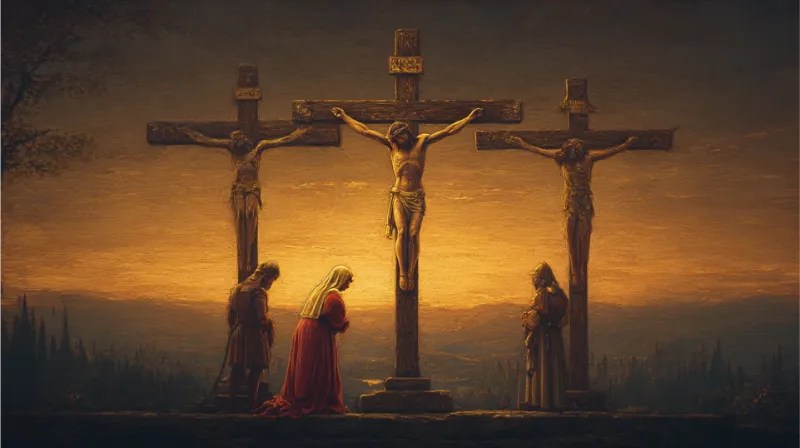
He was not crucified with Jesus. Pilate set him free, and the two men who died beside Jesus were others. Matthew calls them “two thieves crucified with him, one on the right hand, and another on the left” (Matthew 27:38), and Luke calls them “malefactors” (Luke 23:32). Their story is told in the thieves who died with Jesus.
Did Barabbas become a Christian?
Nothing shows that he did. No Gospel, letter or early Christian writer says so. The stories of his conversion, his imprisonment with Christians and his death on a cross in Rome come from a modern novel and the film made from it.
The Swedish writer Pär Lagerkvist published Barabbas in 1950. His Barabbas watches the crucifixion, cannot forget it, and spends the rest of his life near the faith without holding it. Enslaved in a mine, he is chained to an Armenian Christian named Sahak. When a Roman governor questions them, Sahak refuses to deny Christ and is crucified, while Barabbas denies him and lets the governor cross out the sign of Christ on his slave’s disk. Later, in Rome, he sees the city burning, believes Christ has come back to destroy it, and helps spread the fire. He is jailed with Christians, who disown him, and crucified alone. As he dies he speaks into the darkness, delivering up his soul “to thee,” and the novel leaves open whom he means. Lagerkvist’s Barabbas wants to believe and cannot; he never becomes a Christian.
The 1961 film Barabbas, directed by Richard Fleischer with Anthony Quinn in the title role, keeps the mines and the cross and adds the arena. The British Film Institute’s summary has him return to crime, become a slave “in the sulphur mines of Sicily,” fight “as a gladiator in the Roman arena” and finally end “his life on the cross.” The gladiator scenes belong to the film, not the book. Both works are fiction, and neither claims to report history.
What do Christians see in Barabbas’s release?
The Gospels tell the scene without drawing a lesson from it. Christians have always seen in it a picture of what Jesus’ death does: a guilty man walks free because an innocent one is condemned. In the same sermon in which he told his hearers they had acted in ignorance, Peter set the two men side by side: “ye denied the Holy One and the Just, and desired a murderer to be granted unto you” (Acts 3:14). The first letter of Peter states the exchange in general terms: “Christ also hath once suffered for sins, the just for the unjust, that he might bring us to God” (1 Peter 3:18).
Preachers ever since have stood where Peter stood. The London preacher Charles Spurgeon told his congregation in 1864, “You and I may fairly take our stand by the side of Barabbas,” and put the point bluntly: “Barabbas must die or Christ must die.” The Catholic Catechism, which refuses to blame the Jewish people for the Passion, places the blame on all sinners instead: “sinners were the authors and the ministers of all the sufferings that the divine Redeemer endured” (Catechism 598).
That is a reading of faith. Barabbas’s own life after that day remains unknown. But what the Gospels record is enough for it: Barabbas walked free, and Jesus went to the cross, “the just for the unjust.”


Leave a Reply