
 English
 Chinese
 Dutch
 Arabic
 Spanish
 Portuguese
 Russian
 French
 Italian
 German
 Japanese
The Bible does not say plainly where Judas went after death. Churches differ on whether anyone can know for certain. Most readers have long taken Jesus’ words about him to mean hell: Jesus called him “the son of perdition” and said of him, “it had been good for that man if he had not been born.”
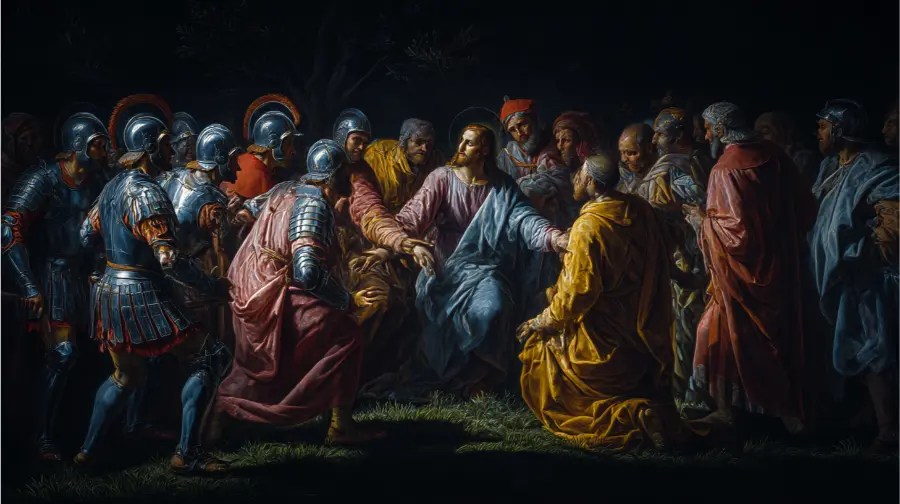
Judas Iscariot was one of the twelve apostles. He agreed with the chief priests to hand Jesus over for thirty pieces of silver, and he led the arresting crowd to Jesus with a kiss (Matthew 26:14–16, 47–49). The Catholic Church has never declared any named person to be in hell, Judas included, and it leaves his judgment to God. Lutheran, Reformed and Methodist teachers have held that he was lost, and the Orthodox Church presents him in its Holy Week hymns as a warning.
What does the Bible say about Judas’s fate?
No verse says that Judas is in hell, and none says that he is in heaven. The evidence is mainly what Jesus said about him on the night he was betrayed, and what the disciples said after Judas died.
At the Last Supper Jesus told the twelve that one of them would betray him. Then he said:
The Son of man goeth as it is written of him: but woe unto that man by whom the Son of man is betrayed! it had been good for that man if he had not been born.
Matthew 26:24
Mark records the same words (Mark 14:21). Many readers have reasoned that no one who ends in heaven could be better off unborn, and so have taken the saying to mean that Judas was lost.
Later the same night, in his prayer for the disciples, Jesus said: “those that thou gavest me I have kept, and none of them is lost, but the son of perdition; that the scripture might be fulfilled” (John 17:12). Perdition means ruin. John Calvin explained the phrase as a Hebrew way of speaking: the son of perdition “denotes a man who is ruined, or devoted to destruction.” Paul uses the same title for “that man of sin” in 2 Thessalonians 2:3.
After Jesus rose and ascended, the disciples prayed before choosing Matthias to take Judas’s place. They asked God to show which man should take up the ministry “from which Judas by transgression fell, that he might go to his own place” (Acts 1:25). Scripture does not say what his own place was. John Wesley read it as the place “which his crimes had deserved, and which he had chosen for himself.”
Two other passages tie Judas to the devil. Long before the supper Jesus said to the twelve, “Have not I chosen you twelve, and one of you is a devil?” and John adds, “He spake of Judas Iscariot the son of Simon” (John 6:70–71). On the eve of the betrayal, Luke writes, “Then entered Satan into Judas surnamed Iscariot” (Luke 22:3). Judas was still a man answerable for what he did. Pope Benedict XVI spoke of “the personal responsibility of Judas, who shamefully ceded to a temptation of the Evil One.”

Can anyone know where Judas is?
The Catholic Church teaches that no one can know who is in hell without a special revelation from God. Lutheran, Reformed and Methodist teachers have read Scripture as saying that Judas was lost. The Orthodox services quoted below present him as a warning and do not say where he is now.
| Tradition | On Judas | Source |
|---|---|---|
| Catholic | Leaves his judgment to God; has never declared any person to be in hell | Catechism 1861; John Paul II; Benedict XVI |
| Orthodox | Presents him in Holy Week hymns as a warning against greed and betrayal; no ruling on his fate | Holy Wednesday and Holy Thursday services |
| Lutheran | His sorrow failed because it had no faith | Apology of the Augsburg Confession, Article XII |
| Reformed (Calvin) | He was never one of God’s elect | Calvin on John 17:12 |
| Methodist (Wesley) | He was given to Christ and was lost | Wesley on John 17:12 |
Catholic teaching
For centuries the common opinion among Catholics, as among many of the Church Fathers, was that Judas was damned. The Church has never made that opinion its teaching. The Catechism of the Catholic Church gives the rule for every person: “although we can judge that an act is in itself a grave offense, we must entrust judgment of persons to the justice and mercy of God” (1861).
Pope John Paul II said the same of hell in a general audience in 1999: “Damnation remains a real possibility, but it is not granted to us, without special divine revelation, to know which human beings are effectively involved in it.” In his 1994 book Crossing the Threshold of Hope, writing about who is lost, he said, “The Church has never made any pronouncement in this regard.” He added that Jesus’ words about Judas “do not allude for certain to eternal damnation.”
Pope Benedict XVI, in a 2006 audience on Judas, said that Jesus’ judgment and Judas’s remorse together darken “the mystery around his eternal fate.” Of his death he said: “it is not up to us to judge his gesture, substituting ourselves for the infinitely merciful and just God.”
Orthodox teaching
The Orthodox Church remembers Judas in the services of Holy Week. On Great and Holy Wednesday its hymns recall the sinful woman who poured ointment on Christ’s head at Simon the leper’s house, and the Orthodox Church in America notes that on the same day “Judas agreed to betray the Lord for thirty pieces of silver.” Because of that betrayal, Orthodox Christians fast on most Wednesdays of the year.
The troparion of Holy Thursday sets the disciples, “enlightened at the washing of their feet before the supper,” beside Judas, “darkened, ailing with avarice.” It ends with a warning: “Flee from the greedy soul which dared such things against the Master.”
Fr. Alexander Schmemann, in an essay the Orthodox Church in America publishes for Holy Thursday, wrote that the betrayal “reveals that sin, death and self-destruction are also due to love, but to deviated and distorted love.” Each year, he said, the day asks every worshipper: “do I respond to Christ’s love and accept it as my life, do I follow Judas into the darkness of his night?” The same choice is in the prayer Orthodox Christians say before Communion: “neither like Judas will I give Thee a kiss; but like the thief will I confess Thee: Remember me, O Lord in Thy Kingdom.” These hymns and prayers warn the worshipper. They do not say where Judas is now.
Protestant teaching
The Lutheran confessions use Judas to show what true repentance needs. The Apology of the Augsburg Confession (1531) names two parts of repentance, contrition and faith, and says that “The contrition of Judas or Saul … is useless because faith is not added.” The sorrow of David and Peter, it goes on, “helps because faith, which takes hold of the forgiveness of sins granted for Christ’s sake, is added to it.”
John Calvin, the Reformed theologian, read Jesus’ prayer to mean that Judas had never truly belonged to Christ: “though he was not one of the elect and of the true flock of God, yet the dignity of his office gave him the appearance of it.” He also rejected the idea that Scripture’s prophecy forced Judas to betray. Calvin called it “a most unfounded argument” to conclude “that the revolt of Judas ought to be ascribed to God rather than to himself.”
John Wesley, whose Notes on the New Testament became a standard of Methodist teaching, reached the opposite conclusion from the same verse. To him Judas was one of those the Father had given to Christ: “So one even of them whom God had given him is lost.” Calvin and Wesley disagree about whether one truly given to Christ can be lost. On Judas’s end they agree.
Did Judas repent before he died?
Matthew says that Judas “repented himself,” and he showed it: he gave back the money and confessed his sin.
Then Judas, which had betrayed him, when he saw that he was condemned, repented himself, and brought again the thirty pieces of silver to the chief priests and elders, Saying, I have sinned in that I have betrayed the innocent blood. And they said, What is that to us? see thou to that. And he cast down the pieces of silver in the temple, and departed, and went and hanged himself.
Matthew 27:3–5
The Greek verb behind “repented himself” is metamelomai, to regret or to change one’s mind. It is not the usual New Testament word for repentance, metanoeō, and many have taken that as a sign that Judas felt remorse without turning to God. The word alone cannot settle it. Matthew uses the same verb for the son in Jesus’ parable who refused to work in the vineyard, “but afterward he repented, and went” (Matthew 21:29). Joseph Thayer’s Greek lexicon judged the sharp distinctions often drawn between the two words “hardly to be sustained by usage,” while calling metanoeō “the fuller and nobler term.”
He confessed his sin to the chief priests, who turned him away, and the Gospels do not record that he went to Jesus or to the other disciples. John Chrysostom, preaching on this chapter of Matthew, faulted Judas “not because he repented, but because he did so, late, and slowly.”

How was Judas’s sorrow different from Peter’s?
Peter failed Jesus on the same night. He denied three times that he knew him, and when the cock crowed “he went out, and wept bitterly” (Matthew 26:75). Luke gives the moment before the tears: “the Lord turned, and looked upon Peter” (Luke 22:61).
| Judas | Peter | |
|---|---|---|
| His sin | Handed Jesus over for thirty pieces of silver | Denied three times that he knew Jesus |
| His sorrow | “I have sinned in that I have betrayed the innocent blood” | “He went out, and wept bitterly” |
| Who he faced | The chief priests: “What is that to us?” | Jesus, who “turned, and looked upon Peter” |
| Afterwards | Took his own life | Restored by the risen Jesus: “Feed my sheep” |
After the resurrection Jesus asked Peter three times, “lovest thou me?” and three times gave him a charge, the last of them “Feed my sheep” (John 21:15–17). Pope Benedict XVI set the two men side by side: “After his fall Peter repented and found pardon and grace. Judas also repented, but his repentance degenerated into desperation and thus became self-destructive.”

Did Jesus forgive Judas?
The Gospels do not say that Jesus forgave Judas, and they do not record that Judas asked him to. They do show how Jesus treated him to the end. At the supper Jesus washed the disciples’ feet with Judas among them, and he handed Judas the piece of bread he had dipped (John 13:26). In the garden, when Judas came to kiss him, Jesus said, “Friend, wherefore art thou come?” (Matthew 26:50), and asked, “Judas, betrayest thou the Son of man with a kiss?” (Luke 22:48). On the cross Jesus prayed, “Father, forgive them; for they know not what they do” (Luke 23:34). Luke does not say whom the prayer included.

How did Judas die?
The New Testament gives two short accounts. Matthew says Judas threw the silver down in the temple and “went and hanged himself.” The chief priests would not put “the price of blood” into the treasury, so they bought the potter’s field with it, “to bury strangers in,” and it was called “The field of blood” (Matthew 27:5–8).
In Acts, Peter tells the believers in Jerusalem that Judas “purchased a field with the reward of iniquity” and died there in a fall, “falling headlong.” The place became known as “Aceldama, that is to say, The field of blood” (Acts 1:18–19). Christians read the two accounts in different ways. Matthew Henry’s Commentary, completed in the early 1700s, joins them into one event. The notes of the Catholic New American Bible treat Acts as “a popular tradition about the death of Judas that differs from the one in Mt 27:5.”
Did Judas go to hell because he took his own life?
No verse ties Judas’s fate to the way he died. The passages about his fate speak of the betrayal. Jesus’ “woe unto that man” was spoken at the supper, before the betrayal was carried out and before Judas died, and it names “that man by whom the Son of man is betrayed.” The prayer in Acts speaks of the ministry “from which Judas by transgression fell.” Matthew tells of the death itself in a few words and adds no judgment on it.
The Catholic Church teaches that life is God’s gift and “not ours to dispose of.” In the same section, the Catechism says:
… Grave psychological disturbances, anguish, or grave fear of hardship, suffering, or torture can diminish the responsibility of the one committing suicide.
We should not despair of the eternal salvation of persons who have taken their own lives. By ways known to him alone, God can provide the opportunity for salutary repentance. The Church prays for persons who have taken their own lives.
Catechism of the Catholic Church, 2282–2283
In his audience on Judas, Pope Benedict XVI drew one lesson from his despair, in words from the Rule of Saint Benedict: “Never despair of God’s mercy.”

Related reading
- The Betrayal of Jesus: Why Did Judas Do It?
- The Price of Betrayal: What Was Judas Paid?
- Did Peter Go to Heaven? Exploring the Divine Journey
- What Is the Unforgivable Sin in the Bible?
- Does the Bible Record How the Apostles Died? Only James and Judas
- Bible Study: What Does the Bible Say About Suicide?


Leave a Reply