
 English
 Chinese
 Dutch
 Arabic
 Spanish
 Portuguese
 Russian
 French
 Italian
 German
 Japanese
No. After he rose from the dead Jesus ate a piece of broiled fish in front of his disciples (Luke 24:42–43), and he kept the Passover, the feast of the sacrificed lamb (Mark 14:12–16). Mark adds that Jesus “declared all foods clean” (Mark 7:19). No Gospel describes him as a vegetarian.
What the Gospels remember about his meals is mostly the company. His critics called him “a friend of tax collectors and sinners” (Matthew 11:19). After the resurrection, on the shore of Galilee, there was a charcoal fire with fish and bread, and he said to his disciples, “Come and have breakfast” (John 21:12). Christians who eat meat and Christians who eat none are both welcome at that fire.
What did Jesus eat?
The Gospels show Jesus eating bread and fish. When the risen Jesus appeared to the disciples in Jerusalem, he asked whether they had anything to eat. “They gave him a piece of broiled fish, and he took it and ate before them” (Luke 24:42–43). Some manuscripts add “and some honeycomb,” which the King James Version follows. By the Sea of Galilee the disciples found a charcoal fire with fish laid on it and bread, and Jesus said, “Come and have breakfast.” He “took the bread and gave it to them, and so with the fish” (John 21:9–13). When he fed the five thousand, he blessed five loaves and two fish, and the disciples handed them out to the crowd (Matthew 14:17–19).
His neighbors ate much the same. The staples of ancient Israel were bread, wine and olive oil, along with legumes, vegetables, fruit, dairy products and fish. For most people meat was a food for the major festivals, weddings and the visits of important guests, eaten only a few times a year. Eggs seem to have come into common use once chickens were raised for food, and they were widely eaten by Roman times. The Gospels never say whether Jesus ate them, though he speaks of a son asking his father for an egg (Luke 11:12).
Did Jesus eat meat?
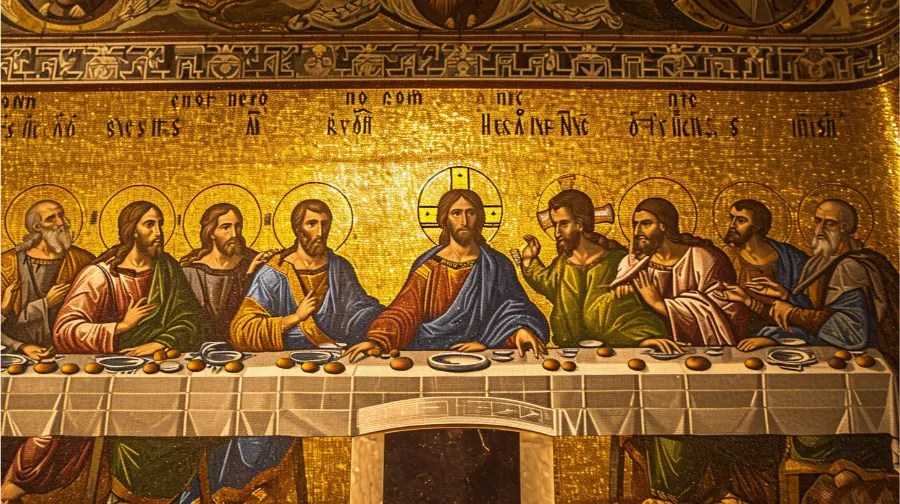
The Passover was a meal of meat. The law commanded that the lamb be eaten “roasted on the fire; with unleavened bread and bitter herbs” (Exodus 12:8). Mark sets the Last Supper “on the first day of Unleavened Bread, when they sacrificed the Passover lamb,” when the disciples asked Jesus, “Where will you have us go and prepare for you to eat the Passover?” (Mark 14:12). In Luke, Jesus tells them, “I have earnestly desired to eat this Passover with you before I suffer” (Luke 22:15). The Gospels never describe the lamb on the table. Matthew, Mark and Luke present the Last Supper as a Passover meal, while John places it before the Passover (John 13:1; 18:28), and scholars still debate whether the accounts can be reconciled.
Jesus did not live as an ascetic. He contrasted himself with John the Baptist, who came “neither eating nor drinking,” and said: “The Son of Man came eating and drinking, and they say, ‘Look at him! A glutton and a drunkard, a friend of tax collectors and sinners!’” (Matthew 11:18–19). Levi gave a great feast for him in his house (Luke 5:29).
Nor do the Gospels describe him as a pescatarian, someone who eats fish but no other meat. They show him eating fish, and no passage says he refused meat.
Eating meat in the Old and New Testaments
In Genesis God first gives people plants to eat: “Behold, I have given you every plant yielding seed that is on the face of all the earth, and every tree with seed in its fruit. You shall have them for food” (Genesis 1:29). After the flood he adds animals: “Every moving thing that lives shall be food for you. And as I gave you the green plants, I give you everything” (Genesis 9:3). The law of Moses then divided animals into clean and unclean.
The New Testament sets those food laws aside for Christians. Jesus taught that “whatever goes into a person from outside cannot defile him,” and Mark comments, “Thus he declared all foods clean” (Mark 7:18–19). In Peter’s vision a voice tells him, “Rise, Peter; kill and eat” (Acts 10:13). Paul treats eating meat as a matter of conscience: “One person believes he may eat anything, while the weak person eats only vegetables. Let not the one who eats despise the one who abstains, and let not the one who abstains pass judgment on the one who eats, for God has welcomed him” (Romans 14:2–3). He also wrote, “It is good not to eat meat or drink wine or do anything that causes your brother to stumble” (Romans 14:21), and he warned against teachers who “require abstinence from foods that God created to be received with thanksgiving” (1 Timothy 4:3).

Why some Christians are vegetarian or vegan
The Christian Vegetarian Association, an international, non-denominational ministry, accepts that “Luke 24:43 describes Jesus eating fish after the Resurrection,” but argues that what Jesus ate in a Mediterranean fishing community two thousand years ago “does not tell us what Christians should eat today.” It writes that “the Bible depicts a plant-based diet as God’s ideal,” pointing to Eden (Genesis 1:29–31) and to Isaiah’s picture of a world where “the wolf shall dwell with the lamb” and “the lion shall eat straw like the ox” (Isaiah 11:6–7). It reads Mark 7 as a ruling about eating with unwashed hands, and it argues that even if Jesus approved of the animal farming of his day, “it would not follow that he would endorse modern factory farming.”
The Seventh-day Adventist Church “encourages a balanced vegetarian diet,” according to its health ministries department, which quotes the church’s book Seventh-day Adventists Believe: “The diet God ordained in the Garden of Eden–the vegetarian diet–is the ideal, but sometimes we cannot have the ideal.” The diet most widely followed in the church includes eggs and dairy. The church “promotes the avoidance of flesh foods wherever possible” but leaves “the decisions of the specific diet to the choice of each member,” citing Romans 14.
In England the Bible Christian Church, founded by William Cowherd in Salford in 1809, required members to sign a pledge to keep a vegetarian diet and abstain from alcohol. Members of that church helped found the Vegetarian Society in 1847.
The claim that Jesus himself avoided meat is older. Epiphanius of Salamis, writing around 377 against the Ebionites, a Jewish-Christian group, said their gospel changed John the Baptist’s food from locusts (akris) to cakes (egkris) and had Jesus say he had no desire to eat the flesh of the Passover lamb (Panarion 30.13; 30.22). He also says that the Ebionites of his day abstained from meat (30.15). Scholars have questioned whether the earlier Ebionites of the second century did. A modern book that presents Jesus as a vegetarian, The Essene Gospel of Peace, was published by Edmond Bordeaux Szekely, who said he had translated it from a text he found at the Vatican in 1923. Scholars consider it a forgery.
Church rules on eating meat
The Catechism of the Catholic Church teaches that God entrusted animals to human stewardship: “Hence it is legitimate to use animals for food and clothing.” It adds, “It is contrary to human dignity to cause animals to suffer or die needlessly” (2417–2418). Catholic law asks for abstinence “from meat, or from some other food as determined by the Episcopal Conference,” on Fridays and on Ash Wednesday and Good Friday, for everyone who has turned fourteen (canons 1251–1252).
Orthodox Christians keep all Wednesdays and Fridays as fast days, apart from a few fast-free weeks, along with four fasting seasons: Great Lent, the Apostles’ Fast, the Nativity Fast and the Dormition Fast. On a strict fast day, according to the Orthodox Church in America, “no meat, eggs, dairy products, fish, wine or oil are to be eaten.” The same source notes that shellfish are allowed in practice, and that the rules are relaxed for the elderly and the sick.
A Catholic keeping a Friday, an Orthodox Christian in Lent, an Adventist at a vegetarian table and a Christian who eats whatever is put in front of him all belong to the same Lord. Paul told the one who eats not to despise the one who abstains, and the one who abstains not to judge the one who eats, “for God has welcomed him” (Romans 14:3).



Leave a Reply