
 Dutch
 English
 Chinese
 Arabic
 Spanish
 Portuguese
 Russian
 French
 Italian
 German
 Japanese
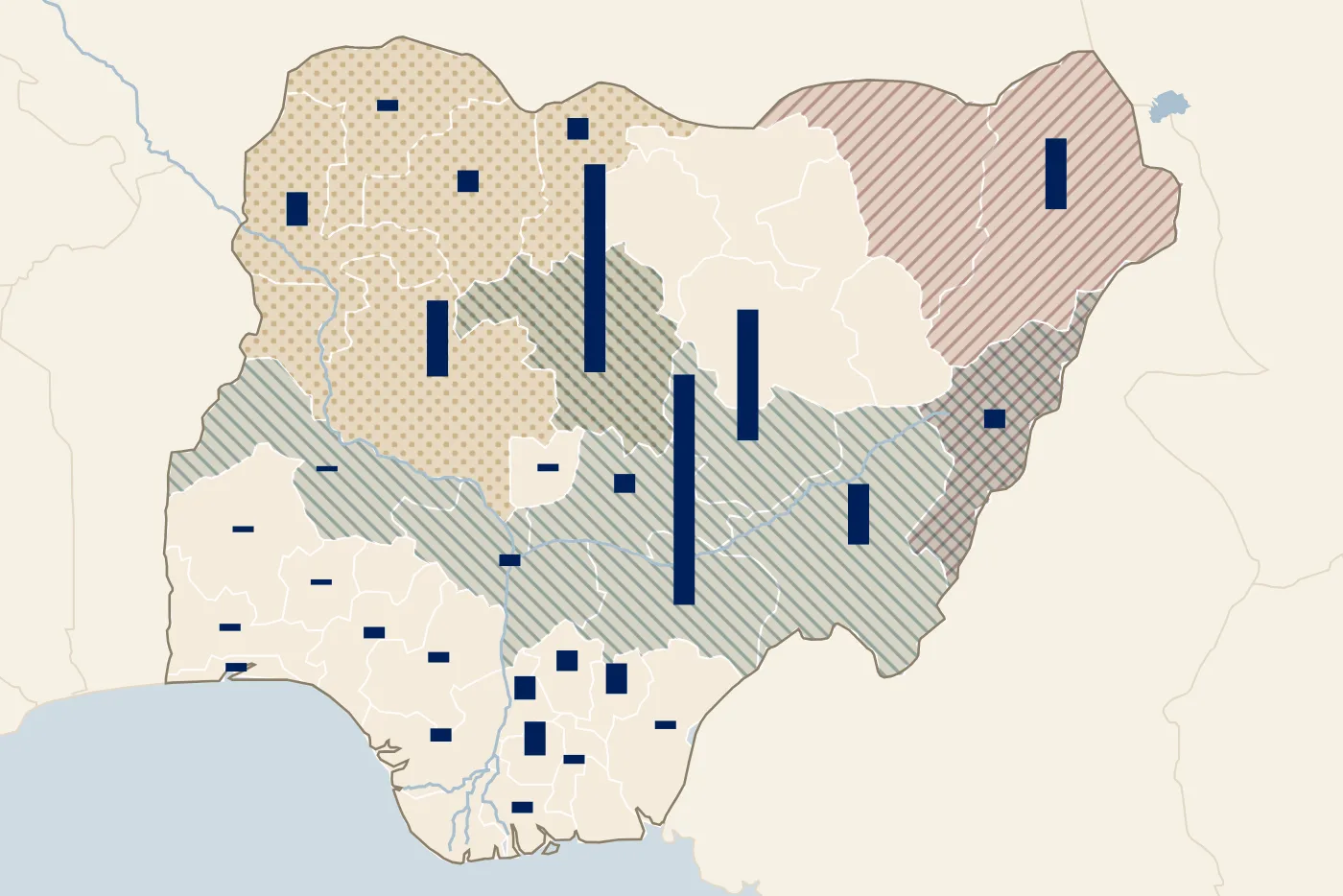
More Christians are killed for their faith in Nigeria than in every other country put together. Open Doors counted 3,490 of them in the twelve months to September 2025, out of 4,849 in the whole world. A wider count, which takes in every Christian civilian killed by the armed groups, comes to 22,835 in six years. They die at three sets of hands: Boko Haram in the north-east, armed Fulani groups who raid the farming villages of the Middle Belt, and the kidnap gangs of the north-west.
These are our brothers and sisters. Paul says of the church, “And whether one member suffer, all the members suffer with it” (1 Corinthians 12:26). So we have set down here what is known of their suffering, from the people who counted the dead and from Nigerian Christians who have spoken for themselves.
The figures in brief
- 3,490 Christians killed for their faith in one year, to September 2025 (Open Doors)
- 22,835 Christian civilians killed in six years, to September 2025 (Observatory for Religious Freedom in Africa)
- 12,160 of those killed by armed Fulani groups, more than half
- 15,932 Christians abducted in the same six years
- 217 churches destroyed in a single diocese, Wukari, in eight months
Who is killing Christians in Nigeria?
Boko Haram, in the north-east
Boko Haram made war on Christians from its first days. In July 2009, when its uprising began, its members “killed 37 Christian men, including three pastors, and torched or partially destroyed 29 churches in Borno State,” Christian leaders told Human Rights Watch. Over the next three years its men bombed or opened fire on at least 18 churches and killed more than 127 Christians in them. On Christmas Day 2011 a car bomb at St Teresa’s Catholic Church in Madalla killed 43 people.
The group called this a “full scale war between the Muslims and the Christians.” It killed Christian men “after they refused to convert to Islam.” In 2014 it took 276 students, most of them Christian girls, from their school at Chibok, and more than 90 have never come home. Its offshoot, the Islamic State West Africa Province (ISWAP), “considers the killing and enslavement of non-Muslims to be permissible,” the European Union’s asylum agency reports. Leah Sharibu, a Christian girl seized by ISWAP in 2018, was still held eight years later, “reportedly because she refused to convert to Islam from Christianity.”
Armed Fulani groups, in the Middle Belt
Most of Nigeria’s Christian dead fall here, in the farming country across the middle of Nigeria. The United States Commission on International Religious Freedom (USCIRF) wrote in May 2026 that Fulani militants have “targeted Christian communities in the Middle Belt and, increasingly, the South, burning homes and churches as well as kidnapping, raping, and murdering.” They often come at Christmas and Easter, it says, “terrifying those communities from gathering to celebrate or worship.”
On the night of 13 June 2025 gunmen fell on Yelwata in Benue State, where displaced families were sleeping at a Catholic mission. The published tolls run from more than 100 to 258, and USCIRF says the attack “killed over 200 Christians, mostly sleeping women and children.” On Christmas Day 2024, at Anwase in the same state, at least 47 people were killed and all eight chapels of St Mary’s parish were burned. On Palm Sunday 2026 at least 28 people were killed in a Christian quarter of Jos.
Families who flee often cannot go back, because the attackers settle on their land. USCIRF counts “at least 1.3 million people in the Middle Belt” driven into camps. In the Diocese of Wukari, Bishop Mark Nzukwein reported in May 2026 that “over 98,000 people, including 16 priests, have been displaced” since the September before.
Kidnap gangs, in the north-west
Nigerians call these gangs bandits, and they kidnap for ransom. Open Doors reports that they are now “specifically targeting Christians regardless of their ethnicity.” In November 2024 gunmen broke into a service at Kauna Baptist Church in Ligari, Kaduna State, and took at least 62 people, the pastor and several children among them. The hostages were told to renounce Christianity and saw two of their number killed. In November 2025 attackers carried off the pupils and teachers of a Catholic boarding school at Papiri: 265 by the bishops’ count, more than 300 by USCIRF’s.
Priests are taken too. Aid to the Church in Need counted 25 priests and seminarians kidnapped in 2023, 12 priests and religious in 2024, and 12 more clergy in the first three months of 2025, two of whom were murdered by their captors.
Twelve northern states have put Sharia into their criminal law, and there the law itself presses on Christians. In 2022 a mob in Sokoto killed Deborah Samuel Yakubu over a remark taken as blasphemy. Rhoda Jatau, a Christian nurse who shared messages condemning the killing, spent 18 months in detention. “If I am not free to build a church, if I am not free to get land, you cannot tell me that I am free,” Archbishop Matthew Man-oso Ndagoso of Kaduna said in 2023.
Our map shows where it is happening: Boko Haram in the north-east, the raids on farming villages across the Middle Belt, the kidnap gangs of the north-west, and how many Christians were killed in each state.
How many Christians have been killed in Nigeria?
Five bodies have published a count. They differ because each counts different deaths over different months.
- 22,835 in six years. The Observatory for Religious Freedom in Africa (ORFA) counted every Christian civilian killed by the armed groups from October 2019 to September 2025, establishing each victim’s religion. Benue lost 4,579, Kaduna 4,134 and Plateau 2,602.
- 3,490 in one year. Open Doors counts only “civilian Christians whose deaths can be linked to their Christian identity or Christian community affiliation,” from October 2024 to September 2025. Where reports differ it takes the lower number.
- 4,216 in eight months of 2026. Equipping the Persecuted, an American charity, says it “recorded 4,216 Christian deaths” from 1 January to 8 September. Its register is not published, so nobody outside can check it.
- 3,083 in eight months of 2026. Intersociety, a Nigerian group, adds estimates to the deaths it has tracked and publishes no list that adds up to its total.
- 317 in nearly six years. This figure, from the conflict monitor ACLED, is often set against the others, and it counts the least. ACLED works from news reports, and its data “do not routinely disaggregate victims of political violence according to their religious affiliation.” Its 317 are the deaths in attacks “where Christian identity of the victim was a reported factor”. A Christian killed in a raid on a village is left out unless a news report said the attackers came for Christians. ACLED itself warns that its figure “is not equivalent to all political violence against Christians.”
ORFA says of its own count that it “is never exhaustive since much violence goes unreported”. Aid to the Church in Need gives no total, and writes, “Although exact figures are difficult to assess, Christians have been the target of extrajudicial killings and abductions by insurgent groups and criminal gangs.”
Are 1,200 churches destroyed in Nigeria every year?
That figure is one group’s estimate, averaged. In 2025 Intersociety estimated that 19,100 churches had been destroyed, looted or closed since Boko Haram’s uprising in July 2009, divided the number by sixteen years, and rounded the answer up to 1,200. It has published no list of the churches. Open Doors says of all such totals, “The extent of damage to churches is not verifiable due to the absence of a central database collecting this information.”
What has been counted, church by church, is grievous enough. Bishop Nzukwein counted 217 churches completely destroyed in his diocese between September 2025 and May 2026. In Takum, on 7 February 2026, community leaders reported at least 35 churches attacked in a single day. In November 2024 the Bishop of Makurdi said that 15 parishes of his diocese had been closed by the violence.
Why are Christians being killed?
Boko Haram and ISWAP say why in their own words, as we have seen. Of the Fulani militants, USCIRF writes that “multiple and overlapping factors, including religion in many cases, likely spur Fulani militants to attack communities or individuals.” Land is one of those factors, and ransom drives the gangs of the north-west. Yet the raids fall on Christian villages at Christian feasts, churches are burned with the homes, and hostages are told to deny Christ. Counting the dead against the number of Christians living in each state, ORFA concluded that Christians in the north-west “were also specifically targeted for violence.”
What has Nigeria’s government done?
Nigeria’s Catholic bishops wrote in November 2025 of “delayed or withheld security responses, giving the impression of possible collusion or a lack of will to act.” At Zike in Plateau State, where 51 Christians were killed in April 2025, there was a military base less than three miles away. Open Doors reports that warnings were passed to the security agencies before Yelwata was attacked. “There are no arrests, no accountability. The impunity is discouraging,” Bishop Nzukwein said.
The government, USCIRF records, “denied the existence of religious persecution”. USCIRF has asked every year since 2009 for Nigeria to be named among the world’s worst offenders against religious freedom, and in October 2025 the United States named it so. Since then President Tinubu has moved 100,000 police officers from bodyguard duty to security work and has declared the kidnappers and armed groups terrorists, and nine men have been charged over Yelwata.
What Nigerian Christians ask of us
The pastor of the church at Ligari, the Rev. Micah Bulus, was carried off with his congregation. “I told my people even if they see my dead body, they should not deny Jesus and they should remain strong,” he told the Associated Press afterwards.
A Christian driven from home told Open Doors what to ask of the rest of the church: “The global church needs to know that many people are displaced. The global church needs to pray for the people to be able to return.”
Bishop Nzukwein has seen his churches burned and his priests driven out. “Our people are suffering a calvary,” he said in March 2026. “With God’s help we continue carrying our cross. We are part of the martyrdom of the 21st century.” We can do what Scripture asks of every Christian who is safe tonight: “Remember them that are in bonds, as bound with them; and them which suffer adversity, as being yourselves also in the body” (Hebrews 13:3).
Bronnen
- Observatory for Religious Freedom in Africa, Killings and Abductions in Nigeria (2020–2025), juni 2026.
- Open Doors, World Watch List 2026 Advocacy-rapport, the Nigeria country dossier, and the research brief Nigeria at the Crossroads, September 2026.
- Amerikaanse Commissie voor Internationale Religieuze Vrijheid, 2026 Annual Report, Nigeria, en Fulani Militants, May 2026.
- Human Rights Watch, Spiraling Violence, October 2012.
- European Union Agency for Asylum, Nigeria: Country Focus, November 2025.
- US State Department, 2023 Report on International Religious Freedom: Nigeria.
- Aid to the Church in Need, Religious Freedom in the World Report 2025, Nigeria, en de interview with Bishop Nzukwein, maart 2026.
- Agenzia Fides, report from the Diocese of Wukari, May 2026.
- Conferentie van Katholieke Bisschoppen van Nigeria, statement of 25 November 2025.
- Associated Press, 18 November 2025, and its report of ACLED’s figures, 17 October 2025; ACLED’s note on what it counts.
- Intersociety, report of 6 September 2026; Equipping the Persecuted, Crisis in the Middle Belt, September 2026.
- Bijbelcitaten zijn afkomstig uit de King James Version.


Een reactie plaatsen