
 English
 Chinese
 Dutch
 Arabic
 Spanish
 Portuguese
 Russian
 French
 Italian
 German
 Japanese
No. Jesus and Krishna are two different figures with two different stories. Even A. C. Bhaktivedanta Swami Prabhupada, who taught that “Christ” and “Krishna” call on the same God, named Jesus “the son of God, the representative of God”, not Krishna. Christians confess what no avatar story claims: that God became flesh once, in Jesus, and died and rose again.
The two faiths meet and part over one small word. In the Bhagavad Gita, Krishna tells the warrior Arjuna, “Manifold the renewals of my birth / Have been,” and promises that whenever goodness fails, “I rise, from age to age.” Swami Vivekananda, a Hindu teacher who honoured Jesus deeply, named what he saw as the Christian mistake: “The disciple thinks that the Lord can manifest Himself only once. There lies the whole mistake.” The New Testament uses that very word, and means it: “But now once in the end of the world hath he appeared to put away sin by the sacrifice of himself” (Hebrews 9:26).
Side by side, in each faith’s own scriptures:
| Question | Krishna (Hindu scriptures) | Jesus (the Gospels) |
|---|---|---|
| Who is he? | An avatar of Vishnu; for many Vaishnavas, including ISKCON, God himself | The Son of God, true God and true man |
| His parents | Devaki and Vasudeva | Mary, with child “of the Holy Ghost” |
| His name | Sanskrit for “dark”; for devotees, “all-attractive” | “He shall save his people”; Christ means “anointed” |
| How often God comes | “From age to age” | “Once in the end of the world” |
| His body | “Unborn, undying, indestructible” | Real flesh, wounded and raised |
| End of his earthly life | A hunter’s arrow; he returns to his abode | Crucified, buried, risen the third day |
| Main scriptures | Bhagavad Gita, Bhagavata Purana | Matthew, Mark, Luke and John |
Who is Krishna in Hinduism?
Krishna is one of the most loved figures in Hinduism. Many Hindus honour him as an avatar of the god Vishnu, one of the ten principal forms in which Vishnu comes to earth. The Sanskrit word avatāra means “descent”, as Monier-Williams’ Sanskrit dictionary gives it: “descent (especially of a deity from heaven).” For many Vaishnavas, the devotees of Vishnu, including the Hare Krishna movement (the International Society for Krishna Consciousness, or ISKCON), Krishna is more than one avatar among others. The Bhagavata Purana itself says so. In the translation of ISKCON’s founder, A. C. Bhaktivedanta Swami Prabhupada, says that “Lord Śrī Kṛṣṇa is the original Personality of Godhead.”
His story is told in the Mahabharata, where the Bhagavad Gita stands, and in the Bhagavata Purana. He is born at night to Devaki, appearing “in the dense darkness of night, like the full moon rising on the eastern horizon,” and his father Vasudeva sees a child “blackish like a dense cloud.” The name itself means dark: Monier-Williams gives kṛṣṇa as “black, dark, dark-blue.” He counsels Arjuna on the battlefield in the Gita, and near the end of his time on earth a hunter named Jarā “mistook the Lord’s foot for a deer’s face” and shot it with an arrow.
How do Hindus see Jesus?
There is no single Hindu view, but the best-known Hindu teachers of the last century and a half all spoke of Jesus with reverence.
Vivekananda, lecturing in Los Angeles in 1900, said, “If I, as an Oriental, have to worship Jesus of Nazareth, there is only one way left to me, that is, to worship him as God and nothing else.” In the same lecture he asked his hearers to “find God not only in Jesus of Nazareth, but in all the great Ones that have preceded him, in all that came after him, and all that are yet to come.” For him Jesus was God made manifest, as Krishna and others were.
Prabhupada was once asked by Christian ministers what he thought of Jesus. “He is our guru,” he told them. “He is preaching God consciousness, so he is our spiritual master.” In another talk he called Jesus “the son of God, the representative of God,” and said, “we appreciate him and give him all honor.”
Mahatma Gandhi wrote in 1941, “To me, He was one of the greatest teachers humanity has ever had.” His Christian friends had told him he could not understand Jesus because he did not accept Christ “as the only Son of God.” Gandhi answered that Jesus “belongs not solely to Christianity, but to the entire world.” All three honour Jesus greatly. None of them gives him what the Gospels give him, a place no one else shares.
Paramahansa Yogananda’s Self-Realization Fellowship comes nearest to joining the two. Its teachings, it says, “are founded upon the original Christianity of Jesus Christ and the original Yoga of Bhagavan Krishna,” and its spiritual lineage “consists of these two great avatars” with the masters who followed. Even there, Jesus and Krishna stand side by side as two.
Does “Christ” come from “Krishna”?
No, though the idea has a famous Hindu source. In a 1974 conversation with a Benedictine monk, Father Emmanuel Jungclaussen, Prabhupada said, “Christos is the Greek version of the word Kṛṣṇa.” The monk had just given him the usual answer: “Christ comes from the Greek word Christos, meaning ‘the anointed one.’” Prabhupada gave his reason: “Kṛṣṭa is a Sanskrit word meaning ‘attraction.’ So when we address God as ‘Christ,’ ‘Kṛṣṭa,’ or ‘Kṛṣṇa,’ we indicate the same all-attractive Supreme Personality of Godhead.” The monk was right about the words. Christos comes from the Greek verb chriō, to anoint, and it translates the Hebrew Messiah, as John’s Gospel says: “We have found the Messias, which is, being interpreted, the Christ” (John 1:41). Kṛṣṇa is a Sanskrit word for “dark.” The names sound a little alike, but they come from different languages and mean different things. His point was a devotional one. Christians hear in “Christ” a title, the Anointed One promised to Israel.
Was the story of Jesus copied from Krishna?
The best-known version of the claim is Kersey Graves’s book The World’s Sixteen Crucified Saviors, written in 1875 to show that the Gospels borrowed from older religions. It put “Chrishna of Hindostan” first on its list of saviours and said that many of them “are reported to have been crucified.” It also said Krishna was “born at midnight on the twenty-fifth of the month Savarana, which answers to our December.”
The Hindu scriptures tell a different story. In the Bhagavata Purana, Devaki and Vasudeva are Krishna’s mother and father, and Prabhupada’s commentary dates his birth by the moon, on “the eighth day of the waning moon.” Krishna is not crucified. A hunter’s arrow strikes his foot, and soon after, the Bhagavata says, “Lord Kṛṣṇa entered into His own abode.” The Gospels, for their part, never give the day of Jesus’ birth; how the Church came to keep it on 25 December is told in why Christmas is on December 25. Two stories of a holy child will always share a few likenesses. These two share far less than Graves claimed.
How is an avatar different from the incarnation of Jesus?
Here the two faiths speak most differently. Krishna, in the Gita, calls himself “Unborn, undying, indestructible,” and comes “from age to age” to set right what has gone wrong. Prabhupada’s commentary on the Gita adds that his body is not made at all: “there is no creation of the Lord’s form or body, since all of the forms are eternally existent.” The commentary on the Bhagavata‘s Eleventh Canto, finished by Prabhupada’s disciples after his death, says the same of the hunter’s arrow. Following the older teacher Viśvanātha Cakravartī, it says the arrow “merely touched the Lord’s lotus foot and did not pierce it,” since “the Lord’s limbs are composed of eternity, knowledge and bliss.”
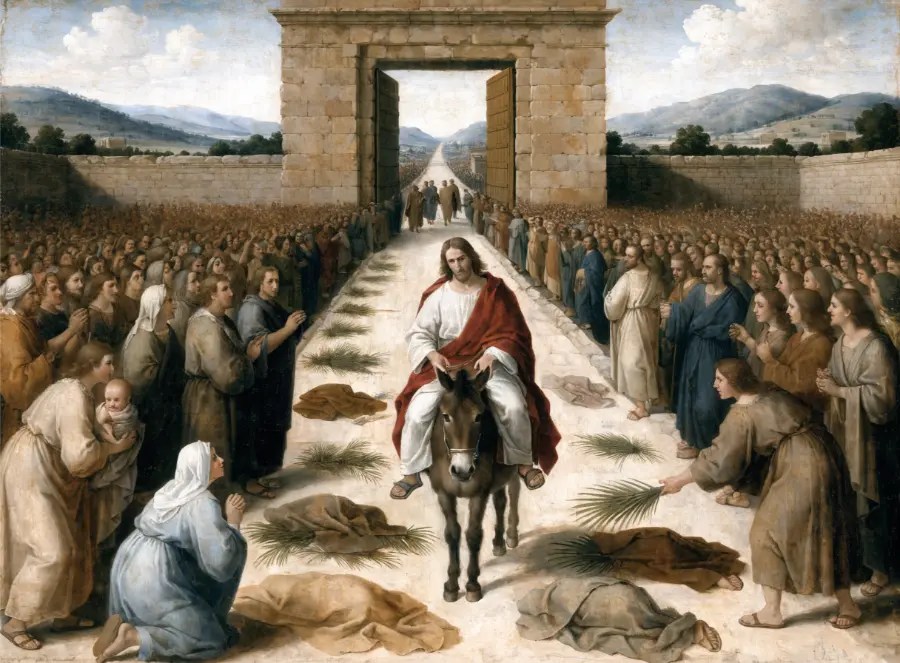
The Gospels tell of a God who let himself be pierced. “The Word was made flesh, and dwelt among us” (John 1:14), once, as one man, in one place. Paul says that Christ Jesus, “being in the form of God,” “took upon him the form of a servant, and was made in the likeness of men,” and “became obedient unto death, even the death of the cross” (Philippians 2:6–8). On Easter evening the risen Jesus showed his friends his hands and feet: “Behold my hands and my feet, that it is I myself: handle me, and see; for a spirit hath not flesh and bones, as ye see me have” (Luke 24:39). An avatar descends and returns. In Christ, Christians believe, God came down and took our flesh for good, scars and all. The belief in many births is also why Christians and Hindus part on rebirth, which whether reincarnation is in the Bible takes up.

Do Hindus believe Jesus died for our sins?
Hindu teachers answer differently. Prabhupada was blunt: “when you commit sinful activities, you must suffer – not Jesus Christ. This is God’s law.” Vivekananda, by contrast, said of all the great souls, Jesus among them, “They each and all suffer vicarious atonement for every one of us.” Christian faith says something narrower: one man suffered once, for all, so that we might be brought home. “For Christ also hath once suffered for sins, the just for the unjust, that he might bring us to God” (1 Peter 3:18).
How should Christians speak with Hindu friends about Krishna and Jesus?
With respect, and without pretending the differences away. The Catholic Church’s Second Vatican Council wrote in 1965 that “in Hinduism, men contemplate the divine mystery and express it through an inexhaustible abundance of myths and through searching philosophical inquiry,” and that “the Catholic Church rejects nothing that is true and holy in these religions.” In the next breath it says the Church “proclaims, and ever must proclaim Christ ‘the way, the truth, and the life’ (John 14:6).” Both halves belong together. When a Hindu neighbour honours Jesus, we can thank him for that honour, and tell him gently why we believe the God he seeks in many descents has come to us once, in a manger and on a cross.
The Christian answer rests on one man, given once for all: “For there is one God, and one mediator between God and men, the man Christ Jesus” (1 Timothy 2:5).


Leave a Reply