
 English
 Chinese
 Dutch
 Arabic
 Spanish
 Portuguese
 Russian
 French
 Italian
 German
 Japanese
Patmos is the small Greek island where John saw the visions of the Book of Revelation. It lies in the Aegean, in the north of the Dodecanese, off the coast of Asia Minor and across the water from Ephesus. John names it himself, in the only verse of the Bible that does: “I John, who also am your brother, and companion in tribulation, and in the kingdom and patience of Jesus Christ, was in the isle that is called Patmos, for the word of God, and for the testimony of Jesus Christ” (Revelation 1:9). The early Church remembered that he had been sent there as an exile under the emperor Domitian, near the end of the first century, and that he went home to Ephesus when Domitian died.
Listen to why he says he was there: “for the word of God, and for the testimony of Jesus Christ.” Those words come twice more in his book, and both times people have died for them. At the fifth seal he sees under the altar “the souls of them that were slain for the word of God, and for the testimony which they held” (Revelation 6:9), and near the end “the souls of them that were beheaded for the witness of Jesus, and for the word of God” (Revelation 20:4). So the man writing to the seven churches was on a rock in the sea for the same word and the same testimony the martyrs gave their lives for, and before he tells them a single thing he saw, he calls himself their brother and their companion in tribulation.
Why was John sent to Patmos?
Revelation never names the person who sent John to Patmos, and it never says how long he stayed. Even the little word “for” can point two ways: he was on the island because of the word of God, as a prisoner, or he went there to receive it. The Catholic Encyclopedia of 1907 thought the second the “more probable meaning”, yet it still heard the old exile in the way John describes himself, as a brother “in tribulation”. It found it “quite natural”, too, that he should have seen his banishment as “prearranged by Divine Providence”. The places where his words come back, in 6:9 and 20:4, point the same way, to suffering, and to an exile rather than a journey.
Rome sent its exiles to the small islands of the Aegean, and Tacitus tells of one condemned man, Serenus, whose island was argued over in the Senate. A senator proposed shutting him up on “Gyaros or Donusa”, and the emperor refused, “on the ground that both these islands were deficient in water, and that he whose life was spared, ought to be allowed the necessaries of life”, and had Serenus taken back to Amorgus instead. When Pliny the Elder lists the islands of that sea, Patmos comes straight after Donusa: “Donusa, Patmos, thirty miles in circumference”. Once Patmos came under Rome, ICOMOS writes in its 1999 report for UNESCO, it was used “like other Aegean islands, as a place of exile for political prisoners”, and John was one of them.
What the early Church remembered
The story of John’s exile comes to us from Christians of the next three centuries, and six of them wrote it down:
| Writer | Written | What he says |
|---|---|---|
| Irenaeus, bishop of Lyons | after 178 | The vision “was seen no very long time since, but almost in our day, towards the end of Domitian’s reign.” |
| Tertullian of Carthage | about 200 | At Rome John was “first plunged, unhurt, into boiling oil, and thence remitted to his island-exile”. |
| Clement of Alexandria | before 215 | On “the tyrant’s death” John “returned to Ephesus from the isle of Patmos”. |
| Victorinus, bishop of Pettau | before 303 | John was “in the island of Patmos, condemned to the labour of the mines by Cæsar Domitian”. |
| Eusebius, Church History | by 326 | John “was condemned to dwell on the island of Patmos in consequence of his testimony to the divine word.” |
| Jerome, On Illustrious Men | 392–93 | Under Domitian “he was banished to the island of Patmos, and wrote the Apocalypse”. |
Irenaeus, the oldest of them, had as a young man seen and heard Polycarp of Smyrna, and Polycarp had been a disciple of John. Tertullian, around 200, tells of the oil: at Rome, before he was ever sent to the island, John was thrown into it and came out unhurt. Victorinus was a bishop who probably died a martyr himself in 303, and he is the one who tells us what John was made to do on Patmos. He was sent to work in the mines, and it was there that he saw the Apocalypse. When Domitian was killed, “all his judgments were discharged”, and John, “dismissed from the mines”, gave the churches the Revelation he had received from God.
Clement tells what came next as “a tale, which is not a tale but a narrative, handed down and committed to the custody of memory”. Back in Ephesus, John went out to the towns around, “here to appoint bishops, there to set in order whole Churches”. Eusebius, finishing his Church History in the 320s, sets all this inside the history of Rome. Domitian, he writes, exiled a great many illustrious men without cause and was the second emperor to stir up persecution against Christians, and in his fifteenth year Flavia Domitilla was sent to the island of Pontia “in consequence of testimony borne to Christ”. “It is said” that John was condemned to Patmos in the same persecution. When Domitian died and Nerva took his place, the Senate voted, as the historians of the time record, “that those who had been unjustly banished should return to their homes”. An ancient Christian tradition said that this was when John “returned from his banishment in the island and took up his abode at Ephesus”. Domitian reigned from 81 to 96, and Jerome puts the banishment in his fourteenth year, so if these writers are right, John spent a year or two on Patmos.
Most of the old witnesses point to Domitian and to about the year 95. Epiphanius put the exile under Claudius, in 41–54, and the Catholic Encyclopedia thought that “exceedingly improbable” against Irenaeus, Eusebius and Jerome. Others date the visions to the late 60s, just after Nero; the Orthodox Church in America’s life of Saint Christodoulos says John wrote his book in the cave “in the years 68-69”. Who this John was, the apostle or another man of the same name, is a question of its own, and we follow it in who wrote the Book of Revelation.
The Cave of the Apocalypse
Halfway up the steep road from the harbour of Skala to Chora, the old town on the hill, and a little below the monastery, is a cave that Christians have honoured for centuries as the place of the vision. Tradition says John received the Revelation there and dictated it to his disciple Prochorus, and UNESCO’s record adds that he dictated his Gospel there too. Saint Christodoulos, who founded the monastery above, is remembered as the first to make the cave a place of prayer, and small churches, chapels and monks’ cells gathered round it until it became the Monastery of the Apocalypse.
The mouth of the cave is a chapel of Saint John now. The bare rock is its roof and its walls, niches for the altar are cut into the rock on the east side, and a wooden screen hung with old icons closes off the sanctuary. Only a fraction of the paintings that once covered the walls survive, and one of them, from the twelfth century, shows John dictating to his disciple, doing what he was told in the first chapter: “What thou seest, write in a book, and send it unto the seven churches which are in Asia” (Revelation 1:11). If the tradition is right, this is also where the vision began, where John “fell at his feet as dead” and the Lord laid his right hand on him and said, “Fear not; I am the first and the last” (Revelation 1:17).
The Monastery of Saint John the Theologian
Raiders laid Patmos waste in the seventh century, and ICOMOS says it was “virtually uninhabited for the next two centuries”. Then in 1088 an abbot called Christodoulos, “the servant of Christ”, came with leave from the Byzantine emperor Alexios I Komnenos to found a monastery on the island in honour of Saint John. He came from Bithynia and had been baptized John, and he had already founded monasteries on Leros and Kos. The emperor’s charter of 1088, the chrysobull the monastery still keeps, gave him Patmos “as an eternal, inalienable property, exempting it from all taxes”, and forbade the emperor’s own officials to act there.
Christodoulos built on the mountain near the cave, and within three years his monastery looked like a fortress, as it still does. It is a many-sided castle with towers and battlements, and its oldest parts, the main church, the chapel of the Virgin and the monks’ dining hall, go back to the eleventh century. He brought manuscripts with him from the monastery he had founded at Miletus, and that was the start of the library. By 1999 it held over a thousand manuscripts and about two thousand printed books. Pirate raids drove him from Patmos in the end, and he died on Euboea on 16 March 1093, asking to be buried in his monastery. His disciples carried his body home, and his relics are there still. The Orthodox, who call John “the Theologian”, have kept the monastery as “a place of pilgrimage and Greek Orthodox learning” ever since.
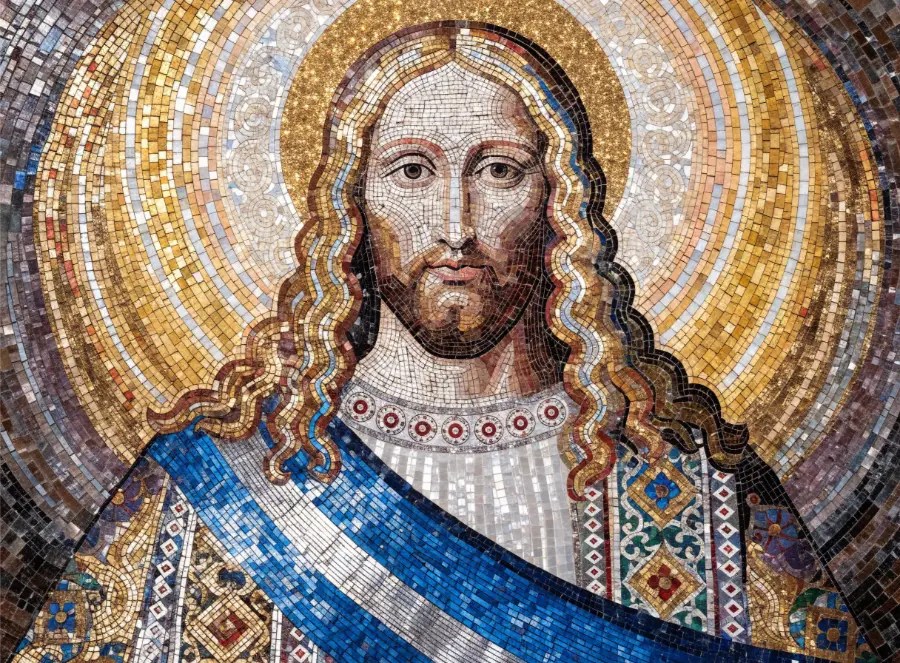
Patmos today
Chora, the town that grew up around the monastery walls, began with the lay people who worked for the monks, and it grew with refugees, from Constantinople after 1453 and from Crete in the seventeenth century. The island passed to the Venetians, then to the Ottoman Turks, and in 1912 to Italy, and it joined Greece in 1948. In 1999, meeting in Marrakesh, UNESCO’s World Heritage Committee inscribed the monastery, the Cave of the Apocalypse and Chora together as a World Heritage Site, as the place where, in its words, “Saint John the Theologian (Divine), the ‘Beloved Disciple’, composed two of the most sacred Christian works”, and it added that “there are few other places in the world where religious ceremonies that date back to the early Christian times are still being practised unchanged.”
One of those ceremonies comes every Holy Week, when the abbot and monks wash feet in the square of Chora before a large crowd, as the Lord washed his apostles’ feet. About 3,300 people live in the municipality of Patmos today, 1,805 of them in Skala at the 2021 census. The Patmian School has taught on the island since 1713.
The visions John received on that small island end with a new heaven and a new earth, “and there was no more sea” (Revelation 21:1). The man who had been sent across the water for the testimony of Jesus heard the promise that “God shall wipe away all tears from their eyes; and there shall be no more death, neither sorrow, nor crying, neither shall there be any more pain: for the former things are passed away” (Revelation 21:4).



Leave a Reply