
 Portuguese
 English
 Chinese
 Dutch
 Arabic
 Spanish
 Russian
 French
 Italian
 German
 Japanese
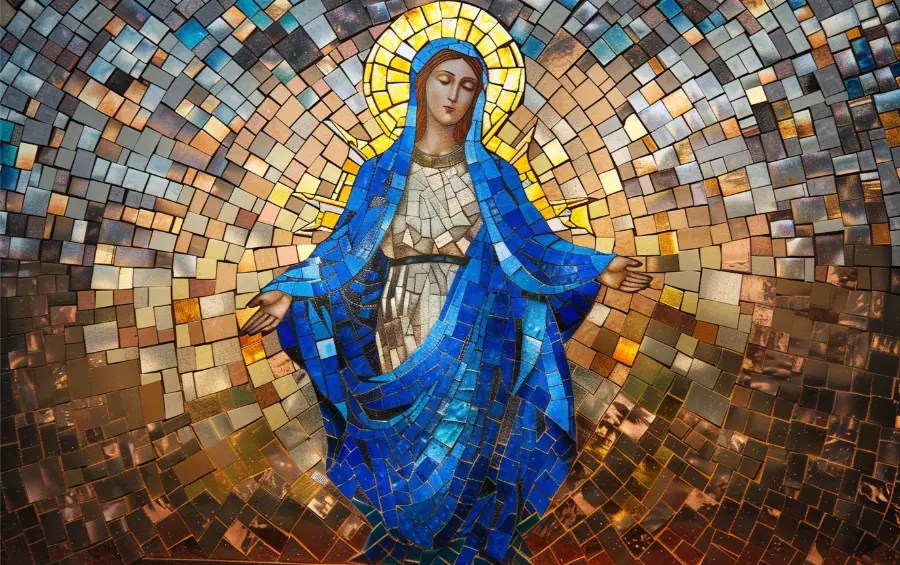
The Immaculate Conception is the Catholic belief that Mary, the mother of Jesus, was kept free from original sin from the first moment of her own life, when she was conceived in her mother’s womb. It is not the virgin birth, though the two are often taken for each other. The virgin birth is about how Jesus was conceived in Mary, by the Holy Spirit and with no human father. The Immaculate Conception is about how Mary herself was conceived, by her own parents in the ordinary way. The Catholic bishops of the United States put it in a sentence: “The Immaculate Conception does not refer to the virginal conception and the birth of Christ, but rather to Mary’s being conceived without inheriting Original Sin.” Pope Pius IX defined it on 8 December 1854, and Catholics keep that day as its feast.
The Eastern Orthodox teach that Mary never sinned, and yet they reject the Immaculate Conception, as the Coptic Orthodox do. No Lutheran or Anglican confession teaches it, and neither church requires it. Most other Protestants say that Jesus alone was without sin, and evangelical leaders, the Churches of Christ and Jehovah’s Witnesses say that Mary sinned. Still, Catholics, Orthodox and Protestants alike say that Mary needed Christ as her Saviour. What they argue about is when he saved her, and how.
| Igreja ou família | Immaculate Conception? Was Mary sinless? | Nas suas próprias palavras |
|---|---|---|
| católica | Yes, a dogma since 1854; free of all sin | “Preserved immune from all stain of original sin” |
| Ortodoxa Oriental | No; but she never sinned | Orthodox Church in America: “without personal sins”; she “could indeed have sinned, but chose not to” |
| Copta Ortodoxa | não | Coptic diocese: “Her birth is like the birth of any common person” |
| Anglicana e Episcopal | Not in the Articles; not required | Article XV: “Of Christ alone without Sin” |
| Luterana | Not in the confessions; none decides it | Augsburg Confession: “all men begotten in the natural way are born with sin” |
| Presbiteriana e Reformada | No; Christ alone without sin | Westminster Confession: Christ took our nature, “yet without sin” |
| Batista (Batista do Sul) | Not taught; sinlessness named of Christ alone | Baptist Faith and Message: Christ “identifying Himself completely with mankind yet without sin” |
| Evangélicos e não denominacionais | No; Mary was a sinner saved by Christ | Evangelical leaders, 2009: “the sinlessness of Christ but not the sinlessness of Mary” |
| Igrejas de Cristo | No original sin for anyone; Mary sinned | Apologetics Press: “she was not sinless” |
| Methodist, Nazarene, Pentecostal, Adventist and others | Their statements do not take it up | No statement on Mary’s conception |
| Santos dos Últimos Dias | Not taught; no one inherits Adam’s guilt | Articles of Faith: punished “for their own sins, and not for Adam’s transgression” |
| Testemunhas de Jeová | No; Mary was sinful | jw.org: “Nowhere does the Bible teach that Mary was free from original sin” |
A nossa ferramenta gratuita, Comparar denominações cristãs, sets any two of 23 churches side by side on whether Mary was without sin, and on 54 other questions.
Is the Immaculate Conception the same as the virgin birth?
No, and the whole difference is in whose conception we mean. Luke tells us that when the angel came to Mary she asked, “How shall this be, seeing I know not a man?” and was told, “The Holy Ghost shall come upon thee, and the power of the Highest shall overshadow thee” (Luke 1:34–35). That is the virgin birth. Mary’s own beginning was not like that at all. “Her body was formed in the womb of the mother, and the father had the usual share in its formation,” says the old Catholic Encyclopedia of 1910. What Catholics believe was singular is what God did for her soul in that moment. Even Jehovah’s Witnesses, who reject the doctrine, draw the same line. Their site asks, “Was Jesus’ virgin birth the ‘Immaculate Conception’?” and answers, “No.”
Scripture never tells us who Mary’s parents were. “The Gospels and other books of the New Testament do not mention anything about Saint Anna, the mother of the Theotokos,” the Orthodox Church in America says, and the names Anna, or Anne, and Joachim come to us from tradition. So when Catholics speak of the Immaculate Conception, it is Anne’s child they mean.
What does the Catholic Church teach?
Pius IX gave the definition in his letter Ineffabilis Deus, and since that day every Catholic has been bound to hold it: “We declare, pronounce, and define that the doctrine which holds that the most Blessed Virgin Mary, in the first instance of her conception, by a singular grace and privilege granted by Almighty God, in view of the merits of Jesus Christ, the Savior of the human race, was preserved free from all stain of original sin, is a doctrine revealed by God and therefore to be believed firmly and constantly by all the faithful.” The Catechism of the Catholic Church adds that “By the grace of God Mary remained free of every personal sin her whole life long” (paragraph 493).
Protestants often ask why, if she never sinned, Mary called God her Saviour. Catholics answer that she needed him as much as anyone, and that he saved her first. Her holiness “comes wholly from Christ: she is ‘redeemed, in a more exalted fashion, by reason of the merits of her Son’” (paragraph 492). As the Catholic Encyclopedia puts it, “He is a greater redeemer who pays the debt that it may not be incurred than he who pays after it has fallen on the debtor.”
Catholics keep the feast on 8 December. In the United States it honours the country’s patroness and is a holy day of obligation. The bishops lift the obligation from some holy days when they fall on a Saturday or a Monday, but not from this one, so American Catholics go to Mass on 8 December even then. Why they ask Mary’s prayers at all is a question of its own, taken up in porque é que os católicos rezam a Maria.
Is the Immaculate Conception in the Bible?
Not in so many words, and Catholic scholars say so themselves. “No direct or categorical and stringent proof of the dogma can be brought forward from Scripture,” the Catholic Encyclopedia admits. What Catholics find are two passages that, read with the Church’s tradition, point toward it. The first is the angel’s greeting, which the Douay-Rheims, the old Catholic translation, gives as “Hail, full of grace, the Lord is with thee: blessed art thou among women” (Luke 1:28), where the King James Version has “Hail, thou that art highly favoured.” The Catechism builds on “full of grace” (paragraphs 490–491). The second is God’s word to the serpent in the garden, “I will put enmity between thee and the woman, and between thy seed and her seed; it shall bruise thy head, and thou shalt bruise his heel” (Genesis 3:15). Ineffabilis Deus teaches that in this prophecy “his most Blessed Mother, the Virgin Mary, was prophetically indicated.”
The churches that reject the teaching start with Paul, “For all have sinned, and come short of the glory of God” (Romans 3:23), and then turn to Mary’s own song: “My soul doth magnify the Lord, And my spirit hath rejoiced in God my Saviour” (Luke 1:46–47). If she needed a Saviour, they ask, what did he save her from? The Coptic Orthodox ask it in nearly those words, and so do the Orthodox Church in America and the Churches of Christ. Catholics reply that her song is exactly right, because she was redeemed, only before sin could touch her. On Romans 3, a joint commission of Anglicans and Catholics points out that the verse “has a quite specific purpose in context which is unrelated to the issue of the ‘sinlessness’ or otherwise of Mary,” since Paul is showing “the equal sinfulness of Jews and Gentiles (3:9).”
How did a feast become a dogma?
Long before anyone defined it, the Church kept a feast. Monks in Palestine celebrated Mary’s conception “at least as early as the seventh century,” on 9 December, and at first they kept it “not discussing the sinlessness.” In the West it reached some Anglo-Saxon monasteries in the eleventh century, and the great teachers did not all welcome it. St. Bernard objected to the feast, and St. Thomas Aquinas decided against the doctrine, because he could not see “how she could have been redeemed if she had not sinned.” The answer to Thomas came from John Duns Scotus, who died in 1308: Mary, he argued, “obtained of her Divine Son the greatest of redemptions through the mystery of her preservation from all sin.”
After that the teaching spread. Pope Sixtus IV adopted the feast for the whole Latin Church on 28 February 1476. When the Council of Trent taught that all are born with original sin, it said that “it had no intention of including the blessed and immaculate Virgin Mary, the Mother of God, in this decree” (the decree is in the Council of Trent’s Session V on original sin). On 2 February 1849 Pius IX wrote from Gaeta to every Catholic bishop and asked them to “tell us in writing” what their people believed, and five years later he gave the definition.
Do the Orthodox believe Mary was sinless?
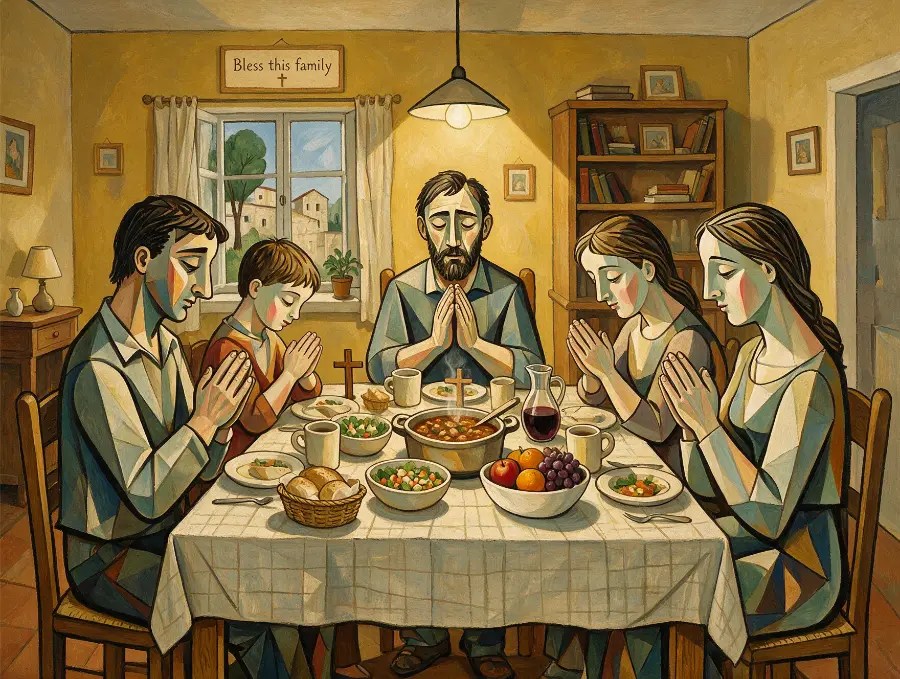
They do, though not by way of the Immaculate Conception. The Eastern Fathers call Mary “the All-Holy,” Panagia, and the Orthodox Church in America teaches in its book The Orthodox Faith that “The Orthodox Church teaches that Mary is without personal sins.” In the same passage it says that “Mary truly needed to be saved by Christ as all human persons are saved.”
Where they part from Catholics is over original sin itself. Answering a reader’s question, the Orthodox Church in America explains that “the Orthodox do not accept that humans share the guilt of the first sin but, rather, only the consequences,” and that “the Orthodox Church believes that Mary, as a human being, could indeed have sinned, but chose not to.” So for the Orthodox her holiness lies in what she freely chose: “Mary is the ‘new Eve’ who said ‘yes’ to God where the first Eve said ‘no.’” They keep 9 December as the “Conception of the Most Holy Theotokos by Saint Anna.” How each church understands the sin we inherit is set out in what Catholics, Orthodox and Protestants teach about original sin.
The Coptic Orthodox Church speaks more sharply. Its Diocese of the Southern United States says the Immaculate Conception “is totally rejected by all the Orthodox churches because it is clearly against the teaching of the Holy Bible,” and goes on: “We do not distinguish St. Mary from the rest of the human race based on the assumption that she was born without the original sin. Her birth is like the birth of any common person.” The same Copts believe that Mary was taken up into heaven, a belief they receive from tradition (we look at it in Se Maria foi para o céu), and they turn this one away because they find it against Romans 3:23.
Do Lutherans and Anglicans believe in the Immaculate Conception?
Neither church has made it part of its confessions, and neither requires it of its members. Lutherans speak of Mary with great honour, and the Smalcald Articles of 1537 say that the Son “was born of the pure, holy [and always] Virgin Mary.” The Augsburg Confession of 1530 teaches “that since the fall of Adam all men begotten in the natural way are born with sin,” but no Lutheran confession asks whether God made an exception at Mary’s conception, and none decides it.
Anglicans have Article XV of the Thirty-nine Articles, “Of Christ alone without Sin,” which says that Christ “was made like unto us in all things, sin only except,” and that “all we the rest, although baptized, and born again in Christ, yet offend in many things.” Yet the Articles never name Mary. The English Reformers, following Augustine, held back from calling her a sinner, and from 1561 the Church of England’s calendar, later reproduced in the 1662 Book of Common Prayer, kept a feast of the “Conception of Mary.” Much later Anglicans and Catholics looked at all this together in the Anglican–Roman Catholic International Commission. In its Seattle Statement, Mary: Grace and Hope in Christ, the commission says that the Articles “neither affirmed nor denied the possibility of Mary having been preserved by grace.” Its members agreed that the teaching about Mary in the two Catholic definitions, of the Immaculate Conception in 1854 and of her Assumption in 1950, “understood within the biblical pattern of the economy of grace and hope outlined here, can be said to be consonant with the teaching of the Scriptures and the ancient common traditions.” Anglicans still hold, with Article VI, that nothing Scripture cannot prove may be required as a matter of faith. The statement was “offered to our respective authorities,” so it is a shared study and not the teaching of either church. An Anglican may believe that Mary was conceived without sin, and nobody may require it of an Anglican.
Was Mary a sinner? What the other churches say
For most Protestants the answer starts from Christ, the one man without sin. The Westminster Confession, which the Presbyterian Church (U.S.A.) keeps in its Book of Confessions, says that the Son took our nature “yet without sin,” and that the fallen nature of our first parents passed “to all their posterity, descending from them by ordinary generation.” Southern Baptists say in the Baptist Faith and Message of 2000 that Christ took our nature, “identifying Himself completely with mankind yet without sin,” and that Adam’s “posterity inherit a nature and an environment inclined toward sin.” Neither names Mary as a sinner, and neither makes her an exception.
In 2009 a group of evangelical leaders wrote to their Catholic friends in Evangelicals and Catholics Together. They said that “Evangelicals find unnecessary and unbiblical the notion that Mary was preserved from the stain of original sin from the first moment of her conception,” and that “Evangelicals confess the sinlessness of Christ but not the sinlessness of Mary.” They reminded those friends that Jesus taught his disciples, “among whom Mary was the first,” to pray “forgive us our trespasses.” And they added, “Still, we affirm much of what this teaching is intended to convey—that Mary was the object of God’s gracious election in Christ; that she was uniquely prepared to become the mother of our Lord.”
The Churches of Christ come to the same place by another road, because they deny that anyone inherits original sin. Apologetics Press, a teaching ministry of the Churches of Christ, says that “everyone arrives in this world without the contamination of original sin,” Mary included, and then reasons that “many Bible verses explicitly state that everyone sins. Therefore, Mary sinned.” It ends: “Because of her godly life, God chose this particular young Jewish virgin to bring forth the Messiah. However, she was not sinless.”
A good many churches have never written about Mary’s conception at all. The Methodists, the Amish and Mennonites, and the Seventh-day Adventists come closest: each says that the fall of Adam passed to all his children, and none goes on to ask whether Mary was the exception. The United Methodist Church’s Articles of Religion say that original sin “is the corruption of the nature of every man, that naturally is engendered of the offspring of Adam.” The Dordrecht Confession of 1632, a confession of the Anabaptist tradition from which the Amish and Mennonites come, says that death “has thus passed upon all men, for that all have sinned.” Seventh-day Adventists confess in their Fundamental Beliefs that Christ “was conceived of the Holy Spirit and born of the virgin Mary,” and that Adam and Eve’s descendants “are born with weaknesses and tendencies to evil.” The statements of faith of the Church of the Nazarene, the Salvation Army, the Assemblies of God and other Pentecostals, the Oneness Pentecostals, the United Church of Christ, the Disciples of Christ and the Quakers do not take up the question either.
The Church of Jesus Christ of Latter-day Saints describes Mary in its Guide to the Scriptures as “a virgin chosen by God the Father to be the mother of His Son in the flesh,” and adds that “After Jesus’ birth, Mary had other children (Mark 6:3).” It says nothing of her conception, and for Latter-day Saints no one is born carrying Adam’s guilt. Their second Article of Faith says, “We believe that men will be punished for their own sins, and not for Adam’s transgression.”
Jehovah’s Witnesses teach on jw.org that “nowhere does the Bible teach that Mary was free from original sin,” and they point to the two birds Mary offered after Jesus was born (Luke 2:24), one of them “for a sin offering” (Leviticus 12:8). “Mary gave evidence that she was sinful,” they write, “when she presented the sin-atoning sacrifice that the Mosaic Law required of mothers.” On the same page they say that “Mary set a fine example of faith, obedience, humility, and deep spirituality.”
Catholics, Orthodox and evangelicals could each have written that last line, though they read her life differently. Catholics see her Son’s grace at work in her from her very first moment, the Orthodox see the new Eve who said yes, and evangelicals see a sinner chosen and saved by grace. And whenever we read her song, all of us are doing what she said we would do: “for, behold, from henceforth all generations shall call me blessed” (Luke 1:48).
Leitura relacionada
- Compare denominações cristãs: o que 23 igrejas ensinam sobre 55 questões
- Ortodoxos vs Católicos: Como as duas Igrejas diferem e por que se separaram
- Crenças da Igreja Ortodoxa Copta e como diferem da Igreja Ortodoxa Oriental
- Anglicanismo vs Catolicismo: Por que a Igreja da Inglaterra não é Católica Romana
- Luteranos vs Católicos: Fé Sozinha, o Papa e a Comunhão Comparados
- Protestante vs Católico: como as suas crenças e culto diferem


Deixe um comentário