
 English
 Chinese
 Dutch
 Arabic
 Spanish
 Portuguese
 Russian
 French
 Italian
 German
 Japanese
Jehovah Nissi means “the LORD is my banner”. It is the name Moses gave an altar after Israel beat Amalek in the wilderness (Exodus 17:15), and its second word, nissi, comes from nes, the Hebrew for a banner or standard lifted high on a pole where everyone can see it.
On the day the name was given, the banner over Israel was a man’s raised arm. While Joshua fought in the valley, Moses stood on the hill with “the rod of God” in his hand, “and it came to pass, when Moses held up his hand, that Israel prevailed: and when he let down his hand, Amalek prevailed” (Exodus 17:9, 11). The name means “the LORD is my banner”. That lifted hand is its picture.
Where is Jehovah Nissi in the Bible?
Only once, in Exodus 17, at a place in the wilderness called Rephidim. Israel had just complained there of thirst, and water had come from the rock. “Then came Amalek, and fought with Israel in Rephidim” (Exodus 17:8). Moses later told Israel what kind of attack it was: Amalek “smote the hindmost of thee, even all that were feeble behind thee, when thou wast faint and weary; and he feared not God” (Deuteronomy 25:18). They fell on the stragglers.
Moses gave his orders. “Choose us out men, and go out, fight with Amalek: to morrow I will stand on the top of the hill with the rod of God in mine hand” (Exodus 17:9). Joshua fought, and Moses, Aaron and Hur climbed the hill. The battle turned with Moses’ hands. “But Moses hands were heavy; and they took a stone, and put it under him, and he sat thereon; and Aaron and Hur stayed up his hands, the one on the one side, and the other on the other side; and his hands were steady until the going down of the sun” (Exodus 17:12). By evening “Joshua discomfited Amalek and his people with the edge of the sword” (Exodus 17:13).
God told Moses to write the day down as “a memorial in a book” (Exodus 17:14). Then “Moses built an altar, and called the name of it Jehovahnissi” (Exodus 17:15). The King James Version prints it as one word. Bible Hub’s lexicon notes that the name “appears only in Exodus 17:15,” and nowhere else in Scripture.
What does nissi mean in Hebrew?
Nissi is nes with the ending that means “my.” Strong’s concordance gives the senses of nes as “a flag; also a sail; by implication, a flagstaff; generally a signal,” and the Brown-Driver-Briggs lexicon calls it a “standard, as rallying-point.” In battle it was the pole soldiers looked for, the place to gather and the sign of which way to go.
The King James translators rendered nes in several ways, and following it through the Bible shows how far the word travels. It is the “pole” that held up the bronze serpent (Numbers 21:8). It is the “banner” of Psalm 60:4: “Thou hast given a banner to them that fear thee, that it may be displayed because of the truth.” It is the “ensign” Isaiah saw raised over the nations (Isaiah 11:10, 12), and the “standard” God promised to raise to the Gentiles, who would carry Zion’s sons home in their arms: “I will lift up mine hand to the Gentiles, and set up my standard to the people: and they shall bring thy sons in their arms” (Isaiah 49:22). The banner is always something lifted up, so that people far off can see it and come.
Jehovah is an English form made from God’s name, the four Hebrew letters YHWH. The preface to the English Standard Version explains the spelling: “When the vowels of the word ’adonay are placed with the consonants of YHWH, this results in the familiar word Jehovah that was used in some earlier English Bible translations.” Most English Bibles print the name as LORD in small capitals, so Exodus 17:15 in many of them reads “The LORD Is My Banner.” The other names built the same way are gathered in the names of God and their meanings.
Is Jehovah Nissi a name of God?
Strictly, it is the name of an altar. Strong’s calls Jehovah-Nissi “a symbolical name of an altar in the Desert.” Abraham named a place Jehovahjireh in the same way (Genesis 22:14), and Gideon called his altar Jehovahshalom (Judges 6:24). Each name is a sentence about the LORD, spoken by someone who had just met him in a hard place.
So when Christians call God Jehovah Nissi, they are saying what Moses said with stones. Joshua’s sword and Moses’ arm were real, but the victory at Rephidim was the LORD’s, and Israel had won under his banner. There is nothing wrong in praying it as a name. It is a confession first.
What does Exodus 17:16 mean?
The next verse explains the altar, and it is one of the harder lines in Exodus. The King James Version reads, “For he said, Because the LORD hath sworn that the LORD will have war with Amalek from generation to generation.” The Hebrew is shorter. Young’s Literal Translation gives it word for word: “Because a hand [is] on the throne of Jah, war [is] to Jehovah with Amalek.”
The word for “throne” there, kes, is found nowhere else, and readers have taken the verse in different ways. The King James translators heard an oath, God’s hand raised by his throne. Others read Amalek’s hand raised against the throne of the LORD. And many scholars, the Cambridge Bible notes, read nes, “banner,” for the otherwise unknown kes, which gives “A hand on the banner” of Yah and ties Moses’ words straight back to the altar’s name. The two Hebrew words differ by a single letter, so that reading supposes a copyist’s slip, and it remains a scholars’ guess. Barnes’ Notes on the Bible answers that the text as it stands “was undoubtedly that which was alone known to the Targumists, the Samaritan, the Syriac, the Latin and the Arabic translators,” all of whom read “throne.” Some modern Bibles still put the banner in the text. The New American Bible, Revised Edition has Moses cry, “Take up the banner” of the LORD, and adds in a note that “the Hebrew text is difficult to interpret.” If your Bible’s footnote offers another reading here, this is the reason.
Why did Moses hold up his hands?
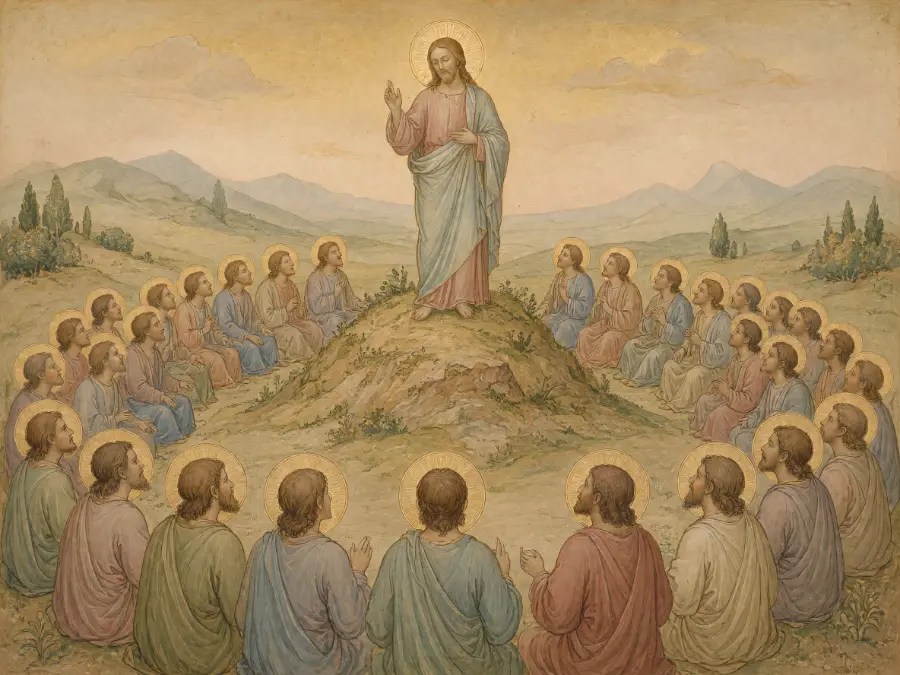
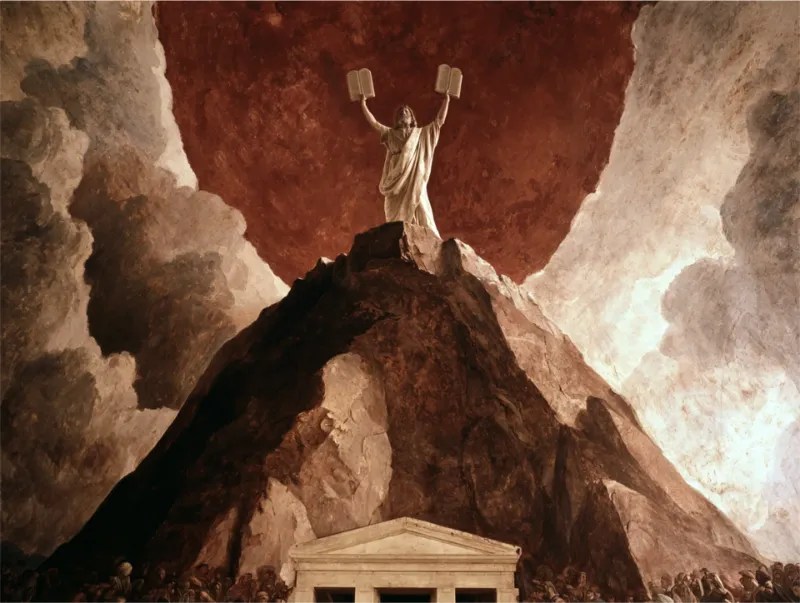
Exodus does not explain it. It tells us only that he held “the rod of God,” the same rod with which he had struck the river in Egypt (Exodus 17:5), and that Israel prevailed while his hands were up. Matthew Henry’s commentary sees two meanings in the raised rod: “The rod was held up, as the banner to encourage the soldiers. Also to God, by way of appeal to him.” The men in the valley could look up and see it. And the man on the hill was looking up too.
Then Moses’ arms grew heavy, as every arm does. He did not hold the banner up alone. Aaron and Hur found a stone for him to sit on and held his hands, one on each side, until the sun went down. If Matthew Henry is right that the raised rod was also an appeal to God, then we know this weariness, and we know these friends. Sometimes we are the one on the stone, and sometimes we are the one holding up an arm that is not our own.
How does the banner point to Jesus?
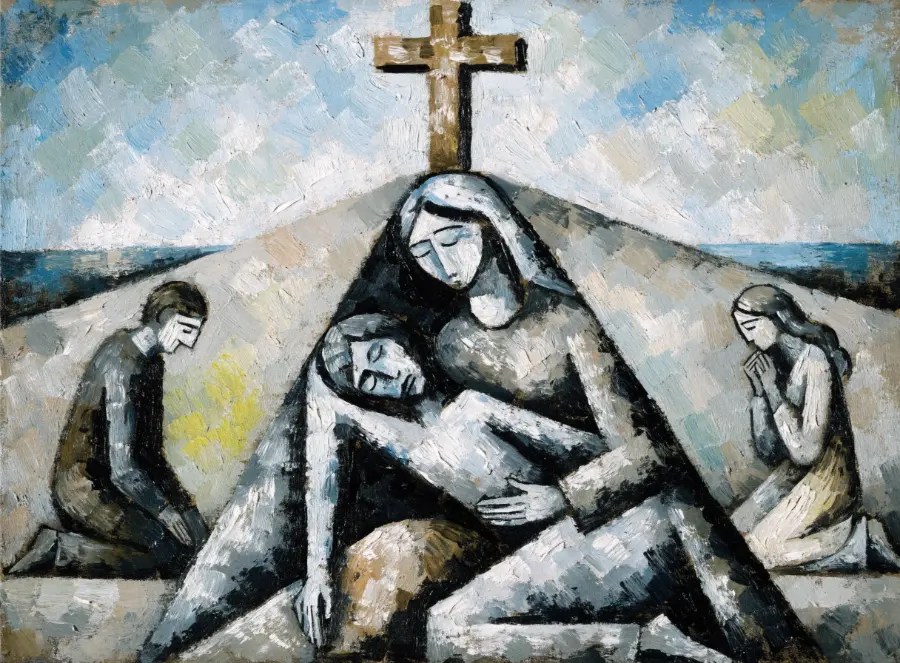
The clearest line runs through the word nes itself. Later in the wilderness, when serpents bit the people, God told Moses, “Make thee a fiery serpent, and set it upon a pole: and it shall come to pass, that every one that is bitten, when he looketh upon it, shall live” (Numbers 21:8). The pole is a nes, a banner. Jesus took that very scene for himself: “And as Moses lifted up the serpent in the wilderness, even so must the Son of man be lifted up: That whosoever believeth in him should not perish, but have eternal life” (John 3:14-15).
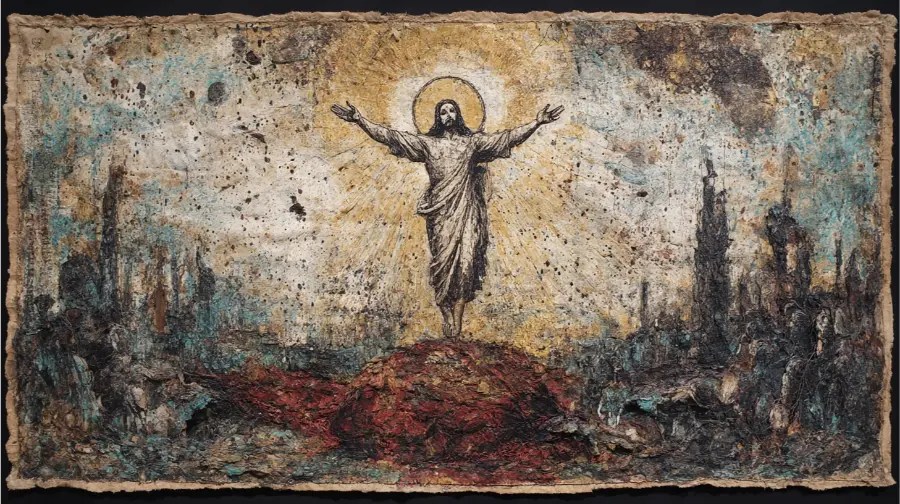
A banner is lifted so that people can see it from far away and come to it. Jesus said, “And I, if I be lifted up from the earth, will draw all men unto me” (John 12:32). Isaiah had already seen a son of David’s family, the root of Jesse, raised up in that way, as an ensign that the nations would seek (Isaiah 11:10). At Rephidim the banner was a raised staff. At Calvary it was a cross, and we who were faint and weary at the back of the line are the ones it gathers.
Is “his banner over me was love” the same word?
No. The Song of Solomon’s “his banner over me was love” (Song of Solomon 2:4) uses a different Hebrew word, degel. It is the word for the standards each tribe camped beside in Numbers 2, “Every man of the children of Israel shall pitch by his own standard” (Numbers 2:2), and the Brown-Driver-Briggs lexicon lists Song of Solomon 2:4 as its one figurative use. Both words are translated “banner,” and both are beautiful, but only nes stands in Moses’ altar.
Why doesn’t the Catholic liturgy say Jehovah?
Jewish readers did not speak God’s name aloud, and the Church followed the same reverence. The form “Jehovah” itself is late. The Jewish Encyclopedia of 1906 calls it “a comparatively recent invention.” It was long credited to Peter Galatin, a Christian scholar who used it in 1518, though the encyclopedia finds it already in a Latin work written in 1270. In 2008 the Vatican’s Congregation for Divine Worship told the world’s bishops that in the liturgy “the name of God in the form of the tetragrammaton YHWH is neither to be used or pronounced,” and that it is to be translated “Lord.” That rule governs what is read and sung at Mass. Catholic study Bibles may still print the name: the New American Bible, Revised Edition, the translation of the American bishops, names the altar “Yahweh-nissi” in Exodus 17:15 and gives its meaning in a note, “the Lord is my banner.” The meaning is the same in every Bible.
Moses’ arms came down at sunset. The banner has not come down. The prophet’s promise still stands over every people on earth: “there shall be a root of Jesse, which shall stand for an ensign of the people; to it shall the Gentiles seek: and his rest shall be glorious” (Isaiah 11:10).


Leave a Reply