
 English
 Chinese
 Dutch
 Arabic
 Spanish
 Portuguese
 Russian
 French
 Italian
 German
 Japanese
This is the Christmas story as Luke and Matthew tell it, from the angel’s visit to Mary to the family’s journey home to Nazareth, put into short, plain sentences for a child of about four to eight. By our own count it runs to about 1,250 words, or eight to ten minutes read aloud at an easy pace. You won’t meet a donkey or an innkeeper here, because Luke and Matthew don’t mention them. Anything inside quotation marks is copied from the King James Bible. We have left out Herod’s killing of the little boys of Bethlehem, and the note after the story says where to find it.
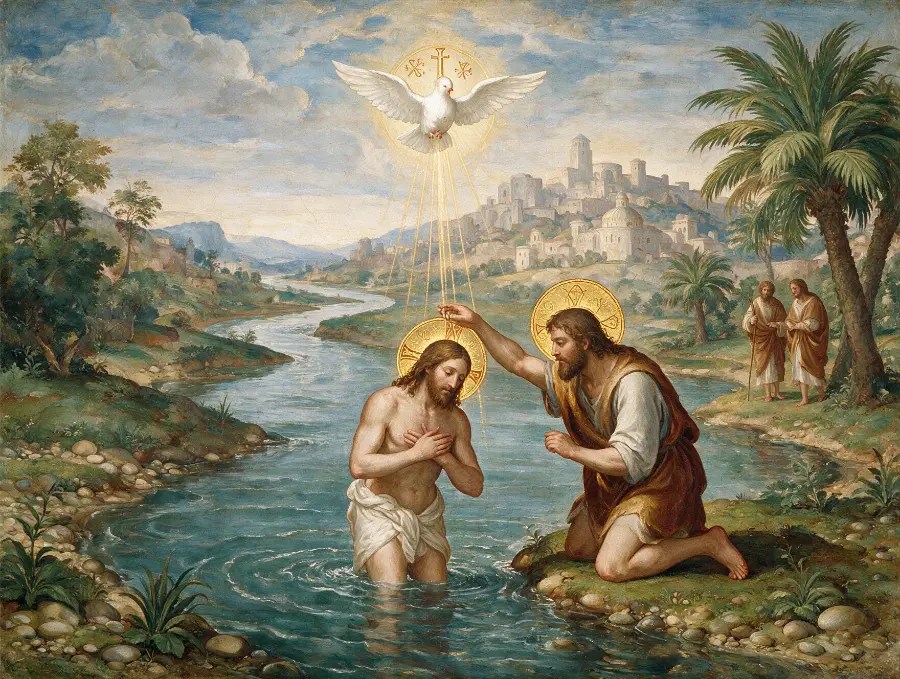
The Christmas story, from Nazareth to Bethlehem and home again
Long ago, God sent an angel to a town called Nazareth. The angel’s name was Gabriel. He came to a woman named Mary, who was promised in marriage to a man named Joseph. Joseph’s family went all the way back to King David.
Gabriel said to Mary, “Hail, thou that art highly favoured, the Lord is with thee.” Mary was troubled when she heard this. What could the angel mean?
Then the angel said, “Fear not, Mary: for thou hast found favour with God.” God was going to give her a baby boy, and she was to call him Jesus. He would be called the Son of the Highest, and he would be a king whose kingdom never ends.
How could she have a baby, Mary asked, when she was a virgin? The angel answered that the Holy Spirit would come upon her, and so her holy child would be called the Son of God. The angel also told her that her cousin Elisabeth, who was old and had never been able to have a baby, was going to have a son. “For with God nothing shall be impossible,” said the angel.
And Mary said, “Behold the handmaid of the Lord; be it unto me according to thy word.” That means: I am the Lord’s servant, so let it happen just as you have said.
Mary went off in a hurry to the hill country to see Elisabeth. The moment Elisabeth heard Mary’s voice, the baby inside her leaped for joy. Mary answered with praise to God. “He that is mighty hath done to me great things,” she said, “and holy is his name.”
Joseph learned that Mary was going to have a baby. Joseph was a just man, someone who did right. He did not want Mary shamed in public, so he decided to call off the wedding quietly.
While Joseph thought it over, an angel of the Lord spoke to him in a dream. “Joseph, thou son of David,” said the angel, “fear not to take unto thee Mary thy wife.” Mary’s baby came from the Holy Spirit. Joseph was to name the baby Jesus, because he would save his people from their sins. Long ago a prophet had promised a son called Emmanuel, and Emmanuel means “God with us.”
When Joseph woke up, he did as the angel said and took Mary home as his wife.
In those days the emperor, Caesar Augustus, gave an order. Everyone had to go to their own family’s town to be counted for his taxes. Joseph belonged to King David’s family, so he had to go to Bethlehem, the city of David. Mary went with him.
While they were in Bethlehem, Mary’s baby was born. Listen to how the Bible tells it: “And she brought forth her firstborn son, and wrapped him in swaddling clothes, and laid him in a manger; because there was no room for them in the inn.” Swaddling clothes means she wrapped him up tightly in cloth, and a manger is an open box that animals eat from.
Out in the fields of that same country, shepherds were keeping watch over their flock by night. An angel of the Lord appeared to them, and the Lord’s glory shone all around them. The shepherds were very frightened.
But the angel said, “Fear not: for, behold, I bring you good tidings of great joy, which shall be to all people. For unto you is born this day in the city of David a Saviour, which is Christ the Lord.” Good tidings are good news. They would know the baby, the angel said, because he would be wrapped in cloth and lying in a manger.
All at once there were many, many angels from heaven with the angel, and they praised God. “Glory to God in the highest,” they said, “and on earth peace, good will toward men.”
Then the angels went back up into heaven. The shepherds said to each other, “Let us now go even unto Bethlehem, and see this thing which is come to pass.” They hurried there, and there were Mary and Joseph, with the baby lying in the manger.
The shepherds told everyone what the angel had said about this child, and everyone who heard them wondered at it. “But Mary kept all these things, and pondered them in her heart.” To ponder is to think something over for a long time.
On his eighth day the baby was named Jesus, just as the angel had told Mary. Later Mary and Joseph took him to the Temple in Jerusalem, to show him to the Lord, as God’s law told them to do.
A good man named Simeon was in the Temple. The Holy Spirit had shown Simeon that he would see the Christ, the Saviour God had promised, before he died. Simeon took the baby in his arms, thanked God and said, “For mine eyes have seen thy salvation.” Salvation means God saving his people, and Simeon was holding the one God had sent to do it. This child, he said, would be a light for all the nations. A very old woman named Anna, who prayed in the Temple night and day, thanked God for the child too, and she told people about him.
Then wise men came to Jerusalem from the east. “Where is he that is born King of the Jews? for we have seen his star in the east, and are come to worship him,” they asked.
Their question troubled King Herod. The chief priests and the teachers of God’s law told him that a prophet had named Bethlehem as the place where the Christ would be born, so Herod sent the wise men there. “Go and search diligently for the young child,” he said, and he asked them to come back and tell him when they found him.
The star they had seen in the east went on ahead of them, and it stopped right over the place where the young child was. When they saw the star, “they rejoiced with exceeding great joy.” That means they were very, very glad.
They went into the house, and there was the young child with Mary, his mother. The wise men bowed down low and worshipped him. They opened their treasures and presented him with gifts: gold, and frankincense, which smells sweet when it is burned, and myrrh, which has a strong smell and is used to make perfume.
In a dream, God warned the wise men not to return to Herod, and they took another way home to their own country.
After the wise men had gone, an angel of the Lord came to Joseph in another dream. “Arise, and take the young child and his mother, and flee into Egypt,” said the angel. King Herod was going to look for the child to harm him. So Joseph got up and took Mary and the child away to Egypt by night, and they stayed there until Herod was dead.
When Herod had died, an angel came to Joseph in a dream once more. Joseph took Mary and the child back to the land of Israel, and they went to live in Nazareth, the same town where Gabriel had first come to Mary.
There in Nazareth the child grew. He grew strong, and he was full of wisdom, “and the grace of God was upon him.”
Questions to ask afterwards
When the story is done, these questions let a child tell some of it back to you.
- Who did God send to Mary, and what was her baby to be called?
- Three times in the story an angel says “Fear not.” Who heard it? (Mary, Joseph in his dream, and the shepherds.)
- How would the shepherds know which baby was the Saviour? (He would be wrapped in cloth and lying in a manger.)
- After they had seen Jesus, the shepherds told everyone about him. Who could you tell?
Where each part of the story is in the Bible
Most of the story comes from Luke. The first chapter of his Gospel has Gabriel’s visit to Mary and her trip to see Elisabeth (Luke 1:26–56), and the second has the birth, the shepherds, the naming and the Temple (Luke 2:1–40). Matthew is where we hear about Joseph’s dream (Matthew 1:18–25), and after that the wise men, the escape to Egypt and the move to Nazareth (Matthew 2:1–23). Neither Gospel tells us how its scenes fit with the other’s. Luke takes the family straight from the Temple home to Nazareth and never mentions the wise men, and Matthew never mentions the Temple. We have followed one common order, with the wise men coming after the Temple. Christians have fitted the two together in more than one way, and our page on how old Jesus was when the wise men arrived sets them out. Our guide to the Christmas story in Matthew and Luke sets every scene of both Gospels beside its verses.
We left three parts out for young listeners. Luke’s story starts earlier, with an angel coming to Elisabeth’s husband Zacharias (Luke 1:5–25), and Matthew’s starts with Jesus’ family tree (Matthew 1:1–17). And after the family fled to Egypt, Herod had the little boys of Bethlehem killed (Matthew 2:16–18). We say Herod wanted to harm the child; Matthew says “destroy”. When your child is old enough to hear that part, our page on telling the Christmas story to children age by age suggests how to tell it, with a reading for each age.
An older child may ask about the inn. “Inn” is the King James word, but Luke uses the same Greek word again at the Last Supper, where the King James calls it the “guestchamber” (Luke 22:11), so the room with no space for Mary and Joseph may have been the guest room of a house.
We also make an app, Halo: Family Prayers & Bedtime, where children can listen to Bible stories at bedtime; it costs nothing to download, and for the full library there is a paid annual plan, $77.99 per year as of November 2026.
Once a child knows the story, Christmas Eve is a good night to open the Bible itself and read Luke 2:1–20 aloud just as Luke wrote it. They will know every scene as it comes, and at the end they will hear the shepherds go back “glorifying and praising God for all the things that they had heard and seen.”


Leave a Reply