
 English
 Chinese
 Dutch
 Arabic
 Spanish
 Portuguese
 Russian
 French
 Italian
 German
 Japanese
The United Church of Christ and the Churches of Christ are two different churches, and the likeness of their names hides how far apart they stand. The United Church of Christ, or UCC, was formed at Cleveland, Ohio, on June 25, 1957, when the Evangelical and Reformed Church and the Congregational Christian Churches became one church. It baptizes infants as well as adults, by sprinkling, pouring or immersion; most of its congregations open the Communion table to every Christian; and it holds the old creeds and confessions, in its own words, “as testimonies, but not tests of the faith.” The Churches of Christ are a fellowship of self-governing congregations that baptize only believers, only by immersion and “for the remission of sins,” take the Lord’s Supper every Sunday, sing without instruments and keep no creed beside the Bible.
Yet when each church tells its own story, the same men walk through its first pages: James O’Kelly in Virginia, Abner Jones and Elias Smith in New England, Barton W. Stone in Kentucky, preachers of the 1790s and early 1800s who wanted to be called simply Christians and to take the Bible as their only guide. The UCC’s motto is the prayer Jesus prayed for his disciples, “That they may all be one” (John 17:21), and a tract explaining the Churches of Christ calls their message “a plea for religious unity based upon the Bible,” so the two churches are answering the same prayer, in very different ways.

How the two churches answer the same questions
| Question | United Church of Christ | Churches of Christ |
|---|---|---|
| Began | 1957, Cleveland: union of the Evangelical and Reformed Church and the Congregational Christian Churches | Stone-Campbell movement of the early 1800s; counted apart from the Disciples of Christ by 1906 |
| Baptism | Infants, children, youth and adults; sprinkling, pouring or immersion, a matter of choice; every Christian baptism recognized | Only those old enough to believe; immersion only; “for the remission of sins” |
| Communion | A sacrament in which Christ is “truly and rightly present”; open to all Christians in most churches | A memorial to some, a spiritual communion with Christ to others |
| How often | No one pattern; many churches monthly or weekly | Weekly |
| Salvation | God’s gift in Christ to all who trust him; no official teaching on whether it can be lost | Grace received by faith that repents, confesses Christ and is baptized; a Christian can fall from grace |
| Mary | No binding teaching; its testimonies confess Christ “born of the Virgin Mary” and call her Theotokos, God-Bearer | The virgin birth; nothing further |
| Authority | Scripture and the Holy Spirit, with creeds as “testimonies, but not tests”; each local church autonomous | The Bible alone, no creed; each congregation led by its elders |
| Worship | Each local church keeps its own ways of worship | Unaccompanied singing only |
| Size | 683,936 members in 4,485 churches (end of 2023) | About 1.3 million members and over 13,000 congregations in the United States (2004) |
Are the United Church of Christ and the Church of Christ related?
Their family trees touch in one place, the American frontier of the 1790s, and the UCC’s own history tells how. In 1794 James O’Kelly, whom that history spells O’Kelley, gathered a group of Methodists in Virginia who had left their church over their objection to bishops, and they “declared that the Bible was their only guide and adopted as their new name, the Christian Church.” In 1801, at Lyndon, Vermont, the followers of Abner Jones organized the First Free Christian Church, and the Baptist Elias Smith joined Jones and in 1808 began a paper called the Herald of Gospel Liberty. Out in Kentucky, Barton W. Stone withdrew from the Presbyterian Synod of Kentucky in 1803, and his followers took the name Christian as well.
These churches of like mind came to be called the Christian Connection, organized in 1820 at the first United General Conference of Christians, and there they agreed on six principles. The first two were “Christ, the only head of the Church” and “The Bible, sufficient rule of faith and practice.” In 1832 some of Stone’s followers united with the followers of Alexander Campbell at Lexington, Kentucky. Those who would not, the UCC’s history says, “gradually identified with the Christian Churches led by O’Kelley in Virginia and by Jones and Smith in New England,” and so the two roads began to part.
The Churches of Christ came down the road of Stone and Campbell. Batsell Barrett Baxter of Nashville, who chaired the Bible department at David Lipscomb College, tells the same beginning from their side in his mid-twentieth-century tract on who they are. He names O’Kelly, Jones and Smith, Stone, and Thomas and Alexander Campbell, and says that “eventually they became one strong restoration movement because of their common purpose and plea.” At the end of the nineteenth century the movement divided, over missionary societies and instruments in worship, and “by 1906 the United States Bureau of the Census in a special religious census had distinguished Churches of Christ as a separate entity from Disciples of Christ,” as the Encyclopedia of the Stone-Campbell Movement records. “Church of Christ” had been a name those churches used of themselves from the beginning, and when the encyclopedia was published in 2004 they counted about 1,300,000 members in more than 13,000 congregations in the United States.
The Christian Churches of O’Kelly, Jones and Smith went the other way. In 1931 they united with the Congregational churches, which grew from the English Puritans and from the Pilgrims who came over on the Mayflower in 1620, and the two became the Congregational Christian Churches. In 1934 two churches of German origin, the Evangelical Synod and the Reformed Church in the United States, joined as the Evangelical and Reformed Church, with “The Heidelberg Catechism still at its heart.” Then on Tuesday, June 25, 1957, at Cleveland, those two young churches, one 23 years old and the other 26, became the United Church of Christ, which at the end of 2023 counted 683,936 members in 4,485 congregations. Its Basis of Union explains the name: it “expresses a fact: it stands for the accomplished union of two church bodies each of which has arisen from a similar union of two church bodies.” It “also expresses a hope,” that further unions would one day make “a more inclusive United Church.”
Both churches still say something close to those two principles of 1820. The UCC’s Constitution names Jesus Christ its “sole Head,” and Baxter calls the Bible “the only infallible guide to heaven.”
How does the United Church of Christ baptize?
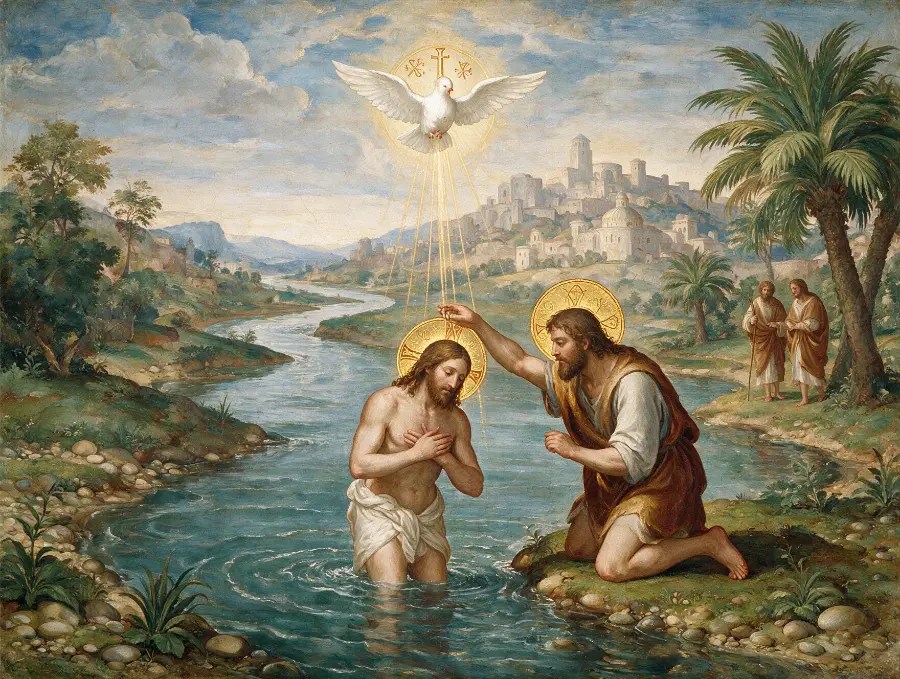
The United Church of Christ baptizes infants, children, youth and adults, and its brochure on baptism says that the mode, whether sprinkling, pouring or immersion, “is a matter of choice,” and that through baptism a person is joined with the universal church, the body of Christ. “In baptism,” the brochure goes on, “God works in us the power of forgiveness, the renewal of the spirit, and the knowledge of the call to be God’s people always.” Baptism is one of the two sacraments its Constitution recognizes, with the Lord’s Supper, and for a baby and a grown believer alike it is “the sign and seal of God’s grace and forgiveness, and the beginning of their Christian faith and life.” That is why the UCC practices infant baptism, or christening, alongside the baptism of adults, and why it “recognizes the validity of all baptisms, therefore there is no need for re-baptism.”
A UCC baptism normally takes place in worship, with the congregation there, because the people make a promise too. They promise “love, support and care” for the one baptized, and the church’s page on what it believes adds, “we promise that we won’t take it back.” The Book of Worship encourages the words most Christians know, “I baptize you in the name of the Father, the Son and the Holy Spirit,” and in urgent circumstances, such as when someone is dying, any Christian may baptize.
Peter’s words at Pentecost stand at the head of the UCC’s brochure on baptism, and the Churches of Christ build their teaching on the same verse: “Repent, and be baptized every one of you in the name of Jesus Christ for the remission of sins, and ye shall receive the gift of the Holy Ghost” (Acts 2:38). For them baptism belongs to being saved. Baxter lists what a person must do as hearing the gospel, believing, repenting, confessing Jesus and being “baptized for the remission of sins,” and then living the Christian life. “Faith must always precede baptism,” he wrote, so only those who have reached the “age of accountability” are baptized. And they baptize only by immersion, because the Greek word means “to dip, to immerse, to plunge” and because Paul speaks of a burial: “Therefore we are buried with him by baptism into death: that like as Christ was raised up from the dead by the glory of the Father, even so we also should walk in newness of life” (Romans 6:4).
Who may receive Communion in the UCC?
The United Church of Christ calls Communion a sacrament in which Christ is “truly and rightly present to those who eat and drink,” and in most UCC churches the table, in the words of its Book of Worship, is “open to all Christians who wish to know the presence of Christ and to share in the community of God’s people.” The broken bread and poured wine, says its brochure, “represent—present anew—the crucified and risen Christ,” and “the wheat gathered to bake one loaf and the grapes pressed to make one cup remind participants that they are one body in Christ.” How Christ is present the UCC leaves to faith: “It is a great mystery,” its page on what it believes says; “we claim it by faith.”
Each congregation serves the Supper in its own way, with a common loaf or individual pieces of bread, a common cup or individual cups at the table or in the pews, and some offer non-alcoholic and gluten-free elements. Children are “increasingly” welcomed to the table at their parents’ discretion, once they have been taught what the sacrament means. As for how often, the brochure says, “While no one pattern prevails in the United Church of Christ, many congregations are moving toward monthly or weekly communion.”
In the Churches of Christ every member is expected at worship each Lord’s day, and the Supper stands at the center of it, as it has since the movement’s early leaders taught the “weekly observation of the Lord’s Supper.” They gather as the disciples did at Troas, “upon the first day of the week, when the disciples came together to break bread” (Acts 20:7). They have no single statement of what the bread and cup are, and some among them hold the Supper to be a memorial while others believe Christ is spiritually present in it. John Mark Hicks, who teaches theology at Lipscomb University, says what happens at the table this way: “At the Table, we remember. At the same time, God communes with us, and we commune with each other.” Every Sunday they do what Paul describes: “For as often as ye eat this bread, and drink this cup, ye do shew the Lord’s death till he come” (1 Corinthians 11:26).
How is a person saved, and can salvation be lost?
The United Church of Christ confesses in its Statement of Faith that God “seeks in holy love to save all people from aimlessness and sin” and promises “to all who trust him forgiveness of sins and fullness of grace,” and the UCC, which imposes no binding doctrine, has no official teaching on whether salvation can be lost. The same Statement, adopted in 1959, tells how God has done it: “In Jesus Christ, the man of Nazareth, our crucified and risen Lord, he has come to us and shared our common lot, conquering sin and death and reconciling the world to himself.” For the UCC that is a gift from start to finish, and its own history counts among the church’s beginnings “the rediscovery by Luther and Calvin of the Bible’s teaching that salvation is not earned, but is a gift.”
The Churches of Christ speak of grace as well, and they teach that a person receives it through an obedient faith: by believing, repenting, confessing Christ and being baptized. Harding University in Searcy, Arkansas, one of the universities associated with the Churches of Christ, says in its Statement of Faith, “We neither deserve nor earn that grace but receive it by obedient faith that repents, confesses Christ, and is baptized into Him for a new life.” They also teach that a Christian who has received that grace can lose it, and they point to Paul’s warning to the Galatians, “Christ is become of no effect unto you, whosoever of you are justified by the law; ye are fallen from grace” (Galatians 5:4). Wayne Jackson of the Christian Courier tells his readers to mark that verse in their Bibles: “Child of God can fall from grace.” What baptism does, and whether a believer can be lost, are the same two questions that divide the Churches of Christ and the Baptists.
What does the United Church of Christ teach about Mary?
The United Church of Christ has no binding teaching about Mary: its Statement of Faith does not name her, and it receives as testimonies of the faith, not tests, both the Apostles’ Creed, which confesses Jesus “born of the Virgin Mary,” and the Definition of the Council of Chalcedon, which calls her “the Theotokos [God-Bearer].” That Definition, written at Chalcedon in 451 and accepted, the UCC notes, by Catholic, Eastern Orthodox, Anglican, Reformed and Lutheran churches, confesses one Christ, begotten of the Father before the ages as God and, “for us and for our salvation,” begotten of Mary as man. Neither testimony speaks of her lifelong virginity, the Immaculate Conception, her assumption into heaven or prayer to her.
Baxter’s tract asks whether members of the Churches of Christ believe in the virgin birth and answers “Yes,” taking Isaiah 7:14 as its prophecy and Matthew 1:20 and 25 “at face value,” and confessing Christ as “uniting in his person perfect divinity and perfect manhood.” Harding’s statement says Jesus “was born of the virgin Mary.” Neither says more about her, and Baxter adds that “God the Father is considered the only one to whom the prayers may be addressed.”
Who decides what the UCC teaches?
The United Church of Christ affirms the Bible as “the authoritative witness to the Word of God” and looks to “the presence and power of the Holy Spirit,” receives the historic creeds and confessions “as testimonies, but not tests of the faith,” and leaves each local church free “to formulate its own covenants and confessions of faith.” Its Constitution says it “claims as its own the faith of the historic Church expressed in the ancient creeds and reclaimed in the basic insights of the Protestant Reformers,” and asks each generation “to make this faith its own in reality of worship, in honesty of thought and expression, and in purity of heart before God.” There is, the UCC says, “no centralized authority or hierarchy that can impose any doctrine or form of worship on its members. Christ alone is Head of the church.” It puts the same conviction in four words that, by its own account, anchor its daily worship: “God is still speaking.”
The local church is “the basic unit” of the UCC, and its “autonomy” is “inherent and modifiable only by its own action.” A congregation calls its own pastor, keeps its own ways of worship and writes its own covenant, and it may withdraw from the United Church of Christ “at any time.” The decisions of the General Synod, where delegates from across the church meet, “should be held in the highest regard by every Local Church,” but no power of the Synod may “invade the autonomy” of a congregation. So when the 25th General Synod, meeting in Atlanta on July 4, 2005, adopted the resolution “Equal Marriage Rights for All,” the vote told us where the General Synod stood without binding any congregation.
The Churches of Christ govern themselves congregation by congregation too, and with no creed at all. “There is no central headquarters of the church, and no organization superior to the elders of each local congregation,” Baxter wrote, and when his tract asks whether they have a creed, the answer is “No. At least, there is no creed in the usual sense of the word. The belief of the church is stated fully and completely in the Bible.” Their plea, as Baxter puts it, is to speak where the Bible speaks and to stay silent where it is silent, and so they sing without instruments. Paul writes of “psalms and hymns and spiritual songs, singing and making melody in your heart to the Lord” (Ephesians 5:19), and they hold that “there is no authority for engaging in acts of worship not found in the New Testament.”
The UCC hears in Jesus’ prayer for unity a call to be “a united and uniting church,” and it has made one church out of four traditions while leaving each congregation free. The Churches of Christ hear a call back to the New Testament, believing that “the Bible is the only possible common denominator upon which most, if not all, of the God-fearing people of the land can unite.” Both are answering what Jesus asked of his Father on the night before he died, and he asked it for us as well as for the Twelve: “Neither pray I for these alone, but for them also which shall believe on me through their word; That they all may be one; as thou, Father, art in me, and I in thee, that they also may be one in us: that the world may believe that thou hast sent me” (John 17:20–21).
Related reading
- Church of Christ vs. Mormon beliefs
- Reformed vs Protestant: what is the difference?
- How the mainline and the conservative Presbyterian churches differ
- Bible verses about baptism, and where Christians read them differently
- How many Christian denominations are there?


Leave a Reply